
TJS S4E5 Israel after 1967 part I: In new territory
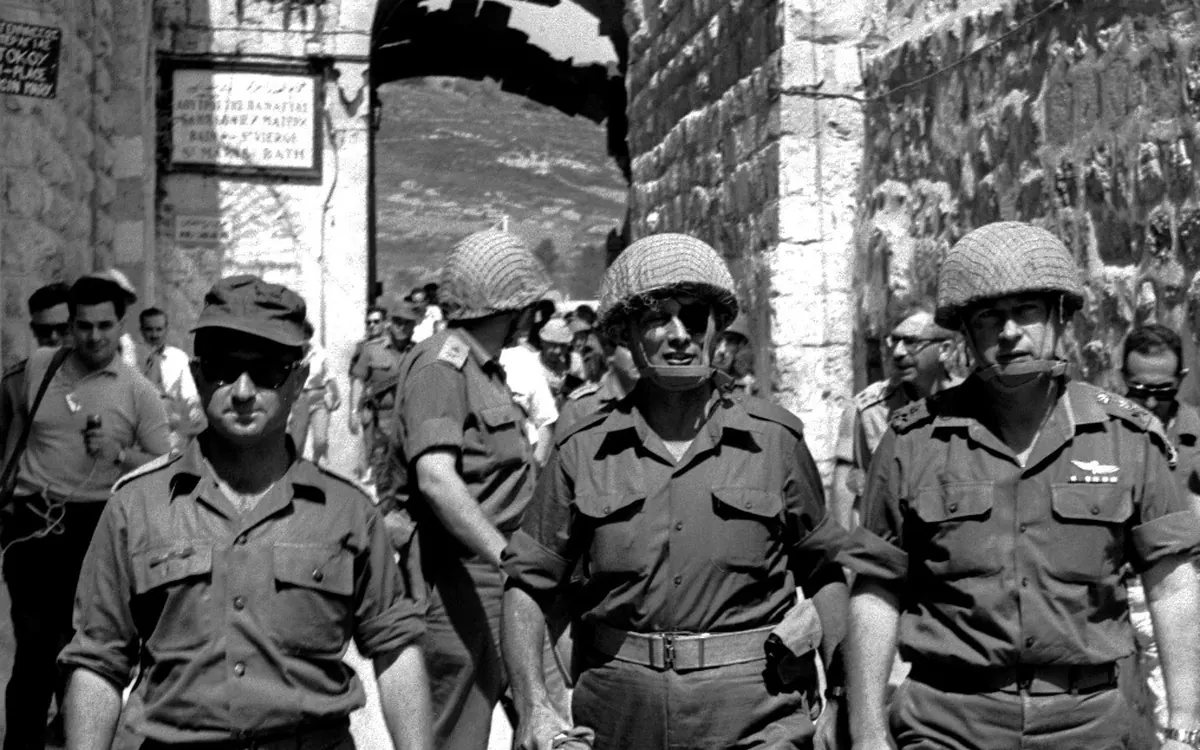
Abundance is always a blessing, so long as one has the capacity to receive it. In the weeks and months after their victory in the Six Day War of June of 1967, the Israeli government struggled to absorb the meaning and practical implications of everything which they had just acquired. This episode begins our exploration of the new political, economic and spiritual realities which began on the day after the war.
About this episode
Life, says Kierkegaard, is a reality to be experienced. Rav Mike begins with our worst habit, reducing complex people into paper-cut categories, and its mirror image, the sloganeering that makes us swallow a group's narrative to feel we belong. Nowhere is this starker than in whether one says the West Bank or Yehuda and Shomron, occupied or liberated. He asks for two things, that we question our narrative and recognize history as an organic process rather than a plot revealed after the fact, since Israel's victory could have been disaster or miracle or both for Arab and Jew. On the morning after, the country woke to a tripled territory and an emotional whiplash beyond words, captured in Rabin's Hebrew University speech about paratroopers weeping at the Wall. The giddy sense of spaciousness ended the Auschwitz borders Abba Eban had named, yet such a sudden expansion of the horizon brings a dangerous vertigo, a loss of every familiar point of reference.
Eshkol told the Knesset there would be no return to the conditions of a week before, bold words the nations needed to hear as they demanded retreat to the 1949 lines, though he well knew that consensus on Israel's indispensable interests had eluded every Jewish government from the start. By June 19 the cabinet agreed on some points, Jerusalem and Gaza to be absorbed, Sinai and the Golan held as bargaining chips for Egypt and Syria, but talk broke down over Yehuda and Shomron, where security, historic connection and population all came to a head. The mountain range gave strategic depth over the narrow coastal waist, the prophets had walked in Shiloh and Shechem, and yet absorbing seven hundred thousand more Arabs looked like a time bomb. So the cabinet decided not to decide, waiting for a phone call from Arab leaders, and the Khartoum conference answered with its three no's, no peace, no recognition, no negotiation, cutting the line.
Politics abhors a vacuum. Two days after the war the military governor of the Shomron, Israel Eitan, faced farmers whose freshly harvested crops had lost their markets across the now-closed Jordan, and on his own initiative he let them load their trucks and cross the last standing bridge. Dayan, who loved bold unconsulted decisions, embraced it as the open bridges policy, and soon goods and then people flowed both ways, more than a hundred and fifty thousand crossings within five years, nearly forty percent from other Arab states still at war with Israel. Dayan, raised in Nahalal among Arab villages and fluent in Arabic, surprised everyone by ruling with a light touch, telling hundreds of muktars and mayors that he asked only that they care for their own people and work with him. He kept Jordanian law and the pre-war administration in place, which, staffed by locals, quietly produced for the first time an authentic Palestinian administration.
On the economy Eshkol the technocrat formed a committee under Michael Bruno, whose September 1967 report raised the question of economic borders, and it landed like a bombshell. Finance Minister Pinchas Sapir feared that a flood of cheap Arab labor would undo the labor Zionist dream of a Jewish economy still mired in recession and unemployment, while Dayan, less moved by that vision, pressed for integration, laying it out in his Beersheba speech of November 1967 about weaving two communities together. The cabinet leaned toward protection, yet Dayan controlled the ground, connecting the grid and promoting Arab employment, and by 1969 the booming economy drew in labor. Sapir's fears partly came true as vocational schools produced metalworkers and carpenters, West Bank product grew fifteen percent a year, per capita income rose eighty percent, and the territories took nearly a tenth of Israel's exports. Sharon once said of Dayan that of a hundred ideas, ninety-five were dangerous and two were brilliant, and history may judge which this was.
Not everyone welcomed the rising quality of life. The PLO, born at the 1964 Arab summit as a tool of Egypt, Syria and Iraq, soon pursued its own agenda, and its Fatah faction, led by Yasser Arafat, saw the 1967 defeat of the Arab armies as the chance for a war of popular liberation now that the Palestinian population was united under one rule. Two days after the war the Fatah heads met in Damascus and resolved to fight inside Israel and the territories, and recruits poured in, trained in Algeria and Syria, slipping across Dayan's open bridges while Arafat set up in Shechem. The uprising failed by January 1968, more than a thousand arrested, crushed by the Shin Bet and by the locals' refusal to cooperate out of fear and clan loyalty. Two consequences followed, Fatah's shift back to cross-border raids from Jordan, and the birth of international terror when the PFLP hijacked an El Al flight in July 1968, declaring civilian jets legitimate targets.
Key ideas
- The clash between saying West Bank or Yehuda and Shomron shows how we swallow a group's narrative, and Rav Mike asks us to question our own and read history as organic.
- A tripled territory ended the Auschwitz borders but brought a vertigo of lost reference points, and the cabinet largely decided not to decide while awaiting a phone call.
- Khartoum's three no's cut the line, so the political future of the territories stayed open while facts formed on the ground.
- Israel Eitan's bridge for the harvest became Dayan's open bridges policy, drawing more than a hundred and fifty thousand crossings within five years.
- Dayan's light touch kept Jordanian law and local staff, producing for the first time an authentic Palestinian administration.
- Arafat's popular uprising failed by early 1968 against fear and clan loyalty, pushing Fatah back to cross-border raids and giving rise to international terror.
Chapters
- 0:00 Kierkegaard; dividing people into types
- 2:15 West Bank or Yehuda and Shomron; two requests
- 4:26 The day after; Rabin at the university
- 5:30 Territory tripled; the Auschwitz borders gone
- 7:45 Eshkol in the Knesset; no return
- 9:57 Deciding not to decide; Dayan on the holy
- 11:01 The June 19 consensus; the breakdown
- 13:16 A population time bomb; Khartoum's three no's
- 14:23 Eitan's bridge; the open bridges policy
- 17:48 Dayan the unpredictable; not asked to love us
- 19:55 Jordanian law stays; the neglected West Bank
- 22:08 An authentic Palestinian administration
- 23:15 Sapir versus Dayan; the Beersheba speech
- 26:33 A booming economy; the numbers
- 28:42 The PLO and Arafat; Damascus resolves
- 33:10 The failed uprising; the birth of terror
Who, where and when
People
Soren Kierkegaard, Yitzhak Rabin, Levi Eshkol, Moshe Dayan, Israel Eitan, Pinchas Sapir, Michael Bruno, Ariel Sharon, Yasser Arafat, Abba Eban
Places
Jerusalem and Gaza, Yehuda and Shomron, The Jordan Valley, Hebron and Beersheba, Damascus
Texts
Rabin's Hebrew University speech, Dayan's Beersheba speech, The PLO charter, The Khartoum resolutions
When
1950 CE: Transjordan annexes the West Bank, 1964 CE: the PLO founded, June 1967 CE: the Six-Day War ends, November 1967 CE: Dayan's Beersheba speech, July 1968 CE: the El Al hijacking
Read the transcript
Life, says Soren Kierkegaard, is not a problem to be solved, but a reality to be experienced. Well, in my experience, the reality is that life presents itself with quite a number of problems, and I'm looking to help solve them, because I'm Rav Mike Foyer, and this is The Jewish Story. Season 4, Episode 5, Israel Post 67, Part 1, In New Territory So, I think that the human desire to divide people into easily defined categories might just be our least pleasant attribute. That trick of mine, which pushes us to reduce complex individuals into paper-cut characters, Republicans, Democrats, gay, straight, black, white, might perhaps have an evolutionary basis. I mean, after all, there's only so much information the brain can process in real time.
And survival does depend on generating a useful map of the world. But the problem is that it's a behavior which has become maladaptive. It might be useful to scan the room and see who's my type before I start flirting or enter general categories into a dating app to save myself some time. But if I want to build a real relationship, if I want to have an inner map which actually matches the complexity of the world, then I have to get to know the person or the situation in front of me in all its fullness, not just as a member of a group or as a simple, dumbed-downed image. Now, that being said, I see a distressing parallel process happening today. And I'm sure it's not new, very little is. But the nature of our society and the communication technology that has overtaken it has certainly supercharged it.
What I'm speaking about is the sort of sloganeering, the party lining. It's the desire to belong to a team or a group which will push us to erase any nuance from our own thinking. In a strange way, it's the categorization process in reverse. Rather than generalizing about others as types and categories, now, in order to find a sense of self, by joining one of those groups, I'm willing to turn off my critical mind and simply swallow the narrative around which my group has coalesced. This may sound familiar. Now, language, of course, is always an indicator of what unites and divides. And one of the most stark and disturbing divisions I see out there in the world, and particularly around the Jewish story, is whether one says the West Bank or Yudah and Shomrung.
Or even better, whether they're the occupied or liberated territories. We have plenty of time ahead of us to analyze the development of Israel's relationship to the lands captured in 67. Don't worry, today is just going to be the first step. But as part of that step, I'm going to make a request. I want to encourage everyone to do two things. First of all, be open to questioning your narrative. Open yourself to asking how Israel's victory could have been disaster or a miracle for Arab and Jew alike, or perhaps it could have been both. Second, we need to recognize that history is an organic process, not a plot that we see revealed post-facto. Even if you believe that we're occupiers in our land, that doesn't mean there was some insidious cabal seeking from the outset to colonize foreign land, which is now manipulating the media and world governments in order to defend its ill-gotten gains.
Many factors, deliberate and otherwise, went into creating the present reality as we see it. And if you believe that we're liberators of our historic homeland, ask yourself what liberty actually looks like and whether we've achieved it yet. Sovereignty isn't just about rights, it's about responsibility. And a sovereign has obligations to every soul under their rule. So like I said, this is the beginning of a long discussion. One which is going to push many buttons and ruffle a lot of feathers because of our tendency to take sides. And when we take sides because of our need to simplify a narrative that fits the side which we've joined in an almost crippling incapacity to hear the other. The whole purpose of the Jewish story is to break down walls, to build up consciousness.
And as we go deeply into what is one of the most controversial issues within the Jewish world, if not the world at large, we're going to push each other's buttons. So I want to make one last request. Let me know what you think. You can always reach me at robmikefoyer at gmail.com or you can personal message me on Facebook, Rav Mike Foyer. I want to know. I want to know when what I've said disturbs you, what it encourages you, when it challenges. I want to know your questions and comments. I want your criticism. As long as your goal is help me to tell a story which is more true, more real, and more uplifting. And so for now, let's start with the day after. So if I say to you that Israel woke to a new reality on the morning of Judah 11th, I'm making a gross understatement.
I mean, the emotional reality of the victory of 1967 is all but impossible to fathom for those that didn't experience it. I mean, we've seen in the last few episodes the incredible impact which the rapid shift from fear of destruction to joy at salvation had on American and Soviet Jewry. But with all due respect, their experience of watching from the side pales in comparison with the emotional whiplash of those whose lives were actually in danger. who fought and died to bring that salvation about. Recall the words of Chief of Staff Yitzhak Rabin, spoken as he accepted an honorary PhD from the Hebrew University less than three weeks after the war's end. The paratroopers who conquered the Wailing Wall leaned against its stones and wept.
Such phrases and cliches are not generally used in the IDF, but this sight on the Temple Mount, beyond the power of words, revealed as though by a flash of lightning, a deep truth. This wasn't just an emotional outpouring. It was a spiritual awakening, one whose consequences we're going to have to explore in coming episodes. For now, I want to recognize that this new emotional reality was combined with a very real change in territory. The area of the country had tripled overnight. This will have its own emotional and spiritual implications. After all, beyond simple square kilometers added, lay the return to Hevron, Shechem the Temple Mount. But for the present moment, just think of a giddy sense of spaciousness which gripped the nation.
No more Auschwitz borders, as Abba even called the 1949 armistice line. No more crowding into a narrow Middle Eastern version of a ghetto along the coast, clinging to what we can with both hands. There's a particular type of vertigo, of loss of center, which sets in when the horizon suddenly expands. It's a dizziness that results from the loss of all points of reference which are familiar, and it's a disorientation which can be downright dangerous, in fact. Of course, such shifts in emotion and territorial reality, to say nothing of the spiritual ones, are going to demand a shift in the political reality. As Prime Minister Levi Eshkol declared in Knesset on June 12th, Let this be said. There should be no illusion that Israel is prepared to return to conditions that existed a week ago.
We have fought alone for our existence and our security, and we are therefore justified in deciding for ourselves what are the genuine and indispensable interests of our state and how to guarantee our future. Bold words. And ones which the nations of the world, frankly, needed to hear, Before the fighting had even ceased, the Arab states and their allies in the UN were already declaring that Israel must retreat to the 1949 lines. In their eyes, this was to be a no-consequence war. Well, they were wrong, and Lady Eshkol was going to let them know it. Although, in all honesty, I wonder what he was really thinking. I mean, after all, he was a Jew, and he'd been a professional Zionist all his life. he well knew that a consensus on the genuine and indispensable interests of our state and on how to best secure our future had eluded Israel's government since day one I mean, frankly, it eluded us before the state even in a situation as desperate as the pre-state mandate when the Jews of Europe were being slaughtered and the British had locked the gates in front of us when resources were short and options few there was no agreement on our genuine and indispensable interests.
And now the new state faces an embarrassment of riches, territory, resources, political capital, domestic and foreign. It's good to have options, but it can be disorienting and even frightening as well. The choices we make in a state of abundance have the power to shape our lives for generations to come. Just picture the lottery winner who strikes it big. You know, There's a reason that many find that money actually destroys their lives. You have to have the right vessels to receive blessing. If you don have what it takes to really receive in a constructive fashion that which God tries to give you then God forbid it can break you Now this being said, certain matters or elements of the new reality were indeed a matter of consensus.
As we saw at the end of season 3, it was a rare Jew who was interested in retreat from Jerusalem. Moshe Dayan said it best upon his entry into the old city as defense minister in wake of its capture. We have returned to all that is holy in our land. We have returned never to be parted from it again. And as we know, the government moves swiftly to make this dream a reality. Even before the war was over, Mayor Teddy Kolick was ordering his crews into the eastern side of the city to fix the phone and municipal water lines and connect the electricity, sending crews out basically to create a political reality. And we saw back at the end of season 3 that before the end of the summer, the Knesset would pass three separate laws linking Jerusalem to Israel, stopping just short of outright annexation, but nonetheless provoking massive international protests.
However, other than Jerusalem, it seemed that everything might be on the table. The territories conquered could be kept, or perhaps they would be used as a bargaining chip to achieve that holy grail of real peace. One thing was clear, though. They would never just be given away simply because they'd been taken in war. Once again, it was Dayan who made it clear. The armistice agreements of 1949 are no sacred law. The relations provided by them, not peace, but armistice, and the borders and all other provisions, the result of the War of 1948. Today's conditions are the result of the War of 1967. Nothing confers on the results of 1948 war any priority over the results of the last war. We are no longer bound by what happened in 1948.
By the 19th of June, the cabinet did manage to reach consensus on certain questions. Jerusalem was to be annexed, even though that would take until 1980, as was the Gaza Strip. I'll let you judge that one from history's view. They were seen as vital to Israel's security and to its cultural historical patrimony. patrimony. The Sinai Peninsula and the Golan Heights were to be held as bargaining tools in hopes of bringing Egypt and Syria respectively to the negotiating table. But discussion broke down almost immediately when it came to Yudah and Shomron, which the Jordanians had named the West Bank, which frankly should come as no surprise, seeing as it's here that all the issues really come to a head.
In terms of security, holding the mountain range would give Israel a strategic depth that protected its population, concentrated along the dangerously narrow waste of the coastal strip, and so easily cut off, dominated by artillery on the heights to the east. Keeping the Jordan Valley meant finally having a clear and defensible frontier against the Jordanian and Iraqi armies who were sure to come again in the minds of the cabinet ministers having the argument. In terms of historic connection, the mountains of Yehuda and Shomron are the cradle of Israelite civilization. The prophets walked in Shiloh and Shechem, not Tel Aviv. And of course, the kings ruled in Jerusalem. In terms of population, it was a potential time bomb.
The Sinai was empty, and the 80,000 or so inhabitants of the Golan had fled largely before the war. No one was sure what to do with the 300,000-350,000 Arab residents of the Gaza Strip, and now they were considering absorbing another 700,000 souls? So rather than, as Eshgol said, deciding for ourselves how to guarantee our future, the cabinet basically decided not to decide. And it even seemed like a good idea. After all, as Zion said, they were waiting for a phone call from the Arab leaders. And when they called, the future of the territories would be on the table. But as the days and weeks ticked by after the war, the phone didn't ring. Not only that, the Khartoum conference at the end of August made it seem like the line had been cut.
Now, we touched on the details of the conference back in Season 3, Episode 33. You can go back there for a bit of a review. For now, just recall the three no's which came out of it. No peace with Israel, no recognition of Israel, no negotiations with Israel. The lines of communication were cut, and therefore, for the meantime, there was no decision to be made on the political future of the territories taken. But politics, just like nature, abhors a vacuum, and life never stands still. Two days after the end of the war, the newly appointed military governor of the Shomron, Lieutenant Colonel Yisrael Eitan, had to make a decision. The economy of the hundreds of thousands of Arabs who were now under his rule was based almost entirely on agriculture.
And at this point in June, their crops were freshly harvested and ready to sell. But their markets were all on the east bank of the Jordan, now politically and physically cut off by the war. It was a potential disaster, not just for these individual farmers, but for the entire local economy. And in fact, considering the brand new and still delicate relationship between the local populace and their new military government, the consequences might reach even further. And so Eitan allowed the farmers to load up their trucks and cross the last bridge over the Jordan still standing within his jurisdiction. It was a bold decision. I mean, he was opening a border with an enemy state only days after the fighting had ceased, and one made entirely on his own initiative.
That might be why it was so beloved of Defense Minister Moshe Dayan. When Dayan heard about this bridge move, he immediately improved. He loved nothing more than bold decisions taken without any consultation. In fact, the defense minister soon allowed the Jordanians to throw further temporary bridges across the river, and in the end, the entire season's harvest was saved. Eventually, both the governments in Jerusalem and Amman saw the wisdom of treating the east and west banks of the Jordan as one economic unit, and endorsed what became known as Moshe Dayan's open bridges policy. It began as a humanitarian response, but soon evolved into a two-way flow of agricultural and industrial goods across the Jordan River, despite the formal state of war between Israel and the state of Jordan.
And of course, it was only a matter of time until people began to flow across as well. And in fact, within five years of Eitan's decision, the number of Arabs crossing from east to west, not to mention from west to east, was over 150,000. And not all of them were Jordanian. According to the military government, nearly 40% of those who crossed from Jordan into the administered territories were residents of other Arab countries, all of whom were still formerly in a state of war with Israel. This had an opportunity of encounter with a world from which Israel and Israeli Arabs had been cut off for almost 30 years. So this all began with a simple decision. It was a response to an organic reality. It became a policy because of the commanding personality of Moshe Dayan.
Now Dayan's been a driving personality in our story for some time. Most recently, we saw him step in as defense minister just before the outbreak of war in response to popular demand, and we witnessed how his decisions shaped much of the course of the conflict. Back in Season 3, Episode 6, we saw him as the architect of Israel's retaliatory policy toward border infiltration. He refined and expanded the brutal but effective methods he'd learned in the pre-state days from the British commando Ord Wingate. To Dayan, retaliation was simply a pragmatic reality. And when he was confronted by Foreign Minister Moshe Sharet over his morality, his response was typical. It may be that this cannot pass review, but I know no other method of guarding the borders.
If the Arab shepherds and harvesters are allowed to cross the borders, then tomorrow the state of Israel will have no borders. Once Ayan became chief of staff, he shifted the IDF's focus away from shooting everyone who crossed and toward deterring the state sponsors of infiltration and terror. And so one might have assumed that he would rule these newly conquered territories with his old-fashioned iron fist. But this was Moshe Dayan, the unpredictable, as Yitzhak Rabinah called him, whose moves were always unforeseeable. Dayan grew up in Halal. It's a Moshev in northern Israel, planted in the midst of the Arab population, as many of them were in that stage of development. And as a boy, he'd wandered through the surrounding villages.
He spoke with people, picked fights with big, tough kids. He basically wanted to feel like a local. And that sense of shared culture and his command of Arabic now stood him in good stead. In the first weeks of setting up the military administration in Yehuda and Shomron, Dayan spoke personally with hundreds of leaders, village muktars, mayors, etc. His goal was to persuade them that cooperation was the only way to avoid breakdown of vital public services. We do not ask you to love us he said We ask only that you care for your own people and work with us in restoring the normalcy of their lives Dayan also saw that that normalcy could best be obtained by giving his military government as small a footprint as possible.
His goal was to let the locals rule themselves. And toward that end, he suggested to the cabinet that Jordanian law remain operative throughout Udan Shomron and that it continued to be enforced by the pre-war Jordanian-built administration. Now, that deserves a quick word of clarification for those who may not know the details of the history. Trans-Jordan had annexed the mountains of Yehuda and Shomron in 1950, labeling it the West Bank as opposed to the East Bank and changing the country's name to Jordan. No longer across the Jordan, it was now on both sides. It was a move rejected almost entirely by the international community. Only Great Britain and Iraq recognized Jordanian rule over the territory it had conquered in 1948.
Nevertheless, Jordan extended citizenship to the residents of the West Bank. It's a status that they held until Jordan renounced its claims in the territories in 1988. Though nominally the Arabs of the West Bank were therefore equal citizens from 1950 onwards, Practically speaking, they had the status of a neglected, unloved child. The area was broken into three separate and individually administered regions. They centered around Shechem in the north, Jerusalem in the center, and Hevron in the south. And all major government offices were located on the east bank of the Jordan, in Jordan proper. Investments in health, education, and industry were negligible. those that did occur were more likely to be acts of charity by the royal family than socioeconomic policies of the government.
Nonetheless, after 19 years of rule, there was a sense of loyalty to the Hashemite king. Weak, though it may have been, that loyalty was shored up, of course, by the fact that even under the Israeli administration, many mayors, judges, and administrators continued to receive at least a partial salary from the Jordanian government. It was a strong enough identity amongst at least a subset of Arab leaders in Yudan Shomran that when it became apparent by the fall of 1967 that the Arab states weren't going to cull, that they weren't interested in bargaining for peace, and Prime Minister Eshkol and his advisors floated the idea of forming a Palestinian entity with which they could make a separate peace, 82 West Bank Muhtar's mayors and civil servants signed an open letter declaring the idea of an independent Palestinian state to be ludicrous now ironically Dayan's construction of a centralized efficient, well organized administration and his insistence on staffing it with the local Arabs of Yudan and Sharon created something new for the first time there emerged an authentic local Palestinian administration.
It was a decision with major unintended consequences in the years to come, and we will have to speak about it. But for now, the most pressing questions on the ground were economic and not political. Prime Minister Levy Eshko was the essence of a technocrat. Remember, his greatest source of pride was the construction of the national water carrier. So in light of this tripling of the size of the territory under his rule, he formed a committee. the Committee for Developing the Administered Territories. And he placed at the head of it economics professor Michael Bruno. And the committee presented its recommendations in an interim report in September 1967. Now, due to the uncertain political future of the territories, the recommendations were primarily around short-term issues.
But the committee did address one long-term question. How to delineate the economic borders between what they labeled the administered territories and Israel? Meaning, will goods and labors flow back and forth between Israel and these new territories? And if so, how? Now that may sound like a technical question, but it landed like a bombshell in the cabinet. Two factions quickly formed on either side of the issue. One was in favor of all but impermeable borders. At the very least, there would be no Arab labor flowing into Israel proper and severely limited goods. The economic hardships of the locals, which was the driver for such a flow, could be dealt with locally through construction, and Dayan's open bridges policy let the Jordanians deal with the problem.
Finance Minister Pintra Sapir stood at the head of this party. His great fear was that the labor Zionist dream of a Jewish economy could not withstand a massive influx of Arab labor. That the economy hadn't yet recovered from pre-war recession and Israel was already faced with an unprecedented rate of unemployment. Now over against him stood, of course, Defense Minister Moshe Dayan, champion of economic integration. You know, he was perhaps personally less moved by Sapir's vision of Jewish labor, or maybe he was just less worried by a sense of economic scarcity. Well, we can say for sure that as the cabinet minister directly responsible for administering these newly conquered lands, relief of economic hardship was going to make his job easier.
Dayan also had a vision, though. It wasn't just about smoothing the transition to Israeli rule. He laid it out in what's known as his Be'er Sheva speech of November 1967. In this southern part of the land, with its Jewish and Arab communities, we can weave our lives together. We can try to change two things. First, we can destroy barriers and prevail over hatred. Secondly, we can create economic integration, link the electric grid, the water system, set up a joint transportation system. Moreover, we can allow Arabs from Hevron to work in Beersheba, because in Hevron there's unemployment, and in Beersheba there's a need for workers. We should connect the two entities, if we on our part and for ourselves do not want to sever connections with these areas.
The debate in the cabinet actually went on for nearly two years, And the consensus moved toward protecting Israel's economy from, let's call it, overexposure to cheap labor and goods. But Defense Minister Dayan controlled the reality on the ground. And as I said, his interest was economic integration. So as the arguments went on, the territories were connected to Israel's electricity grid. And as they continued to bicker about economic political rights, Dayan promoted the employment of Arab labor, increased Israeli investment in Yehuda and Shomron, he created a means for cooperation on tourism, support for local entrepreneurs, and of course, beyond human decisions, economics have a logic all their own.
By 1969, Israel's economy was booming once again, finally recovered from that recession, and employers were desperate for labor. Vocational schools began to spring up throughout the territories, driven by the specific needs of Israeli manufacturers, Pinchas Sapir's fears were proving true. They weren't creating a nation of water carriers and woodcutters that he had so dramatically worn, but rather metal workers and carpenters. Now, at the same time, the gross national product of the West Bank was growing by 15% a year, and unemployment was plummeting. As Arab labor and agricultural produce flowed west, an increasing proportion of Israel's manufactured goods and even some of its productive capacity flowed east within 5 years Yudah Shomron and Gaza were consuming nearly 10% of Israel's exported goods and their own per capita incomes had risen by 80% these are big numbers the question is what do they mean?
Ariel Sharon once said of Moshe Dayan he'd wake up with 100 ideas of them, 95 were dangerous three were bad, and the remaining two, however, were brilliant. I'm going to leave it to you and to history to judge into which category economic integration should fall. Beyond the arguments within the Israeli cabinet, not everyone on the ground was thrilled with the rising quality of life and rational administration brought to the West Bank of the Jordan by conquest. You'll recall that the Palestine Liberation Organization, the PLO, came into being at the first Arab summit meeting back in 1964. Originally, it was the brainchild of Egypt, Syria, and Iraq, who wanted a Palestinian stool with which to wage their war against Israel.
But from the outset, the PLO had its own agenda. The Fatah, largest and most militant faction, at least in the early days, began its cross-border raids against Israel that very year. And we saw last season the role they played in the outbreak of war. But the PLO's ambitions ran much higher than pinpoint guerrilla raids. Their charter declares that armed struggle is the only way to liberate Palestine and eliminate Zionism. And the models to which they look were Vietnam, the ongoing war, and the successful Algerian uprising. Now, ironically, it was the Israeli victory in 1967 which seemed to bring the goal of a war of popular liberation, within their grasp. The Arab armies had been smashed They were no longer to be trusted as the instruments of liberation Furthermore the Palestinian population centers were now for the first time united under one rule.
Remember, before this, they had been under Jordanian and Egyptian rule. Israel's military administration actually made it possible for the PLO to reframe the conflict. It went from being a refugee struggle for survival to a fight for national identity. It also made possible the classic guerrilla approach of a revolutionary uprising from within society, by not only creating that society to begin with, but placing the enemy within its reach. All that was lacking for this popular uprising was a leader. Yasser Arafat was born in 1929, likely in Cairo, son of a somewhat prosperous Gaza food merchant. And PLO tradition claims he was a descendant of the Husseini family, famous in the region for many reasons, not the least of which was the Nazi-collaborating Grand Mufti of Jerusalem that we learned so much about back in the second season.
Arafat lived a student's life in Cairo, studying civil engineering and drifting through the city talking politics. He claimed to have taken part in the Egyptian evasion of Negev in 1948, but for most historians, the numbers don't work out. However, many people do seem to feel it's more substantiated that he found his guerrilla footing in the Egyptian Fadiun attacks of 1953 against the British in the Suez Canal Zone. What is certain is that by 1959, he'd made his way to Kuwait. And there, together with other exiles, he formed the Palestine National Liberation Movement, also known as Fatah. And he began to raise money and plan for the war to come. Like I said, it was Fatah who had proved the largest militant faction of the PLO, eventually coming to dominate its political arm as well.
In 1969, Arafat became chairman of the PLO's executive committee, and he held that title until his death in 2004. But back to our story. On June 12th, two days after the war had ended, the heads of Fatah met in Damascus to chart their next move. The decision they took was to renew the guerrilla war against the Zionist entity. But this time, they wanted to make their operations within Israel and the conquered territory. There would be no more cross-border raids. They felt that the time had come for the popular uprising of which they dreamed. And so they issued the following pronouncement. Our organization has decided to continue the struggle against the Zionist conqueror. We are planning to operate far from the Arab states so that they will not suffer Israeli reprisals for Fedayeen actions.
We are united in our resolve to free our stolen homeland from the hands of the Zionists. It was a bold declaration to make only days after the IDF had smashed the combined might of the Arab world. The governments of the states around Israel were licking their wounds and wondering how they were not going to fall. But for Fatah, the struggle was just beginning. Now this proved a remarkably effective decision. The manifesto went out and recruits poured in from the refugee camps. Palestinian students from across Europe dropped their studies and stepped forward to fight. They sent nearly a thousand to Algeria and Syria for military training in the months of July and August. And then, taking advantage of Dayan's open bridges, sent them into the West Bank to fade into the populace.
Arafat himself crossed the Jordan in July, and he set up his headquarters in Shechem. That being said, he was well known to rotate through a series of safe houses in order to stay ahead of the Shabbat, Israel's feared general security service. And on August 31st, he declared the official beginning of the popular rebellion. September saw more than a dozen attacks. grenades thrown at Israeli patrols, or explosives set off in bus terminals in town squares in hopes of intimidating Arabs out of working in Israel. The violence escalated through the end of 1967, but the Shabbat was well ahead of Fatah in its organization. And so by December of 1967, Israel had arrested more than 1,000 operatives and killed 200 others.
By January of 1968, the Fatah leadership had to acknowledge defeat. The popular uprising was not going to materialize. And they had to also recognize that the principal reason for this failure was the widespread unwillingness of the Arabs of Yudan Shumron to cooperate. On one hand, this was out of fear of reprisal. I mean, after all, the IDF had just defeated the entire Arab world, and the feared Moshe Dayan was at their head. How could a handful of ragtag guerrillas hope to win? All they were going to do is cause local suffering. It was also because Fatah was seen as a bunch of outsiders who were demanding allegiance that conflicted with the traditional clan-based loyalty structure of the West Bank.
The mayors of the local towns, by and large, wanted nothing to do with the Fatah, and the Israelis knew that. It made a policy of selective reward and prisal, the carrot and the stick, extremely effective. And so the popular uprising of 67 didn't bear the fruits which Arafat and the Fatah had hoped. But it did bring about two extremely important consequences for our story ahead. And so we're going to need to put a finger on them before we close. One was Arafat's decision to backtrack on that Damascus resolution, to operate far from the Arab states so that it will not suffer Israeli reprisals? In 1968, Fatah began to move its base of operations out of Yodan Shomron and back into northern Jordan. Arafat himself crossed the Jordan just in time.
They say that the squad of GSS men who raided his safe house in Ramallah found his mattress still warm. The Fatah was thrown back on its original model of cross-border raids, and they doubled down. in 1968, there were nearly 1,500 attacks. Israel, in turn, revived its policy of reprisal, and its raids across the Jordan were as likely to involve firefights with the Jordanian Legion as they were with the Fatah guerrillas. Add to this escalation the fact that the Palestinians now proceeded to carve out an independent territory, basically seized a series of refugee camps and villages for themselves, and set down a system of government complete with taxes, uniforms, military recruitment, all in competition with the Hashemite kingdom.
Soon enough, the Fatah guerrillas were going to pose a bigger threat to King Hussein of Jordan than they did to Israel. So this is one consequence of Israel's swift victory, and we will see how it plays itself out in episodes to come. But the theater of war wasn't just pushed back across to Jordan by that clampdown. 1968 also heralded the birth of international terrorism as we know it. Many experts place the date at July 22, 1968, when the Popular Front for the Liberation of Palestine, that's the PFLP, hijacked an El Al flight traveling from Rome to Tel Aviv. We'll tell the details of such stories when we have an episode about the Black September uprising. But for now, just know that hijacking was certainly nothing new.
But until now, most hijackers were simply looking to divert a plane to where they wanted to go. This time, they sought to trade the lives of the passengers for the lives of Palestinian terrorists imprisoned in Israel. Furthermore, they made a declaration that civilian jets were now legitimate targets because they were a symbol of the Israeli state. This would prove to be a particularly effective tactic for people who couldn't manage to fight Israel head on. As the PFLP's operational mastermind, Wadie Haddad, said, This is a particular animal, the IDF. We cannot fight it plane for plane, tank for tank, soldier for soldier. But he did know that hijackings and other operations would cause pain to Israel and grab world attention, giving the Palestinians their best hope for international justice.
PFLP head George Habash put it quite bluntly. To kill a Jew far from the battlefield has more effect than killing a hundred in battle. International terrorism, of course, isn't going to limit itself to Israelis and Jews. And so, in a sense, the whole world has now entered new territory. I just want to thank a few folks before I sign off. I want to thank all the folks who give their hard-earned money to help make this show happy, keep it free and widely available. I want to invite you to join them. it's not too late to help me make season 4 happen go to my website on www.jewishstory.co you'll see a little button in the upper right hand corner that says be a patron you can click on that to give a little bit of per podcast support I also want to thank the Land of Israel Network that's thelandofisrael.com for creating a platform that allows me to reach so many special people I want to thank the Pardes Institute pardes.org.il for building an educational institution that gives me the privilege of teaching so many wonderful Jews and I want to thank you for listening.
I'm Rav Mike Foyer, and this is The Jewish Story.
More from Season 4
TJS S4 Interlude: Sukkot
If you feel a bit like the world might be falling apart, then look to the sukkah for how to hold it together. Here are a few thoughts...
Play Episode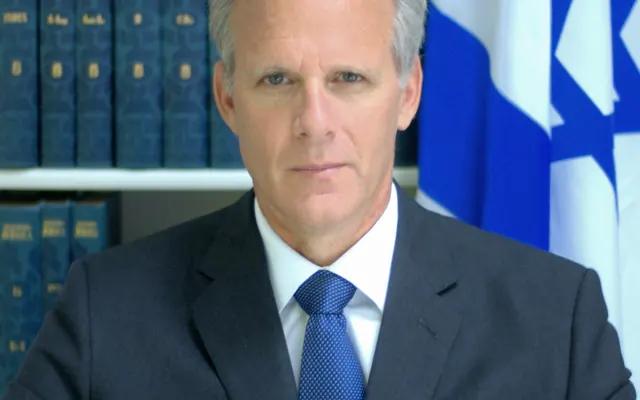
TJS S4 Interlude: Interview with Dr. Michael Oren
In this interlude I am joined by special guest Dr. Michael Oren, author of Six Days of War: June 1967 and the Making of the Modern Middle East...
Play Episode
TJS S4 Interlude - Interview with Yossi Klein Halevi
This week I host author and thought leader Yossi Klein Halevi. Our conversation touches on his personal experience the early struggle for Soviet Jewry, the challenges of writing,...
Play Episode