
TJS Live - Survival Zionism part IV
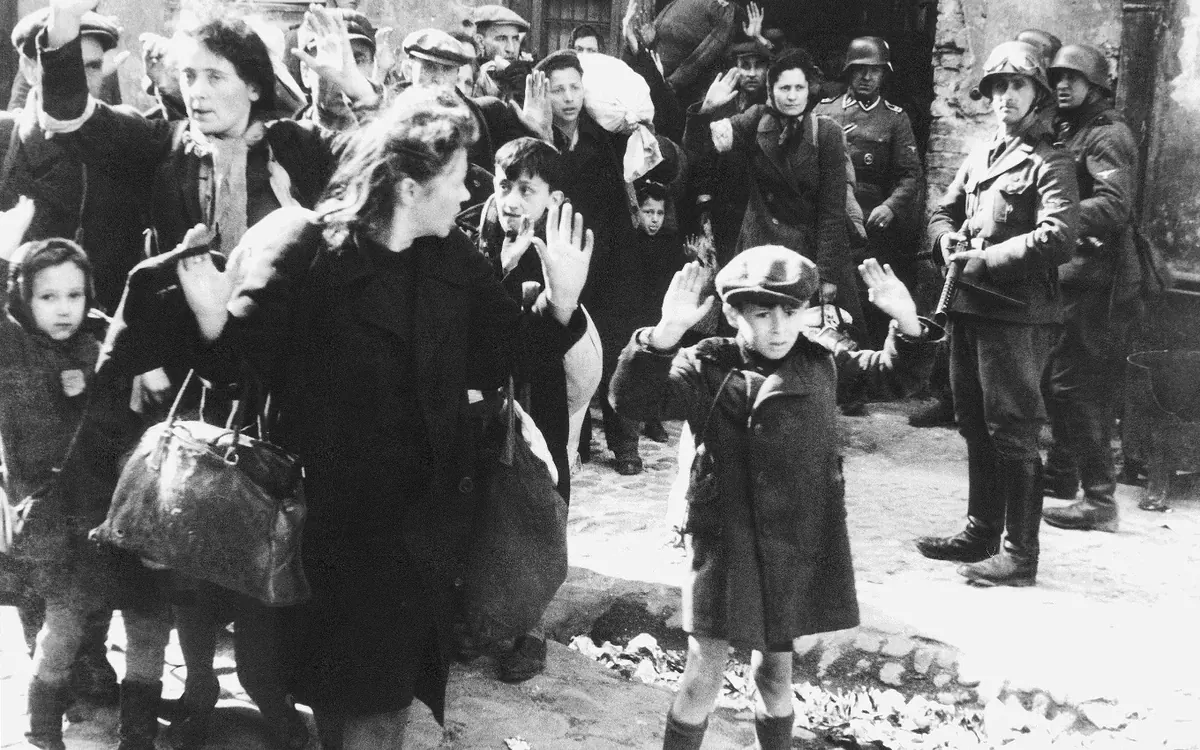
Here is part four of the live series on Survival Zionism. This episode tells the story of the Warsaw Ghetto. If you like the live style, sign up for this year's TJS Live weekly class at:
About this episode
Extinction is the rule, said Carl Sagan, and survival the exception. Before telling of the destruction of a third of the Jewish people, Rav Mike names his fear, that the Holocaust has fallen prey to partisan political use. Make it a stick to beat opponents and you narrow its meaning and claim it for yourself. He points to the pull toward willful forgetting among some Israeli voices, to the officer missions to the death camps whose one message is Auschwitz or the IDF, and to the progressive instinct to universalize the Shoah by detaching it from the particular Jewish experience. When an event of this magnitude becomes a tool, it may gain power to shape events and it robs honor from the dead. The story of the Warsaw Ghetto, he says, is as much about how it was told afterward as about the events themselves.
For the first fifteen years of Israel's existence, the memory was all but binary, the martyr heroes who fought and those who went like sheep to the slaughter, a phrase then just short of an insult. It was first publicized in Abba Kovner's ghetto manifesto of January 1942, let us not go like sheep to the slaughter, the only reply to a murderer is resistance. Rav Mike reads the psychology, that faced with the impossible and the unacceptable, people cling to the impossible rather than act on the unacceptable. The survivors who reached the Yishuv were hailed as embodiments of shlilat hagalut, redeeming Jewish honor by fighting to the last breath. A subtle and ugly conclusion followed, that those who stayed were somehow guilty of their own blood, and Yom HaShoah in 1951 fixed the uprising at the center of memory.
The Warsaw Ghetto was the largest the Nazis built, nearly half a million people pressed into a mile and a third, piety and Hasidim beside the most modern cosmopolitan culture, the end of Jewish life as it had been. Emanuel Ringelblum, a historian, grasped that what was happening was unprecedented, and he gathered a cross-section of the ghetto into a secret group called Oneg Shabbos to collect data on everything, buried in milk cans so that someday the story would be told. Among the documents lies the deepest Torah, the drashot of Kalonymus Kalman Shapira, the Esh Kodesh, written week by week in the ghetto, an exploration of suffering and faith that Rav Mike calls a cleaving to the infinite in a situation humanity should never know again.
Shapira survived as long as he did under the protection of the Judenrat, the Jewish council the Germans forced the Jews to form, put to work in Schultz's shoe factory, where German businessmen turned hunger into slave labor and a place in the factory became a ticket to life. After Wannsee the mass murder began in July 1942, and when the volunteers stopped coming the Nazis cleared the ghetto block by block, deporting a quarter million to Treblinka. From the remnant the uprising grew. The standard story names Mordechai Anielewicz of the left-wing ZOB and the bunker at Mila 18, made famous by Leon Uris. Rav Mike sets the record straight on the omission, the Jewish Military Union founded by Beitar and the revisionists, which fought alongside but never together with the ZOB.
On April 19, 1943, Erev Pesach, the final battle began, and the Jews held out longer than some European countries. On Miranowski Street, where the revisionists had their headquarters and a tunnel to the Aryan side, the Polish flag and the blue and white rose together, a call to arms that went unanswered. The Germans burned the ghetto building by building, and at Mila 18 as many as a hundred and twenty fighters, Anielewicz among them, chose death over surrender. Afterward the ZOB survivors told the story and erased the JMU, as Chaim Lazar and later Moshe Arens would protest. Ringelblum, a Marxist who did not love these men, had written that even though we are not friends, a trace of them should belong to history, and he went to his death holding that the telling itself was a sanctification.
Key ideas
- The Holocaust becomes partisan when it is made a stick to beat opponents, which narrows its meaning and robs honor from the dead.
- Abba Kovner's cry against going like sheep named a shift in Jewish mentality, that the only reply to a murderer is resistance.
- The survivors who fought were hailed as the negation of the exile, and an ugly conclusion blamed those who stayed for their own blood.
- Emanuel Ringelblum's Oneg Shabbos archive preserved daily life in the ghetto so that someday the story would be told.
- The Esh Kodesh, written week by week in the ghetto, cleaves to the infinite in a situation humanity should never know again.
- The standard story of the ZOB and Mila 18 erased the Jewish Military Union, and Ringelblum held that a trace of them should belong to history.
Chapters
- 0:01 Extinction the rule, survival the exception
- 4:32 The Holocaust as a partisan tool
- 6:45 Willful forgetting; Auschwitz or the IDF
- 13:35 Sheep to the slaughter; Abba Kovner
- 19:48 Negation of exile; the fighting Jew
- 25:54 The largest ghetto
- 29:13 Ringelblum and the Oneg Shabbos archive
- 36:06 The Esh Kodesh in the ghetto
- 40:37 The Judenrat and Schultz's factory
- 42:55 The deportations begin
- 45:15 Setting the record straight
- 47:30 The Jewish Military Union
- 57:44 The uprising begins
- 60:06 The flags over Miranowski Street
- 61:13 Mila 18; the burning ghetto
- 64:29 Erasing the JMU from history
Who, where and when
People
Abba Kovner, Emanuel Ringelblum, Kalonymus Kalman Shapira, Mordechai Anielewicz, Pawel Frankel, Moshe Arens, Leon Uris, Jan Karski
Places
The Warsaw Ghetto, Mila 18, Miranowski Street, Treblinka, Vilna
Texts
The ghetto manifesto, The Oneg Shabbos archives, The Esh Kodesh, Mila 18, Flags Over the Ghetto
When
1940 CE: the Warsaw Ghetto wall completed, 1942 CE: Kovner's manifesto; the Wannsee Conference, 1942 CE: the great deportation to Treblinka, 1943 CE: the Warsaw Ghetto Uprising, 1951 CE: Yom HaShoah established
Read the transcript
Extinction, said Carl Sagan, is the rule. Survival is the exception. I'm not really one for rules, but I'm definitely looking to survive and thrive. I'm Rav Mike Foyer, and this is the Jewish Story. We interrupt your regularly scheduled programming to bring you part four of the live Survival Zionism series. If you like this Jewish Story live, sign up right now for the upcoming weekly class beginning on August 8th. You can do so by sending me an email at rovmikefoyer at gmail.com, or you can find the registration information at rovmikefoyer on Facebook, or at my website, jewishstory.co. Hope to see you there. As always, I want to thank the Parties Institute parbs.org.il for making this class happen, and I'm excited to be here with you guys.
This is class number four, if I can still count. So my goal is to the extent that it's possible, round out the side of the story which is going to take place centrally within Europe. Before I get started, I just want to recall that this decade we're looking at through a very specific lens, and that's the lens of what I call the evolution of survival Zionism. Remembering that Zionism, though it was one voice amongst a multitude, and in fact a minority voice in most places in the Jewish world before the Shoah, emerges after the Shoah in some places numerically and certainly sort of ideologically and practically as a leader. And considering that the state of Israel is born on the wings of World War II, as it were, and emerges then for the next, I mean, until our very day, sort of as a central organizing body and guiding light and fill in the blank of Jewish life, It's an important question to consider how it is that Zionism emerges and furthermore, what type of Zionism it is that comes out of this process.
So that is our goal. In the first two classes, we looked at the sort of conflicts within the Yishuv and the Jewish settlement there, the internal conflict between, for lack of better terms, left and right, the sort of labor socialist Zionist led by people like Ben Gurion and the right wing revisionist Zionist led by people like Zev Jabotinsky. In the second, we looked at the pattern of conflict between Jews and Arabs as the issue grows and Arab nationalism emerges in a more sort of conscious, focused fashion in response to the perceived threat of Jewish immigration and statehood. And last class, we began to look at the unfolding of the Shoah, of the, I would say, decimation, but as Menachem Begin used to say, the tertiation, like the reduction by a third, right, decimation, of course, being the reduction by one-tenth, the reduction by a third of the world Jewish population.
Before I launch into the flow of history, just a couple of technical things. Of course, the chat is open. Please, if I lose you or you need clarification, don't be shy. Everyone that can have their cameras open and allow me to see your shining faces, it's always a wonderful benefit. And last but certainly not least, I've gotten some good feedback. You know, I cannot hold every detail of the flow of history. I don't presume to do so. And your feedback is very helpful. You send it to me in emails. I will do my best to correct it. But don't be shy to correct me. For instance, you know, Chuck noted that I used the term Pale of Settlement with the Nazis advancing on the Soviet Union in Operation Barbarossa in 1942, last class.
Of course, the Pale of Settlement disappeared with the Bolshevik Revolution in 1917. So that kind of stuff, it may sound small to you, but for people who don't have a deep grasp of the details, sometimes it can be very confusing. So please don't hesitate to correct me is all I'm saying. That was a very long-winded way of saying don't hesitate to correct me. The best way to do it is just put it in the chat address to everyone, and that will really, I promise you, you're not being nitpicky. I will not take it personally, and it may actually really help someone who was confused by a reference that I made that they thought they understood what was going on, but wait, he said this. So you're really doing everyone a favor, and at the very least you're not doing any harm.
So I ask you please to do that for me. um tov so this is what i want to do today today we need to talk about uh if not the end game because we're probably going to stop in 1943 maybe 1944 but certainly um the heart of darkness and really i want to speak about the warsa ghetto uprising and for me it's a bit of um i don't know if a mea culpa is dramatic although i do tend toward the dramatic as you guys know best but um but a correction because you know there are multiple ways to tell the story of the warsa Ghetto Uprising, and I want to supplement the way I've done it in the past. But before we can do that, before we can talk about the destruction of a third of the Jewish people, I need to give an intro.
Because, you know, the class is called Jewish Story, and I chose that name deliberately because, as many of you are aware, but it's important for me to remind you, the goal that I'm attempting is through a fusion of a traditional internal-voiced narrative and a critical historical external narrative by synthesizing the two. My goal is to actually tell a story which is life-giving, in which multiple types of people can find themselves, but most importantly, which exposes the power of story itself, right? There's history, and there's the way that we tell the story about it, which of the academia is known as historiography. Why am I saying this? Because as we will see in the class today, the story of the Warsaw Ghetto is as much about how the story was told afterwards and the impact it has as it is about the events themselves.
And I have a fear. I have a deep fear about the Holocaust, and that is that it has fallen prey to sort of partisan political perspectives. something which really began even forget immediately afterwards even in the midst of but I just want to put my finger on a couple of the modern challenges that we face in telling the story of the Holocaust and you will see as we go forward that they have very deep roots in the general story which is told and specifically in the role that the Warsaw Ghetto Uprising plays in the emergence of survival of Zionism. So what do I mean about partisan political agendas? First of all, it is quite obviously a stick which we use to beat our opponents. Right. Meaning meaning how can you expect us?
You know, you need to be quiet because don't you remember that you did this? Now, by the way, it doesn't mean that's untrue, nor am I saying that that's always an incorrect response. I'm just pointing out that as soon as you do that. And make the Holocaust a partisan tool for your agenda, two things happen. You narrow its significance, meaning, oh, it's, you know, the Holocaust supports the morality of the state of Israel. Ergo, if I don't believe in the morality of the state of Israel, the Holocaust doesn't matter. You understand? Right. Second of all, you claim it for yourself and therefore exclude the diversity of, you know, of lessons and connections which can be made. More specifically, it's often used as a fear to stoke our unity.
Right. This is what happens when we can't stand together. and because of that I see increasingly particularly amongst my American students it's being perceived as a burden that a lot of people would like to move on from and I'm not speaking about this sort of European guilt fatigue that's not my problem frankly everybody's got to deal with the past in their own way and this is the Jewish story I'm not speaking to non-Jewish Europe they have their own road to hoe as is said what I'm talking about is the complex ways in which Jews would like to move on which may sound strange to some of you, and maybe it's a generational phenomenon, although not entirely certain. You may be familiar, there are certain voices within Israeli society that call for what's called willful forgetting, as opposed to never forget.
There are actually voices, real academic and cultural voices, calling for a willful forgetting of the Holocaust, feeling that it has poisoned our political and cultural discourse, and in particular, identifying an unhealthy link between the militarism within our society and the use of inherited trauma. You guys understand what I mean by the use of inherited trauma? I remember when I was probably 11, 12 years old, my grandmother, who was married to a survivor, took us to watch the show, that massive documentary film. How many hours? I don't even remember. My brother and I in the theater, preteen. You know, what does that do to your mind? Now, here in Israel, I'll give you a very specific example. I have a dear friend who is involved in planning and training for the course Katsinim, the officers training courses in the army.
And in that capacity, he has participated in a number of the educational missions which are sent to the death camps in Europe. People may or may not know that a certain subset, a significant subset of officers in the IDF are sent to the camps on educational missions. Just wave at me if you're aware that this is going on. So it's interesting to me as an educator, I asked him, what's the message? Like, well, you know, you guys all know, right? You have one chance. There should be one sentence that you want everyone to take away. And you say it over and over again. I said, what's the message that the IDF is trying to deliver? And it was very simple and to me shocked me to the core, which was it's either Auschwitz or the IDF.
That the message of the death camps is it's this or that. Now, I don't disagree with the sort of general principle, as we'll see today, of disempowered sort of exilic life, which depends for its security on others versus the sort of more robust stand on your own two feet and defend yourself. But really, you're going to reduce the Holocaust to that. And the problem is, as I said before, when you do that, it's very effective for a subset of your society and repulsive to another subset. right so on the other side i'll just remind you guys that you may recall it was probably like a year or two ago there was this tempest in the teacup amongst progressive american jury around the usage of the term concentration camp in reference to the um detention centers that were being used by american immigration authorities to hold people crossing the southern border you guys recall this and it was like a classic tempest in a teacup people were really hot under the collar and there was both intelligent and less intelligent commentary being made on it but um to me it's indicative of another aspect of a desire to move on which is the more sort of progressive liberal perspective wants to move on by universalizing the holocaust and in order to do so is willing to detach its memory and even its language and of course therefore its educational message from the particularly Jewish historical experience, right?
That the Holocaust doesn't belong to the Jews. It belongs to humanity, which again, I'm not saying that that's untrue, but just notice that when an event of this magnitude becomes a tool for partisan politics, what happens is in through the narrowness of its focus, it may gain the ability to shape events, but it also does real damage and i think in many ways um robs the honor from from the dead who's just deserve to be honored and not necessarily shoehorned into our present day issues and that's as i said not something which began in our day but rather really in the midst of the war itself because to understand survival zionism which is our goal And I will now move a little bit back into our flow of history.
And that was an end parenthesis of my moral dilemma as an educator. Is it you? Right. But to understand the survival Zionism, we have to consider how the Holocaust was experienced during the events and then framed afterwards by the Zionists who were both in Europe. And, of course, had their, I wouldn't say safe base per se, but their their location in the issue. And in order to do that, like I said, I want to tell the story of the Warsaw Ghetto. Now, you may or may not know that for the first decade or two, almost I would say the first 15 years of Israel's existence, the framing of collective memory around the Holocaust was all but binary. There were the martyr heroes, right, those who struggled and fought.
And, of course, the vast majority did not survive, but they were martyr heroes. And there were those who went like sheep to the slaughter. That's a phrase that gets used a lot. And its usage, at least at the time in the Israeli society, was not a positive. Today, I think it's been the meaning that it bears has shifted somewhat in the sense of the nobility of sacrifice and the purity of soul. And we're going to speak about that aspect. But when it was used in Israeli society, it was just short of an insult. There are those who fought and struggled and those who went like sheep. But it's a phrase, actually, which was first publicized, you may or may not know, in something known as the First Call. It was also known as the Ghetto Manifesto.
It was given by 24-year-old Russian Jewish poet Abba Khovner at a meeting of Zionist youth on January 1st, 1942. Now, remember, January 1st, 1942 is three weeks before the WANSI conference at which the administrative mechanisms of the final solution were sort of solidified. Dorothy, was that a hand or you were just? No. OK. So meaning the mechanism hasn't been perfected yet, but it's pretty clear that the sort of mission, as it were, of the Nazi machine was already well underway. Kovner, like I said, was speaking at this Zionist youth gathering on January 1st of 1942, and that's already several months after the Jews of Vilna had been ghettoized in August of 1941. And the Nazis apparently practiced many of the methods that they were going to use for the mass extermination of the Jews upon the Jews of the Vilna ghetto.
So Kovner writes the following, let us not go like sheep to the slaughter. Notice he's already posing this dichotomy. Oh, Jewish youth, do not believe those who are deceiving you. Out of 80,000 Jews of the Jerusalem of Lithuania, which is what they called Vilna, only 20,000 remain. Now, just pause for a second on that. They were ghettoized in August of 41, and by January of 42, three-fourths were already gone. And he's saying, don't believe those will deceive you because, of course, they're being told that they're being taken for transportation to the east, that there are labor camps, etc. And one of the pieces we just need to keep reminding ourselves is that faced with the impossible and the unacceptable, people will almost always choose the impossible.
Right. When they looked at, as he says, he says, where are the hundreds of men who were snatched away from labor by the Lithuanian kidnappers? Where are the naked women who were taken away on the horror nights? Anyone who's taken through the gates of the ghetto will never return. That's unacceptable. It is unacceptable to believe that they are actually going to exterminate the Jews. And therefore, people will continue to cling to the impossible. We just don't know where the trains are going. The fact that we haven't heard from anyone who went away to the labor camps is because the conditions are so difficult. You understand you keep feeding yourselves belief in the impossible because to face the unacceptable is to force oneself to act.
And I want you to remember that. To face the unacceptable is to make a decision to act or to despair. Whereas to cling to the impossible is to cling to the illusion that somehow, just like the Jews for centuries, millennia, have sort of danced between the raindrops and managed. will somehow come. It's not so bad. It can't be final. Notice, final solution. The finality of that word is its weight. And he points out all the roads of the ghetto lead to Poneri, and Poneri means death. Poneri was a forest outside of Vilna, where the Nazis were progressively, as I said, practicing their methods of mass shooting, gas, etc. So he goes on. Hitler is aimed at destroying the Jews of Europe. It turned out to be the fate of Jews of Lithuania to be the first.
Let us not go like sheep to the slaughter. He repeats, and then here's the final line. It's true we are weak, lacking protection, but the only reply to a murderer is resistance. Brothers, it is better to die as free fighters than to live at the mercy of killers. resist, resist to our last breath. Now, this is a fantastic document for any number of reasons, not the least of which, because it's the death cry of Lithuanian Jewry. But the idea that anyone could resist to the last breath will become crucial for the Zionist leadership that emerges at the head of the Jewish people following the Shoah. And that's not just for those individuals. Let's remember, scrolling forward, remember we're going 38 to 48.
And as I warned you, I need to be able to consider this decade in its wholeness to some degree. So we're going to jump back and forth. That from 1945 to 1947, the crucial two years between the end of the Holocaust and the real sort of emergence of full-scale war of independence, in those two years, 70,000 immigrants will pour into the Eshuv. Now remember also that despite the best efforts of the British Navy to blockade, 70,000, despite the fact that the British Empire which is no longer locked up in a war over Europe is trying to stop them And of course the vast majority of them will be survivors And amongst them will be like grains of sand, or let's say in the eyes of the Zionist leadership, like diamonds amongst the sand.
Amongst them will be a handful of surviving underground fighters, including some of the survivors of the Warsaw Ghetto Uprising. And when these people reach the land of Israel, at a time when the underground is fighting the British occupation with increasing violence and increasing success, they will be hailed as national heroes and will speak about the fact that they represent a very specific subset of the resistance to the Nazis that came out of Europe. Because they're not just hailed as national heroes. They're hailed as embodiments of a very specific narrative which becomes core to the Zionist ideology and specifically to the labor Zionist leadership. What do I mean? The ideology is easy to identify.
We've talked, we talked about it last week, Shlilat HaGalut, the negation of exile. Zionism has been built ideologically on the idea that we need a new Jew, right, that the exiled Jew is stuck in the past. And those of us who sort of did those episodes on the rise of Zionism and its ideology, we've spent a lot of time speaking about what is this new Jew of which you speak. But the one thing it's not is the classic old European Jew. So that negation of the exile ideology, I mean, dare I say that the Holocaust proves beyond a doubt the truth of Jabotinsky's warning that they had to liquidate the exile before the exile liquidated them. right and and unfortunately not enough were able to respond to that call in time um but you know there's a subtle and and somewhat ugly conclusion which gets drawn from that which is that the Jews the Yishu who are struggling first to fight the Nazis together with the British army and then against the British in order to find their national liberation they got out or their parents got out.
And that means, at least by some association, not even the implication, that somehow those who stayed were guilty of their own blood. And that may sound unreasonable and it may sound deeply unsavory, but you need to understand that as part of this story, and, you know, sometime either you can listen to the podcasts I've done on it, or maybe we'll keep going into class next year on this same time frame. I don't know. We'll speak about that some other time. But you have to understand that in order to understand that during the first decade following the Shoah, there was little to no, more, 15, 16 years, little to no conversation or understanding of what actually happened to the Jewish people in Europe.
Believe it or not, even though at a certain point a quarter of the country's population were survivors, it was not, forget the fact it was incomprehensible. There were plenty of people there who could testify to it. It was unacceptable. It was unacceptable. The narrative was they were consumed in the negation of exile, but those few that survived participated in an negation of exile, which was even more important because they negated the exilic Jew. You understand? Because the exilic Jew was the stoop-shouldered Jew who ducked and dodged and absorbed the blows. They redeemed Jewish honor. They literally negated that weak ghetto Jew by fighting, as Kovner said, resisting to their last breath. Resist, resist.
Remember, I mean, it's an incredible term, incredible phrase. The only reply to a murderer is resistance. It's better to die as free fighters than to live at the mercy of killers. That's a shift in Jewish mentality. For most of Jewish history, I do not believe that the leadership would have said that. They would have said, better to live at the mercy of whomever, because you're alive and we'll survive. And when Mashiach comes, we'll go home. But there's a portion of the Jewish people that's done with that attitude, and they are stepping very quickly into the lead or being pushed there. I mean, on that note, of course, it's worth just noting something I'm sure you're aware of, that the public narrative within Israel establishes this dynamic very quickly when in 1951, the law commemorating the Holocaust, Yom HaShoah, what we today call Yom HaShoah, is passed in 1951, which is Yom HaShoah U'Kvura, the day of the Shoah and heroism.
and as originally was for, remember, of the Ghetto Fighters Day, was Holocaust and Ghetto Fighters Day, and of course, the date chosen is the date of the Warsaw Ghetto Uprising. If people aren't aware of that, the reason that the date was chosen is because it marks the date of the Warsaw Ghetto Uprising. The secular date, mind you. Negation of exile, yes, is, the Hebrew phrase is shlilat ha-galut. The shlol is to negate. Shlilat, here, you want me to write it in Hebrew in the chat one second. So this emphasis of the bravery and revolt of the few, while almost entirely neglecting that horrific suffering of the many, has a lot of implications for our story going forward. On one level, one has to just say there just simply wasn't enough of an exposure to the reality of the horror of what happened to cut through the heroic narrative.
And that heroic narrative was very important at the time. I don't know that in 1945, 46, 47, that you really wanted the Jews of the land of Israel who were fighting a war of liberation to look the horror in the face. I mean, what do you do in the face of that other than drop your weapons and stand in shock? And that's exactly what they could not afford to do. It might have been best at the time, right, that they harden their heart and focus on the heroism. But that will have its consequences. But right now, I want to tell the story of the Warsaw Ghetto. And as I will speak about this further, there's one more piece I mentioned already, which is this wasn't just an issue of a framing between those that went like sheep to the slaughter and those who fought.
Even amongst those who fought, there are certain ones whose story gets told and ones who don't. and I want you to remember that as we go forward I'm going to come back to it because while the Warsaw Ghetto is burning Jews won't be fighting Jews per se but they won't be cooperating in their fight against the Nazis but back in the land of Israel Jews are indeed fighting Jews and the factions which managed to make peace between them at least a cold peace in the Warsaw Ghetto will be at hot war between one another in the land of Israel. And so that therefore, when one story, the Warsaw Ghetto story, resistance, the redemption of the exilic Jew, the final negation of exile and the birth of the fighting military man jumps to the land of Israel, it's very important to the leadership who's struggling with their fellow Jews that only one story be told.
You understand? So we're going to do a little bit of deconstruction of that right now. But before I dive into the story of the destruction of the Warsaw Ghetto, I want to give people an opportunity for clarifying questions. A little bit of information. I mentioned, I think, last class, that the construction of the Warsaw Ghetto, remember, of course, the Nazis invade Poland on September 1st, 1939. It takes them, if I'm not mistaken, a week or two, maybe two, to actually conquer Warsaw. It's pretty quick. But the construction of the Warsaw ghetto lasts from April 1st. The date that I saw for most people is that the end of the wall was November 15th, 1940. From April 1st to November 15th, 1940 is the construction of the ghetto.
It's the largest ghetto that the Nazis build in Germany. And it's important also to remember at this point, we're well before the Wansi Conference. We're even before the events that Abukovna described in Lithuania. It's still not clear to the Nazis what they're doing with all these Jews. Recalling the example of the St. Louis and the Heskem Havaravet transfer agreement between the Zionists and the Nazis back in 1933, the Nazis were more than happy just to get rid of the Jews and certainly weren't shy to kill them along the way. But the idea of the total liquidation of European Jewry had not yet set in. Right now, they're simply trying to bunch them up and contain them like the disease that they perceive them to be.
So this was the largest ghetto that Nazis constructed. in Europe. At its height, there were close to half a million Jews in an area of 3.4 square kilometers, that's 1.3 square miles, average of 9.2 people per room. Just an intense concentration of humanity. And you need to consider that this intense microcosm of all Polish Jewry, which was 3.3 million Jews at the beginning of the war, and not just a bunch of massive Jews. It was Piety and Hasidim alongside the most modern cosmopolitanism and sort of artistic, cultural, you know, learning, literature, art. Every facet of Jewish culture existed in Poland in general, and Warsaw in particular now, is squeezed into this ghetto. And remember that before the ghetto, despite widespread and deep rooted Polish anti-Semitism, the Jews were part of every aspect of European social, civic and cultural life at everything except the highest level.
I mean, they sang their songs, they drank their beer, they fought in their patriotic wars. So the reason, aside from the drama of the story that I choose to tell it, is that the destruction of the Warsaw Jewry really embodies the end of Jewish life as it was known. And whatever it may be now, it is not a continuation of what was. Like I said, on the evening invasion, the Nazi invasion of Poland, Jews made up 30% of Warsaw's population. There were nearly, I have 3.3 million Jews, and those type of census numbers bounce between FCN 3.3, FCN 3.5. It's enough. And 90% of them would be murdered before the war's end. 90%. But in the theme that we're developing here of survival Zionism, you can think of what the Nazis did by creating the ghetto as a reification, boiling down and concentrating to essential elements.
And, of course, if you've read the accounts, there was much ugliness and venality. But there's a power which they unleashed, which, as I said, plays a very important role in this emergence of survival Zionism. Now, remember Jan Karski. Jan Karski was the Pole whose story that we told last week, who was smuggled in by the home army into first the Warsaw Ghetto and then into a concentration camp. Right. He'd been smuggled into the Warsaw Ghetto in November 1942. And there I told you he gathered information. So much of the information that was provided to him behind his own personal observations came to him from an important man named Emanuel Ringelblum. Ringelblum was born in 1900. He dies in 1944. He was a scholar, historian.
He was a teacher and also a social worker, deeply committed to all of the, he wasn't himself religious, but all the classic, what's called the Tam Kui and the free loan societies, all the ways in which not just religious jewelry, but the Jews of the social fabric had supported one another. And indeed, when he entered the ghetto after the Nazi invasion, continued that massive work, in particular, focused on educational programming for children. He was well known for this deep, deep commitment that children should not simply just lose everything that the world had to offer just because it was being denied to them. But for our story, what's important to me, at least, is that as a historian, Ringelblum was perhaps one of the first to realize that what was happening to the Jews was unprecedented.
And that's a worthwhile piece just to keep on the board. that there's a certain subset of people who go through life and they make sense out of the world by comparing their experience to something which has happened to them before or something which has happened to their people or something that they have read about in history. And that's a very important survival skill because it offers real wisdom and also psycho-emotionally allows a person to integrate the events of their life into some wholeness and survive and take action. At the same time, sometimes that takes you down a blind path. I mean, on a personal note, my grandfather, who I name as a survivor, but he escaped from Europe in 1937. I may have told you he actually went to Belgium.
He was the oldest of 11. Said to his mother at a certain point, we have to get out of here. And they all said, no, no, no. His father was a successful timber salesman in Romania. No, we're going to be fine. We're going to be fine. And he went to Belgium with his cousin, snuck onto a boat, hid in the engine room somewhere under some, you know, metal whatever. and made it all the way to New York before the captain discovered him, and he had relatives there that ransomed him. And he was the one that survived. He actually ended up going back. He was a naturalized American citizen by joining the Army, went back to Europe as a GI. You know, why do I mention it? Because there was something, and he died before I was born, so I never got to ask him this question.
But I've always wanted to know, how did he see things differently? How was he able to realize that all the historical precedent which you could bring bear on this situation was not to serve you? So Immanuel Ringelbaum realized that this was, he was witnessing basically an unprecedented unfolding of Jewish history. And so he set out to chronicle the fate of the Jews in the ghetto. right um he therefore was able to supply jan karski with everything he needed to know um but what what the reason that was is because ringelbaum assembled a group that was representative of what he felt to be a cross-section of warsaw jew he got an orthodox rabbi he got yeah his name was uh shimon huboband um he got uh the yuda feld who was an editor of an underground communist press he got people working within the judenot that we'll speak about shortly etc he and he formed a group which was known as Oneg Shabbos, which is just part of the beauty of his perception.
Oneg Shabbos, of course, literally means the pleasure of Shabbat. And it is classically on Friday night, people get together to eat and drink and sing. I'm sure you're aware. But in this case, it was a group that met secretly on Shabbat afternoons to report to him. And what they were doing was collecting data on everything they could. The cruelty and militia, the Nazis, the hunger, living conditions, medical, sanitary, data, data, data. And Ringelblum himself wrote letters and essays and treatises, et cetera. And what they did was they hid these records in metal milk cans and file boxes, buried under buildings and smuggled out the coordinates. They triangulated off of structures outside of the ghetto because they knew in the end that the Nazis would leave nothing standing.
And they smuggled that information out of the ghetto in the hopes that someday their story would be told. And indeed, two sections of the archive were recovered in 1946 and 1950. The third was never found. And I'm here to tell you, has anybody here ever read the book by John Hersey called The Wall? Now, if you hadn't, I'm wetting it up. if you have not i i would enthusiastically recommend it except for the fact that it's the story of the liquidation of the warsaw ghetto so enthusiasm is probably not the right word but the most moving fictional account that i have ever read um a with all due respect to mila 18 that we're going to speak about shortly it doesn't hold a candle to the power of this book i thought it was true it's written as excerpts from the archive that he strings together into a narrative and it was only later after the second time i read it that i noticed the front there's a disclaimer saying like no no this is a fictional account that's how powerful it is i highly encourage everyone to read it but my point is is that um the the ringelblum archives the onek shabbos archives actually give us a detailed view, not just of like, you know, the hero that did this or the war that was fought there, but the day-to-day living conditions in the most inhuman situation that I think a human being could imagine.
And there amongst the documents, it's important to me to mention, is actually the deepest Torah that a person could ever imagine. What am I speaking about? Kalanimus Kalman Shapira was born in 1889 in Poland outside of Warsaw his father was the Imri Elimelech of Grzinsk if you're familiar with Hasidists, if you're not he comes from a long line of Hasidic masters the Meor Vashemesh was his maternal great-grandfather the Rabbi Elimelech of Lisent the Chose Lubin, the Magimi Koznitz these are all his ancestors and you may know him as the Holy Eish Kodesh, the Rebbe of the Warsaw Gero, who secretly, or maybe not so secretly to some of you, I am more than a shtickle of a chassid of his writings. And I want to tell his story as part of this.
By the way, his birthday is 34th of Omer. It was just a few days ago. I just discovered this So is my youngest son which if I known I would have named my son Colonymous which I suppose he should be grateful that I didn know Or at least Kalman So I tell him when he older He should be grateful I only discovered it when he was seven So he was orphaned to his father at age three. He was married by 16. And by 1909, at age 20, was already appointed rabbi of Pius Nesso, which is a town outside of Warsaw. Now, just pause for a second and appreciate what it means to become a rabbi, a chassidish rebbe, outside of Warsaw in 1909 at age 20. The power of his writings is unparalleled. His educational perspective is light years ahead of his contemporaries.
The impact for me personally was I know it's a little bit of a worn term, but was was transformative. And he was swept into the ghetto in 1939 along with the rest of the surrounding Warsaw Jewry. There, by all accounts, he focuses efforts first and foremost on maintaining Jewish life. I mean, mikvot and trying to make kosher marriages and, you know, servicing people in every way. But what we have there in the Oneg Shabbos archives are also the most profound explorations of suffering and faith that I have ever encountered. I mean, along with his book, Hachshad Avrechim and Mavosh Haarim, which are two of his Hasidic works, he has drashot on the Torah portions. I think it's 1940, 41 and 42, if I'm not mistaken.
Those are the three years. I'm pretty sure that those are the three years that he has not every week but just try to imagine what it would be to give a Davar Torah or even just to write it in the Warsaw Ghetto in 1942 what do you have to say? and I'm not going to really delve into it now because I want to stay focused on the history and the narrative but it's important to me to know that in addition to the sheep like slaughter and these sort of martyr heroes There was a spiritual greatness that emerged from the Jewish people in their struggle to be who they are and hold fast to our God in the midst of an incomprehensible situation. And that's something I encourage you all, if you have not read the Esh Kodesh, the holy fire, as it's called, you must encounter it.
Because it is so far from apologetics and so far from a loss of faith that all it can be called is a cleaving to the infinite. in the face of situation which humanity, please God, should never know again. So he was, the Esh Kodesh, Reb Kalan Miskalman, was protected by the Judenrat. And he was able to avoid the terrible deportations that we'll speak about that happened in the summer of 1942. That was the first round of liquidation of the ghetto when hundreds of thousands were taken to Drupalinka. The Judenrat, if people are unfamiliar, Judenrat literally means like Jewish council. And it was a standard practice of the Germans throughout occupied Poland to create self-enforcing intermediaries, basically to require the Jews to make their own council, which the Germans would then use to control larger communities.
And you can imagine, if you don't know, that this lent itself to spiritual and moral greatness and the most horrible corruption. I am not going to go into it now if we ever get to the 1950s in our class we can speak about the Kastner trial or you can listen to the podcast what happens in Israel and the attitude because the piece I didn't add is there was another attitude that many native born Israelis had toward those who survived which is that if you survived when so many others died you must have collaborated and the sort of like facile view of oh you must have collaborated just illuminates how poorly the suffering was understood and how we all willfully interpret events, you know, in the way in which reinforces our narrative.
But in this case, the Judenrat protected the Yish Kodesh, and we should be grateful. It did it in the way it protected many notables, which they put him to work in what was known as Schultz's shoe factory. I want to say a word about this because it's an ugly side of the Warsaw ghetto, and it's a story which in many ways continues today. Schultz and Tobins were German businessmen who appeared in Warsaw in 1941, right? And they saw the hunger, unemployment, the starvation of the Jews in the ghetto as a business opportunity. They started out as middlemen contracting with Jewish factories in the ghetto to make products for the German war effort. But very quickly, they realized they were missing a real business opportunity.
And within weeks, maybe a month or two, they had their own slave labor factories on a record scale. By the spring of 1942, when deportations began, there were upwards of 20,000 Jews working for Schulz and Tobin's in various capacities, shoes, leather products, basically anything that the German army could need that they could make a profit on. They were so powerful that in early 43, even as the ghetto was being liquidated, Tobin's gained for himself the right to keep his own workforce secure and therefore maximize his profits. And that's why working in his factories was such a coveted position, because it was essentially a ticket to life. And so that's also why Rabcalonymous Colin Shapiro was able to survive as long as he did and perhaps why we received his writings.
So, you know, it's strange how the world works. But as we know, the WANSI conference in January of 42 had resolved the ambivalence of the Nazi hierarchy. And the mass murder, as I said, within the Warsaw Ghetto began on July 22nd, 1942, which was Ere Vt. Shabav. it's not known to me whether the nazis knew that but um now at first the germans promised that anybody who reported voluntarily for transportation to the east would receive three kilos of bread and a kilo of jam and there were enough people at starvation level that it brought in thousands and remember they had no proof of where these trains were going hard labor is certainly better than death. People feed their slaves, right? And the Zionists who were circulating these rumors of gas chambers and mass murder, it was unacceptable.
Who could believe such a thing? Don't forget that tendency. But after a few days, the volunteers stopped coming, maybe the sight of the cattle cars, maybe the Zionist propaganda. So the Nazi switched tactics and began to clear whole city blocks, block off a block. The Jewish police were sent in to drive the Jews out. The Ukrainian and Poles were doing the selection. No, sorry, the Germans did the selection. The Ukrainians, the Poles, sacked all the buildings. And by the time this action ended on September 21st, which was Yom Kippur, upwards of 250,000 Jews had been deported from the ghetto, and an estimated 60,000 remained. It was a shell of its former self. And it's really from here in many ways that the uprising begins, because until that point, faced with the impossible and the unacceptable, people clung to the impossible.
And now they realize the impossible was truly a lie. And they had to decide what was going to now be a new acceptable. before I tell the story of the uprising like I said I want to own the fact that there's a certain amount of setting the record straight that comes with telling this story because the standard story told which I'm imagining many if not all of you know is the story about Mordechai and Jelewitz whose name by the way I'm gonna I'm gonna apologize now for wrecking the pronunciation of Polish names I just sorry I'm American I'll do my best but but the you know Mordechai and Levitz who's a member of Shomer Hatzair, right? I would say far left-wing activist youth group, which has a very prominent position in the underground struggles that are going on in the land of Israel, right?
And that story about him, he's commander of what's known in various languages. We're going to call it the Jewish Fighting Organization or the Zionist, the Z-O-B, as the acronym works in Polish. and his bunker at Mille 18 made famous by Leon Urus' 1961 novel, which has a huge impact in the way in which the English-speaking Jewish world and even non-Jewish world tells this story. You know, but it's important to note that he's not the only one, right? That story basically is a story of the young and strong who survived in this process of not natural selection, but this process of forced selection, creating the evolutionary process that what emerges is the fighting Jew. And the Nazis, in their own evil fashion, helped to force that to come into being.
And in particular, they forced the Jews to unite under circumstances which without them they perhaps never would have. They began really with three youth movements, Hashomer Hatzair, Dron, and Akiva, which were all left and center left, united to form the first cell. Pol Eitsion, the workers of Zion, which always looked askance at the Hashomer Hatzair, joined them in October of 1942. And then they finally began to call themselves the Z-O-B, the Jewish fighting source. after a shorter period of time, the Bund, Jewish socialists, and the communists put down their ideological opposition and united behind Enchelevis as the commander. And this is all a true story. The story that you may know is all true story, except there's a very important element of omission.
Lies by omission are real lies. There's a whole side to this story that gets left out. And it's known as the Jewish Military Union. We're going to call them the JMU. as opposed to the ZOB. The ZOB, Mila 18, Morcha Yenta Levitz. True. True story. I'm not undermining that, and we will tell them together. What was the Jewish military union who fought alongside with, but not together with the ZOB? They never united. It was formed by activists of the New Zionist Organization. That's Jabotinsky's revisionist group that had broken away from the World Zionist Organization back in 1925, and particularly by the leaders of Beitar, the youth group, the revisionist right-wing youth group. Now, remember, Beitar was gutted by the Nazi invasion of Poland.
Menachem Begin, whose story we'll tell maybe even perhaps next week, fled Warsaw in 1939. Furthermore, many of the leaders of the revisionists who didn't actually flee Poland altogether actually took refuge in eastern Poland in 1940. By 1942, they had gathered there and they were caught and killed by the Germans. A very few managed to return to the ghetto. So therefore, it was lesser known and in many cases, unknown Beitar activists. Because of this loss of the known leadership and because of various circumstances that I'll explain, the commandant, the commander of this Jewish military union, which, by the way, was a Yiddish version of Irgun Tsevay Udi. Remember, the underground fighters on the right wing in the Yishuv were Irgun Tsevay Udi, the national military organization.
Here it's going to be the Jewish military organization, but it's the same idea, militancy and the national identity. So for many years, it was assumed that the leader of this JMU was a man named David Appelbaum. Turns out he's a fictional character. There's no evidence he existed. The assumption is that it was actually a man named Pavel Frankel. And they are actually mentioned, Frankel and another leader whose name was Leon Rodo, are mentioned by Emanuel Ringelbaum in one of the few pieces of documentary evidence we have about the JMU. Ringelbaum writes, at this point, Ringelbaum had already been smuggled out of the ghetto, and he was hiding on the Aryan side, the non-Jewish side of the wall. And he says, I received a list of the JMU associates.
I have biographical data about several persons. Listen to this. Somebody should collect data about all of them. Why is there no information about the JMU? Even though we are not friends, a trace of them should belong to history. Now, those are words that echo down through time. Even though we are not friends, a trace of them should belong to history. Ringelblum, who himself was on the Marxist side of the political spectrum and therefore did not love these men, had an allegiance to history. The fellow leaders on the left did not. They had allegiance to the future. And their interest became in telling a story which reinforced their role and erased the roles of others. Furthermore, the JMU didn't engage in educational or sort of printing activities in the ghetto before the uprising.
So there's very little documented evidence of their existence. What we do know is that they refused to come to terms with the left wing, the ZOB, because they were unwilling to follow the organization's orders and donate their arms in order to enter as individuals. Most of the other groups that I listed that joined together were given the option to join as a unit. The Bund had their group within the ZOB. The communists had their group. But the revisionists and the Beitarnikim were told, join as individuals. You cannot join as an organized bloc. So they refused. But one thing everybody knew, whether they agreed on politics, and actually it's worth it just to pause for a second. Just think about how heartbreaking it is.
It's like a bad cliche that even here, surrounded by the ghetto walls, as they of all people are aware of the liquidation of European Jewry, which is progressing. after surviving the 250 to 300,000 Jews who've been taken out of the ghetto itself, they still can't agree to follow each other's orders. Right? And because of that, I want you to appreciate that what's driving this, of course, there's personal animosity. There's no question that these people, their ego is always involved in things. But I want you to understand there's also a belief that their goal was not just to save Jews, but to save the Jewish people. And therefore, their ideology must be the future. You understand? That is a big part, as I mentioned last week, that when we say that it was ideological reasons that prevented them from uniting, you guys, I'm sure, have heard this phrase, right?
What does that really mean? It means that it's not worth it to me that we survive the present in order to live in your future. You understand that? And right or wrong, it's a frightening thought. I'll say it again. It's not worth it to me that we survive this present if it means I have to live in your future. My vision of the future is correct, and I might even fight you, even though you're not the enemy, in order to make sure that my vision of the future is that which emerges. And we will see that happen in the land of Israel next class. But for now, I'm watching the clock. We've got to finish this story. So the ZOB on the left and the JMU on the right did share one thing, like I said, an awareness that the end had come and a burning desire to go down fighting, to resist, like Abu Kovner said, with the last breath.
And even before the uprising, they were both engaged in assassinating traitors and informers, in taking minor sabotage actions. And since the records are so not just scarce, but deliberately manipulated, it's hard to tell who did what action. Both were, of course, also focused on weapons purchases, a desperate need, right, which was extremely difficult to fulfill. You know, they were often funded by expropriations, meaning going to the last remaining wealthy Jews of the ghetto and saying your money or your life, basically. the uh what the difference is is that the the zob on the left managed to establish some level political relationship with the polish home army the poles weren't going to help them but they did see the power of their resistance in the beginning whereas the jamu on the right had a purely business relationship now meaning they purchased weapons they but they wouldn't in a political association.
Now, what's interesting is the JMU headquarters were located at 7 Mirnauska Street. Emmanuel Ringelbaum paid a visit to there right before the uprising broke out, and this is how he described it. He said, I've seen their JMU armory. It's located in a wild house at 7 Mirnauska Street. He goes on, he said, equipped with an excellent radio, providing information from the world. Members of the leadership who have been talking to for several hours carry guns in their belts. He talks about diverse arms, light machine guns, rifles, revolvers hand grenades apparently they were heavily armed and their plan was to hold out in the ghetto but they had where Murnauska street was they had a tunnel which extended onto the Aryan free side of the ghetto of Warsaw sorry and their plan was to hold out within the ghetto for a while then escape into Warsaw and fight the Germans in the sort of roving resistance that they knew who existed, as opposed to the ZOB headquarters, which were famously first at Milla 29.
Ultimately, they moved to Milla 18. Now also the ZOB we know had several hundred members The JMU you find estimates from a few dozen to 250 Right None of their command structure survived And very few like four of their members even survived So therefore as I said the information was quite scarce right but I'm going to I want to tell the story of the actual destruction now so I'll pause again before we finish out just curious who did they buy these arms and guns from the Polish home army which was the underground Polish resistance also listen in wartime you'll get a profiteer anywhere and we know from our own region there are god forbid Israeli soldiers who will sell their guns money talks i know huh so right before the uprising broke out the following manifesto was pasted on the walls of the ghetto and i think it serves as a good um yeah that is true i'll problem the the uh the following manifesto was based and i think it serves as a a good introduction to what's to come.
Jews of Warsaw, the hour is drawing near. You must be prepared to resist. Not a single Jew should go to the railroad cars. Those who are unable to put up active resistance should resist passively and should go into hiding. Our slogan must be, all are ready to die as human beings. And that last piece is what I want you to carry with you, that on some level in the end, for the Jews that were inside of the ghetto, I don't believe that this was a fight for Jewish national existence any longer. As that story became told in the land of Israel where it was. Here, in the end of the day, it was an insistence on their humanity. On January 9th, 1943, the Germans launched another round of deportations. And the underground leadership actually believed that this was the final liquidation, and they decided to come out fighting.
Just imagine, by the way, the surprise of the Nazis, who believed their own propaganda that the Jews were sort of weak, vermin, incapable of resistance, when instead of cowering victims that they expected to find, they were met by a hail of bullets and Molotov cocktails. And they managed to shoot some 600 Jews and remove 5,000 more for transport. But after a few days of fierce house-to-house fighting, the Germans were forced to retreat from the ghetto. and a subsequent attempt by the German army to retake the ghetto was pushed off again and for a couple of precious months the Warsaw ghetto actually became sovereign Jewish territory in the truest sense of sovereignty and on April 19th 1943 Erev Pesach the final battle began and the Jews were outnumbered outgunned outsoldiered except on their courage in every way you're talking about several hundred German troops escorted by tanks, armored cars.
There were Ukrainian auxiliary units that went in front of them. They were pushed out at first. And Warsaw watched as ambulances carried German wounded and dead out of the ghetto. And the impact is hard to even calculate. And then a site appeared that no one could have imagined, even in their wildest dreams. The Polish flag and the white and blue Star of David were hoisted atop the house on Miranowski Street, where the JMU, the revisionists, had their headquarters. Now, remember, I told you, Miranowski Street had a tunnel that went to the Aryan side, which means it was visible through half of Warsaw. The Polish flag, together with the Jewish flag, were meant to send a message. The revisionists who raised the flag wanted to show their patriotism and devotion to both the Jewish cause and the Polish national symbol, that they saw the Nazis as a common enemy.
The left-wing Zionists were not about to declare any loyalty to Polish nationalism. The information about the flags, which were made famous at this point by Moshe Aarons, former defense minister, member of Knesset, who wrote what is considered at this point the definitive historical work of the revisionist history of the Warsaw Ghetto. The flags, the report of them appear in a document prepared by the Polish underground on 23rd of April 1943, and they also were published in an underground newspaper on the 21st of April. It made an impression and became a symbolic act of resistance and also a call to arms, which unfortunately was not answered. On the third day of the uprising, the SS commander, Jürgen Strupp, decided the only way to break them out was to burn them out.
And so he sent in flamethrowers and began to burn the ghetto down and sent sappers to detonate building by building because he had discovered that all the resistance groups had built bunkers that extended into the sewers below. Yes, the book is Flags Over the Ghetto by Moshe Aarons. It's highly worthwhile. And it's a true act of revisionist history, small R and big R, meaning he's retelling a story, revisionist, but it's about the revisionists, big R. So at this point, the ZOB command had moved to melee 18, which was Shmuel Ozer's bunker. Ozer was the head of the mafia in the ghetto. And on the 8th of May, the Germans discovered the bunker and blocked five of its exits, demanding them to surrender.
Some of the civilians inside did indeed surrender, but most of the fighters, by most estimates, as many as 120, including Mordecai and the Levitz, chose to commit suicide rather than surrender, right? Remembering the echoes of Masada in their own history. A few of the ZOB fighters managed to escape by a sixth undiscovered exit. A dozen or so will survive the war, as I said, and carry their story to the Yishuv and to the world. And as I said, the JMU had a different plan from the outset. They, a few of their leaders escaped through that tunnel already after the first days of the uprising, while the rest stayed behind and fought their sort of tragic resistance. The leaders that escaped into Warsaw were eventually betrayed and killed.
And the symbolic end of the uprising really is marked when on the evening of May 16th, 1943, Stroop ordered the Great Synagogue of Warsaw to be destroyed with explosives. And he wrote in his report, the Jewish quarter of Warsaw is no more. And indeed, the ghetto was in ruins. The remaining estimated 60,000 Jews were either killed on the spot or deported to die in the camps. and you know in many ways it was a fulfillment of a perdition that had been made by Alexander Friedman he was the Secretary General of Goudat Yisrael of Poland Goudat Yisrael was the religious organization of today we would call ultra-Orthodox or created Jews, they were non or even anti-Zionist but he had been amongst the first nonetheless to try to tell world jury about the death that awaited them saying that the Warsaw Ghetto would be the fulfillment of the prophecy in Amos, the fifth chapter in the third line that says the city that goes out a thousand strong will have a hundred left, and the one that goes out a hundred strong will have ten left, the house of Israel.
And unfortunately, he vastly overestimated the percentage that would survive. So, you know, the question that always comes up for me when I think about the story of Warsaw Ghetto was, was it a victory? I mean, the fighters of the Warsaw Ghetto, the ZOB, the JMU, they held out longer against the German army than a number of European countries. And even though in the end only a few survived, their acts of courage served as an inspiration for a national liberation struggle in the land of Israel, which would ultimately drive out the British. Nonetheless, there is a framing that happens here, and this is where I want to end on this note. There's a framing that happens that needs to be considered, because immediately after the war, the ZOB fighters who escaped began to tell their story.
The first book is written in 1945. It's called The Ghetto Fighters, and it literally erases the JMU from the story. I mean, listen, here's a quote. There was heavy fighting at Miranowski Square. The Germans are attacking from all direction. The trap fighters are defending fiercely, repelling attacks and superhuman struggles. No mention of the fact that these are not your men. Right. There was already an effort in 1946 by one of the surviving JMU, JMU mentor to write an article to explain what had happened, but it was largely ignored. in 1963 63 Chaim Azar publishes a book called Murnauski 7 and his introduction he speaks about how the resistance of the Jews of water is the story told as a deliberate falsification by those attempting to glorify themselves while ignoring others above all ignoring deliberately and stubbornly the other fighting underground the Irguns Faiyudi as he calls it the JMU, founded by Beitar and other organizations from the Jabotinsky movement.
And what we're going to see going forward is that in the land of Israel, the ideological brothers of the ZOB are actually going to turn their guns on the ideological brothers of the JMU. and because of that it would become an almost impossibility to tell a story which elevates the heroism of both and in my eyes that tragic conclusion robs the story of some of its heroism which is why i'm always hesitant to tell it nonetheless i think we need to understand in in context of the jewish story that the power lies not just in the events but in the narrative which emerges from them. And I'm giving this to you, and all these pieces are in play now, in order that as we go forward and think about this emergence of survival Zionism, remember I told you, you have to ask the question about whether the qualities that allow a people to survive are the same ones that you want to build a society with, and whether the people that manage to do it, even though we're grateful for their survival, are the ones you want to lead the next stage.
And that's going to take some further consideration, particularly in light in the way in which this story is told. So to round things out, you know, the P.S. Nassarevi of economist Kalman Shapira is taken to Trawinkia. He actually survives the uprising. And even though he's offered an opportunity to escape from the concentration camp, apparently he refuses. You may know that the Warsaw Ghetto Uprising sparked resistance in other places, or at least gave courage. There was an uprising in the Treblinka death camp on August 2nd, 1943, and in Sobibor on October 14th, 1943, so much so that the Nazis became concerned that they were losing their grip and decided to liquidate all the remaining Jews, at least in work camps like Treblinka, and that's where Rav Kalanis Kalman Shapira met his death on November 3rd, 1943.
What about Emanuel Ringelblum? Well, I said that he'd been smuggled out. At one point, he was smuggled out to the Aryan side of Warsaw before the uprising, and he went back because he wanted to be part of the uprising. We lose track of him for several months, but then in July 1943, he surfaces again in Trawinki, where he met Rav Kalman Shapira. Two members of the Warsaw ghetto underground identified him, a non-Jewish Pole and a Jewish woman, and seceded in smuggling him out of Trawinki, disguised as a Polish railway worker, he went back to Warsaw. He reunited with his family until on March 5th, 1944, he was betrayed. And Ringelblum and his family, his son and his wife, as well as everyone else hiding with them in the Pole that was courageously hiding them, were taken to Pauyak prison.
Even in the prison, people tried to save Ringelblum. A fellow prisoner tried to move him from the cells of those who were condemned to death to the ones who were going to be shift off for slave labor in Germany. He managed to get into Ringelblum's cell and tell him what the plan was. And when he heard there was a chance to be rescued, Ringelblum pointed a finger at his son and he said, what will happen to him? What will happen to my wife? and Hertzhaut who's the the Jew that tried to save him who actually survived and wrote the account wrote down he said what could I answer him we all knew well that if we succeeded in taking Ringelblum out of there and bringing him to us as a shoemaker or tailor his family would still be doomed my silence conveyed the truth to him and he added that I prefer to go to the way of Kiddush Hashem together with him and I think that this is the image that I choose to end this story on that that Emmanuel Ringelbaum in many ways had a commitment now remember this is when I was a Marxist who was not a religious man but his devotion to the story and his sense that there was a sanctification of God's name which happened through telling it and that and that fighting to one's last breath was one way of doing that.
But that resisting and insisting on the importance of the story was another, I think is an important addition to the understanding that there was more than the martyr heroes and those who went as sheep to the slaughter. So it's probably enough for now. I'm going to pause here for people's questions and comments. I see that there's a link that Debra has placed here, a film produced by Nancy Spielberg, which someone else had already recommended. It's powerful. I haven't seen it. Things people want to clarify or comments they want to make in the last couple of minutes? There was a very interesting play written by, I believe, the son of Abner Kovner. He wrote a graphic novel and a play was produced about it.
And at the center of the story is a relationship between the son and his father who has all these memories to remember and choices he had to make in order to save whatever he could save. And the son is having a totally different experience as a soldier in Israel. And seeing some things that are unacceptable to him, he tries to approach his father about it. And as a result, they end up being disenfranchised from each other. I mean, it was a very, intelligent way of showing conflict between the two experiences that we're burdened with. It's really very, very interesting. That sounds very powerful. This is true. He had to leave his mother behind because she couldn't carry a gun and go through whatever they had to go through in order to escape.
Thank you. Mike, at some point you might want to discuss briefly the Armenian genocide versus non-genocide versus the Holocaust. Probably worth a couple minutes of discussion. Okay, thank you. Israel, you have something there? It's the first time I think you've ever asked something or said something that I really have difficulty with. And I think with your question as to whether the Warsaw ghetto uprising was successful or not. I think that's a question that can't be asked. I think the issue is that the people who were there felt that they needed to demonstrate what they believed was right. And they could no longer continue to go as sheep to the slaughter. and they needed to make a statement. And I think it took a great deal of commitment and bravery and wanting to be very clear that they knew that they weren't going to beat the German army, but it was something that needed to be done.
And so the issue of success I don't think applies in this case. I think it was. Fair. I mean, I posed the question, and I guess we have to wrap up here. I posed the question in order really to offer the answer, which is it really depends on how you tell the story. And I think we're saying the same thing, is that if a person's looking for a military victory, the answer is obvious. If a person is looking for a spiritual human victory, then perhaps the answer is obvious as well. Tov, we have to stop there because it's 12.15. Thank you all for your focus and attention. And I'll see everybody next week. Before I sign off, I want to thank a few people. I want to thank all the folks that give their hard-earned money to make this show possible, keep it free, make it widely available, I want to invite you to join them.
Go to my website, jewishstory.co, and you'll see a button in the upper right-hand corner that says, Be a patron. You can click on that to make a little bit of per-podcast support. I'd also like to invite you while you're there to sign up for Jewish Story Live. The upcoming weekly live class is beginning on August 8th. It's going to be a whole lot of fun. I want to thank the Land of Israel Network, that's thelandofisrael.com, for creating a platform that allows me to reach so many wonderful people. I want to thank the Pardes Institute, P-A-R-D-E-S dot org dot I-L, for building an educational institution that gives me the privilege of teaching so many fantastic Jews. And I want to thank you for listening.
I'm Rav Mike Foyer, and this is The Jewish Story.
More from Survival Zionism (Live)
TJS Live - Survival Zionism part II
Here is the second installment in my LIVE series exploring survival Zionism. This episode explores many of the roots of the Arab Israeli conflict and how they contributed...
Play Episode
TJS Live - Survival Zionism part III
Here is part three of my live series on Survival Zionism. This episode takes us to Europe in the war years and explores the evolution of the Final...
Play Episode
TJS Live - Survival Zionism part V
Here is part five of the live series on Survival Zionism. This episode returns to the United States to look at the impact of these fateful years on...
Play Episode