
TJS Live - Survival Zionism part V
Here is part five of the live series on Survival Zionism. This episode returns to the United States to look at the impact of these fateful years on American Jewry. If you like the live style, sign up for this year's TJS Live weekly class at:
About this episode
Success is survival, said Leonard Cohen. Rav Mike turns the lens on American Jewry and warns against a facile contrast of power and powerlessness. A posture of powerlessness is itself a strategy of survival, the way you play dead before a grizzly, and it was one of the primary strategies Jews used in exile for two thousand years. Rabbi Stephen Wise embodies the complexity. He rose as a rebel in the Reform movement, founded the free synagogue, helped found the NAACP, and was a Zionist of almost unimpeachable pedigree, a delegate to the early congresses and a friend of Herzl. He became founding chairman of the American Jewish Congress and president of the World Jewish Congress, built in 1936 to find a comprehensive solution for European Jewry through public policy and diplomacy rather than aliyah.
Wise's partner and the driving thinker behind the World Jewish Congress was Nahum Goldmann, who carried shtadlanut politics into American Zionism. A shtadlan is the court Jew of the Middle Ages, wealthy and able to help his community through a personal relationship with the powerful, with no democratic mandate and no official standing, which means he must never rock the boat. When Goldmann addressed the Zionist Organization of America in October 1942, he said one half of the generation is being slaughtered before our eyes and the other half can only sit and cannot prevent it. The question Rav Mike presses is whether that was true. When your only tool is the hammer of shtadlanut, every problem looks like the nail of your own limited power, and you must always see the limits in front of your face.
The accusation leveled by historians is that the American and World Jewish Congress helped mute the American Jewish reaction to the Holocaust, and it comes with three fears. One was rising antisemitism in a troubled, isolationist America, where Father Coughlin reached thirty million radio listeners and Henry Ford distributed the Protocols. Another was the fear of losing access to Franklin Roosevelt, whom Wise called the boss. Roosevelt refused to condemn Hitler until war came, and played Wise with flattery and intermittent access while giving him nothing. The third fear was losing their own leadership position. Wise believed in democracy more than he practiced it, and assumed his personal tie to the president made him indispensable, and his rival Abba Hillel Silver was already rising to challenge him.
The greatest challenge came from a thirty-year-old Jew of the Yishuv, Hillel Cook, nephew of Rav Kook, who had risen in the Irgun and come to America at Jabotinsky's call to raise a Jewish fighting force. He changed his name to Peter Bergson to spare his uncle embarrassment and formed the Committee for a Jewish Army, arguing that the Jews of the land and the homeless Jews of Europe had a right to fight as a co-belligerent. His thought ran deeper, a distinction between Hebrews and Jews, a nation like the French rather than an amorphous religious people. He broke every rule of American Jewish leadership, full-page ads, alliances with non-Jews, aggressive lobbying, and he refused to accept that nothing could be done while half his brothers were slaughtered.
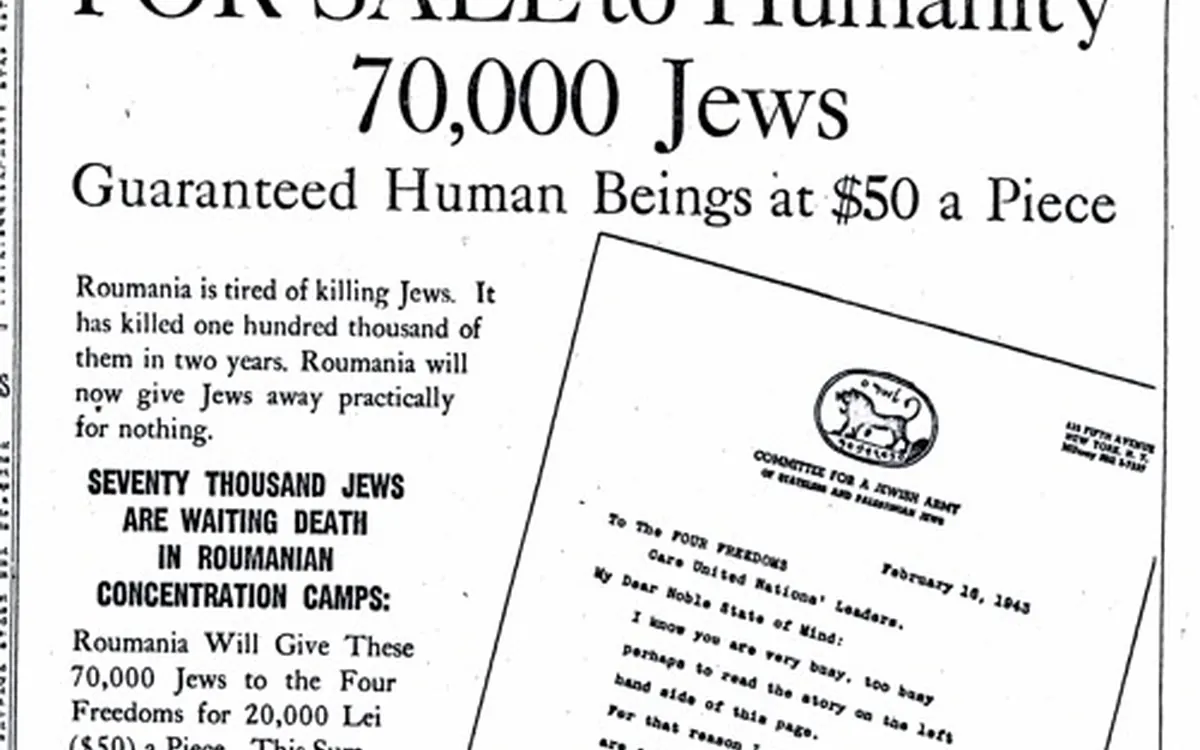
In August 1942 the Riegner telegram reached the State Department with word of a plan to exterminate European Jewry, and the department sat on it rather than pass it to Wise. Wise learned of it through Britain, agreed to stay silent three months while it was verified, and finally held a press conference in November 1942 that the New York Times buried on page ten. Bergson read that buried story over coffee and doubled down, forming the emergency committee, staging the pageant We Will Never Die, leading five hundred rabbis to the White House, and taking out the ad For Sale to Humanity. When Wise demanded who made him a leader, Bergson answered, no one, and that is why I am free to follow my conscience. His pressure, joined by Henry Morgenthau, forced the War Refugee Board in January 1944, which saved perhaps two hundred thousand Jews.
Key ideas
- A posture of powerlessness is itself a survival strategy, one Jews used in exile for two thousand years.
- Stephen Wise led through shtadlanut, the court Jew's reliance on personal access that forbids rocking the boat.
- Nahum Goldmann said half the generation could only watch, and the class asks whether that was ever true.
- Three fears muted the leadership: rising antisemitism, losing access to Roosevelt, and losing their own positions.
- The State Department buried the Riegner telegram, and Wise's press conference landed on page ten of the Times.
- Peter Bergson's nuisance diplomacy, from We Will Never Die to the White House march, forced the War Refugee Board in 1944.
Chapters
- 0:00 Success is survival
- 2:34 Powerlessness as a survival strategy
- 3:44 Stephen Wise; the free synagogue
- 10:42 The World Jewish Congress
- 16:25 Nahum Goldmann; shtadlanut
- 20:28 Half slaughtered, half can only watch
- 26:03 The three fears
- 29:38 Rising antisemitism; Father Coughlin
- 36:29 The relationship with Roosevelt
- 43:26 Hillel Cook; a Jewish army
- 50:15 The Riegner telegram
- 53:52 The State Department sits on it
- 54:56 Buried on page ten
- 64:05 We Will Never Die
- 67:32 Who made you a leader?
- 73:02 The War Refugee Board
Who, where and when
People
Stephen Wise, Nahum Goldmann, Hillel Cook, Franklin Roosevelt, Father Charles Coughlin, Henry Ford, Gerhart Riegner, Henry Morgenthau, Ben Hecht
Places
New York City, Geneva, Evian, Washington D.C., Madison Square Garden
Texts
The Riegner telegram, We Will Never Die, For Sale to Humanity, The Protocols of the Elders of Zion
When
1936 CE: the World Jewish Congress founded, 1942 CE: the Riegner telegram, 1942 CE: Wise's press conference, 1943 CE: We Will Never Die, 1944 CE: the War Refugee Board
Read the transcript
Success, said Leonard Cohen, is survival. Well, what do I really need to add to that? I'm Rav Mike Foyer, and this is The Jewish Story. We interrupt your regularly scheduled programming for Part 5 of the live Survival Zionism series. If you like this Jewish Story live content, I invite you to join my weekly upcoming class beginning on August 8th. You can send me an email at ravmikefoyer at gmail.com. Or you can find all the registration information at Facebook, Rav Mike Feuer, or at my website, jewishstory.co. Hope to see you there. So where are we? This is the second to last class. The sort of focus of this class is shifting to American Jewry. Right? Up until now, we took a couple classes to talk about the internal and external conflicts that led to the sort of emergence of survival Zionism pre-war in the Yishuv, in the land of Israel.
Right? We spent the last two classes touching on some of the elements of the struggle within Europe for survival, with the focus really being on the rise of a militancy and the sort of small but very potent portion of European jury that shows physical struggle as a response to its elimination. and what I want to do in today's class is turn the lens on American Jewry and then the last class I'll bring us back to the land of Israel and we're not going to be able to give it a full treatment but we'll speak about what's known as the revolt right the sort of rising tide of a war of liberation against the British colonial oppressor I just like to say that because it feels good So, Toph, in the meantime, what I want to do today is speak in the context of, we'll speak about what's coming next in a little while, but I can't do that now.
What I want to talk today is in the context of this idea. Remember, the class is about the emergence of survival of Zionism. And, you know, American Zionism is a beast unto itself. Its full discussion really lies beyond the scope of what we're doing here today. But one thing I want to just point out is that there's often a very facile contrast made between power and powerlessness. I mean, to be a Zionist is to believe in power, right? Strong, upright Jews in their land and to sort of be a non-Zionist or an anti-Zionist to believe in powerlessness. Well, we'll see a bit of that as we go forward today. But what I want to point out as a frame for what we're going to discuss is it's always important to remember that a posture of powerlessness, a posture of powerlessness, is actually a strategy for survival.
Right? Think about playing dead. Right? If you're ever in the woods and a black bear approaches you, you should make yourself as big as possible and a lot of noise. If you're ever in the woods and a grizzly bear approaches you, play dead. Right? That has to do with the relationship to power. And what we're going to see today is that there's a major voice within the Zionist world in America for whom some element of powerlessness was built into their understanding of what survival actually meant. So I want you to remember that as part of the frame because, you know, survival Zionism is a complex beast, as is true of most, you know, organisms or organizations. So, okay, we're going to start with the personality of Rabbi Stephen Wise.
We've spoken in the past about his full story, so I'm not going to detail it now. But if you're not familiar, Rabbi Stephen Wise rose as a rebel through the Reform Revenant. What do I mean? Perhaps the best-known example of this is in January of 1906, he published a letter in the New York Times, already a little bit edgy for an American rabbi at the beginning of the 20th century, that raised, quote, the question of whether the pulpit shall be free or whether the pulpit shall not be free, and by reason of its loss of freedom, rest of its power for good. I read this to you both because you hear his rhetoric and the way in which he is quintessentially American in that sense, but also in his stance when he founded, soon after this announcement, what he calls the free synagogue as an anti-establishment sort of countercurrent within the reform movement.
Because Wise believed that reform movement, which at the time was based in Cincinnati, led by middle to upper class German Jews, had lost its relevance and therefore much of its vibrancy in light of two things. The sort of political and social changes in the United States. and most importantly for our story, the new demographic reality where a million plus Eastern European Jews had moved to America, most of them living, literally most of them in New York City, and were rapidly becoming the defining element in American Jewish life. And so what Wise did was he put forward a vision for liberal Judaism, which is what most people associate with the reform movement today, that he considered more modern and American.
And liberal, the term was understood in its day. That's one piece just to give you some context for where we're going. When we speak about his relationship with Franco and Delano Roosevelt, you'll understand why that's important. In addition to his rebellion against this sort of classic reform, what's called the high reform infrastructure, Wise was a Zionist. He was a committed, passionate Zionist, and that was extremely anti-establishment within the reform movement of his day. And he was an early adopter of Zionism. He was one of the founders of the New York Federation of Zionists in 1897, remembering that that's the same year of the first Zionist Congress. He was, in fact, a delegate and the secretary for English language in the second Zionist Congress.
And he served as the president of the Federation of American Zionists in close cooperation with Herzl until his death in 1904. So so he is a Zionist of almost an unimpeachable pedigree. Right. In addition to that, he is deeply American and committed to classic liberal values. Between the years of 1911, 1914, he becomes a founding member of the NAACP, which, of course, nominally has nothing to do with Jewish life. But in his eyes had everything to do with it because he believed that the struggle for one minority was a struggle for all minorities. And basically, he worked his way up to becoming one of the nation's most prominent rabbis. In 1922, he founds his own seminary, the Jewish Institute of Religion in New York City.
Remember, he's moved his base to New York City because that's where the Jews are, right? And that eventually gets folded into Hebrew Union College after his death. But when he was alive, it was really a driving institution that was pushing the reform movement to take a very different stance on what it meant to be an American and a Jew. So it makes sense that he would be a natural candidate for founding chairman of the American Jewish Congress. If you recall, we spoke about the American Jewish Congress. It began as an ad hoc group which wanted to send representatives to the Paris Peace Conference of 1919. Right. And then evolved into a freestanding organization by 1928. And it's important. What was its purpose?
Because the American Jewish Congress plays a role in our story going ahead. The purpose of the American Jewish Congress was to defend Jewish interests at home and abroad through public policy advocacy, diplomacy, legislation in the courts. Right. This is the first time there is any body which claims to represent American Jewry as a whole within the political, diplomatic and legal spheres. Right. And, you know, we're going to see they were somewhat self-appointed and that will pose its own problems. Not in addition to becoming founding chairman of the American Jewish Congress in 28, Rabbi Wise also became involved in democratic politics in that year when he backed Franklin Delano Roosevelt in his successful run for governor of New York.
Now, that was a big step into politics. You should know that Wise was far to the left on almost every issue. of FDR, but it felt that FDR was a powerful and important candidate for the things which he believed in and therefore backed him. But he didn't support FDR's first attempt to get the Democratic nomination for president in 1932, where he indeed got not only the Democratic nomination, but also won the presidency. And he didn't back him because basically felt like FDR hadn't done a good job as governor in New York, in particular in fighting corruption. But they got over that apparently because by 1936, Rabbi Stephen Wise was a firm backer and increasingly personal friend, or at least personal associate, of Franklin Delano Roosevelt, of the president, right, who, if you're familiar with American history at that point, was growing increasingly powerful.
Now, in 1936, that same year, that Wise really cemented his relationship with FDR, and he did it because of the New Deal. Again, there's only so much of American history we can teach here, but remembering that the New Deal was in many ways the origins of any aspects of a welfare state within American democracy. It was a direct attempt by FDR and those around him to address the economic disaster of the Great Depression. And since Stephen Wise was more than half a socialist, he felt that backing a president who was going to open up such social welfare programs was worthwhile. So also in 1936, of course, at this point, Hitler has risen to power in 1933. The Nuremberg Laws, which were the sort of big public declaration of the exclusion of the Jews from the public sphere and perhaps even from the social fabric altogether within Germany, is 1935.
In 1936, in Geneva, in August 1936, is the inaugural convention of the World Jewish Congress. It was attended by 280 delegates from 32 countries. Sounds like a global effort, but in reality, it was in many ways simply an international branch of the American Jewish Congress. And therefore, it should come as no surprise that one of its founding members and first president was, I'll give you three guesses, the first two don't count, Rabbi Stephen Wise. Now, the mission of the WJC, the World Jewish Congress, was to find a comprehensive solution for the masses of Eastern and Central European Jews through the same tools that the American Jewish Congress employed. Public policy and diplomacy, of course, at this point, there's no international court, so they can't go to the courts.
And the League of Nations still exists, but is being shown to be sort of increasingly irrelevant on the diplomatic stage. They're interested in, it's noteworthy that their rhetoric, at least, is about the democratization of Jewish life. They want to create a forum within which Jews are no longer ruled by sort of Parnassim, like rich, you know, sort of like community rulers and intellectually, but rather sort of there are more voices in the process. I say nominally because, as we'll see, Wise was far more interested in the idea of democracy than its practice. And they basically wanted to rescue Jews and oppose the Nazis. They didn't engage directly with Aliyah, which is an important piece here. Even though many of the founders were prominent Zionists, they felt that Aliyah was ideologically driven, meaning Jews leaving Central Europe to go to Israel was not in their eyes a sort of refugee issue.
It was an ideological issue. Those who choose to make their life in the land of Israel, that concern belonged to the Jewish agency at that point in their eyes. and therefore they stayed out of it. They were looking for a comprehensive solution and not looking to the land of Israel necessarily to provide it. If you want to really understand what was going on, I can actually give you with the World Jewish Congress and give a quote from Horace Callen. You remember Horace Callen? He's a philosopher, sociologist, professor who we spoke about in the context of his sort of tossed salad model of the cultural amalgamation in America as opposed to the melting pot. Right. He addressed actually the preparatory conference a couple of years before the WJC was actually founded.
He argued a very interesting idea. He says that the process of globalization and democratization have destroyed the Jewish solidarity of the Middle Ages. It's fascinating. And it's essential to establish the WJC in order to rebuild it. Now, notice, this is the assumption, which is the dominant assumption, even when Callum was a Zionist, remember, he was an ardent Zionist, amongst Jews all over the world, that the Yishuv, the settlement of Jews in the land of Israel was an important piece, but was never going to supply the base for a unified Jewish life. In their eyes, the World Jewish Congress would do that. And I emphasize it to you, first of all, because it's just important to know for context, but also because to remind you, it's only after the destruction of Europe that Zionism really emerges as what most people see the viable vehicle for Jewish national life.
And that will be still in distinction to America. Because in America, this idea of the American Jewish Congress, which, like I pointed out to you, is virtually identical with the World Jewish Congress. I mean, Stephen Wise is the president of the American Jewish Congress and the chairman of the executive committee of the World Jewish Congress. And in 1936, the World Jewish Congress moves its offices to New York because as the situation in Europe is getting worse, there's, you know, it's a safe haven. And what's emerging at this point is the model that we're familiar with today, which there are basically two models of life. There's, dare I say, indigenous Jewish life in the land of Israel. I'm not allowed to say that.
Right. We'll just say Jewish life in its national embodiment in the land of Israel and Jewish life in its diaspora embodiment within America. Obviously, even today, there are Jews all over the world. But in terms of weight of sheer numbers and sort of cultural momentum, it's basically American Israel. And this is what you're hearing now, that the solution to the breakdown of Jewish solidarity, which it's interesting that he puts the ideal in the Middle Ages, right, caused by globalization, democratization, the ideas of Horace Callen and Stephen Wise is a global Jewish Congress, not moving to Israel, even though both of them are Zionists. So it's an important piece. I will indeed mention Nachman Goldman in about 30 seconds.
That was where I'm going next. Right. So as long as that was directly to me, it wasn't it wasn't ever. So Israel just asked me, can you discuss this without mentioning Nachum Goldman? And the answer is no, because the next line on my page says, Wise had a partner in the founding of the World Jewish Congress. And in many ways, the driving thinker behind the construction of the World Jewish Congress was German Zionist Nachum Goldman. Now, he's going to have a rich future in the Jewish story, in particular in the task of holding the disparate parts of the Zionist movement together. We're not going to go into his full story because it would take us well beyond the scope of our time period right now. But nonetheless, Nahum Goldman escapes Germany in 1935.
As I said, he was a prominent member of the German Zionist movement. He escapes in 35, and he could really be called an early adopter of the awareness of the Nazi threat. And again, I just keep saying it again and again. This seems bizarre to us, sitting where we are with the information we have, et cetera, who, especially escaping Germany in 35, wouldn't already have assumed that the Germans were a threat. But, of course, everybody knew they were a threat. They just didn't realize the extent of the threat that they pose. So he was an early adopter. And when he came to America, was driven by the sense that basically was, you know, pull things together or, you know, we will, you know, we'll survive together.
will hang separately, as they say, right? Stand together or hang separately, whatever the expression is. And when he got to America, he was deeply disappointed because what he found was that the sort of post-Louis Brandeis phase of American Zionism was fragmented, and the leadership of American Zionism was divided and essentially impotent at a time in which they really needed to be strong and concerted in their focus. So together with Stephen Wise, with Rabbi Stephen Wise, he attempted to basically gather the rings. And that's important because part of the story that's coming is a somewhat, let's say, autocratic face, which comes out from Rabbi Stephen Wise, which he holds responsibility for in the face of history.
But it needs to be appreciated that he and Nachum Goldman worked extremely hard to try to create a structure that they felt could legitimately save the Jews of Europe. This is part of the story of survival Zionism. so another piece that goldman really brings into our story even though rabbi wise certainly agreed is he carried the essence of what i would call shtadlanut politics into the mix of american zionism his mantra i'll explain what i mean by shtadlanut in one second but his mantra is quote in exerting political pressure at home one must always be cautious and tactful or risk incurring the hostility of influential diplomatic figures, meaning push, fight, but don't rock the boat. And that is shtadlan.
A shtadlan, li shtadel in Hebrew, is to make an effort. And a shtadlan is a model of leadership which really emerges out of the Middle Ages. you know, Jewish communities, and it reaches its essence in what's known as the court Jew. People are familiar, or those have been in this class together long enough, we've spoken about it, but essentially it's someone who is wealthy and powerful, a Jew who is wealthy and powerful, and serves as the unofficial representative of their community based on their personal relationship with non-Jews in power, right? So it might be a wealthy banker who has the ear of the prince because he holds his debts It might be you know the successful businessman who is a purveyor for the king army and is able to supply him with what he needs to wage war and therefore is able to get what he wants in order to protect his community But the key is the Shadlan on one hand has no democratic relationship to his constituency He wasn't chosen or elected.
It was his power and personality that brought him to the fore. And second of all, he has no real official standing. Everything he's able to accomplish is based on his personal relationship with people in power, which means you have to be careful not to rock the boat. And as we're going to see, this model of shtadlanut, of personal relationship as the source of real power, is the model that Rabbi Stephen Wise will attempt to use, to what degree of efficacy we shall see, in engaging the growing awareness of what's actually happening to European Jewry and trying to push the American government to take a stance upon it. So, I mean, I do want to say in honor of the fact that Israel asked the question, Nachman Goldman has a deep, rich story of his own, but there's only so many people's stories that we can tell.
So for now, he's going to remain a little bit of a placeholder. If we get to the later episodes of the 50s, he's actually got quite a bit to say. So it was actually Goldman who represented the WJC, the World Jewish Congress, at the failed Avion Conference. Recall that was the conference in France in July of 1938, which attempted to find a solution to the Jewish references of Europe and failed, not of Europe, sorry, originally of Germany and Austria. It failed when the Polish government jumped up and said, hey, if the Germans and Austrians can get rid of their Jews, so can we. And the idea of trying to find a home for three, four million Jews suddenly just became an absurdity. And therefore, the conference broke up without any solutions.
He, like Golda Meir, was a silent observer. He was there on behalf of the WJC. She was on their behalf of the Jewish agency. Neither was permitted to speak. Both simply bore witness to the abandonment of their people, if I dare be so dramatic. Now, that abandonment begs a question, which is what do you do when you perceive yourself to be powerless in the face of larger men? Here, picture Goldman and Golda Meir at this conference. The representatives of the world's most powerful nations are there, and they are either unable or unwilling, the difference at this point is irrelevant, to find a home for the world's Jews. Furthermore, let's not forget that by 1938, the British hadn't completely locked the gates of the land of Israel, but they were closing quickly.
It's really in 1939, as we spoke about with McDonald's white paper, that the gates were fully locked, but they're essentially only a crack of light left. And they have a sense, basically, that they are being left to die. The question is, what do you do? Right. Especially what you do if your entire approach to power and problem solving is the Stadlan's approach, which is which is accept the limits of your power. Because if you don't accept the limits of your power, then you will have nothing. Picture in the Middle Ages, the wealthy sort of army purveyor. Oh, sure. He feeds the king's soldiers and he provides his cavalry with horses. But if he walks into that room and starts talking truth to power and telling the king that he's a rotten anti-Semite and that the Jews are human beings just like everybody else, what's the king going to do?
get another purveyor. And even if he's going to lose out in the short term, right, the reality is that the Stadlon has very little real base on which to stand. And the question is, was that true of the Jews of America in the mid 20th century, early to mid 20th century? Right. You know, when he addressed the ZOA, the Zionist Organization of America in October of 1942, Now, remember that the WANSI conference is in January of 1942. And Jan Karski's publication of, you know, published by the Polish government in exile about the mass extermination of the Jews of Poland in occupied, of the Jews of occupied Poland by Germany is published in December of 1942. So he's addressing the ZOA, the Zionist Organization of America, in October of 1942.
Now, they've already heard the reports, as we'll see, but no one knows exactly what's going on. He says the following. Our generation is in the tragic position that one half of the generation is being slaughtered before our eyes, and the other half has to sit down and cannot prevent this catastrophe. And the question is, was that really true? Now, I understand that's what he believed. And you understand how the Stadlon model led him to believe that. You know the old saying, when your only tool is a hammer, every problem looks like a nail. When your only capacity to exercise power is through shtadlanut, then you must always see in front of your face the limits of your power. Because a shtadlan that doesn't constantly see the limits of their power loses their power altogether.
The second that they're kicked out of the king's presence because they went one step too far, yoteh sharo behef seder, as we say. They've lost everything. And the question is, is that really true here? Because notice he just says, has to sit down and cannot prevent this catastrophe. And now I will formulate the accusation, which is leveled increasingly by historians and even in its day. The accusation is basically that the American Jewish Congress and the World Jewish Congress, which are functionally at this point the same thing, cooperated with the other Jewish elites of America and with the United States administration, FDR's administration, to basically mute the American Jewish reaction to the Holocaust.
Right. Even though they were increasingly aware of the full dimensions of what was happening to European Jew. I mean, listen to Goldman's quote. So the tragic position one half of the generation is being slaughtered before our eyes. He says this in October 1942. The other half has to sit down and cannot prevent it. So we have to ask the question, is it true? Is this accusation accurate? Now, the accusation comes with three explanations, which are important to remember, and they're essentially the frame for what we're discussing today. Meaning, why would they do such a thing? They weren't evil people. I want to be clear on that. You know, these were Jews who, as I said, powerlessness, a posture of powerlessness is a strategy of survival.
It's not just a strategy of survival. It was one of the primary strategies of survival that Jews in diaspora used for 2000 years. And to think that you can just let that go or that it's not not effective is a mistake. It's a misunderstanding. Obviously, as we're going to see, the Zionist Jew has a very different attitude. the Israeli Zionist Jew, or not Israeli, the Yeshuv Hebrew Jew, as they liked to call themselves at the time, has a very different attitude, and we will see that shortly. So there are three factors that historians want to claim might have motivated if in one deed accepts the accusation that the Jewish leadership of America was an active participant in suppressing the reaction of American Jewry to the Holocaust.
us. One was fear. There was a fear that any aggressive protest would stimulate domestic anti-Semitism, and we'll look at that in a second. Another one was worried. They were worried that public Jewish criticism would undermine their relationship with FDR. That's the Shadad Banut model. If you start making waves and lots of noise, then we have no power at all. So there's a fear of anti-Semitism. Basically, it all boils down to fear in the end, but there's a worry that They will lose their connection to the administration if they publicly criticize. Right. And there is the self-interest. They want to protect their own leadership positions from the more activist elements that are growing within American Jewish life.
And we're not going to discuss it now. But but Abba Hillel Silver, Rabbi Abba Hillel Silver, is is the foil to Rabbi Stephen Wise within the reform movements, Zionist movement. And those who are familiar with the history of American Zionism will know that he indeed in the end manages to usurp the position of power and representative big Jew within the American Zionist movement. But he also, his story lies ahead. So, again, there's a fear of anti-Semitism. There's a fear of losing their ability to influence the administration through much public criticism. And there's a fear of losing their own personal positions. So let's look at each in turn. First of all, I'm going to pause. I've been speaking for a half hour.
Do people need clarifications? I want to ask some questions. Yeah, Joanne, I saw the hand. You're muted, Joanne, if you're speaking. Gee, I'm sorry. It's not exactly a clarification. It was more, and maybe you'll be getting to this, more of a perspective issue. In other words, like this developing horror in Europe was huge for us. For the President of the United States, it was an issue. We're going to speak about that. Okay. I mean, I'm really more interested in the Jewish story, so I'm mostly interested in the dynamic amongst the Jews. But, yes, we're going to have to talk about what was FDR's thinking. By the way, Israel recommended a very powerful book here in the chat, which you should send everyone when you say those things, which is Tom Sege of The Seventh Million.
It is a very important and not so easy book to read, just to warn you now. It can be quite disturbing in places. Other other way I see from Matt, true that there was massive anti-Semitism. I'm about to speak about that right now. That's meaning. I just gave you a list of these three fears and I want to explore them a little bit each other. Other pieces, things people want clarified. Yes, Robert. The problem in my own mind is that perhaps Nachum Goldman was absolutely correct in saying, you know, half of us can only watch uh well i'm going to challenge that thought that's exactly what i want to look at now okay because we're going to see that that there's a whole other approach that certain american jews took um okay we're good to go let's do it so first of all again fear of rising antisemitism fear of losing their ability to influence administration at all if they enter into public criticism and fear of losing their own positions.
So first of all, anti-Semitism. Now, remember that in the 1930s, the United States was a deeply troubled country. And the context there is very important. The economy was totally paralyzed by the Great Depression. We're talking about nearly 25% of the workforce unemployed. And frankly, a good section of the country is still licking its wounds, physical, psychological, or otherwise political from World War I. It's not so long since World War I had ended. And therefore, there's a deeply isolationist element which grips the country. And isolationist element, which is an essential element of American culture in many ways. Remember, rugged individualism, if you're familiar with this idea that underlies the sort of classic frontier culture of America, I mean, what is the desire of rugged individualism except to be left alone?
And so on the national level, isolationism, to a certain degree, is a characteristically American expression, which has its roots in the most simple sense of the fact that America is isolated from the rest of the world in its history, right? People left Europe and went far away in order to get there. And what's important is that to some degree, that's also the attraction it held for Jews. I mean, America as the golden medina, you know, the place of big economic opportunity as a refuge from Europe, et cetera, is very true. But don't forget also America was a place you could go far away and leave the past behind. right? Whether it was tradition, whether it was your family, whether it was the hatred deeply rooted in European culture.
And so that sense of isolationism was actually shared by many Americans and Jews. And everything was rosy so long as American and Jewish interests coincided, right? But as we know, isolationism has darker sides to it. In politics, it's a desire to basically leave the world to its own problems. Why should America be the world Policeman should sound familiar. It comes up again and again in American history. And that's why Congress actually rejected membership in the League of Nations, even though Woodrow Wilson, after World War I, was a major architect of the idea. In the end, Congress wasn't having it. We already fought over there in Europe, and it's their problem. On a social level, this sort of ugliest manifestation of this isolation is what's called nativism in American history.
It's basically fear or dislike in exclusion of foreigners. It's nothing unfamiliar. And it has a reminiscent ring to it when you see it's a mix of economic competition for scarce resources and a cultural desire to claim American means WASP, white Anglo-Saxon Protestant, right? It's very similar in that respect to some of the older veins of anti-Semitism. And that's why, as we know, American immigration law in the years leading up to the Holocaust reflected the desire to basically shut the door. And therefore, the desire by American Jews in the late 30s to find shelter in America for their brothers and sisters was very Jewish, but un-American. You understand? And there becomes like a split. It was very Jewish because they want to save their Jewish brothers and sisters, but it's un-American because the stance of America in the mid to late 30s was the world has its problems.
They're not our problems. We need to work this out on our own. So Jews who were American Jews were torn on a brutally painful issue. Now, that's all the sort of theoretical construct, because as the situation in Europe deteriorated, American Jewry began to walk on eggshells, because even though anti-Semitism in America never reached European scale, but it was quite real. And anti-Semitic leaders and movements began to grow on the fringes of American politics in the 30s, which is, of course, where they always begin. The difference is that in America, they have, until this point, remained on the fringes. I'm not getting into recent history and what you think about the role that anti-Semitism may or may not have played in the last 10 years of American politics, but certainly they were on the fringes, but they were growing.
And perhaps there's no better example than that of Father Charles Coughlin. Coughlin was a charismatic priest and political organizer in the 30s. In fact, he's one of the first American leaders to use the radio as a tool of reaching a mass audience, therefore mass political organization. This is very reminiscent of the Nazi party, who were very quick to understand the power of mass media in order to not only get their message across, but to create a collective movement. And during the 30s, an estimated 30 million listeners tuned into his weekly broadcast. I want you to appreciate that. 30 million people, I don't have the numbers in front of me, but that's a significant percentage of the American populace.
I mean, at this point, it would be just shy of 10%, and it would be significantly more. Somebody can Google what the population of America was in the 1930s, don't know. But that's a huge percentage. And they're tuning into these weekly broadcasts. At first, he was a vocal supporter of FDR on the New Deal because he thought that FDR was going to get them out of the Depression. Right. But as the decade progressed, he became a pretty harsh critic of FDR, in particular claiming he was too friendly with the bankers, meaning the Jews, because Conklin wasn't just a radio personality. he had as I said politics in mind and post the 1936 election he started expressing sympathy for the governments of Hitler and Mussolini and because he saw them as the only antidote to the Jewish conspiracy of communism this is sort of like classic anti-semitism and in fact so classic that he had a newspaper a periodical it was a you know that called social justice interestingly enough um which reprinted the protocols of the elders of zion in weekly installments now after the outbreak of the war war ii meaning right fdr's administration managed to use its wartime powers to force the cancellation of coffin's radio station but uh any and ban the distribution of social justice but let's remember that 30 million people don't just disappear They may not have their access to their radio station, but it only reinforces the sense that FDR is in the pocket of the Jews if one of the ways he uses his wartime powers is to shut down the guy who's telling the truth about the Jews.
You understand how these things work? And, of course, as Matt pointed out here, just to add to the context, because we're not diving into the anti-Semitism right now, it's not our main story, is that America's biggest industrialist at the time was Henry Ford, who was also America's biggest supporter of Hitler, and also distributed the protocols of the elders of Zion in his own periodical. So the idea in the minds of Stephen Wise and other leaders that speaking out vocally against what was happening to the Jews and trying to push the American administration to take action, which might not be perceived as in the interest of America's sort of national interest, would stoke antisemitism was not a fantasy, right?
It was a very present reality for them. That's one. So that's the fair side. What about the relationship with FDR? How much reality was that? Listen, FDR even then was a hero to American Jews. They had gained unprecedented access to the White House in his period. I mean, he appointed a Jew, Henry Morgenthau, as his secretary of treasury. We're not going to get into the whole Jewish why the treasury thing, but, and there was a deep personal relationship between Rabbi Stephen Wise and FDR, right? Wise basically embraced the role of Stadlan. He called FDR the boss. He called him the boss, which may sound affectionate, but to me is also a little bit icky, to be honest with you. And now we have to remember to his credit that Wise spoke out forcefully about the situation of the Jews in Germany from 1933 He was fighting to loosen immigration quotas If you recall he also fought in favor of the boycott of German goods And that was really where Wise, in 1933, when Hitler first came to power and there was a wave of violence against Jews, if you don't recall, there was a boycott movement, an anti-Nazi boycott movement that began in America and swept through Europe.
was broken, interestingly, by the Eshuv. We talked about that story. But this is where Wise first sort of got sort of exposed to the tension between his loyalty to sort of the New Deal and his liberal, you know, liberal vision and to FDR personally, and his role as the defender of Jewish interests. Because he, at the same time that he was back in the boycott, he could not afford to undermine the power and popularity of FDR. So in order to make his job easier, he did two things. First of all, he assured FDR that he was toning down what he called the militancy of certain voices within American Jewry. And he urged FDR to at least verbally condemn the Hitler regime, something which FDR steadfastly refused to do.
He, from the Nazi Olympics to the Nuremberg rallies, to Kristallnacht, Roosevelt refused to condemn Hitler until they waged war. He said he was not going to speak out about Germany's, quote, internal affairs. And furthermore, Secretary of State Cordell Hull in 1933 actually said a boycott was going to damage U.S. economic interests, meaning Jewish Americans protesting Hitler were harming America. You understand the problem that Wise now faces? was that true was it not true i'll leave that to you in your own analysis but i what i need you to understand is that this man who had based his entire power base and his ability to help his people and he's been painted in pretty ugly you know but with pretty ugly colors by many people since then i don't want to necessarily weigh on that right now but one thing you do have to understand is that this is a man who had devoted his entire life to serving the jewish people and was doing it the way he felt it should be done did he do it perfectly was he right well Let's see.
So, like I said, his focus was on maintaining access to the White House. And that was all that would allow him to accomplish anything which could actually be accomplished. I mean, it's a very simple equation. Either you do what you can and protect your position or you try to do more than you can and you lose your ability to affect things altogether. This is Stadlanut in its essence. And he recognized that that might require turning a blind eye to what was happening in Europe in order to preserve his influence. But the reality is, according to most historians, that Wise was simply outmatched in personal politics by FDR, who was a master with people, by all accounts. I mean, I hope it doesn't sound un-PC to you, but just he, I mean, you're talking about a man who couldn't walk, who was arguably the most powerful president in American history.
Just think of the magnetism he was able to wield. Most people, sadly, tend to look at someone who's physically disabled as somehow inferior. This man was able to rise to the heights of power. And so you should understand the ability he had to wield personal influence. Some fact claim that FDR played wise basically a fiddle. Using flattery, intermittent access to the White House, which he would cut off and then offer again, cut off. He called, you know, wise by his first name, made him feel like he was a personal friend of the most powerful man on earth. But in the end of the day, he didn't actually give him what he wanted. I have a quote here that the, what's his name, Medoff in his book, oh, the Jews should keep quiet, right?
The Israel put out there, right? But he uses, I think it's in the opening of the book, if I recall correctly, that Wise sent a letter to his son in February of 1943. It says that Justine and Chad, who are Wise's daughter and son-in-law, had dinner with the Roosevelts on Saturday, including the president. Then Wise writes, Justine, his daughter, said, the president sends his affectionary guards to me. Then he adds, if only he would do something for my people. You hear that? I mean, he has this sense of a warm, deep personal relationship and a complete incapacity to do anything with it that actually matters to something which matters to him. Now, so we have fear. We have protecting this particular personal position.
Then we have the question or sorry, the personal relationship with Roosevelt in order to maintain his ability to influence. Right. And then we have the question of his own leadership position within American Jewry. Now, like I said, Wise was a great believer in democracy, but he wasn't so tolerant of democratic dissent within the community. He basically assumed, like every good Stalin before him, that his personal relationship with the president made him an indispensable leader and therefore he should not be challenged. There are examples here, but for the sake of time, I'm not going to get to some sort of examples that I could bring to you from his rise to power. What's important, though, is that the greatest challenge to Wies' leadership and his entire strategy of Shtadlanud actually came from a 30 year old Israeli Jew.
Well, it wasn't Israeli yet. A Jew from the Yishuv by the name of Hillel Cook. So I'm going to pause briefly, though, because we only have a half hour left. If there are clarifications people need before I get into the story of Hillel Cook and what's known as the Bergson Group. I'm going to charge ahead. So Hillel Cook was born in Lithuania in 1915. He was the son, actually, of Rabbi Dov Cook, who was the nephew of Rabbi Avonitschaka Cohen Cook. Sorry, who's the brother. Hillel Cook was the nephew. sorry he was he was the nephew of of famous rav cook um chief rabbi uh first ashkenazi chief rabbi of mandatory palestine right in 24 his father and whole family came up to israel his father became the chief rabbi of fula they were a rabbinic family um hisrael was raised fittingly within the religious world he went to rav cook's yeshiva merkazerab in jerusalem at the same time as he attended the hebrew university um and uh apparently the hebrew made a deeper impression on him than the yeshiva, although, I mean, one could question that.
But it was that Hebrew era that he became a member of a small group of students who later became core elements of the revisionist movement, including David Raziel, who was that commander who first broke restraint, if you recall. Also, Abraham Yetir Stern, head of the Lechi, or also known as the Stern Gang, which is not such a nice term for them. And basically, as the situation began to deteriorate between Arabs, British and Jews, Hillel Cook rose to be a founding member of the Irgunsadaylu Mi, the militant faction of the revisionist movement. He served as a commander in its fight during the 1936 Arab revolt that we discussed. He quickly rose to become a member of the general staff. And he finally met Jabotinsky himself in Poland in 1937.
where he'd gone to organize and fundraise on behalf of the Irgun, and Jabotinsky filled him with his inspiration and asked him to come to America to accompany him on his mission, which Jabotinsky had been pursuing his entire life, to create an independent Jewish fighting force. If you recall from our earlier discussions, Jabotinsky had marginally succeeded in this toward the end of World War I, which was the creation of the Jewish Legion, and he really, as we'll speak about why in a moment, He really had this dream that as World War II was about to break out, that it was critical, actually, by 1940, it had already broken out. It was critical to create an independent Jewish fighting force. But Jabotinsky, as we spoke about, died in 1940.
He had a heart attack in upstate New York. And Hillel Cook was left as the head of the Irgun and the revisionist mission in America. And as he described it himself, basically, he was cut off from anything but the most sporadic communication with the Irgun command in the land of Israel. I mean, 1940, anyway, communications were very different than today. Plus, there was a war going on. And so therefore, he described himself as the head of a cutoff battalion with a clear mission. That mission was to raise the Jewish army that had been Jabotinsky's life dream. And it was a mission which conflicted directly with that of mainstream Zionist leadership in America, British imperial interests, and even American foreign policy.
Now, what would you do if you were cut off from your leadership? You were basically a man alone, maybe with a handful of supporters, and your mission conflicted with the Zionist leadership around you, who you think would be your natural allies, the British Empire, and the American foreign policy? I don't know what you would do, but you know what he did? He doubled down and took work harder. But he first had changed his name because he didn't want to embarrass his uncle because he knew what he was going to do was going to make waves and upset people. So he changed his name from Hillel Cook to Peter Bergson, which is maybe how some of you have heard of him. And as Peter Bergson, right, he formed just a few days before Pearl Harbor and America's official entry into the war.
He formed the Committee for a Jewish Army. And their claim is actually an important one to understand that I want to put on the board, even though it's not really our focus right now. Their claim was basically that the Jews of the mandate, meaning the Jews in the land of Israel and those of Europe who had become homeless because of the war, had a right and a duty to a distinct fighting force which could join the allies as a co-belligerent. I mean, because American Jews and British Jews, et cetera, could join the armies of their respective countries. But Jews of the land of Israel and now the Jews of Central Europe had no home. And this is a part of a bigger discussion in the thought of Peter Bergson or Hillel Cook about the formation of an identity for Jews, what he called Hebrews, as opposed to Jews.
And we're going to see this Hebrew stance opposed to the Jewish stance was something that he felt needed to be clarified. He was not a fan of this idea that every Jew is a latent citizen of the land of Israel. Not a fan at all. He felt there needed to be a sharp and clear distinction, not as a sort of like an amorphous religious people, but as a nation, that it was going to be the Jews who fought for their independence with an independent force as co-belligerents who would be able to claim a national stake in the post-World War II world. so he made waves right off the bat press releases full page ads in major newspapers making alliances with non-Jews aggressive lobbying all the no-nos of American Jewish leadership these are all the no-nos and I mean listen to give you an example he ran one of the first advertisements he ran in the New York Times which was one of his favorite bases even though the New York Times was a notoriously anti-Zionist paper at the time run by Jews of course Jews fight for the right to fight.
Right. Now, eventually, Bergson joined forces with journalist and Hollywood screenwriter Ben Hackett. And a big plays and pageants theater became part of their strategy and their struggle for the Jewish army. Now, you're thinking, why are we talking about the Jewish army when this is the topic we've been speaking about right now is the American response to the Holocaust? Well, I'll tell you why. Because that struggle was hard enough. But in November of 1942, Berkson completely changed his course. What happened? August 8th, 1942. Remember, the Wansi Conference is in January of 1942. Jan Karski and the Polish government exiles publication of the mass extermination of Polish juries in December of 1942. We're right between those things.
So on August 8th, 1942, a telegram reached the British Foreign Office and the American State Department at the same time. It was sent by Gerhard Reiner. He was secretary of the World Jewish Congress. You recall that entity, right? Secretary of the World Jewish Congress in Geneva. And he sent it through the British Foreign Office and the State Department because they were both allowing the World Jewish Congress to use their communication channels in order to maintain links between Europe, Britain, and America, because otherwise the war had cut off every means of communication. And this is what that telegram said. Received alarming reports stating that in the Fuhrer's headquarters, a plan has been discussed and is under consideration, according to which all Jews in countries occupied or controlled by Germany, numbering three and a half to four million should, after deportation and concentration in the East, be at one blow exterminated in order to resolve once and for all the Jewish question in Europe.
And then he adds details. Actions reported to be planned for the autumn. Wait, stop. Ways of execution are being discussed, including use of prussic acid. Stop. We transmit this information with all necessary reservation. As exact due cannot be confirmed by us. Our informant is reported to have close connections, etc., etc. Please inform, consult New York. It's a bombshell. Remember I told you that the report by Jan Parsi was the first word that the Western governments had? It wasn't true. I was setting you up. It was the first word that the Western governments were even vaguely forced to listen to. Because this cable, remember, was meant to get to the heads of the WJC via the State Department and the British authors.
Well, the head of the WJC in America was Rabbi Stephen Wise. He never got the telegram. Not from the State Department. They didn't deliver it. And he did, however, learn of the telegram through Jewish leaders in Britain. Now, what happened? After the U.S. entered the war, FDR's administration basically took the position that aiding Jews trapped in Europe would divert resources from the military campaign against the Axis and would cause unnecessary political turmoil, domestic political turmoil. I mean, FDR was already fighting a battle being labeled as in the pocket of the Jews. Again, there's a whole analysis, as Israel pointed out. There have been a number of books written on the topic of FDR on the Jews.
And frankly, as more and more documents are on Earth, he looks less and less rosy. That's not my topic right now. My point is that their stance was, at best, this is not worth fighting. We need to defeat the Nazis. That will solve all problems. At worst, let's face it, as I pointed out to you before, the less Jews there were after the war, the less of a headache there would be for the Allies in this messy question of what to do in the land of Israel. And you can always throw in the fact that did they really love the Jews to begin with. But here is that when the regular cable got to the State Department, it wasn't just greeted with skepticism, which you could understand since it was an unsubstantiated claim, right?
But it was actually greeted with obstructionism. They didn't want unwanted. They didn't want public pressure to act. So therefore, the State Department simply didn't pass it on to Rabbi Stephen Wise. And the one top diplomatic official actually warned Wise might kick up a fuss if he found out. And so therefore, he ordered the Geneva Consulate, which had forwarded the telegram to begin with, not to transmit any more reports from Gerhard Reiner unless they were, quote, in the national interest. Meaning letting American Jews know about what was happening to their brothers in Eastern and Central Europe was not in the American national interest. um now but like i said reinhardt's for the ragnar's sorry foresight in presenting that information not just to the americans but also the british consulate paid off because stephen wise did indeed find out and he went immediately to undersecretary of state sumner wells to report what he thought was new and vital information on what was happening to the jews of europe because remember as far as he knew the state department didn't know because he'd gotten the information from Europe, from Britain, sorry.
He had no way of knowing the State Department knew well they got the exact same telegram, right? He also wanted, and of course, what did Wise really want? A meeting with the president. Well, Wells never told him that he'd been sitting on that cable for almost three weeks, nor did Rabbi Wise get a meeting with the president. Instead, what Wells did was demand that the rabbi maintain secretly while the State Department checked the cable's veracity. and Wise agreed and waited until November of 1942, three months later, right? September, October, November. Three months later, while the final solution was really moving toward its height, it's chilling to think about how many tens of thousands, if not hundreds of thousands of Jews died in those months.
So when he finally received the authorization for the release of this information from the State Department. Robert Wiles held a press conference on the evening of November 24, 1942, and the next day's New York Times reported the story on the 10th page. It was buried. And in fact, history has not been kind to Arthur Sulzberger, the owner of the Times, who was a Jew deeply committed to assimilation and equally opposed, therefore, to Zionism. He gets a lot of criticism for basically burying the story of the murder of the six million. And frankly, as far as I can tell, he deserves it. Right now. No, you know, Stephen Wise also gets a lot of criticism for not risking his personal relationship with FDR and doing more.
Now, the press conference wasn't the only effort. Mainstream Jewish organizations did pick up the voice, sponsored rallies, mass meetings, but they would never directly challenge American policy. They did not want to make waves because the dominant model was Shtad Lanut. You can make this about a challenge because what could have happened was to stand up to the president and say you letting people die on your watch This is inhuman As we going to see it indeed what happened but not coming from Rabbi Stephen Wise and the mainstream leaders of the Jewish community You know there a grim comment recorded in the diary of Chaim Kaplan which he wrote actually in the Warsaw Ghetto, and it was found in the Oneg Shabbos archives.
He says, a joke is making the rounds. Ready for this? Stephen S. Wise is helping. He's ordered the American Jews to say Kaddish for the departed souls of Polish Jewry, his foresight is accurate. Remember Nahum Goldman's comment? There's nothing we can do. So the question is, was that really true? Because not every Jew was willing to sit there and assume there was nothing they could do while half of their brothers were slaughtered. Because Hillel Cook, who was fighting for a Jewish army and had heard rumors, as many Jews had heard, about what was happening in Europe, but had not had them confirmed. And, you know, at a certain point, he's the cutoff battalion. He's got a mission given to him. And let's face it, Jeb Patinsley wasn't just his leader.
It was his Rebbe in the full sense of the word. He's filled with a mission. But he was one day sitting, sipping a cup of coffee before his meeting on Capitol Hill in order to keep pushing this committee for the Jewish army forward. And he picks up the New York Times to have a read. I don't know what you're referring to there, Yisrael. He picks up the New York Times to have a read with his copy and discovers this story about the cable buried in the back pages. Like I said, the idea of Nazi murder was far from new, but this was different. It was a telegram confirmed by the U.S. State Department that described the program for systematic extermination of European Jewry. And Hillel Cook was now the kind of man to take that sitting down.
He picked up the phone and called the assistant secretary of state out of Burl, whom he'd met on a number of occasions to discuss his his quest for the Jewish army. He wanted to make a meeting for that very morning. Right. And the doors of Washington were still open to Hillel Cook, even though, by the way, the British government had tried to discredit him. And even many Jews of officialdom had done as well. Apparently, Cook had a magnetism. He had a diplomatic bearing and a persistent force of character that simply couldn't be resisted. So he got this meeting with Burrell and asked if the news of the extermination was correct and received the reply, yes, there is no doubt that it's correct. And Bergeson only had one question.
What are you going to do about it? The answer was, what can we do? Right. That's all the answer he got. And as we know, that became the majority voice of the U.S. government and the mainstream leadership of American Jewry. Nothing can be done to save the Jews until we win the war. and any rocking of the boat, any causing of domestic conflict weakens the president, which weakens the military, which weakens our efforts to defeat the Nazis. Not an illogical statement, but it wasn't the only way. Well, Peter Bergson refused to accept that. And the result was he completely reformed his mission and formed the emergency conference to save the Jewish people of Europe. He wasn't so good with acronyms, by the way.
He could use some help there. And it was basically the most dramatic political action campaign to that point in American Jewish history. He and his men were able to swiftly overcome the sort of incomprehensibility of what was happening in Europe and the inertia of the conventional thinking of what was permissible to do about it. And basically move into, I don't know, a hectic mode. I mean, if the efforts of the Committee for the Jewish Army had been strenuous, then the activities of this emergency conference were frenzy. Lobbying, propaganda, fundraising, et cetera. You know, Bergson liked to call himself a nuisance diplomat. He was a nuisance diplomat. And his activities provided a real nuisance to the Roosevelt administration, right, and the leadership of American Jewry who were claiming that saving the Jews was impossible.
Just to give you an example, there was a report that the Romanian government was prepared to ship 70,000 Jews to a safe haven as long as the Allies were willing to cover the expenses. And this was not acted upon. 70,000 Jews. So when Bergson heard about it, he took out a full-page advertisement in the New York Times with a headline, For Sale to Humanity, 70,000 Jews Guaranteed Human Beings at $50 a Piece. That, I think, is all you need to know in order to understand the tools that he was bringing to bear. Now, this was not taken well by Stephen Wise and the mainstream leadership of Dury. On one hand, there is a genuine, like, machloket here. Let's just remember that. There's the Shtadlan model, which had proven itself over a couple thousand years, that when it comes to survival, a posture of powerlessness is a means of surviving.
So that can't be ignored. And you put that up against the whole essence of the Zionist effort with Peter Bergson, Hillel Cook represented, which is the upright fighting Jew. And remember, our discussion is, as Israel sort of called me out at the end, that even asking the question of whether the Warsaw Ghetto uprising was successful is offensive, because the reality is to struggle is to succeed, no matter what the outcome. That is the attitude which is represented by Peter Bergson here. You know, at one point, Wise declared that Bergson was worse than Hitler. Right. Because why? His provocative protests like marching through the streets, et cetera, were increasing anti-Semitism and weakening FDR during the war.
Right. And in fact, they made constant efforts to get the administration to draft him or deport him, as they said. Right. Now, the Bergson Group on their end charged that beyond their fear and sort of posture, they felt the American Jewish leaders were reluctant to have those kinds of Jews in America. Samuel Merlin, who was Bergson's associate, he put it this way. He said they weren't interested in people who were behaving in embarrassing ways. old world European Jews. Whatever it may be, the feeling on the behalf of the mainstream leadership was that the Bergson Group was basically all about sensationalism and recklessness. And further, they argued that foreigners have no right to speak for American Jews.
And part of the sort of underlying tension here, which I guess we're just going to have to leave as a statement and not analyze too deeply, is what constitutes the national leadership? Right. Meaning Stephen Wise is an American Jewish leader. Nobody argues that. However, he is also head of the World Jewish Congress, as we said from the beginning, an attempt to create a democratic base for world Jewry. But it doesn't include the land of Israel and the Zionist embodiments of a national existence in our homeland. Peter Bergson actually believes ultimately in his heart that there are Hebrews and there are Jews and never the two shall meet. and that what Zionism is having to do is create a Hebrew nation, just like there's a French nation.
And by the way, Bergson lived straight through to, I think, 2001. He might have died. And to his dying day, believed that one of the great failures of Zionism was its inability to draw a distinction between Hebrews and Jews. Because as he pointed out, that if we were a Hebrew nation, then you could have a Muslim 100% member of a Hebrew nation. But you can't have a Muslim 100% member of a Jewish nation because they're different things. And his thought is actually quite noteworthy. And in many ways, he was a visionary who, like most visionaries, was ignored, if not downright erased. He was erased from American Jewish history up until relatively recently. So moving on with our story, aside from their conflict.
On March 9th, 1943, things hit a boil. Why? Because now we're only a month before the liquidation of the Warsaw Ghetto at this point. Right? And on that night, thousands of thousands of people filled Madison Square Garden to watch a pageant, part play, part drama, part just over the top, you know, dramatic presentation. produced by Ben Hat. It was called We Will Never Die. Now, the cast ultimately performed the same show again for a second sold-out performance that began at 11.15, and the radio was broadcasting it to the world while there was an overflow throughout clouding the theater. You know, it's beyond comprehension. The level of tens of thousands of people actively participating, and I'll describe the show in a second, and beyond that, the emergency conference had convinced New York Governor Thomas Dewey to proclaim the day of the pageant, an official day of mourning for the Jews of Europe in New York State.
Now the show opens with the narrator saying the following, we are here to say our prayers for the two million who have been killed in Europe. And then 20 rabbis stood up, the audience being told they had escaped from Europe, recited the Shema standing on risers in front of two 40-foot-high tablets of the Ten Commandments. I mean, this is what we're dealing with here is the exact opposite of everything that American Jewish leadership had done to this point. They're not only putting it in your face, they're hammering you over the head with the narrator says there will be no Jews left in Europe for representation when peace comes. The 4 million left to be killed are being killed, right? No voice is heard to cry, halt the slaughter.
No government speaks to bid the murder of human beings to end. But we here Tanakh have a voice. Let us raise it. And the next morning, the conference published a full page ad in The New York Times once again, stating the success of the show showed the conspiracy of silence surrounding Jewish disaster in Europe is definitively broken. It will be sinful if we do not agree upon a policy of action to save the millions who have survived. You have just thrown down the ultimate card to remember America is a very religious place. And they're speaking to Jews and non-Jews. Sinful. Basically, you are now facing a moral dilemma. And the production of We Will Never Die was a huge success. It toured six major cities after its opening.
Eleanor Roosevelt, diplomats from 40 nations, congressmen filled Constitutional Hall in Washington, D.C. for the production there. But, you know, the perhaps real conflict point between Bergson and Weiss personally came in their only meeting that's ever been documented, at least. Maybe they met otherwise. The only meeting in this document was that following the production as part of its play in Washington, Bergson's group organized a march of 500 Orthodox rabbis from the Capitol to the White House. Now, again, you're thinking, I don't know, I grew up with marching Jews. It's like not such a big deal. There's a whole other story here of how the movement for the freeing Soviet Jewry owes a huge debt to the Bergson group in terms of laying the framework for how Jews access political power in America.
But for 500 Orthodox rabbis to march in the middle of Washington, D.C. in 1943, for many Jews, was the ultimate embarrassment and nothing they wanted to see. And Wise actually confronted Bergson and said to him, Who appointed you a leader and a judge upon us? Now, anybody know who said those words first? Or to whom they were said? To Samuel. Horach. Well, it's probably Datan and Aviram. It was Datan and Aviram when Moshe kills the slave master. And then the next day, he sees the two Jews arguing, right? And he says, oh, don't hit your friend. One of them looks at him and says, who made you boss? Meaning Rabbi Stephen Wise, who was a knowledgeable Jew, obviously, quoted Datan and put Peter Bergson in the position of Moshe.
He said, who? Me samcha. And you know what Bergson's answer was? No one. That's why I'm free to pursue my conscience. So now, Bergson wasn't just interested in sensualism. He wanted to change policy. In April of 1943, there was another conference on the refugee situation in Europe. It was called the Bermuda Conference. Unlike the Avion Conference, this one was a closed door affair. It was basically between the United States and Great Britain. and the question of what to do with the Jews who had been liberated by the allies and those who remained under an oxy occupation was the question at hand and the only agreement was we have to win the war there was no change in u.s immigration policy and there was no change in opening the gates of mandatory palestine to aliyah meaning win the war and as many historians claim the less Jews that are left afterwards the easier the problem will be to solve you know those words were never set, but according to many historians, they were directly implied.
Now, in response to that, the Berkson Group once again used its newspaper power and it took out an ad and said, we all stand before the bar of humanity. History and God's will will be judged blood guilty if we do not create the machinery to save the Jewish people of Europe. They sponsored, not long after, a six-day conference in New York City, 1,500 people took part. I'm saying this to you to point out that there's a basic failure of mainstream American leadership, Jewish leadership, to appreciate the degree to which their constituency, as it were, cared. Meaning it's all well and good for Nahum Goldman to say half of world Jewry can't do anything. But Peter Bergson proved that they could. And it's not that Nahum Goldman was an evil person who didn't care.
It's that perhaps he was simply too stuck in the way he knew the world to change. And remember, you know what happens to people who are stuck and can't change when the world moves? You go extinct. This is a story of the evolution of survival Zionism. And Peter Bergson's willingness to make noise and speak truth to power and to disrupt and to make unhappy alliances, et cetera, et cetera, et cetera, is part of that evolution. So ultimately, he formed now an emergency committee, as opposed to conference, for the rescue of the Jews of Europe. And it boasts more than 125,000 active members and supporters. That's a lot of people, including major personalities like New York Mayor LaGuardia. I've got other names down here, but I don't want to list them all because I only have a few minutes.
I've got to wrap this up. What happens is, as the pressure increases and it becomes apparent that Bergson and his group of non-Jewish political supporters are able to put bills in front of the House and in front of the Senate to demand the creation of some sort of commission to rescue the Jews of Europe, right? And they keep hammering away as these bills are entered in November 9th of 1943. In the New York Times, how well are you sleeping? You want victory for Hitler? Time race's death. They're just hammering away at the conscience here, right? As this happens, they are aided by a personality no less than Secretary of Treasury Henry Morgenthau, Jew and longtime supporter of Roosevelt, whose employees discover that the State Department has been actively thwarting efforts to inform the world about the extermination of the Jews, and even has been lying about how many visas were issued to European Jews.
And Morgenthau, his department, prepares a report entitled Report to the Secretary on the acquiescence of the government to the murder of the Jews. And he basically goes to FDR and says, you have a choice. You can create a committee for the rescue of the Jews, or you can face the biggest political scandal of your life when this report gets released. And indeed, in January of 1944, FDR issues an executive order creating the War Refugee Board. The War Refugee Board is probably most famous for working with Raoul Wallenberg. And according to many historians, it managed to save upwards of 200,000 Jews, which is a lot. But ask yourself, what would have happened if the War Refugee Board had been founded in August of 1942, when Gerhard Reitner's telegram reached the United States State Department.
Because this idea that half of world Jewry had to sit by because there was nothing they could do about the slaughter of the other half was essentially rooted in the assumption that powerlessness was the base of power in exile. And what Peter Bergson brought to the dynamic of American Jewry, which plays itself out to this day, was a recognition that that's simply not true, that there's another way of being, which is insisting on not only your rights as Jews and human beings, but your rights as citizens of a democracy to employ all means within the law in order to make change, and indeed change they make. So it's 1215, and I have to stop there. It's a passionate story with a lot more to be said, but I thank you for your focus.
and we have one more class ahead, not this coming week, because everyone should have a wonderful Hagsameha, but the week after we'll close with the introduction of the struggle for liberation back in the land of Israel. Before I sign off, I want to thank a few people. I want to thank all the folks that give their hard-earned money to make this show possible, keep it free, make it widely available. I want to invite you to join them. Go to my website, jewishstory.co, and you'll see a button in the upper right-hand corner that says, Be a Patron, and you can click on that to make a little bit of per-podcast support. I'd also like to invite you while you're there to sign up for Jewish Story Live. The upcoming weekly live class is beginning on August 8th.
It's going to be a whole lot of fun. I want to thank the Land of Israel Network, that's thelandofisrael.com, for creating a platform that allows me to reach so many wonderful people. I want to thank the Pardes Institute, P-A-R-D-E-S dot org dot I-L, for building an educational institution that gives me the privilege of teaching so many fantastic Jews. And I want to thank you for listening. I'm Rav Mike Foyer, and this is The Jewish Story.
More from Survival Zionism (Live)
TJS Live - Survival Zionism part III
Here is part three of my live series on Survival Zionism. This episode takes us to Europe in the war years and explores the evolution of the Final...
Play Episode
TJS Live - Survival Zionism part IV
Here is part four of the live series on Survival Zionism. This episode tells the story of the Warsaw Ghetto. If you like the live style, sign up...
Play Episode
TJS Live - Survival Zionism part VI
Here is part six of the live series on Survival Zionism. This episode returns to the land of Israel to look at the struggle for liberation which preceded...
Play Episode