
TJS S4E14 Yom Kippur War part II The Cherbourg Boats
Long before there was a start-up nation the Jews were the can do people, but a constant crisis-solving posture poses problems of its own. Here is part two in our effort to build the context for the surprise of the Yom Kippur War of 1973. It is a story of technological revolutions, unstoppable confidence and even what might be called an act of piracy. Learn about the Popular Front for the Liberation of Palestine (PFLP), President Charles de Gaulle of France, Walter Eytan of the Israeli Foreign Ministry, Prime Minister Golda Meir, Beirut, Felix Amiot, Martin Siem, and more.
About this episode
George Bernard Shaw said those who say it cannot be done should not interrupt those doing it, and Rav Mike reads the whole Zionist project through that spirit. Before the startup nation there was the can-do nation, a people rich in adversity and short on long-term planning, adapted to on-the-fly decisions and desperate measures. He warns of the hidden cost when a people stays too long in can-do mode, since being best adapted to overcoming whatever comes becomes a disincentive to plan. His own master's research found a KKL development chief who said he had no strategic vision, only a lot of bulldozers, building with one hand while another destroyed and no head thought between them. Israel, he suggests, is the world's longest state of emergency, and much of what is wrong with the country flows from that attitude.
Yet the very scale of reviving a nation made long-term planning look laughable, since Dubnow and university statisticians preached demographic impossibility to a people now pushing millions. In the opening stages only the will to move forward was viable, best caught in Ben-Gurion's line that in Israel a realist must believe in miracles, even though the sages taught that we do not rely on miracles. That ad hoc success left real strategic questions unaddressed, and the Yom Kippur War would show the cost. To build context for both the surprise and the coming victory, Rav Mike tells the tale of the Cherbourg boats. It begins with Operation Gift in December 1968, when Israeli commandos destroyed thirteen planes at Beirut airport in reprisal for PFLP attacks, several of them of French financial interest, and President de Gaulle rebuked Israel before the diplomatic corps.
Days later France placed a total arms embargo on Israel, covering planes, parts, guns and even naval equipment, which many read as courting Arab oil rather than cooling the conflict. Oil had become a strategic weapon, supplying over forty percent of world energy with nearly half flowing from the Middle East, so client states were interests and never friends. Against this stood another stream of Zionism, the must-do attitude that drew life from rocky hillsides and defied the powers of the world. Its embodiment was Yochai Ben-Nun, who in 1948 sank the Egyptian flagship Emir Farouk by riding an explosive-packed boat to within a hundred meters and leaping clear, earning the Hero of Israel decoration and, by 1960, command of a navy built of World War Two hand-me-downs that had shared none of the glory of 1967.
Ben-Nun gathered his officers to reimagine the navy, and from that room came the most absurd idea of all, mounting Rafael's guided missile on a small, fast attack boat to give Israel whole task forces for the price of two cruisers. No Western navy had a sea-to-sea missile, yet Ben-Nun judged the missile era had arrived, and Shimon Peres backed him with his blessing and the money. The Gabriel came alive through Ori Eventov, a garage tinkerer who held Rafael's theorists in contempt and chased a sea-skimming missile that flew meters above the water. French engineers called it impossible or twenty years away, but Eventov's stationary antennas and years of fourteen-hour days made it fly, and the sinking of the Eilat in 1967 by a Soviet Styx missile proved the new reality the whole establishment had failed to see.
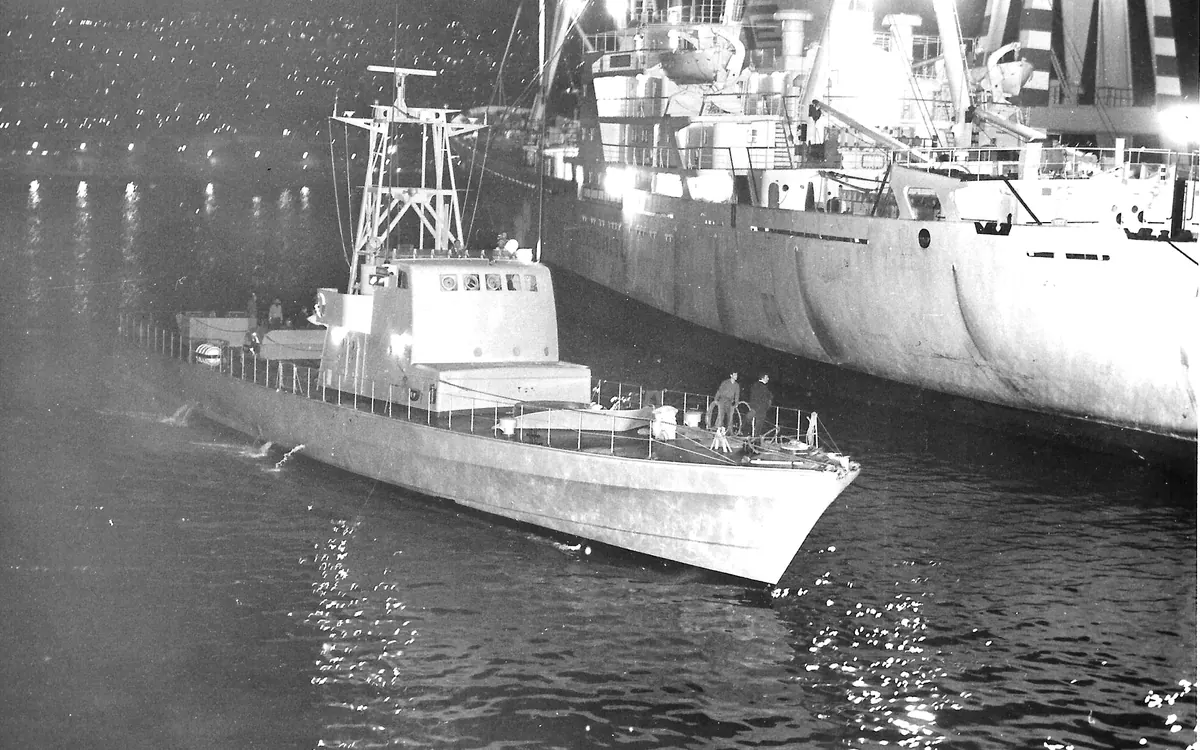
French shipwrights at Cherbourg built the platform, the Saar-class boats, funded through German war reparations, with over two hundred Israelis living quietly in the town. When the embargo threatened to trap the last seven boats, bought and paid for, Mordechai Limon slipped the first two out as a test drive, and then arranged an elegant ruse. A Norwegian magnate and a Panamanian firm only weeks old claimed to need fast boats for Alaskan oil work, and the French, eager to be rid of them, chose not to look too closely. On Christmas Eve 1969, as France celebrated and a Force Nine gale rose, Israeli crews picked for their blond appearance fired the engines and sailed through thirty-foot seas. By New Year's Eve the boats reached Haifa, and a barman's joke that the Norwegians had left for Alaska sealed a conspiracy of silence.
Key ideas
- The can-do spirit that made Zionism possible also bred a lasting neglect of strategy, a state of permanent emergency.
- Operation Gift at Beirut airport triggered de Gaulle's total arms embargo, read by many as courting Arab oil.
- Yochai Ben-Nun embodied the must-do attitude, sinking the Emir Farouk by riding an explosive boat to its target.
- Ben-Nun and Peres bet on a sea-to-sea missile mounted on small fast boats, an idea no Western navy had tried.
- Ori Eventov, a self-styled garage tinkerer, made the Gabriel fly, and the sinking of the Eilat proved him right.
- The Cherbourg boats escaped through Limon's ruse and a Christmas Eve run through a gale, reaching Haifa by New Year.
Chapters
- 0:00 The can-do nation and its hidden cost
- 2:10 A lot of bulldozers, no strategic vision
- 4:25 Demographic impossibility and the will
- 6:40 Operation Gift and the Beirut raid
- 7:48 De Gaulle's embargo
- 9:59 Oil as a strategic weapon
- 13:24 The must-do attitude
- 14:32 Yochai Ben-Nun rides the torpedo
- 16:45 The navy nobody believed in
- 19:00 Reimagining the Israeli navy
- 21:15 The Gabriel missile
- 24:33 A sea-skimming impossibility
- 27:58 The Eilat and the missile age
- 30:14 Building the boats at Cherbourg
- 37:01 The Norwegian ruse
- 40:23 Christmas Eve and the storm home
Who, where and when
People
Yochai Ben-Nun, Charles de Gaulle, Shimon Peres, Ori Eventov, Shlomo Erell, Mordechai Limon, Felix Amiot, David Ben-Gurion
Places
Cherbourg, Beirut airport, Haifa, The Bay of Biscay
Texts
Dubnow's demographic argument, Ben-Gurion on miracles, The Starboat contract
When
1948 CE: the sinking of the Emir Farouk, 1967 CE: the Eilat is sunk, 1968 CE: Operation Gift, 1969 CE: the Cherbourg escape, 1970 CE: the boats reach Haifa
Read the transcript
People who say it cannot be done, says playwright George Bernard Shaw, should not interrupt those who are doing it. And I beg of you, I'm in the midst of doing it, so please hold your peace, because I'm Rav Mike Foyer, and this is The Jewish Story. Season 4, Episode 14, Yom Kippur War Part 2, The Oaths of Sherberg. You know, before there was the startup nation, there was the can-do nation. A driving element in Zionism has always been the attitude that there's no alternative to what life serves up to you. The only relevant question is what to do with it. And in truth, we could say this of the Jewish story as a whole. Our journey down through time has been marked again and again by the most audacious situational courage and creativity and by the most cold and pragmatic of decision-making.
I point out Zionism not just because that's where we are in our story, but also because the element within the movement that is this can-do attitude serves to explain much about the society to which it gave birth. Hence, like I said, the can-do nation, a people rich in adversity, eminently adapted to the on-the-fly decision-making, bold thinking, and desperate measures, rich in adversity and short on long-term planning. There is a deeply problematic side that can emerge when one stays in the can-do mode for too long. I can do, and I'm best adapted to overcoming whatever comes, and if so, there's actually a disincentive, be it conscious or not, toward planning and strategic thought. In many ways, I could say that Israel is the world's longest state of emergency, and much of what you see wrong with our country is a product of that attitude.
I'll give you an example of what I mean. My master's thesis was designing a sustainability study for the JNF's role in water resource management in Israel, with a focus on the reservoirs they were then building on a large scale. We could talk about it sometime if you want, but for present purposes, the bulk of my research involved interviews with professionals, government reps, academics, people in the non-governmental world, etc. And the first interview I did was with the head of development arm of the KKL, Keren Kaim at Lisrael, which is the Israeli version of the Jewish National Fund, and was at the time, and I believe still is, the largest land development agency in Israel. So, thank God, I was able to get an interview with the head of the development department.
And I sat down, and my first question was, of course, tell me about your strategic vision for developing land in Israel. And his answer was, I don't have one. Now, I figured I was new in the country. My Hebrew wasn't so good. Perhaps his English wasn't so good. So I tried to explain in sort of more simple terms. And he said, no, no, I understood your question. I don't have a strategic vision. What I have is a lot of bulldozers. And when this kibbutz calls me up and asks me to do something, I do it. And when that, you know, town calls me up and asks me to do something, I do it. And this attitude followed me throughout the process of my research. I found that while one hand built, the other one destroyed, and there was no head between them that was thinking about whether this was a good idea or not.
Now, this is more than laxity, or even an overwhelming case of getting stuck in the urgent versus important trap, although I have to say that's a real factor. as a sign, that urgent important trap, if it sounds familiar, is something that I work with a lot of my counseling clients on. If you want to try to get a grip on doing what's important in your life and not just what's in your face, shoot me an email at robmikefoyer.com. We'll make an appointment. Meanwhile, the extent of the challenges faced in reviving the Jewish National Project, the scale and number of the hurdles, which had to be cleared in order to even think about re-embodying as a people in our land, basically made the very idea of long-term planning laughable from the outset, at least in the eyes of most.
In the opening stages of this crazy project in which we live, only the will to move forward and solve whatever problem presented itself in the immediate was a viable strategy, because the plan and calculate would have been to give up before we ever started. No less a personality than Simon Dubnow, famed historian, an advocate of national autonomy for the Jews, put it this way in response to Herzl's dream right around the turn of the 20th century. He said even if a thousand Jews a year moved to Palestine, a number which he felt, by the way, was absurdly high, the number would only reach half a million by the year 2000. You can do the math. That would leave, he said, the problems of the vast majority of world Jewry unaddressed and in his eyes made Zionism an immoral solution to the Jewish question.
There were professors of statistics at the Hebrew University who preached a similar doctrine of what they called demographic impossibility to Ben-Gurion when he was trying to decide whether declared independence or not. They said that there would never be enough Jews here to make a viable state. Mind you, we're pushing 7 million only 70 years later, of course. And then there was the tripling of the population, fighting three wars against the combined Arab states, the need to forge a common national identity amongst immigrants from places as far-flung as Brooklyn, Warsaw, and Baghdad, now you can get a little bit more of a sense of what a state of emergency really looks like. This forward momentum, sometimes reckless in its enthusiasm, that allowed Zionism, and indeed, like I said, the whole Jewish story to succeed against all odds, is perhaps best expressed by Ben-Gurion himself when he said, in Israel, in order to be a realist, you must believe in miracles.
it's a powerful stance and one which has served us well but not without cost because remember before Ben-Gurion ever uttered those famous words our sages said we don't rely on miracles the fantastic success which Zionism in particular was able to achieve through this can-do attitude the ad hoc approach to life meant that then and now major issues which require foresight, strategic planning, and a constant consideration remain unaddressed. And when the fighting finally breaks out in the Yom Kippur War in our story, we'll see the disastrous results of this lack of strategic vision and the reliance upon the fact that whatever comes, we'll deal with it. We'll also witness the saving power of individuals who've been trained to believe that they can do anything, provided that the need is great enough.
So our goal is still building context at this point, both for the surprise as well as the victory in the war to come. Right now, I want to tell a tale that does just that. And also, frankly, some stories just need to be told. On December 28, 1968, three Israeli helicopters touched down at the Beirut airport. This was no friendly visit, because as soon as the birds hit the runway, commandos poured out and proceeded to destroy every plane within reach. The retaliatory raid was in response to several PFLP attacks on El Al planes in the preceding months, dubbed Operation Gift. It was part of Israel's ongoing war with the terror organization that we discussed back in Episode 11. When the explosion ceased, there were, thank God, no injuries, but 13 commercial planes lay smoking on the runway, including several in which the French government had a significant financial interest.
I said no injuries, but there was one major casualty of the attack, diplomatic relations between Israel and France. The first warning came at the President Charles de Gaulle's traditional New Year's reception, which took place in the Lise Palace, I'm sure I said that wrong, only a few days later. When President de Gaulle stepped forward to greet the entire diplomatic corps assembled for the occasion, he deviated from the power of Diplo-Speak, which traditionally marked the occasion, and instead chose to rebuke Israel before the assembled ambassadors, condemning, quote, exaggerated violent acts like those that were just committed by a regular army of a nation on the civilian airport of a peaceful country and traditional friend of France.
I can only imagine the look on Israeli Ambassador Walter Eitan's face. Five days later, Eitan got the really bad news. France had placed an embargo on all arms shipments to Israel. Now, truth be told, de Gaulle had been backing away from France's role as Israel's arms supplier for some time. You may recall that he froze delivery of 50 Mirage fighters to Israel in June of 1967, right before war broke out, planes which were already bought and paid for. That was the move that drove Israeli Prime Minister Eshkol to plead with President Johnson for American phantom fighters on the visit that we discussed back in Episode 8. But that was a symbolic act compared to this embargo. Throughout the mid-60s, France had continued to supply nearly three-quarters of Israel's arms need.
And now she was declaring a ban that was comprehensive in its scope. planes, spare parts, guns, ammunitions, even naval equipment, a significant detail as we'll see. A public statement by the French Foreign Ministry called the measure a warning in view of Israel's aggressive acts, especially the recent raid on the Beirut International Airport, which it said threatened to enlarge the area of the conflict. But the Israeli government didn't see this as a warning shot. It was a real blow, one with the potential to impair her defensive capabilities, and thus with mortal implication. Many voices in the Israeli establishment felt that de Gaulle's decision was less about cooling the conflict and more about heating his country, meaning courting the Arab countries which supplied one-third of her oil consumption.
And that's also part of the context of the coming war, which is worth putting a finger on. There's nothing new to our story about oil as a strategic resource. I mean, since World War I, we've watched the colonial powers jockey for control of these riches of the Middle East. and the process really took off after World War II. You may remember that we spoke back in Season 3, Episode 29 about the intersection between Middle Eastern oil in the Cold War and America's oil denial policy that bespoke their determination to prevent the Soviet Union from accessing Middle Eastern oil at all costs, even at the cost of deadening oil fields with nuclear weapons. Now, the stakes have only risen since then. In 1971, oil will supply 41% of the world's energy, and nearly half of its production will flow from the Middle East.
And that means the Arab nations have a potential oil denial strategy of their own We see what happens to the economies of the world when they decide to shut the taps as part of the Yom Kippur War But for the present the French calculus was far more simple, how to gain their favor by throwing Israel to their mercy. There were sympathetic voices within the French administration which cried foul. One observed that Francis Stan now, quote, approaches open enmity toward Israel and in turn encourages enmity by the Arab states. But no matter what the cause, it was clear to Israel that their French patron had switched sides, a move that provoked as much defiance as fear, as the Daily Haarist newspaper declared, we will never forget de Gaulle's hostile intention to make us surrender, but we will not surrender.
And one can imagine the implication of the French surrender in World War II was being directly referenced. Now, before we get too hasty and pass moral judgment on the French, Let's just remember that such are the vicissitudes of international patronage. Client states are interests, not friends, and therefore always expendable on some level. And Israel knew this well. Ever since Herzl and the birth of political Zionism, the quest for national rebirth has been bound up with a need, be it real or perceived, for the backing of a world power. And since the post-World War I heyday of the Anglo-Zionist alliance, we've been following the story of how these world powers have both pushed the Jewish National Project forward and sought to hold it back.
By 1969, the Israeli leadership was no newcomer to this patronage dance. That's why they knew better than to keep their eggs in one basket. And if you're going to bow to the realities of what it means to be a client state, you should diversify your patrons, thus the American Phantom deal. But there are other defining streams and stances within Zionism. In particular, there's one that always rejected a reliance on any outside power, indeed, on any limitation altogether. It was the stance which held that, if you will it, it is no dream. A stance that drew life out of rocky hillsides, turned swamps into farmland, and made the desert bloom, which defied the powers of the world by declaring independence and proceeded to build an army from scratch while simultaneously fighting a multi-front war.
This is way beyond a can-do attitude. This is the must-do attitude, which allowed the Jewish National Project to accomplish downright miracles. Or it requires, at least in my experience, for this core element of our story to emerge, is for someone to throw up a high enough barrier that anyone who stopped and thought about it would say, can't be done. And then you'll see what can be accomplished by a people who simply stop in the face of nothing. And this French embargo would prove to be just such a chrysituni, as our friend Homer might say. Yochai Ben-Nun was a true hero of Israel, a literal embodiment of this can-do attitude of which we've been speaking. the one that sees obstacles as opportunities and will stop at nothing to achieve its mission.
He was born in Haifa in 1924 to pioneers of the first Aliyah, and he spent his childhood in Jerusalem, although he wasn't actually there for so long, because already by age 16, Ben-Nun had joined the Haganah, and a year later became a member of its striking arm, the Pal-Mach. Over the next three years, Yochai rose to the rank of squad leader, until in 1944 he was encouraged by his commander to join the Pal-Yam, the Sea Corps of the Palmach, where he quickly gained the reputation of a daring sea commando. With the outbreak of the war independence, Ben-Nun became the founder of Sheyetet Shlochesrei, the storied commando unit within the newly commissioned Israeli navy. Now that's not to say that he was just bumped up the ranks and relegated to making bureaucratic decisions and pushing ideas through a new naval administration.
That role would come, but only later. During the war, he founded Shayet Etshlochisrei by personally sinking the flagship of the Egyptian navy, the Emir Farouk. The Farouk was too powerful and well-protected to destroy by conventional means, and so it was decided that the weapon of choice would be what's called an above-water torpedo, basically a small boat packed with explosives that could be unleashed on the large sloop. The only catch is that being a boat rather than an actual torpedo, It was inevitable that lookouts aboard the Farukh would spot the weapon in time to evade it. What was needed was a volunteer who could sit astride this kamikaze boat and guide it home to its target. And that's where Yochai Ben Nun came in.
Can you imagine the courage it takes to ride a torpedo to within 100 meters of a heavily armed ship and then jump off into the water just in time to avoid the impact? Not only did the successful attack Earn Ben Nun, the Hero of Israel, decoration, the country's highest honor, it set him on track, which made him commander of the Navy by 1960. Now, that sounds a lot more impressive than perhaps it actually was. Israel's Navy had its origins in two things. The daring do of men like Ben Nun, who brought the attitude and methods of underground fighters to the sea, and a bunch of, let's just say, recommissioned hand-me-downs. Boats received from the British, the French, and the Americans, mostly World War II era ships, which were less than stellar in their performance.
You know, the one branch of Israel's armed forces which didn't share in the glory of the Six-Day War was the Navy. By and large, the Navy saw no meaningful action in 67, with the notable exception of their infamous mistaken strike on the USS Liberty. After the war, things only went from bad to worse. we spoke about the disastrous sinking of the destroyer lot back in Episode 8. And we haven't mentioned the disappearance of the submarine Dakar with all hands aboard only a few months later in early 1968, a tragedy which is shrouded in mystery to this day. When you compare this to the stunning performance of the Air Force and the Armored Corps in 67, you can understand why the inclination of the general staff of the IDF was to shrink the already meager budget of the Navy, basically relegating it to the role of a glorified Coast Guard.
Nonetheless, we will see that in the coming Yom Kippur War it will be the Navy that's the one branch of the armed services which proves ready for battle and in fact performs beyond all expectations. Part of that turnaround is what I like to think of as the advantage of failure. It's often missed, by the way, how dangerous it can be to succeed time after time. Put it this way, after the Six-Day War, the Air Force and the tanks were convinced that a singled armored battalion backed by one fighter squadron could defeat the combined armies of the Arab world in the space of one day, probably with an arm behind their back. And when the fighting actually breaks out in 73, we'll see the catastrophic results of such self-reliant arrogance, the failures in planning and execution it promotes, and the shock and inability to even accept the reality on the battlefield within the first days of war.
The Navy, on the other hand, had no such illusions. Truth be told, since well before even the Six-Day War, it was obvious to all concerned that Israel's naval forces required a serious overhaul. In 1960, Yochai Ben-Nun, now Rear Admiral Ben-Nun, assumed command of Israel's Navy, and one of his first acts was to gather his staff, along with all his flotilla commanders, to his headquarters at Stella Maris on Mount Kamau above the Haifa port. With a breadth of vision and a courageous willingness to reject all orthodoxies, a combination that really defines this part of our story, he asked the assembled officers to reimagine the Israeli Navy. Now, you can only imagine the conversation. Beef up the surface fleet by purchasing the best destroyers, said some.
Abandon the surface altogether and invest in more submarines, cried others. Some even lobbied for getting rid of their boats and forming an all-commando navy that could destroy the Arab forces before they ever left port. And then, someone voiced the most absurd ideal at all. It was known to the assembled officers that Raphael, Israel's highly secretive authority for weapons development, was working on a guided missile, which they called the Luz. Now, what if the weapon could be adapted for sea-to-sea use? And, considering that to buy new cruisers to use as missile boats was too costly and too much of a risk if all men went down aboard, what if rather than mounting such a missile on a big boat, it was installed on a small, fast attack boat?
For the price of two ships to the line, Israel could have two whole task forces, one each for the Syrian and Egyptian waters, staffed with boats that packed a missile-sized punch. It was too good to be true. And in fact, the idea was dismissed by most present as a futuristic fantasy. No Western Navy had a sea-to-sea missile or small boats from which to launch it. How could tiny Israel possibly hope to do what the world powers had not? Nonetheless, in the coming months, the idea of a small boat-big punch combo would not die. Fantastic as it might seem, it also appeared to be the perfect solution to the Navy's needs. And with an insight that eluded even the American Navy, Admiral Bin Nun decided that the missile era had arrived, even if no one could see it yet.
He assigned his deputy, Captain Shlomo Arrow, to assemble a think tank of senior naval officers. Their task was to develop a guided missile and a new naval platform from which to launch it. In other words, Arrow and his team of Israeli naval specialists were going to take the Israeli Navy on a voyage to where no ship had gone before. In 1962, the Soviet Union began supplying Comar-class ships to its Warsaw Pact allies and client states like Egypt, boats that were equipped with the brand new STIX C-to-C guided missile. And suddenly, Admiral Ben Noon knew that the clock was ticking. The fantasy of naval missile warfare was about to become a grim reality. He went to the Deputy Defense Minister, Shuman Perez, and explained that the Navy could no longer live on floating hand-me-downs.
Bendun laid out his radical vision of small, fast missile boats and, expecting to have to fight to convince Perez of such an absurd idea, was shocked when the response was, you have my blessing and you'll get the money. From here, our story begins to unfold on parallel tracks. Let's start with the Gabriel missile. Before 1967, Israel saw herself as a small country, resource poor, surrounded and heavily outgunned. And it was a perception that drove an almost manic devotion to technological development which was aimed to offset the quantitative deficit with a qualitative edge something which defines the Israeli military as well as our economy to this day Only the Navy. Israeli scientists at Rafael, as I said, have been working on a guided missile since 1954, but from the outset, the Army saw it as an overly expensive version of traditional artillery, while the Air Force views it as a poor substitute for a fighter plane, and that at best, only the Navy, ever the poor stepchild of the military, found the project of interest.
But things didn't really take off, pun intended, until at the invitation of Captain Shlomo Errol, young engineer Ori Eventov left Rafael's project and took his ideas about how to make the missile fly to the newly formed IAI, the Israel Aircraft Industry. Eventov was also Jerusalem-born, and had served as a commander in the battle for the city in 1948. In 1952, he traveled to the U.S. to pursue his education, graduating from Colombia, receiving an engineering degree from Drexel University as well. After a decade, he came back to Israel and was put to work at Raphael, working on the guidance system for the missile project. Now, Eventov was an Israeli tipus, a classic type. brilliant, but independent-minded to the point of being a crank.
He held most of Raphael's top scientists in contempt because he believed that their preference for complicated solutions over simple ones was really a desire to publish theory papers in international journals rather than to solve real problems in the world. His colleagues in turn called him a garage nick, meaning that he was a dirty-handed tinkerer rather than a real scientist. Though they intended it as an insult, it was a title that Evento embraced with pride. In his eyes, the real progress in life was found in meeting head-on whatever reality dealt with you, not some theoretical question. Evan Tove told Captain Errol that in his eyes, it would take five years and maybe five million dollars to turn the idea of a missile into a reality.
And despite the risk, both the Navy and the Defense Ministry got on board. Now, in general, the military had a preference for using its limited funds on proven weapons that they could purchase abroad. But Deputy Defense Minister Peres also understood the situation I outlined before, that Israel's political isolation and its poverty and resource demanded the development of a domestic military industry. And this missile represented the cutting edge. So Ori Evento got his approval and his money. Now all he had to do was make his project fly. The next few years of development were marked by an approach that was one part chutzpah and one part blissful ignorance and a third part absolute genius, as well as repeated failures.
His vision was of a sea-skimming missile, one which would fly just a few meters above the water's surface. That would make it difficult for the enemy to spot and therefore evade or shoot down, and would mean it struck right near the waterline, increasing its destructive potential. It was a brilliant idea. The only problem was nothing like it had ever been created before. The Russians, who are currently the only country in the world producing C-to-C missiles and frankly leading in the technology in general, had gone with the classic ballistic model. Early on in the project, Paris sent Oriyevitov to France in order to meet with some senior engineers at three different aeronautical plants. He wanted to get their opinion on the feasibility of building such a weapon.
Two came back with total confidence of its impossibility. The third was hardly more encouraging. I believe it can work, he said, but it won't take five years and $5 million as you estimate. It would be more like 20 years and $50 million. Nonetheless, Perez authorized him to continue. For months, years, Eventoad played with altimeters and radars, struggling to find a combination that would send his missile home rather than plunging into the sea as it did in test after test after test. One turning point came when he installed stationary antennas projecting from the sides of the missile in place of Raphael's original rotating antenna. It was a solution that only a Garajnik would try. It didn't exist in any book, and any radar expert would have assured him that it was a mathematical impossibility, except, fortunately, he didn't bother to ask any, because it actually worked.
If this sense of doing the impossible was a hallmark of the project, so was an unbelievable level of commitment. In 1964, Yom Kippur was the only day on which Evan Tov's team didn't assemble, and even then, he and a few key guys still showed up to work. Work days ran to 14 hours. Individual health and even marriages collapsed under the strain. At one point, a member of his team solved a particularly difficult machining problem by indulging in his own personal act of industrial espionage on a tour of several European defense plants. In short, there was nothing which would stand in the way of Eventov and his team's determination to do something which everyone said could not be done. By 1966, Yochai Ben-Nun had retired from the Navy, and Captain Shlomo Ero was now Admiral Shlomo Ero, commander of the naval forces.
From this high position, he continued to push the project, now dubbed the Gabriel Missile, and took to outlining his vision of a missile navy to anyone within the Israeli military and political leadership who would lend an ear. When, in October of 1967, the Eilat became the first ship in the history of naval warfare to be sunk by a sea-to-sea missile, The whole establishment realized that Ben-Nun and Errol hadn't been chasing a fantasy, but had simply recognized a new reality before anyone around them had eyes yet to see. Unfortunately, Errol's career was also a casualty of the sinking of Eilat, and so he wasn't among the members of the general staff who assembled to witness the first live fire test, Ori Eventove's deadly toy.
Eventov held his breath as the white firing pod, secured to the deck of a new Tsar-class ship, popped open to reveal the cone of a missile. Several kilometers away, the destroyer Jaffa lay anchored at sea. Only a few months ago it had been Israel's flagship. Now it stood empty, waiting through its destruction to usher in a new era for the Israeli navy. As Eventov watched, there was a spurt of flame, and the missile shot upwards. It arced over, dove toward the sea, and then leveled out. Half a minute later, there was a flash aboard the destroyer, and the sound of an explosion rolled across the water. A second missile lifted off the Haifa and impacted the Jaffa as well. As the destroyer sank beneath the surface, it carried with it the entire past of naval warfare, whether the world knew it yet or not.
Israel was now the first Western Navy to enter the Missile Age, and as Errol would say, they'd done so because their ignorance and lack of tradition, and I would add chutzpah, had led them to embark on an undertaking that more experienced navies would have judged to be impossible and thus never started. And it's on that note of chutzpah that I want to add the parallel track and end to our story. By 1967, the dream of a navy built on fast patrol boats that would pack a missile punch strong enough to sink any ship in the Mediterranean was well on its way to a reality. While Ori Eventov and his team were tackling the weapons side of the equation, French shipwrights were building a naval platform worthy of his efforts.
In the mid-60s, it was only natural that Israel turned to the French, who were still supplying three-quarters of her arms, and they seemed to be the right address for the construction of these boats. But before you could start building, then Captain Schlomo Errol needed a design and the money to fund it. And in a twist of historic fate, both came from Germany. As Errol searched for an existent boat that could meet the Navy's needs, he found that Germany was already producing a light torpedo boat, dubbed the Jaguar, which itself was a descendant of the Schnellboats that had harassed Allied shipping in the North Sea during World War II. He then got Deputy Defense Minister Peres to devote a portion of the German war preparations that Israel was receiving toward paying for the construction of 12 boats.
Errol took his plans, and the money, to Cherbourg, a port and shipboard on France's northern coast. And within a few months, over 200 Israelis were living and working in the town. Many of them were actually French speakers, often born in what were until recently the French provinces of Algeria, Tunisia, and Morocco. The goal was to fit smoothly into their surroundings, to make as few waves as possible and to get the job done. And that quickly. When Errol had first explained what he required to the German engineers who drew up the plans, what he was now calling a SAR-class boat, a range of 1,000 miles, top speed of at least 40 knots, anti-sub torpedoes, rapid-fire guns, sonar, radar, advanced communication systems, not to mention, of course, the undisclosed missile project, the head of their technical division had replied, Ja, ja, very interesting, Captain.
But tell me, don't you want a grand piano on this boat too? And by 1967, Errol had gotten almost everything he wanted, excepting, of course, the piano. It would also be the world's most advanced electronic warfare system. The race of yet another Israeli team to invent a missile defense so advanced that its first use would astound the navies of the world is a story for another episode. For now, the first five boats of the Tsar class were delivered to Israel just before the Six-Day War broke out. Too late to be armed for the war effort, but offering the Navy hopes for a bright future nonetheless. However, with the sinking of the A-Lot only a few months later, that bright future took on a darker aspect.
Construction continued at a furious pace, but at the beginning of 1969, it seemed that international politics might prevent the boats from ever making it home to port. De Gaulle's announcement that we mentioned, this total embargo, placed in the wake of Israel's attack on the Beirut airport, seemed to freeze the Sherwood project, along with every other military purchase, despite the fact that the boats were bought and paid for. After all, that hadn't stopped De Gaulle from holding back a shipment of Mirage fighters just before the Six-Day War. Mordecai Limon was head of the Israeli military purchasing mission in Paris, as well as former commander of Israel's navy, and his extensive contacts made it clear to him that despite the fact that few people outside of the Cherbourg shipyard were even aware of the project, de Gaulle's wrath could easily extend to those boats.
And his naval experience told him just how critical it was that the remaining seven vessels make it to port. Getting the first two was actually simply a matter of telling the French they were off for a test drive. Lehman called Captain Hadar Kimchi head of the Israeli naval mission in Cherbourg and in as indirect a fashion as possible for fear he might be under surveillance let him know that it would be good to get those two boats seaworthy and out of port for a little vacation as soon as possible. And it really was that easy for the first two. The Israeli crews spent a few hours readying the ships, and when all was set, simply raised the flag and set off. No one even challenged them. Back in Paris, Mordecai Limon was not as fortunate.
The French minister of defense himself called, demanding to know what had become of the ships. Limon's reply was quite straightforward. They were given orders to sail to Haifa. They belong to us. When word of the escape reached President de Gaulle and his cabinet, they were furious. Only a few days after its announcement, the embargo had been severely breached. And you know they say that poop rolls downhill? This angry mess was coming from the top, so by the time it reached Cherbourg, it had quite a bit of momentum. But somehow it came to a full stop at the port, where the locals were far more sympathetic to Israel in general, as well as grateful for the economic boost that the project had brought to the little shipping town.
Naval authorities claimed that the first they'd heard of the embargo was in a letter of instructions received on January 6th, two days after the boats had left. They even had documents and a statement from the post office to support their claims, a rather fishy thing to produce. Someone, something must have gone wrong with the post, they apologize. C'est la vie. The customs officials, who were responsible for approving the export of the boats as merchandise rather than military goods, simply shrugged their shoulders, professing ignorance of any embargo altogether. By an extraordinary coincidence, it turned out that not one of them had read a newspaper, watched television, or listened to a radio during the entire preceding week.
As the months passed and the arguments simmered between the government in Paris and the authorities in Cherbourg, construction continued on the last five missile boats as if nothing had happened. At least, almost nothing. The naval and customs authorities were bothered by the accusations of negligence and so kept a much sharper eye on these last remaining boats as they came together. Desperate to take possession, Limon proposed a commando-style snatch-and-run operation to get the boats. All you have to do, he said, is infiltrate the crews into the port and make their escape when all hands are aboard. But when Defense Minister Moshe Dayan relayed the idea to Prime Minister Golda Meir, she gave it a final no.
Golda was not about to risk losing diplomatic relations altogether with France over some boats, as she called them. Her message was clear. Whatever was done must be legal in order not to give Paris an excuse for severing their already strained relations. But of course, legal has a broad and somewhat flexible definition. By the end of the summer, the French were gratified to hear that Mordechai Limon was open to renouncing all Israeli interests in the boats in Cherbourg and beginning negotiations over compensation. But you know, such deals are slow going, and Limon quibbled, backtracked back and forth for a couple of months. Meanwhile, construction of the boats continued apace, and the Israeli team remained in Cherbourg.
In November, we're in 1969 by now, in November 1969, Felix Amiat, owner of the shipyard that was building Israeli vessels, received what he considered to be a hopeful visit. Now Amiat was a friend to the Israelis. When Admiral Yochai Ben-Nun had first visited his Paris estate years ago to propose the construction project, Amiat took he and Shimon Peres on a teary-eyed tour of the grounds of his estate, explaining how he'd hidden Jewish children there during the war. He was also a businessman, one who took a personal interest in his workers and their community, not to mention that he stood to lose a good bit of money if this deal went sour. With all that in mind, it should come as no surprise that when Martin Seem came to visit, Ammiat received him well.
Now, Seem was a Norwegian shipping magnate, and he said that he was involved in oil exploration off the coast of Alaska on behalf of a company based in Panama. It turned out, in order to do such exploration, he needed five boats for assistance in this offshore work. Boats that needed to be fast, capable of handling strong seas, carrying heavy loads, and if it were possible to arm them, well, that's never a bad thing, is it? And most importantly, he needed them right now. Felix Amel was overjoyed. He contacted the French Ministry of Defense and told them that if the Israelis could be persuaded to drop their claims to the boat and accept compensation, he might have an elegant solution to what was becoming an increasingly awkward situation for many people.
Now, if this sounds a bit fishy to you, then good, you're listening. Seams was indeed a major Norwegian ship owner, but Starboat, the Panamanian-based firm he claimed was doing offshore oil exploration in Alaska, was only a few weeks old. What happened was this. Seams had been approached only a month before by an old friend, the Israeli shipping mogul Mila Brenner, who asked Seams to work as a frontman on behalf of the Israeli Navy. And so, when Morhae Limon received a call from the French Ministry of Defense proposing that Israel drop its claims to the ships in return for full compensation, he was hardly surprised. Nonetheless, he acted surprised, and he put up a fight, and in the end, the French Ministry was convinced not only that the sale was their idea, but they'd strong arm the Israelis into accepting it.
After all, what other choice do they have? You may be wondering how anyone could fall for such a paper-thin disguise. A Norwegian ship owner buying missile boats on behalf of a Panamanian company to use for offshore oil drilling in Alaska? The answer seems to be that it's likely that all along the line there were people empathetic to Israel and certainly that the French ministerial committee assigned to examine all French armed exports must have contained at least one or more who were truly sympathetic to Israel and willing to help her get those boats. Furthermore, in general, the French were as eager to get rid of the boats as the Israelis were to receive them. It wasn't in anyone's interest to look too closely at the sail.
After all, the contract affirmed that the boats could not be re-exported, which meant they couldn't find their way into Israeli hands, right? Now from here, our story moves rapidly to its close, although not without some drama for the sailors involved. The plan was to take the boats on Christmas Eve, obviously not to Alaska, Panama, or Norway. And when all of France was celebrating, it seemed unlikely that anyone would notice what was going on in the Cherbourg harbor. The crews of the so-called Norwegians began to filter into Cherbourg in the weeks before. In reality, young Israelis picked for their skills as well as their blonde-haired, blue-eyed appearance. The locals noticed that these new Norwegians, as they called them, weren't just sailors, but apparently linguists.
Such accomplished linguists, in fact, that they included Hebrew among their repertoire of languages. But no one said a word. By late afternoon on Christmas Eve, about 20 Israeli sailors were aboard each of the five boats. But a storm had come up and was working its way into what would become a Force 9 gale. Bad conditions for the largest of ships, but potentially fatal for such small missile boats. Nonetheless, they had passed the point of no return. They must sail that night. The engines were first fired up around 9 p.m., and as they pulled out of the harbor later in the dead of the night, only two men were there to see it, Mornichai Limon and Felix Amiot. Nonetheless, Amiot wasn't the only local who participated in this conspiracy of silence that allowed for you to escape.
As the roar of the engines split the night, audible even over the raging storm, a barman in a dockside cafe remarked to his customers, I see the Norwegians have left for Alaska, and the room shook with a laughter. But there was nothing amusing about the conditions that the Israelis faced on their homeward journey. As they headed down the English Channel, the wind was at their backs, and the long swells carried them forward. But when they emerged into the Bay of Biscay, the wind had come around, and they were struck by the full force of the storm. Thirty-foot waves tossed the boat like corks on the sea, and men only ventured onto the deck secured by a lifeline. Even the veteran sailors would later say it was the worst ride of their life.
By December 26, local and then international news had caught wind of the story, as did the French government soon after. But with the boats already on the high seas, there was really nothing they can do. The French foreign minister, Maurice Schumann, summoned the Israeli ambassador to his office for a dressing down. Just back from Algeria, where he'd promised friend relations and large amounts of arms, in return for Arab oil, Schumann was humiliated. and sure that the Arabs would blame the French for the escape. He warned that if the boats did show up in Israel, the consequences will be very grave indeed. But no matter how bad his bark, the French weren't really willing to bite. Oh, Defense Minister Debray actually did offer a proposal to the Prime Minister that the Air Force intercept the fleeing boats, but it was rejected out of hand.
France's honor was important, but not important enough to be restored by attacking foreign nationals in international water. The diplomatic storm turned out to be a tempest in a teacup. The Israeli government first refused to accept responsibility, then temporized, made excuses. In the end, Mordecai Limon was expelled from France, where he'd lived for seven years, but relations were not cut off. The boats were soon overshadowed by French mirages flying overhead, and later picked up by American and even Soviet observation ships. But they motored on toward Israel unimpeded. As they passed the British lighthouse at the Straits of Gibraltar, A light flashed out for them with a simple message saying, Bon voyage!
And the men on the bridges laughed at this gesture of English solidarity against the French. As the ships approached the shores of Israel, an escort of Israeli fighter planes flew overhead, and on New Year's Eve 1970, the Israeli radio reported to the public the arrival in Haifa of five newly built missile patrol boats. The dream of a missile navy was almost a reality, and these boats will indeed pack a powerful punch in the coming war. But that is a story for another time. I just want to thank a few folks. I want to thank all the folks who give their hard-earned money to help make this show happen, to keep it free and widely available. I want to invite you to join them. Go right now to my website, jewishstory.co.
In the upper right-hand corner, you'll see a button that says Be a Patron. You can click on that for a little bit of per-podcast support. Or, if you want to sponsor a show in honor of someone with you today or someone who's moved on, I'm happy to do so. So send me an email at ravmikefoyer at gmail.com or a message on Facebook. That's ravmikefoyer at Facebook. And I'll share with you the details of how you can do that. I also want to thank the Land of Israel Network. That's thelandofisrael.com for creating a platform that allows me to reach so many fantastic people. And I want to thank the Pardes Institute, P-A-R-D-E-S dot org dot I-L, building an educational institution that gives me the privilege of teaching so many Jews.
And I want to thank you for listening. I'm Rav Mike Foyer, and this is The Jewish Story. Thank you.
More from Season 4
TJS S4E13 Yom Kippur War part I - the context for surprise
If we call what happened in the 1967 a war of the spirit, then what occurred seven years later was a struggle of psychology. Here is the first...
Play Episode
TJS S4 Interlude: Haggadah - interview with Mark Gerson
Telling the story of the Exodus is something so simple that we do it every year, and so complicated that we never get it quite right. With all...
Play Episode
Conversation with Yehudah HaKohen - politics, liberation and the tribes of modern Israel
Here is a raw take from a great pre-Passover holiday conversation. Apologies for the lack of polish - sometimes this holy day takes all you've got! Join Rav...
Play Episode