
TJS S4E20 The domestic aftermath
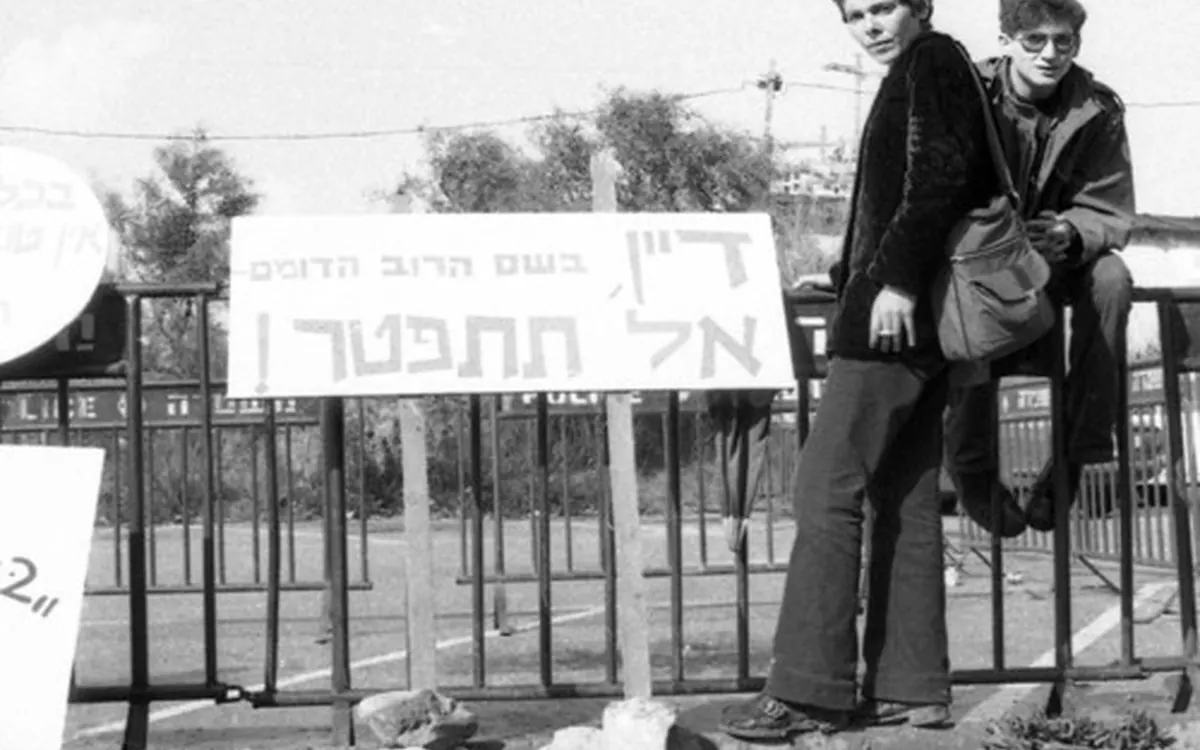
The shock waves of the Yom Kippur War ripple through Israeli society down to our day, but the days immediately after tell a story all their own. This episode explores the rise of Israel's first protest movement around Motti Ashkenazi, the first cracks of the Labor government under Prime Minister Golda Meir and the formation of the Likud at the hands of Ariel Sharon. All of these combine to make up the domestic aftermath of the war.
photo from: ארכיון דן הדני
About this episode
You cannot escape the responsibility of tomorrow by evading it today, said Abraham Lincoln. If one word describes Israeli society after the Yom Kippur War it is demoralized. The Egyptians and Syrians had been stopped, yet 2,500 soldiers had died, masses of men still stood entangled in the field, and the mourning could not begin. Now the held-back question pressed in: how had Israel come to be so vulnerable, and the easy answer was that the leadership had failed the people and forced the people to save the nation. Demoralization, Rav Mike notes, is a loss of morale that flows from the destruction of its moral roots, and in that sense the war opened the postmodern era in Israel. The myth of austere leadership faded, as did the myth of an invincible IDF, though historians rate the war a greater achievement than 1967.
Days after the ceasefire, correspondent Charles Mohr flew to New York carrying by hand an interview with Ariel Sharon, smuggled past the military censor. It carried scathing criticism of the war's conduct and the narrative foundations of Sharon's rising legend, the general gripping a cigar like a baton, offering smoked oysters and cognac in his desert trailer. Sharon claimed the politicians' fear of international pressure had robbed the IDF of real victory, and his off-record calls to remove the chief of staff led General Gonen to seek a court-martial, a move that backfired when Dayan removed Gonen instead. Mohr understood that Sharon's combat was already political, aimed at reshaping the electoral field. Having left the army in July, Sharon had joined the Liberals within Gahal and set out to consolidate the whole right.
Sharon's push bore fruit as Likud, a true consolidation of the democratic right, though Begin's Herut remained the senior partner and set the goals. Sharon and Begin shared a backstory, since Sharon's grandfather had been best friends with Begin's father and his grandmother had served as the midwife who birthed baby Menachem. Meanwhile public pressure forced Golda Meir's cabinet to appoint a judicial commission into the failures of the first days, and on the very day its mandate was settled, November 18th, 1973, David Ben-Gurion suffered his fatal stroke, an echo of the divine voice. The commission fell to Shimon Agranat, the Chief Justice born in Louisville, Kentucky, a champion of free speech who had nonetheless barred the Arab Al-Ard party from the ballot. He chose Landau, Nebenzahl, Yadin and Laskov, and Rav Mike hears in their task a parallel to the prophets who checked the power of kings.
Golda Meir had told Oriana Fallaci in 1972 that she was old and exhausted and would retire by October 1973, yet when the delayed election came she ran as usual. The country faced tripled defense spending, inflation nearing twenty percent, and a war that cost nearly a year's gross national product. In the first debate Begin, free of the war's taint and looking prophetic, laid the 2,500 deaths at the prime minister's feet and begged her, as a father and grandfather, to go now. Go she did not, and she positioned Labor as the party of peace against a Likud painted as hungry for war. Labor emerged largest with 51 seats, down from 56, while Likud leapt to 39, and a quiet shift of Mizrahi voters away from the left foreshadowed the revolution of 1977.
Real change needed a leader, and it came in Captain Moti Ashkenazi, commander of the one Barlev outpost that never fell, who went straight from the front to a 48-hour hunger strike in the cold Jerusalem rain, calling for Dayan's resignation. His movement, Israel Shelanu, drew thousands and named the deeper wound, that the government and the people lived on different planets. On April 1st, 1974, the Agranat Commission issued its interim report, placing blame squarely on the military command while ruling the question of ministerial responsibility a political matter for the people to judge. The public, enraged that the cabinet seemed absolved while the generals fell, turned its wrath on the leadership, and within weeks Golda Meir resigned. Rav Mike closes on her Yom Kippur letter to bereaved families, written before 2,500 more joined the dead.
Key ideas
- Demoralization is the loss of morale that follows the destruction of its moral roots, and the Yom Kippur War opened Israel's postmodern era.
- Charles Mohr smuggled out Sharon's interview, a scathing critique that helped build the general's legend and his political war.
- Sharon consolidated the right into Likud, drawing on a family backstory that linked his grandparents to Menachem Begin.
- The Agranat Commission was born the day Ben-Gurion fell, and Rav Mike hears in it the prophetic role of checking the power of kings.
- Golda Meir ran as usual despite her promise to Fallaci, and Labor won but lost ground as Mizrahi voters began drifting rightward.
- Moti Ashkenazi's hunger strike and the Agranat interim report turned public wrath into Golda Meir's resignation.
Chapters
- 0:00 Demoralization; the loss of moral roots
- 2:14 The postmodern era begins in Israel
- 4:25 Smuggling the Sharon interview abroad
- 6:37 The making of the Sharon legend
- 8:58 Sharon turns right; the birth of Likud
- 12:34 Sharon and Begin; an old backstory
- 16:58 The Agranat Commission; Ben-Gurion dies
- 18:03 Agranat of Louisville; Israel v. Al-Ard
- 20:21 Choosing the commission; the prophetic check
- 23:42 Golda's promise to Fallaci
- 25:59 A campaign as business as usual
- 28:09 Begin's please go now
- 31:28 Labor wins but pays a price
- 33:58 Moti Ashkenazi's hunger strike
- 39:32 The interim report; Golda resigns
- 42:47 The letter to the bereaved families
Who, where and when
People
Ariel Sharon, Menachem Begin, Golda Meir, Moshe Dayan, Shimon Agranat, David Ben-Gurion, Moti Ashkenazi, Charles Mohr, Oriana Fallaci
Places
Lod Airport, The Sinai front, The Suez Canal, Louisville, Kentucky, Jerusalem, The Budapest outpost
Texts
The Charles Mohr interview, The Agranat Commission report, Israel v. Al-Ard, The Fallaci interview
When
October 1973 CE: the 8th Knesset election delayed, November 1973 CE: Ben-Gurion's stroke, December 1973 CE: the election, April 1974 CE: the Agranat interim report, April 1974 CE: Golda Meir resigns
Read the transcript
Said Abraham Lincoln, you cannot escape the responsibility of tomorrow by evading it today. Well, there's a whole lot of things that we're all responsible for, and I'm not looking to evade a one of them. I'm Rav Mike Foyer, and this is The Jewish Story. Season 4, Episode 20, The Domestic Aftermath You know, if I had to use one word to describe the state of Israeli society in the wake of the Yom Kippur War, I might choose demoralized. I mean, the Egyptians and the Syrians had been stopped, but 2,500 Israeli soldiers had sacrificed their lives to stem the tide. The fighting was over, but massive numbers of Israeli forces still remained in the field, entangled in often precarious positions with both the Egyptian and Syrian lines.
Beyond the standing army, thousands of reservists would remain mobilized until well into 1974, and the economic cost paled in comparison to the fact that sons, husbands, brothers had not yet returned home, and therefore the mourning couldn't really begin. Furthermore, now that the sense of mortal danger had passed, the question of how did it come to be in the first place that Israel had found itself in such a vulnerable position, a question that had been held back by the necessities of war, began to feel pressing. And for most, an easy answer wasn't too hard to find. This was a war in which the national leadership had failed the people and forced the people to save the nation. Now, demoralization is an interesting concept.
Because if I asked you what exactly it was, or more precisely, how it looks, I think that most people would give the first order answer of lack of motivation, a sense of despair, that kind of thing. But if we take a slightly deeper look and pause for reflection, I think that many of us will see what is actually apparent in the simple word. Demoralization is a loss of morale that flows from the destruction of the moral roots, which, consciously or not, had anchored it. And in that sense, I might call the Yom Kippur War the beginning of the post-modern era in Israel. Many of the narratives that had given so much of the strength to the nation in its first few decades wouldn't survive the national cheshbon nethesh, the personal accounting that flows from the war.
The ideal of austere, morally pure leadership was really the first to go. There is no more David Ben-Gurion doing handstands on the beach, living out his days in a simple kibbutz bungalow. Now we have general politicians with travel expenses and accounts and fancy cars. And with that image will fade a belief in visionary and ideologically motivated leadership. The sense of a political rot is on the rise. Also gone will be the myth of the invincibility of the IDF. Despite the fact that the Yom Kyi War is seen by most military historians to be a far greater achievement than the victory of 1967, that's not how it felt in the winter of 73-74, and it isn't how the war is perceived today by most. This was a war in which fathers and sons fought together, and sometimes neither came home.
And that gave little sense of strength, even in victory. There's much more to be explored about what sense of morality was actually lost, which narratives collapsed and left in their wake this sense of demoralization. And that, in fact, is going to be a big part of our story for the coming couple of decades. For right now, I want to focus on the immediate political impact, the way in which the Yom Kippur War transformed Israeli domestic politics. Because elections for the 8th Knesset had been scheduled for October 31st, 1973, and the campaign season actually was well underway when the Egyptian and Syrian armies struck. I can't help but wonder how the soldiers returning from the front at the end of October, rather than heading for the ballot box as they were originally intended to, viewed the naively optimistic labor alignment posters, which still hung from every kiosk and bus stop, and read, There is peace on the banks of the canal, in the Sinai Desert, the Gaza Strip, the West Bank, Judea, Sumerian, on the Golan.
The lines are safe. The bridges are open. Jerusalem is united. New settlements have been established and our political position is stable. This is the result of a balanced, bold and farsighted policy. You know that only the labor alignment could have accomplished this. Well, the sense of safety along the lines is clearly gone. And with it, the feeling that the country was led by a farsighted policy. Ben-Gurion's labor coalition had ruled the nation in various iterations since well before the state was born. And at long last, there was a growing sentiment amongst the populace that perhaps the time had come for a change. Early in November 1973, not long after the war's end, Charles Moore flew out of Lodd Airport, bound for New York City.
It's really nothing exceptional. Moore was a correspondent for the New York Times and surely went back regularly to check in with his editors and just touch base with home. Nothing exceptional, except for the fact that Moore was carrying with him the copy for an article he had written only days before. It was not only unusual for an international reporter to file his copy by hand, in this case it was actually illegal. To this very day, Israel's military censor has extraordinary powers and discretion concerning publication of anything within the country which may have bearing on her national security, which meant that in 1973, considering the state of technology, the really juicy stuff had to be filed from abroad.
And what Moore had in hand was an interview he had just received from General Ariel Sharon only days before, and that means less than two weeks after the ceasefire that ended the fighting of the Yom Kippur War. It was filled with scathing criticism of the political and military leaders' conduct of a war, as well as key, let's call them, narrative foundations for the hero status that Sharon was already achieving in the popular imagination as the man who had saved the nation. Now, I say narrative foundations rather than facts because, frankly, many would dispute the veracity of some of Sharon's key claims later on. Nonetheless, when he made them, they were widely accepted. In fact, they were widely accepted by many before he made them.
And Moore's interview was a key early chapter in shaping Sharon's legend. In a sense, the opening paragraph says it all. The general who led Israeli forces across the Suez Canal says he believes that his superiors were too slow to reinforce and exploit his breakthrough, losing the chance to achieve a decisive victory over Egypt. Now, I have to say, from my study, the critique is legitimate. There may have indeed been a major chance lost through the way in which the crossing was handled. But even if we are willing to say that Arik was the driving force behind the very idea of the crossing, and in fact pushed so hard that he had to be held back by the defense minister and chief of stack from personally overrunning Africa, for truth's sake, it was actually General Bren Adan who led Israeli forces over the canal, and achieve the encirclement of the Third Army.
No matter, though, because if the New York Times printed the story as such, it must be true, right? Now, speaking of popular imagination, you can know much about a people by how they picture their heroes. And Moore's description of Sharon during their conversation is both powerful, specific, and perhaps deeply problematic. Seated in a trailer, he wrote, at the forward command post of his reserve division in the Egyptian desert and gripping a lighted cigar like a field marshal's baton. He talked over plastic cups of cognac and hot tea. He pushed forward a plate of smoked oysters, saying to his visitor with a smile, you might like these unless you insist on kosher food. Now, whatever criticisms the interview may have contained of his military superiors or Israel's political leadership, they were positively muted when you compare them to Sharon's words that he'd been throwing around off the record.
His calls for the removal of the Chief of Staff, General David Eleazar, actually led Southern Commander General Shmuel Gonan to request Sharon be brought before a court-martial. I mean, after all, Sharon was a soldier publicly criticizing his superiors in the aftermath of a war that wasn't really quite over. But, unfortunately for Gonan, his efforts at military discipline backfired, as they so often did when Arik was involved. Rather than pulling Sharon up short, Defense Minister Moshe Dayan actually removed Gonen himself from his position of southern command. Now that wasn't really because of his complaints over Sharon. Even in the midst of the war, the Defense Minister had sent former Chief of Staff Chaim Barlev down to the Sinai to, quote-unquote, assist the southern commander, meaning hold his hands and make sure he didn't blow it.
And they were among the many who held Gonen personally responsible for many of the war's early failures. But in this interview, Sharon wasn't interested in how the battle had been managed. He had things to say about the war. Speaking of the first grim hours on October 6th, Sharon told Moore, what happened to us should not have happened. And even though he expressed deep pride in the victory achieved by the men of the IDF on the battlefield, including his own accomplishments therein, of course, he was somewhat grim of his view of the war overall. I think Israel lost in several fields, Sharon asserted, the Egyptians achieved results in a full canal crossing, which I doubt they ever dreamed possible, and we suffered heavy casualties.
Secondly, for the first time since 1956, the two great powers, America and the Russians, were acting together, although from entirely different interests, and Israel found itself facing them acting together. And then Sharon labeled his most serious accusation, that politicians' fear of international pressure had robbed the IDF of a real victory. The government took it too seriously, he said. We had to examine how serious was the Russian threat to intervene and how serious was the American pressure. Had we done so, I think we would have found them not so serious. But we ended up with an unfinished, undecided war. We could have taken more risks. And this is from a man, of course, who built his life on risk.
As a result, Shrone concluded Israel, quote, Now these are political statements not really military ones And Moore understood that quite well He also recognized that Sharon combative stance in the interview was really part of a new battle he was already fighting to reshape Israel's electoral field. As he wrote, quote, the 45-year-old general's remarks are likely to stir a bitter controversy in Israel, where a grim but publicly muted debate on the conduct of the war has begun. General Sharon himself has already come under attack by opponents who attribute delays in exploiting the canal crossing to him. And then he pointed out that General Sharon had become deeply involved in Israeli politics after he left the army on July 15th and then formed the Likud, a coalition of opposition parties critical of the government of Premier Golda Meir.
He will run for parliament in December. That last bit seems like a simple point of information, but it requires more than a little bit of unpacking. Now today, anyone who's been watching Israeli politics knows Likud as the party of Prime Minister Benjamin Netanyahu. And maybe, maybe, if they've been around long enough, they remember it as Sharon's party as well, that is, before he tore it apart in conjunction with his fateful disengagement from Gaza. But you may not know that in the most literal sense, Likud was actually Sharon's baby. The process of formation began when Sharon joined the Liberal Party immediately after leaving the army in July, like Moore noted. The Liberals were at the time already part of a joint list known as Gahal, together with Menachem Begin's Cherut Party, and Sharon saw in this the potential to serve as a foundation for the unification of all the parties on the right.
Through his past with the Haganah, Sharon had tried to fit in on the political left, but he was always pushed to the margins of the politics. I mean, after all, if his own mentor, Moshe Dayan, was unwilling to appoint him chief of staff because of his, let's call it, insubordinate nature, nobody in their right mind was going to give him real political power, right? Now think about the last 15, 20 years. And so Sharon turned to the right, where anyway, he had really more than a passing connection to Menachem Begin. They had, as we call it, yichus. They had a backstory. Sharon's grandfather, Mordechai, had been best friends with Menachem Begin's own father. The two had actually busted down the door of the local synagogue when the rabbi refused to hold a memorial after the death of Theodor Herzl.
His grandmother, Miriam, actually served as the midwife who birthed baby Menachem. So there's a connection. And beyond the connection, as much as Sharon needed Begin, Begin needed Sharon as well. Now today, Menachem Begin is remembered as a prime minister of Israel. And whether one recalls him with fondness, awe, or disgust, no one questions that he was one of the most influential politicians of the post-Yom Kippur War era. But this was far from the case in 1973. When Sharon made his first entree into the political scene, Begin wasn't quite as deep in the political wilderness as he had once been, driven there, by the way, along with all of Ben-Gurion's political and underground opponents after independence.
he'd made it slightly out of the woods through the formation of Gachal that partnership between Cherut and the Liberal Party and his role as part of the unity government which led Israel through the Six-Day War and into the War of Attrition had given Begin some measure of public legitimacy but decades of demonization do not pass so quickly too much of the Israeli public was used to considering Begin as a threat to democracy to accept him in a real role of leadership quite yet. Now, on one hand, Sharon's efforts bore tremendous fruit. To Gachau, he added the rest of what was known as the democratic right in order to distinguish it from the religious right. This was Har Shima HaMachtit, or the nationalist, the free center, Merkaz HaChofshi, and the greater land of Israel movement.
And the result was Likud. And as he's saying in Hebrew, Uch Shmo Ken Hu. as its name, so it is. Likud means a consolidation or a joining together. And Sharon had succeeded in consolidating the Israeli right into a united bloc just before the elections for the 8th Knesset. Heyrut, Begin's party remained the senior partner within that bloc and it was Begin who defined the three primary goals. One, to serve as a voice for the incontestable right of the Jewish people to the land of Israel. Two, to abolish poverty. and three, to be the viable counterweight to the ruling labor alignment. And for now, the shadow of his personality would continue to hang over the new party. Sharon was appointed head of Likud's election campaign, but as we've seen, before he could really head out for an election, he had to go to war.
There were those who worried that having come straight from the electoral battlefield to the Sinai Front, Sharon might let his political aspirations cloud his military judgment. In fact, there are those who claim that he did. Whether he actually did or not, I'll leave to wiser authorities. But there is no question that once the fighting in the field was over, Sharon engaged the battle of political blame as a full-scale war. And he wasn't alone in that struggle. Public pressure to get the bottom of how such a disaster had occurred began to amount as soon as the shooting stopped, really somewhat before. At first, Prime Minister Meir simply avoided the issue. But that wasn't a viable long-term strategy.
Bowing to pressure, her cabinet was forced to order the establishment of a judicial committee of inquiry with a mandate to look into and to apportion blame for the disasters of the first three days of the war. On November 18, 1973, the Attorney General of Israel completed his consultations about the language of the mandate vesting power in a commission of inquiry into the failures of the Yom Kippur War. In a strange twist of, call it fate, or divine irony, the very same day, former Prime Minister David Ben-Gurion suffered what would prove to be a fatal cerebral hemorrhage. And his death two weeks later was almost lost in the social upheaval surrounding the aftermath of the war. Despite the fact that he died almost unnoticed, Ben-Gurion's passing marked the end of an era.
And even though it will still take a few more years until the labor Zionist political machine that he created, the one that had ruled the state and its institutions uncontested for four decades, even before it was a state, it would take a few more years, as I said, to finally crumble. I can't help thinking that his stroke and the launching of the Agranat Commission, as it was known, coming on the same day is nothing short of an echo of the divine voice. The Agrenat Commission was named for its head, Shimon Agrenat, who in 1973 was serving as Chief Justice of the Israeli Supreme Court. Agrenat's an interesting character. He was born actually in 1906 in Louisville, Kentucky of all places. He grew up in Chicago studying law there and eventually receiving his JD from the University of Chicago in 1929.
Now it's true, he thought of himself as a Chicago guy his whole life, But I can't help wondering if there wasn't something in the water of Louisville that produced jurisprudence, because after all, Agrenat and his older contemporary American Supreme Court Justice Louis Brandeis were both Jews from Louisville, of all places. Now, Agrenat made Aliyah to Haifa in 1930, at the height of the British mandate, and he served in various legal and judicial positions under the British until the state was declared in 1948, where he was appointed the youngest judge in the newly formed Supreme Court. By the time of our commission, 1973, Agherna had been president of the Supreme Court for eight years. And like his fellow justice from Kentucky, he was known as a champion of freedom of speech and of democratic rights in general.
In fact, he served as the president of the Israeli Association for Human Rights until his death in 1992. Nonetheless, there are many things which distinguish Israeli democracy from American and other global democracies, even for such an avowed defender of classical liberal values. In fact, one of Justice Agonot's best-known decisions was in the case of Israel v. El-Ard, in which he held that an Arab party avowedly opposed to the existence of Israel as a Zionist state could not be allowed to take part in the political process. And political process is what our story is all about right now, or really, the lack thereof. Prime Minister Golda Meir's cabinet was frozen in place at the end of the war, seemingly incapable of taking individual or collective responsibility for what was becoming increasingly seen as a national disaster.
Only Minister of Justice Jacob Shapiro managed to take action by submitting his resignation, after failing to persuade Moshe Dayan that he himself should assume responsibility and resign. And so it was that Aghronot found himself at the head of a commission of inquiry fitted with judicial powers to subpoena witnesses. Now, the law provided that the head of the commission choose its members, and Agarnot first chose fellow Justice Moshe Landau, who was his colleague and confidant since their days on the Haifa magistrate court. To Landau, he added Yitzhak Nebensal, then State Comptroller General, a man known not only for his objectivity and integrity, but who, through the virtue of his position, had some expertise in military oversight.
However, none of those three had actual military experience, And so Agrenat rounded out his commission with two generals, Yigal Yedin, now professor of archaeology, but once Israel's second chief of staff, and forever the hero of its war of independence, and Chaim Laskoff, also a chief of staff, or former chief of staff, who was currently serving as the army's ombudsman, and therefore intimately aware of how things worked on the inside. Over the coming months, the commission would review 90 direct witnesses and receive 188 more written testimonies. And through it all, Shimon Agrenat would come to know the harsh and somewhat fickle nature of public opinion. From the relatively secluded and really venerated position of Chief Justice, he now found himself thrust out into the public eye.
and in the end, labeled as a collaborator, charged with participating in a cover-up, even accused of partiality, the worst thing you can really say to a judge. It puts me in mind, frankly, of the abuse heaped on the prophets of Israel. Not that I'm putting Shimon Agrenat and his compatriots in that category, but it's worth appreciating the parallel which does exist. I mean, the prophetic institution existed specifically in its relationship to the monarchy in the later days, and their role was really a built-in moral check on the power of the kings. In the same way, the 1968 Commission of Inquiry Law, which gave the Algernot Commission such broad powers, I mean, the ability to call as witnesses and compel them to testify if they refuse, is quite powerful.
That was an expression of a deep understanding within Israeli society that there always a need that there be someone to speak truth to power But since so many people prefer power to truth or at least are cynical enough to believe that there's really only power versus power in the world and not power versus truth, the inquiry was surrounded by harsh criticism almost from the outset. And by all accounts, Aghanot bore the personal attacks with characteristic dignity and reserve. But the wounds he suffered at the hands of the press and people never really heal. His friends testify that to his dying day, Agrenat would become visibly upset at the mere mention of the commission and vehemently insist that he had been grossly misunderstood in the conclusions which he drew, that we'll speak about by and by.
But here at the outset, at least, the commission was greeted with high hopes. The media and the politicians praised Agrenat's choices for the committee, and the daily paper Haaretz wrote, quote, that the commission gave Israel, quote, a chance that the painful blow we have suffered will turn into an invigorating act. If that's not a parallel to the prophetic institution, which is able and really meant to transform failure into a deeper sense of divine intimacy and moral clarity, then I don't know what is. Now that same editorial noted that though the commission had been launched in record time, less than a month after the ceasefire took hold, it was nonetheless unlikely that there would be enough time for them to draw any conclusions before the upcoming elections for the Knesset, which had been pushed back to the 31st of December.
And in the end, they were correct. The commission's interim report was not published until April of 1974. But neither the editors of Aretz, nor the members of the Agrenot Commission, or the politicians in the government could know that no matter what conclusions would be drawn officially, one way or another, change is in the wind. In October of 1972, Prime Minister Golda Meir gave an interview to Italian journalist Oriana Falaci. It's a worthwhile conversation to read in full if you can get your hands on it. But for present purposes, I'm interested in a simple question, which Falaci asks, Will you really retire? Now, Ms. Meir had led the Israeli government since Levi Eshkol's sudden death in 1969, and she had poured all of her considerable energy into guiding the state through the difficult last three years.
This, of course, on top of a lifetime of Zionist activism and government service. So her answer really came as no surprise. She said, I swear to you, look, in May of next year, I will be 75. I'm old. I'm exhausted. I cannot continue in this lunatic pace forever. If you would have known how many times I say to myself, the hell with everything, the hell with everybody. I've done my share. Now let others do theirs. Enough, enough, enough. If I've stayed until now, if I'm here for another minute, it's out of a sense of duty and for no other reason. Yes, there are many who do not believe that I will leave. Well, let them start believing. I will even give you a date, October 1973. There will be elections, and immediately after them, goodbye.
Well, as we already noted, there were no elections in October of 1973. and by December when they were held, apparently something had changed in Prime Minister Meir's outlook. Not only did she refuse to resign in response to the public's judgment that she had failed the country in the war, it seemed as if Golda and her labor alignment approached the campaign for the 8th Knesset as business as usual, which was probably a losing strategy in face of a host of challenges. Before the war, the electorate populace had been primarily concerned with the economy, and the rise of international terrorism. At this point, terrorism may have backed off, but the economic stress was only worse. Between 1972 and 1974, expenditure for national defense had more than tripled.
At the heart of this lay the Yom Kippur War, whose costs, through a decrease in production and export, mobilization, and military equipment, was nearly $7 billion. That's the equivalent of Israel's gross national product for an entire year. On top of this, inflation was spiraling. It would soon reach a whopping 20%. And yes, the concern over terror may have faded, but that was only because what had taken its place was anger and pain in the wake of a live war. Now you would think that these alone would be enough to oust a sitting government. But the elections took place so quickly that, to some degree, the shock had not yet quite coalesced into blame and anger. After all, though the ceasefire had been signed, and the opening session of the Geneva Peace Conference took place less than two weeks before the vote, a significant chunk of the voting populace was still mobilized in their positions in the Syrian enclave up north, and on the east side of the Suez Canal down south, and that gave the rest of the population the sense the war wasn't really quite over.
perhaps the biggest new threat to the labor alignment's 25 years of rule was that new Likud block that we mentioned created by Aral Sharon and Menachem Begin you may recall that back in episode 10 Begin had resigned from Prime Minister Meir's unity government in 1970 in response to the Rogers plan the end of the war of attrition and in particular in response to Israel's failure to stop Egypt's placement of surface-to-air missiles along the Suez Canal in direct violation of the Rogers plan. Now, that decision left Begin not only free of any association with the events of the war, but looking positively prophetic in light of the dire predictions he had made of the consequences of ignoring Egypt's actions, predictions which had unfortunately come so terribly true.
And the prophetic was always Begin's favorite pose. As head of the opposition, he'd held his tongue during the fighting and given only support to the government because to his dying day, Begin's primary concern was always the safety of the state and of the Jewish people. But in the first full debate after the war, the gloves came off, and he laid the blame for the deaths of 2,500 Israeli soldiers directly at the feet of the prime minister, saying amongst other harsh accusations that, quote, the question every household in Israel is asking is, why was it that between Rosh Hashanah and Yom Kippur, you did not mobilize the reserves and move our armor forward? It was, in fact, the very question which Justice Agrenat and his fellows had been commissioned to investigate.
But Bacon wasn't really concerned with the cause. He was interested in what he felt must be the result. Miss Meir, you know full well that a government which fails in a matter so fateful to the life of the nation, such a government inevitably loses the trust of the people. So I ask you, by what moral authority do you stay in office after being responsible for such a misfortune? And then Begin delivered what for many was the most devastating blow. I am compelled to say to you, not as a politician or a party member, but as a father and a grandfather, that I can no longer depend on your government to ensure the future of my children and grandchildren. So, with all the respect and regard which I hold for you, I have to say to you, please go now.
Right now. Go to the President and hand him your resignation. You are duty-bound to do so in the name of truth. Please go. But go she did not. Despite her promise to Falashi, and despite the fact that Begin's Likud bloc now appeared to offer a legitimate alternative to decades of labor dominance. Or, perhaps, because of that. Weygin had vocally objected to the ceasefire agreement signed at Kilometer 101, which in his eyes had snatched victory from the hands of the IDF. He was also vehemently opposed to the emerging Geneva peace process, having learned from an early age that no Jew who understood history would put his safety, let alone that of the entire Jewish state, in the hands of the international community.
And because of this, Prime Minister Meir was able to position her labor bloc as the leadership committed to peace, and to paint Begin and the Likud as those rejecting it, if not ones outright hungry for war, it's a distinction which would carry through the next three decades of struggle between the labor and Likud. And as the labor election slogan declared, even a responsible government can err, but to elect an irresponsible government would be a grave error. Or, as Prime Minister Meir would say in her first speech to Knesset, after her re-election, the Likud faction opposed Israel's acceptance of the Security Council resolution of 22nd October regarding the ceasefire. They objected to the government's decision of 17 December on Israel's participation in the Geneva Peace Conference and opposed the signing of the agreement for the separation of forces on the Egyptian front.
In this period, the country needs a government whose policy is guided by a striving for peace, a government which has the capacity both to decide and to act in the international sphere. Now I said her first speech after her re-election because despite the trauma of the war and despite the growing sense amongst the public that she herself was personally to blame, Prime Minister Golda Meir's labor alignment emerged from the 1973 elections as the largest Knesset faction and succeeded in forming Israel's 17th government. Now that's not to say they didn't pay a price to the polls. The alignment won 51 seats, down from 56 in the previous election, which is a real drop, but Begin's Likud captured 39, an enormous leap from the 26 that Gachal had held in the 7th Kedesset.
Beyond the numbers, there was another key shift, which wasn't yet obvious to observers at the time, but is going to be essential to the electoral revolution, which will finally bring Menachem Begin to power in 1977, so it's worth it for us to note it now. And that was a shift amongst the Jews of Middle Eastern and North African origin, then known as Sephardim and now more accurately labeled as Eidot HaMizrach, the communities of the East. According to a study by the Applied Research Institute, before the war, 62% of this populace supported the left. And that percentage dropped to 43 in the 1973 election, and it will continue to fall until its shift proves the key to the undoing of labor domination.
but not quite yet. For now, Golda Meir and Moshe Dayan are still in charge. Now, I have to say, it's reasonable to attribute their victory to the incredibly short period between the end of the war and the elections, meaning it hadn't really set in what had happened, and perhaps to a sense of public hopefulness that if the war had been bad, at least the Geneva Peace Conference offered a hope for end of the war altogether. Nonetheless, one of my favorite expressions is, many a slip twixt the cup and the lip. Winning an election and building a stable government are in no way the same thing That something of course we today know all too well And despite the labor victory public anger against the Prime Minister and the Defense Minister was on the rise All it needed to bring about real change was a leader.
In February of 1974, four months after the ceasefire had been signed, Captain Moti Ashkenazi was finally released from active military duty. Now, Ashkenazi was already somewhat of a popular hero by that point. As the commander of the Budapest outposts, the furthest north fortification along the Barlev defensive line, he was the only one whose position had not fallen or been abandoned during the war. Ashkenazi had led his men in repelling two full-scale Egyptian assaults and countless other attacks, and the cost had been terrible. 32 of his soldiers were killed, and almost every single survivor wounded. And as a 33-year-old veteran of more than one war, Ashkenazi knew that death was often the price we pay for victory.
But in this case, he also knew that the bill was higher than it should have been. He'd taken up his post in Budapest only days before the outbreak of war, and immediately had been shocked by the neglect, the indifference, and almost total lack of preparation for the possibility of an Egyptian attack, which he had found there. What was worse, when Ashkenazi communicated this concern about the situation to his superiors, he was ignored or dismissed as alarmist. As he would later say to a reporter, the men in my unit who were killed died because of six years of neglect that preceded the war. We were too complacent and failed to prepare for the attack the Arabs eventually had to make. It's a clear expression of what Israelis were already at this point calling hamehdal, the fiasco, a terrible situation in which the military and political leadership failed the nation so badly that it could only be saved by the sacrifice of its children.
And so, when Ashkenazi came home, he wasn't interested in returning to life as usual. In fact, he didn't really go home except to drop off his kit bag, because from there he went directly to the prime minister's office. Now, he didn't have an appointment, and he hadn't been called for a meeting, but that was fine. He wasn't looking to talk. Instead, Captain Ashkenazi took up a new post, a 48-hour hunger strike. For two days, he stood alone in the cold, rainy Jerusalem weather, calling for the resignation of Defense Minister Moshe Dayan and for the rest of Golda Meir's government to take responsibility for their failure. But he wasn't alone for long. A New York Times article filed on February 17th, Only two weeks after his hunger strike began, described a crowd of several thousand demonstrators gathered today outside the office of Premier Golda Meir to demand the resignation of Defense Minister Moshe Dayan as the man responsible for Israel's failures in the October War.
They had come, the article said, in response to a call from a 33-year-old Reserve Army captain, a hero in the war, who has been maintaining a vigil outside Ms. Mayer's office for two weeks. Now, inside the building, the Prime Minister's government was holding its weekly meeting, while outside, people waved signs and chanted slogans like, Moshe Dayan, minister for mistakes. Perhaps the harshest slogan was addressed to Prime Minister Meir on one placard which read, Grandma, your defense minister is a failure, and 3,000 of your grandchildren are dead. The article also noted that while public demonstrations may be a routine element of democracy around the world, there are relative rarity within Israel where, quote, the public seldom takes to the streets to express its views for or against the government.
Now, in light of the last several decades of Israeli democracy, that may seem a little bit strange to you. But Matei Ashkenazi's one-man vigil not only brought about the governmental change he was seeking, in some ways it marked a transition in the face of Israeli politics altogether. Ashkenazi himself was no politician or even really an activist. His friends went so far as to label him as politically naive, but that very naivete actually bolstered his popularity with the Israeli public. They were fed up with politicians, political parties, and slogans all around. Sensing that, Ashkenazi resisted the advice of those around him who urged him to align the protest with established parties in order to make real change.
because beyond his assertion that Dayan and Meir were personally responsible for the mechdal, for the fiasco, and therefore must go, Ashkenazi's most damning accusation was against the political system itself. As he told that Times reporter, the government and the people are on different planets. They have adopted a psychology of we versus they. This is what has to change. I want you to remember that we're talking about something which took place almost 50 years ago. As February passed, Ashkenazi went from frontline war hero to national political figure through his one-man protests, which became a movement. He dubbed it Israel Sholanu, Our Israel, and was very careful that, aside from his calls for personal resignation, to steadfastly refuse to take stances on the political questions of the day.
Instead, his goal was, as he said, to represent the whole country, city dwellers and country people, religious and not. Basically anyone and everyone who felt a need for grassroots activism, who had a desire to root out, as he said, the negligence and corruption which had taken hold of government. Now, it's important to know, especially in light of what comes ahead, not in this episode, but in those that lie forward, that despite his disavowal personally of any intent to enter politics, the time was ripe for change. A poll taken at the beginning of April indicated that a quarter of the electorate was ready to cast its vote for the new protest movement if they could offer candidate lists in the next election.
Remember that when we get to the political revolution of 1977. But in the end, Ashkenazi got what he was after without having to wade into the muddy waters of the Knesset. On April 1st, the Agrenot Commission issued its initial 25-page interim report. As a first step, the commission had limited itself to examining the intelligence factors and the state of preparedness in the lead-up to the war. And furthermore, when considering the two possible loci of responsibility, government and the military command, the commission further limited itself to a focus on the military. They had started by asking, did Golda Meir and Moshe Dayan bear responsibility because of their failure to expect the attack? But in the end, the commission decided that that was a question which didn't really fall within its jurisdiction.
Governmental responsibility was a political question, and only the political institutions, the Knesset, political parties, the cabinet, were really empowered to decide it. And thus, the commission left it to the people and their representatives to judge whether the state leadership was accountable for the Mechtal. But when it came to the military, they were far less hesitant. The military command were government employees, not elected representatives like Mir and Dayan, and therefore the commission had no problem passing judgment on their behavior. Here, their words were clear and unequivocal. The chief of staff, the head of military intelligence, two brigadier generals, and several lower officers were specifically found responsible for the mishap, and the commission recommended their discharge.
They noted that the military command had all the information necessary to foresee the attack, but had failed to read the writing on the wall because of that prevailing conception. The conception we've discussed so many times. Egypt won't go to war until its air power matches Israel's. The other Arab countries won't go to war without Egypt. and, giving Israel's military superiority, the regular army can handle anything the Arabs throw at them until the reserves are mobilized. All that, of course, had collapsed. But because the army allowed themselves to be blinded by the conception, the commission held the generals had to go. However, rather than satisfying the public, the interim report actually further fueled its wrath.
People were unable to comprehend how it could be that the cabinet would be absolved from such a colossal disaster and let the military command take all the blame. The sense was that the results were grossly unfair and that some sort of politically motivated double standard must have been applied, which deepened the crisis of trust between the political leadership and the majority of the people. Following a week of intense public debate and finger-pointing, Prime Minister Golda Meir addressed a Labour Party meeting and just one month after forming the 16th government of Israel, following the December 1973 elections, announced her resignation. Five years are enough, she said. I've come to the end of the road.
It's beyond my strength to continue carrying the burden. Now, this wasn't just a personal decision. In the end, the power brokers within the labor alignment had been unable to negotiate a graceful removal of Moshe Dayan from the position of the defense minister in a way which wouldn't split the party and ruin all of their power. That, together with the unprecedented scale and vehemence of the new protest movement, left Prime Minister Meir feeling that the political system itself was in need of a change. And as she warned in her resignation speech, there is, quote, a ferment which cannot be ignored. Now, I also have to imagine that despite Israel's victory and the role that she really did play in it, Golda Meir's heart was broken by the great cost of the war.
and I want to end on that note you know on the eve of Yom Kippur in 1973 Prime Minister Meir had sent a letter to the bereaved families of the IDF it was a traditional act for the Prime Minister to do before the Day of Atonement it was dated October 5th and it read your pain is the pain of the entire nation our main concern is achieving peace for Israel the memory of our loved ones motivates us to do anything in our power so that there be no more casualties and we know no more bereavement. Now, only months later, there were 2,500 more dead. And no matter what the justice of the claim, Golda Meir was held responsible. I just want to thank a few people. I want to thank all the folks that give their hard-earned money to help make this show happen and keep it free and widely available.
I want to invite you to join them right now. Go to my website, jewishstory.co There in the upper right-hand corner, you'll see a button that says Be a Patron. You can click on that to give a little bit of per-podcast support. Or, if you'd like to dedicate a show in honor of someone alive today or in memory of someone who's passed on, send me an email at robmikefoyer at gmail.com or a personal message on Facebook, robmikefoyer, and I'm happy to share with you the details of how you can do so. I want to thank the Land of Israel Network, that's thelandofisrael.com, for building a platform that allows me to reach so many amazing people. I want to thank the Pardes Institute, p-a-r-d-s.org.il, for building an educational institution that gives me the privilege of teaching so many fantastic Jews.
And I want to thank you for listening. I'm Rav Mike Foyer, and this is The Jewish Story.
More from Season 4
TJS S4 Interlude: Despite it all
Here is a rant on the current struggle in Israel and Gaza. There is something in it for everyone, both to provoke and inspire. Make sure you don't...
Play Episode
TJS S4E19 The international aftermath of the Yom Kippur War
Every war has a winner, but sometimes identifying who that may be is not a simple task - nor a neutral one. This episode explores the international aftermath...
Play Episode
TJS S4E21 Epilogue
Every chapter comes to an end sometime, and with this epilogue season four draws to a close. Listen in for some reflections and where we have been and...
Play Episode