
TJS S5E2 Let My People Go - the ongoing fight for Soviet Jewry
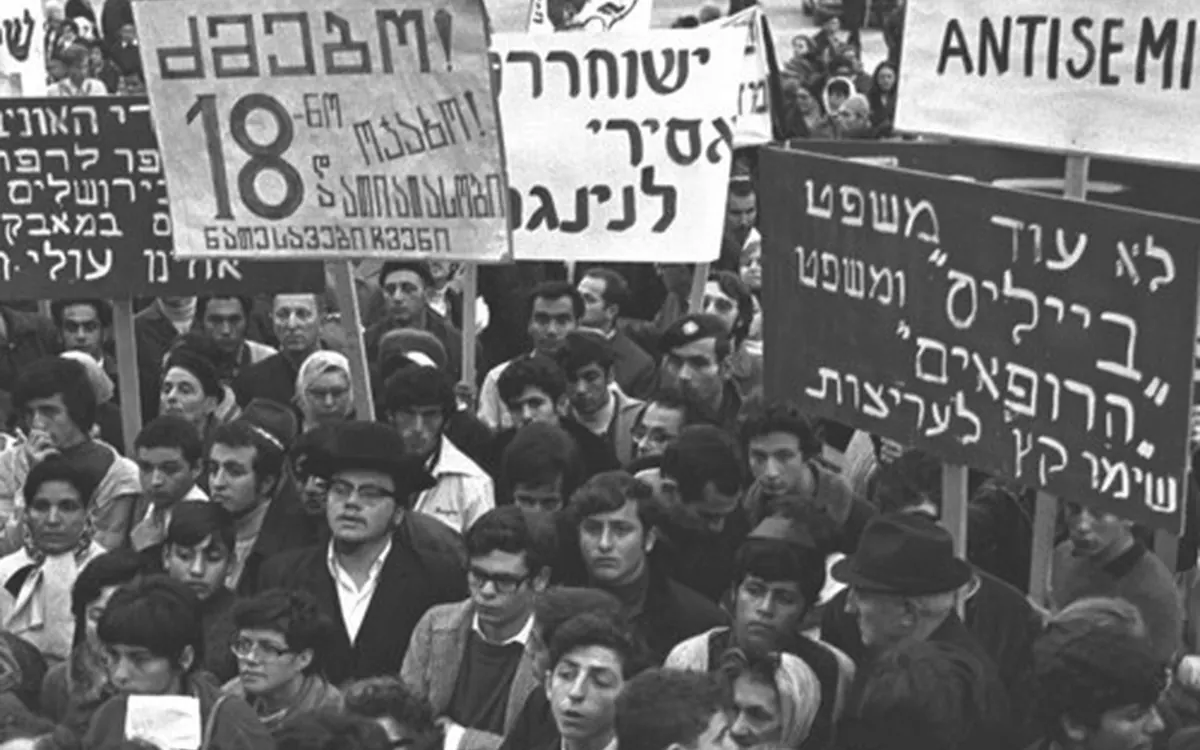
Rav Mike Feuer talks about Russian Jewish refuseniks, why they were denied exit visas to immigrate to Israel, and how the Communist regime eventually let them go. Learn about US President Richard Nixon's détente with the Soviets, championed by Secretary of State Henry Kissinger and opposed by Henry "Scoop" Jackson, co-author of the Jackson-Vanik amendment of 1974 and his assistant Richard Perle.
Others discussed regarding the issue of Russian Jews include Shaul Avigur, founder of Israel's Liaison Bureau (Lishkat Hakesher), also known as Nativ, Jacob Birnbaum of the Student Struggle for Soviet Jewry, Moshe Decter of Jewish Minorities Research, and Russian dissident Andrei Sakharov and his influence on the most well known refusenik, Natan Sharansky.
About this episode
Samuel Adams said it takes an irate, tireless minority to set brush fires of freedom, and in the American Jewry of the seventies Rav Mike sees two parts of a people moving fast in opposite directions. The Look magazine cover of 1964, The Vanishing American Jew, named a crisis of freedom, and ten years on the birthrate was down, intermarriage up, and the suburban masses would enter synagogue once or twice a year while their children treated bar mitzvah as the end of Jewish education. Against that drift stood the activist Jews who leaned in, and one powerful channel for them was the movement to free Soviet Jewry. Jacob Birnbaum, who founded the Student Struggle for Soviet Jewry in 1964, grasped that helping three million Jews behind the Iron Curtain was a way for American Jews to build and be built, livnot u'lehibanot.
The deeper story moves past the grassroots to how a tribal fight for freedom became a Cold War battlefront. By 1951 the great waves of immigration to the young state had slowed, and the Zionist leadership turned its eyes toward the nearly three million Jews of the Soviet Union. Ben-Gurion was determined to stand with the West yet could not afford to poke the Russian bear by shouting let my people go in its face, and so in 1952 the former head of illegal immigration, Shaul Avigur, was asked to create Nativ, meaning path or way. Its guiding principle was clear, that the regime should never be attacked and no action should endanger Soviet Jews, so in the fifties its emissaries quietly carried shofarot, kosher food and word of Israel to any Jew they could reach.
After the Six-Day War the Soviets broke relations with Israel, Nativ's work on the ground was all but over, and it turned toward building a world movement. In practice Jewish communities often saw the struggle as a long shot and somebody else's problem, so Nativ focused on liberal and even communist intellectuals in Europe, whose condemnation of the Kremlin's ban would sting most. In America it obtained the help of the journalist Moshe Dechter, since hiring him outright would have made him an Israeli agent, so Nahum Goldman funneled an annual contribution to the Jewish Minority Research office he headed. Dechter recruited writers, justices, unions and clergy, fed his journalist friends exclusive Israeli information, and even opened correspondence on Soviet Jewry between Khrushchev and figures like Eleanor Roosevelt, playing ghostwriter all the way to 1975.
By the late sixties the grassroots had made Soviet Jewry a popular cause no politician could ignore, and Nativ moved from information to action. The turning point came in 1972, when a highly placed aide, Richard Perle, drew his boss Senator Henry Scoop Jackson into the fight. Nixon had gone to Moscow and negotiations began toward granting the Soviets most favored nation status, the crown of detente, and Kissinger wanted the domestic affairs of the superpowers left outside their talks. Then in August 1972 Moscow imposed a diploma tax of 12,200 rubles on educated emigrants, barring the door to a largely Jewish intelligentsia. Jackson introduced an amendment, found his partner in Congressman Charles Vanik, and tied economic privileges to immigration rights. In plain terms, if the Russians wanted the cash, they had to let the Jews out.
Kissinger labored against the amendment, shaped by Weimar Germany and the lesson that given a choice between order and justice he would choose order every time, convinced that only a strong American state could protect any human right. American Jews, moved by guilt over their silence in the Holocaust years, were drawn by the moral clarity of confronting the empire directly. The point of no return came in September 1973, when the physicist Andrei Sakharov, already the Soviet Union's leading dissident after his 1968 essay on peaceful coexistence, sent an open letter to Congress backing the amendment and warning that capitulation to blackmail would betray thousands. In Kissinger's own words the letter opened the floodgates, Congress passed the 1974 Trade Act with Jackson-Vanik, and a young refusenik named Natan Sharansky, who had read Sakharov and chosen to speak, would one day go free with nearly a million others.
Key ideas
- Samuel Adams said it takes a tireless minority, and the fight for Soviet Jewry gave activist American Jews a way to build and be built.
- Nativ, founded by Shaul Avigur in 1952, worked to continue the ingathering while never attacking the Soviet regime or endangering its Jews.
- After the Six-Day War Nativ turned from quiet contact to a world movement, enlisting European intellectuals and the ghostwriter Moshe Dechter.
- The diploma tax of 1972 and Richard Perle pushed Senator Jackson to tie most favored nation status to Soviet immigration rights.
- Kissinger, shaped by Weimar, chose order over justice and fought the amendment as a threat to detente and to American power.
- Sakharov's 1973 letter to Congress opened the floodgates, the 1974 Trade Act passed with Jackson-Vanik, and Sharansky would later go free.
Chapters
- 0:00 The vanishing American Jew
- 3:19 The movement to free Soviet Jewry
- 8:52 From a tribal fight to the Cold War
- 11:09 Nativ; do not attack the regime
- 13:22 After the Six-Day War; a world movement
- 15:32 Moshe Dechter and the ghostwriting
- 17:59 From information to action
- 20:29 Richard Perle and Scoop Jackson
- 23:45 Jackson shames the Jewish leaders
- 25:56 The diploma tax; timing is everything
- 28:16 Kissinger between a rock and a hard place
- 31:48 Order over justice; the lessons of Weimar
- 35:11 Moral clarity and Jewish guilt
- 37:17 Sakharov enters the ring
- 40:40 Sharansky the refusenik
- 42:59 The letter opens the floodgates
Who, where and when
People
Samuel Adams, Jacob Birnbaum, Shaul Avigur, Moshe Dechter, Nahum Goldman, Richard Perle, Henry Jackson, Henry Kissinger, Andrei Sakharov, Natan Sharansky, David Ben-Gurion
Places
The Soviet Union, Moscow, Washington, Leningrad
Texts
The Vanishing American Jew, The Jackson-Vanik Amendment, Sakharov's Thoughts on Progress, Sakharov's letter to Congress
When
1964 CE: Birnbaum founds the SSSJ, 1952 CE: Nativ is created, August 1972 CE: the Soviet diploma tax, September 1973 CE: Sakharov's letter, 1974 CE: the Trade Act with Jackson-Vanik
Read the transcript
It does not take a majority to prevail, said Samuel Adams, but rather an irate, tireless minority, keen on setting brush fires of freedom in the minds of men. Well, I may not be up to a bonfire, but I have a few sparks I'd like to share. I'm Rav Mike Foyer, and this is The Jewish Story. Season 5, Episode 2, Let My People Go The Ongoing Fight for Soviet Jewry So there's no question that for American Jewry, the 70s were a time of polarization But not in the way you might think Because I'm not talking about the partisan nonsense of our day Where everybody retreats into their separate camp circling wagons and hating on the other just in order to promote group solidarity. I'm speaking about a simpler phenomenon, two parts of a people moving ever faster in opposite directions.
We actually spoke about the phenomenon last episode, and I couldn't do better to sum it up than by citing the cover story run by the popular Look magazine in May of 1964. The title was The Vanishing American Jew. Leaders Fear a Threat to Jewish Survival in Today's Crisis of Freedom. That title says it all. A Crisis of Freedom. What is it that it means to be a Jew in a world in which we're free? Now the main image for the article shows a young man reading from the Torah and the caption below reads, While more Jews than ever are participating in religious affairs, marriages outside the faith are increasing at an alarming rate. The apocalyptic tone of the article, which, by the way, predicted the near demise of American Jewry by the dawn of the new millennia, have proven to be somewhat overblown.
But the trends it was mapping have not. As we saw last episode, ten years after this article's publication in 1974, the birth rate was indeed down, intermarriage was sharply up, and the communal fabric of American Jewry all but dissolving under the pressures of geographic and sociological dispersion. What's emerging are the suburban masses of American Jewry, those who wouldn't deny their Judaism, God forbid, but they won't exactly do much to affirm it either. They'll never go to Israel. At most, they'll enter synagogue once or twice a year, and their children will have bar and bat mitzvah celebrations which mark the end of their Jewish education, not its beginning. At the same time, we also met the other pole of this equation, the activist Jews of Chavarat Shalom and the cultural movement which they helped to channel.
They saw this trend of assimilation as a result of a spiritual crisis and as a call to, no matter how you do, do harder. Which, by the way, I think is good advice for us all to this very day. So, but hence the polarization, two parts of a people, one drifting out, the other one leaning in. Now, today, I'm actually interested in a different force, which is working upon these activist Jews, because religious affiliation wasn't the only means for building a deeper Jewish identity in America in the early 70s. Another was unquestionably the movement to free Soviet Jewry, Because while American Jews, according to that Vanishing Jew article, were threatened by their freedom, three million other Jews halfway around the world were struggling to gain it.
Back in Season 3, Episode 4, we met Jacob Birnbaum, who we labeled as a Klal Yisrael Jew, the type of Jew who embraces his whole nation. He'd inherited the pain of the Holocaust through his upbringing in Europe, and he'd imbibed an optimism about the possibilities of social change from his adopted American home. 1933, Hitler came to power, and both my father and I had right away negative experience. He was jostled in the street, and I was, little German boys came around and stuffed my mouth with mud. They were just doing what was going around. I heard Hitler's voice on the radar all the time. It was scary. And the crowds, hundreds of thousands of Germans, answering, screaming, howling, the dirty Jews, the Jews, the Jews, you know.
Deutschland! My father worked in the National Censorship in the Uncommon Languages Department. So he read all the terrible letters which were coming out from Europe. So we knew what was going on, and there was very little which we could do. So it was not very surprising that immediately after the war, I rushed to work with people who had survived the camps. I wanted to do something. So I came to America with a major personal background from my grandfather and father, and my own encounter and experience with the victims. To teach their children their heritage, to teach their children Hebrew, Yiddish, Jewish history, literature, all the things which we take for granted in a free society, these things are absolutely and completely forbidden in the Soviet Union.
If you recall, in 1964, Birnbaum founded SSSJ, the student struggle for Soviet Jewry, which until 1971 remained the only full-time organization in the U.S. fighting for the freedom of Soviet Jews. And what's most important for this introduction is that beyond his mission to help free his brothers from behind the Iron Curtain, Birnbaum understood that such a struggle was actually a critical element for American Jews who wanted to come Livnot Ul Hibanot, to build and to be built. He recognized that by helping others, American Jews would actually draw together in their solidarity and become more of themselves. In the larger picture, as ethnic pride took center stage in the social struggles of the early 70s, student activists began to flow out of the civil rights movement and into a struggle whose slogan actually expressed their own particular Jewish roots and national mission, let my people go.
And it turned out that Birnbaum had hit upon the perfect growth model for a mass movement. Once he'd engaged the activist core, it began to be successful. And more successful than it was, the greater swath of Jews he was able to draw in from ever further out on the periphery. And as they were drawn in, they added strength for the struggle and thus brought greater success to the point where I myself got on a bus with hundreds of thousands of other Jews to march on Washington for the sake of people that I'd never met, but nonetheless felt were a critical part of my own identity. How many times I heard that it is impossible to make American Jews to come in hundreds of thousands to Washington in winter.
And here you came and winter retreated. How many times from the very beginning of our struggle we heard that it is impossible to open the gates of the Soviet Union. And we didn't listen to these voices. And we struggled, and you demonstrated, and you struggled, and that's why quarter of a million Jews were released. and that's why I and other prisoners of Zion today are free, today are here. Mr. Gorbachev today destroyed one more Jewish demonstration in Moscow. But Soviets for us have to know that no missiles and tanks, no camps and prisons can extinguish the light of candle of freedom. So, like I said, we saw it begin to take off this movement back in season three. And as someone who grew up in a synagogue environment influenced by Chavu HaShalom, in a community, like I mentioned, which was mobilized to free our brothers and sisters from behind the Iron Curtain, I can say it worked quite well as a Livnot Ulihi Banot, to build and be built, model of identity.
But this introduction aside, I've got to actually admit that today my interest is less in the grassroots struggle and the identity which it spawned, although have no fear, I'm going to have to come back to it. Today, I recognize that if we want to understand the full scope and impact of the movement of free Soviet Jewry, then we need to move beyond the sound and fury of the early struggle and take a closer look at how what really amounted in its beginnings to a tribal fight for freedom became a major battlefront in the Cold War. By 1951, the first massive waves of immigration to Israel from North Africa and the Middle East and post-Holocaust Europe had started to trickle off seriously. And for some, this was just fine.
After all, the young state was already struggling to absorb a population that had tripled in its opening years. But among the Zionist leadership, there was still a sense that the ingathering must go on, be it for pragmatic or for ideological reasons, and thus their eyes turned toward the nearly 3 million Jews living in the Soviet Union at the time. Despite having taken a clear side in the Cold War almost from the outset, I mean, they did flirt with the non-aligned movement, but in the end of the day, Ben-Gurion was determined to be part of the West. Nonetheless, Israel was too smart to poke the Russian bear by shouting, let my people go, in its face, and thus exposing the less than free conditions within their workers' paradise.
Bottom line was, the young state couldn't afford to sacrifice relations with Moscow for the sake of these Soviet Jews, but it wanted them out nonetheless. And in fact, in the eyes of many, it needed them out in order to survive and thrive in the Middle East. The solution to such a dilemma was obvious to men who had fought an underground war against empires for the last decade and a half. A clandestine body, designed to reconcile interests of Israel as a state, meaning to maintain its relations with one of the two superpowers of the world, almost at any cost, and its goal as the nation of the Jewish people, which was to help endangered Jews in the diaspora and ensure that their flow into Zion would not stop.
The former head of Ali Abed, the illegal immigration movement which took place during the British Mandatory Period, Shaul Avigul, was chosen to create an organization called Nativ in 1952. Nativ means path or way and their job was indeed to find a way to continue the ingathering of the exiles from the Soviet Union Nativ guiding principle was clear from the outset The Soviet regime should not be attacked in any way and any action which was taken should avoid endangering Soviet Jews at all costs, which practically speaking meant that in the 50s, Nativ needed to stay far from the Cold War propaganda battles which were heating up around the world at the time. So, to Israel's diplomatic mission in Moscow were added members whose job was to maintain a constant contact with any Jew they met, to give them information on the state of Israel, to provide for their religious needs, including objects like shofarot and kosher food, in order to encourage their identification with the Hebrew state.
Now, as the Cold War heated up in the 50s, Nativ's position actually became less delicate. The pro-Arab turn of the Kremlin came clear when they armed Nasser in 1955, and in the wake of the Soviet invasion of Budapest in 1956, they gained a new sensitivity to their image in non-communist countries. The demand that Jews be allowed to immigrate, as, by the way, stipulated by the UN's Universal Declaration of Human Rights, was suddenly resonant with the first sparks of a rights-based discourse that was emerging as a powerful force in international politics. but really things changed when the USSR broke diplomatic relations with Israel after their victory in the Six-Day War now Nativ's operations on the ground were all but over and so they turned their sights toward creating a world movement that could set Soviet Jewry free it may sound grandiose but hey, we're Jews, we always think big in theory, Jewish communities everywhere ought to have been their main allies But in practice, the members of Nativ found those communities often reluctant to get involved in what they saw to be a long-shot struggle, and frankly, to some degree, somebody else's problem.
And so, engaging and educating intellectuals and politicians, specifically in Europe, became the primary targets of what was known as Lishkat HaKesher, the liaison office in their internal discourse. Nativ specialized in focusing on liberal and even communist personalities in Europe, knowing that the condemnation of these people, when their focus on the Kremlin's ban on immigration was brought to the front, was going to be extremely disturbing for the Soviet Union and make a much greater impression on international opinion than cold warriors who were opposed to the Soviet Union in and of itself. Despite the European focus, already in 1958, Shaloui Vigour had come to view the United States with its open political system and its Cold War foreign policy as a unique opportunity to really set his people free.
Now, he also added to this the fact that American Jews were anxious at this stage to put an end to their association with communism in the American mind and to compensate for what they saw to be their communal inaction while their brothers were dying during the Holocaust. Nativ began to send its best emissaries to the states, where they in turn stepped up their efforts to sensitize intellectuals to the cruelty of Soviet Jewry's plight and to persuade them to take a public stance in condemning Moscow's discrimination toward Jewish nationals. Beyond the intellectual discourse, these emissaries also fed journalists information about the Soviet Union, hoping to entice them to publish articles on Soviet Jews.
Now, you need to know that such information was a rare and precious commodity at the time, one to which Israel actually had unique access through its debriefing of this steady trickle of Soviet Jews who continued, even now, to be set free. But the work to be done in America was far bigger than that which was happening in Europe. And so Nativ obtained the support of Moshe Dechter, son of an Orthodox Jew, socialist himself, a journalist well-connected in progressive circles, and a known anti-communist. He was particularly close to the first editor of Commentary Magazine, Elliot Cohen, who had preceded Norman Podoretz, and had distinguished the publication for systematic opposition to the Soviet Union.
Now, I said that Nativ obtained the help of Dekter, because to hire him outright would have made Dekter an Israeli agent, meaning spy. So rather than risk that, Nahum Goldman, President of the World Jewish Congress, was persuaded to receive a contribution of $25,000 annually to the American Jewish Congress, which he in turn gave to an office called the Jewish Minority Research, headed by Dechter. And it just happened to be housed in the AJC's headquarter. As director of this new organization, Dechter stepped up his activities. He recruited researchers, writers, Supreme Court justices, unions, civil rights leaders, clergymen, all to the cause of Soviet Jewry. He gave his journalist friends all kinds of information, even providing them with notes for how to write articles on Soviet Jewry.
And that spice of exclusive Israeli-provided information made it all but irresistible. He even managed to initiate correspondence on the treatment of Soviet Jews between Premier Khrushchev and such diverse personalities as Eleanor Roosevelt, Supreme Court Justice Thurgood Marshall, and the theologian Reinhold Niebuhr. All the way up until 1975, Defter would play the role of ghostwriter, shadow organizer. But in the late 60s, the recruitment of intellectuals and journalists actually became secondary to Nativ's campaign. As we heard in the introduction and we saw extensively in last season, activism for Soviet Jewry had begun at the grassroots level by this point. And between their actions and the show trials being orchestrated by Moscow in the late 60s and early 70s, the suffering of Soviet Jewry was quickly elevated to a popular cause which no American with any interest in politics could ignore.
And that meant neither could any politician. Nativ saw it was time to move on from information to action, which meant that politicians and Jewish organizations would now be their best allies. Now, unfortunately, mobilizing major American Jewish organizations to get behind the movement to free Soviet Jewry was not a simple task. We actually saw that in Jacob Birnbaum's frustrations back in season four. Nativ also felt the frustration of institutional inertia, of endless discussions about what responsibilities a new organization might take, how would we put it together, who's going to be a member. And then, of course, they felt the inevitable turf wars. Even the highly influential Conference of Presidents of Major Jewish Organizations considered the idea of creating a new organization aimed at freeing Soviet Jewry to be a threat to its power.
Add to that the inevitable ideological divisions. I mean, we are Jews after all. And the most extreme opposition actually came to the very goal of mass exodus. World Jewish Congress and its president, Nachum Goldman, felt that the aim of any campaign should actually be to sustain Jewish life on the ground in the Soviet Union, not to get them out. I'd call it let my people grow as opposed to let my people go. And of course, there were plenty of organizations who resisted simply because they didn't want to take order from the Israelis. But as with so many things amongst American Jewry, resistance to both Israeli emissaries and the United Mission vanished in the euphoria created by the Six-Day War. That dissolved their opposition to Zionism and opened them in many ways to united actions.
And it was in this environment that the grassroots struggle begun by Birnbaum and the SSSJ had the opportunity to blossom into a full-scale political campaign. The turning point came in 1972, when the Jewish communal efforts to raise awareness of the plight of Soviet Jewry intersected with Nakti's recruitment of a highly placed political advisor, Richard Pearl, to the cause. Pearl was a legislative assistant to Henry Scoop Jackson, powerful senator from the state of Washington, and a fierce opponent of Nixon and Kissinger's foreign policy of detente with the Soviet Union. Now, 1972 was the summer of love for Dayton. First, Nixon went to China, something which apparently only he could do, and in May, he topped that diplomatic achievement off by meeting with General Secretary Brezhnev in Moscow, becoming the first American president ever to set foot in the city.
Limiting strategic arms was the real focus of the summit, and I can assume that the ugly little question of the oppression of a large body of Soviet citizens didn't come up. This wasn't just real politique, or even an effort to simply avoid an awkward topic. National Security Advisor Henry Kissinger was there on hand for the talks. In fact, he had made them happen, and as we will see, he firmly believed that the only way to achieve global stability, and thus, by the way, to help Soviet Jews, was to leave what he called the domestic affairs of the superpowers outside of their discussions. but Kissinger didn't count on the problems that could be made for him by his fellow Jews stiff-necked people that we are when Nixon came back from Moscow negotiations began toward granting the Soviet Union most favored nation status it was something that would open up a new level of tariff-free trade between the superpowers bringing with it more stability and in particular for the USSR desperately needed foreign currency and it would also make detente the foreign policy victory of the century.
In the years since 1967, the movement to free Soviet Jewry had gained real political ground at every level. Nativ was hard at work. Local, state, national. Resolutions had been introduced in both congressional houses to pressure Moscow, though none had yet been adopted. And even the White House was rumored to be considering raising the issue. But it was still a question of how people and politicians felt about human rights, which as noble and as aspiring as it may be, is a little bit too amorphous to make a headway in the hard-nosed world of politics. A word of advice, to make real change, you have to have something specific to push on. In this case, there needed to be a particular law on which to focus.
And not just that, there had to be the right constellation of interests to push that law, which is why the storm broke only a few months after Nixon came home for the USSR. According to some, it was Richard Perle who convinced his boss, Henry Jackson, that the best way to throw cold water on detente was to push the issue of the imprisonment of Soviet jury and to tie it to Nixon's policy aims. Scoop was consulted by presidents all the time, even those who disagreed with it. and from time to time they acted on his advice. I remember one meeting which has been reported in a number of the books and articles that have been written about Jackson Vanek with a meeting with leaders of the Jewish communities in 1973, I think, maybe 1974 in which these mainstream Jewish leaders were very nervous about Jackson Vanek The administration was dead set against it Nixon was lobbying them personally, implying that American support for Israel could be prejudiced by insistence on Jackson Vanek.
And I sat in the meeting where Scoop essentially said to these Jewish leaders, you should be ashamed of yourselves. I mean, for people who think that this was scoop looking for political support, and he went on to explain why it was vital that we see this through to a successful conclusion. I think he more or less won them over in the end, but he depended in getting Jackson Vanek through rather less on the Jewish establishment and less on the moneyed Jewish establishment for those people who say he was trying to get campaign contributions from the Jewish community. he relied rather more on young groups. From the beginning he knew that in the end what it was possible to achieve was not completely free immigration but much freer immigration.
Not only could Jackson count on the American Jewish organizations to step in behind him He knew there was a large bipartisan coalition in Congress, one that combined defenders of human rights, anti-communist detente opponents, and even protectionists who were opposed to trade with the Soviet Union. They would all come together behind the right law. But beyond that right law and the constellation of interests, in politics as in life, timing is everything. In August of 1972, the Soviet Union introduced what they called a diploma tax. It was a one-time payment to be leveled on any would-be immigrant who had received a higher education in the USSR. Nominally, the justification was to repay state expenses for public education.
But in reality, it was meant to fight the brain drain caused by the growing flight of the intelligentsia from the Soviet Union. Of course, an intelligentsia which was disproportionately Jewish. and many felt, in fact, this was yet another tool to keep the Jews locked up. By setting the fee at 12,200 rubles, at a time when the monthly salary was between 130 and 150, the law effectively barred the door to Jewish and other immigration. According to Pearl, this was the moment that pushed Senator Jackson to action. As he later said in an interview, Scoop believed that immigration was in some ways the most powerful of all the human rights Because if people could vote with their feet, governments would have to acknowledge, and governments would have to make for their citizens a life that would keep them there.
If you can imprison people, you can do anything. But if people have the right to leave, you'd have to create a decent society. In September of 72, as the trade agreement under negotiation with Moscow began to take a legislative form, Senator Henry Jackson introduced an amendment into the proceedings. In classic legislative jargon, it linked the extension of economic privileges like most favored nation and credit guarantees to any non-market economy, meaning at this point the Soviet Union, to its respect of minority immigration rights. And he found his legislative partner in Congressman Charles Vanek of Ohio, powerful head of the House Ways and Means Committee. And thus, the Jackson Vanek Amendment was born.
What it said in simple terms was, if the Russians want the cash, then they have to let the Jews out. I can only imagine the dismay with which Henry Kissinger received the news that his grand plan of detente was threatened, and not only by a political rival to the president, but by his fellow Jews as well. There is a complex story of negotiation and politics, which we could follow here, but in truth, it doesn't interest me all that much. Suffice it to say that Kissinger suddenly found himself between a rock and a hard place, or more than one. On one side, there was Senator Jackson and company, bent on teaching Kissinger that detente was a failed concept. Their attitude was that any smell of compromise would only make the Soviets more intransigent.
And they were also bent on taking the presidency from Nixon when the time was right. On the other side was Moscow, with whom Kissinger was actively engaged in these most favored nation status negotiations. Not a simple process. Despite their knowledge of the American political system, the Soviets seemingly couldn't grasp the idea that President wasn't just a supreme ruler who could overturn the will of Congress if he really wanted, like they did. Once, as Kissinger was trying to explain to Brezhnev the necessary legislative steps that he and the president would have to take in order to turn their negotiations into actual legislation, Brezhnev replied, but you yourselves write the laws. It's for you to change them.
Then there was the Jewish thing. Rarely explicit, but ever present, and the source of endless speculation on what actually motivated the man who in 1973 was on the fast track to becoming amongst the world's most powerful leaders. But of course, true to form, the organized Jewish community itself was sending Kissinger mixed signals. Jewish leaders closest to the White House were under constant pressure, sometimes from the President himself to withdraw their support from the Jackson-Vanick Amendment. And frankly, sometimes they seem like they do it. They were torn between their gratitude for Nixon's supportive policy of Israel. I mean, he'd increased financial and military aid to the state to unprecedented levels in the early 70s, and their loyalty to Soviet Jews.
Perhaps the most difficult moment occurred in the midst of the Yom Kippur War, where Nixon tried to convince Golda Meir that she could persuade American Jewish organizations to stop supporting Jackson. There are those who say that Kissinger even delayed the airlift of arms to Israel in hopes to add to the pressure on Prime Minister Meir. In the end, the leaders of Nativ in America phoned up Golda and they said that if she convinced the Jews to back down, she would completely discredit the Jewish establishment in the entire American political scene. And so they held firm. You can see, Kissinger was under serious pressure from basically every side. But for the sake of the Jewish story, I want to understand a bit of Kissinger's larger motivations.
As I actually mentioned last season, in a sense, the position he has reached, the ultimate court Jew, some would say, is representative of an entire plot line within the Jewish story. Now first, we need to note that it was in the context of these arguments over Soviet immigration that Kissinger first attacked the very idea that humanitarian intervention should be a guide to foreign policy at all. Now, in his day, Kissinger was known as the Apostle of International Stability. The talk with the Soviet Union was an expression of his desire to find a guarantee, and in his eyes the only guarantee against nuclear destruction. In pursuit of such stability, as far as Kissinger was concerned, nothing mattered.
In fact, not only should nothing interfere, that there had to be a doctrine of what he called strict non-interference in the domestic affairs of other powers. There can be no peaceful international order without a constructive relationship between the United States and the Soviet Union. There will be no international stability unless both the Soviet Union and the United States conduct themselves with restraint, and unless they use their enormous power for the benefit of mankind. Thus, we must be clear at the outset on what the term detente entails. It is the search for a more constructive relationship with the Soviet Union. Simply put, if he tied any negotiation to the domestic concerns of his negotiating partner, he would violate their sovereignty.
And without real sovereignty, no state can be stable and therefore no international order. Detente was to be the ultimate stabilizer. And if the Soviet Jews had to suffer on some level, so be it. Wasn't that better than the discussion of the entire planet through nuclear holocaust? And speaking of Holocaust, I might say that the real difference in approach between Kissinger and the mainstream American Jewish leadership to the plight of Soviet Jews was actually rooted in the very different lessons they derived from the Holocaust. Throughout his career, Kissinger held the assumption that democracies are weak and prone to extremes of action and then passivity. passivity. Where did he get such a thing? Well, from what he felt and seen growing up as a Jew in interwar Weimar Germany.
Later in life, he commented on what he learned there of, quote, the fragility of societies and the fragility of achievement. He said, I saw the collapse of what was a very secure society because the German Jews were very middle class and they were actually more integrated into German life than American Jews on the whole. This experience of collapse drove a personal, lifelong quest for stability, not just in the way many survivors sought to make their own lives stable, but international stability. After all, this is a man making policy on the highest level. And the idea which gripped Kissinger was that only international stability could ward off total catastrophe. To put it another way, he often said that given a choice between order and justice, he would choose order every time.
A little bit chilling for a man who just missed the death camp of Auschwitz. But he said, a country that demands moral perfection of itself as a test of its foreign policy will achieve neither perfection nor security. And those are words to be meditated upon. Kissinger's experience was that it was American power and the ability to wield it in pursuit of national interests that had saved he and his family from the ovens, not American morality. For him, a powerful American state was the core for all diplomacy. It was the touchstone for international values because there could be no human rights, no justice, no social progress in any meaningful, beyond verbal sense without a strong American state to support and protect them.
Therefore, diplomatic agreements would only bring improvements in human rights if they strengthened the American state. And that's why Kissinger saw the attempts to free Soviet Jewry by eroding detente and thus American power as counterproductive and even dangerous to the Soviet Jews themselves. Now, on the other hand, a major factor pushing American Jews toward the issue of Soviet Jewry was a deep sense of institutional guilt over the moral confusion and lack of action in their response to the Holocaust And now they had a chance to finally help their fellow Jews. And the very moral clarity of the issue, the aggressive moral stance that the Jackson-Vanick Amendment represented by directly confronting the Soviet Empire, appealed to their sensibility.
And they weren't alone. Many Americans, troubled by their loss of moral high ground in the wake of Vietnam, were moved by the Jackson-Vanick stance. From the moment that the amendment was introduced, Kissinger labored in private and in public to convince America and American Jews to support detente by rejecting the amendment. He gave eloquent speeches, granted interviews to hand-picked members of the press, met with all the big Jews, but to no avail. Public polls showed consistently that the average American, much less the average American Jew, was supportive of Jackson Vanek, and that Congress was simply echoing their call to let my people go. Of course, ongoing Soviet persecution didn't help his case, but the point of no return for the passage of the amendment came in September of 1973, when Soviet nuclear physicist and internationally known dissident, And Andrei Sakharov threw his hat into the ring.
The idea that human rights are a real international political issue is a defining characteristic of late 20th century politics, or at least of its political discourse. But Lok Kachahaya, that wasn't always that way. Though the UN did indeed put them on the board right from the beginning. If you look at Article 1 of the UN Charter, which defines its purpose, it has three sections. One is about maintaining international peace and security. Two is about developing friend relations amongst nations. And the third is focused on what it calls humanitarian work and, quote, promoting and encouraging respect for human rights and for fundamental freedoms for all without distinctions. It's a nice idea penned in 1945, but it would have to wait until the late 60s until human rights became a real topic of international concern, as the Cold War turned them into a serious propaganda stick with which the U.S.
and USSR could beat each other in public. By the way, we'll see soon enough in the Jewish story that turnabout is always fair play, and Israel may have caused to regret the supercharging of rights as a tool of discourse in the public stage, but that's a story for another time. For now, perhaps the seminal moment in the emergence of human rights as an international issue came with Andrei Sakharov's publication of his 1968 essay Thoughts on Progress, Peaceful Coexistence, and Intellectual Freedom. And you should know, the essay had nothing to do with Soviet Jewry. Sakharov was an elite Soviet scientist, sometimes called the father of the hydrogen bomb. In his early career, he was motivated not only by scientific curiosity, but by the somewhat naive belief that nuclear weapons would actually promote peace by securing a balance of power between the U.S.
and the USSR. It's a perspective not unlike Kissinger's, but before too long it became clear to Sakharov, whose status placed him at the very center of Soviet power, that his achievement had actually had the opposite effect. It strengthened the Soviet reign of terror at home and its aggressive posture abroad. And so he published Thoughts on Progress, Peaceful Coexistence, and Intellectual Freedom, originally as Samizdat, underground literature, in order to offer a different approach to international affairs. His essay rests on three ideas. First, that if a state represents a threat to its own citizens, it will inevitably be a threat to its neighbors. Second, that respect for human rights actually guarantees democratic oversight over a country's policy, and therefore can avoid the militarization of the economy during peacetime, which promotes war.
And third, that only a guarantee of human rights allows the free exchange of information and ideas between peoples, which is ultimately the foundation of real peace. Overnight, Sakharov was transformed from the Soviet Union's top scientist to its top dissident, and his break with the regime had a powerful influence on the people around him, one of whom was a young Soviet Jew by the name of Anatoly Natan Sharansky. Sharansky was born in the Ukrainian Soviet Socialist Republic, the other USSR, I guess, on January 20, 1948, only a few months before the state of Israel, though it would take him almost 40 years to get there. A child chess prodigy, Sharansky was drawn toward math and science, and after graduating from the Moscow Institute of Physics and Technology, He began working for a secret state research laboratory, but all the time he was dreaming of Zion.
You know, later in life, Shransky would write of the impact which reading Sakurov's essay had on him, and on his choice to dissent. He said that many who opposed the Soviet regime had, quote, hoped to escape the indignities of doublethink through academic or professional success. By devoting ourselves to science and arts, we thought we could cloister ourselves and avoid being compelled to publicly proclaim fidelity to a system we despise. In other words, he was hiding in the life of the mind. But Sakharov's essay changed that. As Sharansky wrote, I realized that this option was untenable. Here was someone at the pinnacle of my profession, explaining that success was not an escape. His message was unequivocal.
There is only one way to avoid a life of lies. In order to be truly free, you must speak your mind. And so he did. In 1973, Amatoly Sharansky made an application for a visa to immigrate to Israel. And upon its rejection, he became a refusenik, as those who tried to get out and were rejected were known, and launched a new career as a fighter for human rights. Soon after this denial, Shcherensky went to work for Andrei Sakharov as a translator and human rights activist. Now, in 1973, Sakharov was meeting regularly with Western news correspondents. He was holding press conferences in his apartment. It was an unprecedented defiance of the Soviet regime, which evoked intensifying harassment and ultimately his exile to the closed city of Gorky.
But, undaunted, in 1973, Sakharov sent an open letter to the U.S. Congress in support of the Jackson-Vanick Amendment. It was published by the New York Times on September 14th, and I think we could do worse than end this episode with a little bit of its words. If every nation is entitled to choose the political system under which it wishes to live, this is true all the more so of every individual person, A country whose citizens are deprived of this minimal right is not free. But as you know, there are tens of thousands of citizens in the Soviet Union who want to leave the country and who have been seeking that right for years and decades at the cost of endless difficulty and humiliation. You know that prisons, labor camps, and mental hospitals are filled with people who have sought this illegitimate right.
You know the name of the Lithuanian, Simis Kudirka, who was handed over to the Soviet authorities by an American vessel, as well as the names of the defendants in the tragic 1970 hijacking trial in Leningrad. You know about the victims of the Berlin Wall. There are many more lesser-known victims. Remember them, too. Sakharov goes on to argue that for decades, the Soviet Union had been developing under conditions of what he calls an intolerable isolation, bringing with it the ugliest consequences. and he warns that even a partial preservation of those conditions will be highly perilous for all mankind, for international confidence and, he says, for detente. And then he makes a direct appeal, quote, for the Congress of the United States to give its support to the Jackson-Vanick Amendment, which does not represent interference in the internal affairs of socialist countries, but simply a defense of international law, without which there can be no mutual trust.
now his final words are not simple and they deserve real thought in our day the abandonment of a policy of principle would be a betrayal of the thousands of Jews and non-Jews who want to immigrate of the hundreds in camps and mental hospitals of the victims of the Berlin Wall such a denial would lead to stronger repression on ideological grounds it would be tantamount to total capitulation of democratic principles in face of blackmail, deceit and violence The consequences of such a capitulation for international confidence detente and the entire future of mankind are difficult to predict. I express the hope that the Congress in the United States, reflecting the will and the traditional love of freedom for the American people, will realize its historical responsibility before mankind and will find the strength to rise above temporary partisan considerations.
I hope that the Congress will support the Jackson-Vanick Amendment. signed Andrei Sakharov. In Kissinger's own words, Sakharov's letter opened the floodgates. Liberal groups who had formerly supported detente and opposed any trade restrictions now reverse course and the administration found itself deeply on the defensive. In the end, Congress indeed passed the 1974 Trade Act together with the Jackson-Vanick Amendment, a legislative act which is seen by many historians as a turning point in the incorporation of human rights in U.S. foreign policy and in many ways in the Cold War. As I said, Sakharov himself goes into exile. And in 1977, Anatoly Natansharansky would be jailed for his audacious insistence that he and his fellow Jews be allowed to go home.
I may follow this story further at another time, but for now I just want to appreciate that as the Soviet Empire begins to crumble in the late 80s, Mikhail Gorchov, its last leader, will set Natanzaransky free, together with nearly a million of his brothers and sisters, in an attempt to gain favor with the West. So, there's no question that moral clarity, human rights, and the assistance to let my people go can change the world. I just want to say thank you to a few folks before I sign off. I want to say thanks to those who give their hard-earned money to help make this show happen, to keep it free and make it widely available. I want to call you to join them. You can go right now to my website, jewishstory.co.
In the upper right-hand corner, you'll see a button that says Be a Patron. You can click on that to give a little bit of her podcast support. I'm also happy to dedicate a show if you want, in the honor of someone who's with you today or in the memory of those who've moved on. Send me an email at robmikefoyer at gmail.com or you can send me a message on Facebook, Rav Mike Foyer. I'm happy to share the details of how you can do so. I want to thank the Land of Israel Network, that's thelandofisrael.com, creating a global center for spirituality and transcendence in the heart of Judea. I want to thank the Pardes Institute, P-A-R-D-E-S dot org dot I-L, for building an educational institution which throws the doors wide for all of my people.
Let my people know, as they say. And I want to thank you for listening. I'm Rav Mike Foyer, and this is The Jewish Story.
More from Season 5
TJS S5E1 A portrait of American Jewry, circa 1974
The changing culture of American Jewry after the Yom Kippur War in Israel and the Vietnam War meant leaving old neighborhoods, a surge in Zionism and new developments...
Play Episode
TJS S5 Interlude Crowning the King 5782
Sometimes a simple question sparks the deepest thoughts. This episode is in answer to a simple question - what is the story of Rosh Hashanah. It explores the...
Play Episode
TJS S5E3 Feminism and American Judaism
The feminist movement and Jewish American life came together in the 1960s and 70s - each influencing the other. In this episode we touch on Betty Friedan's Feminine...
Play Episode