
TJS S5E5 - Gush Emunim
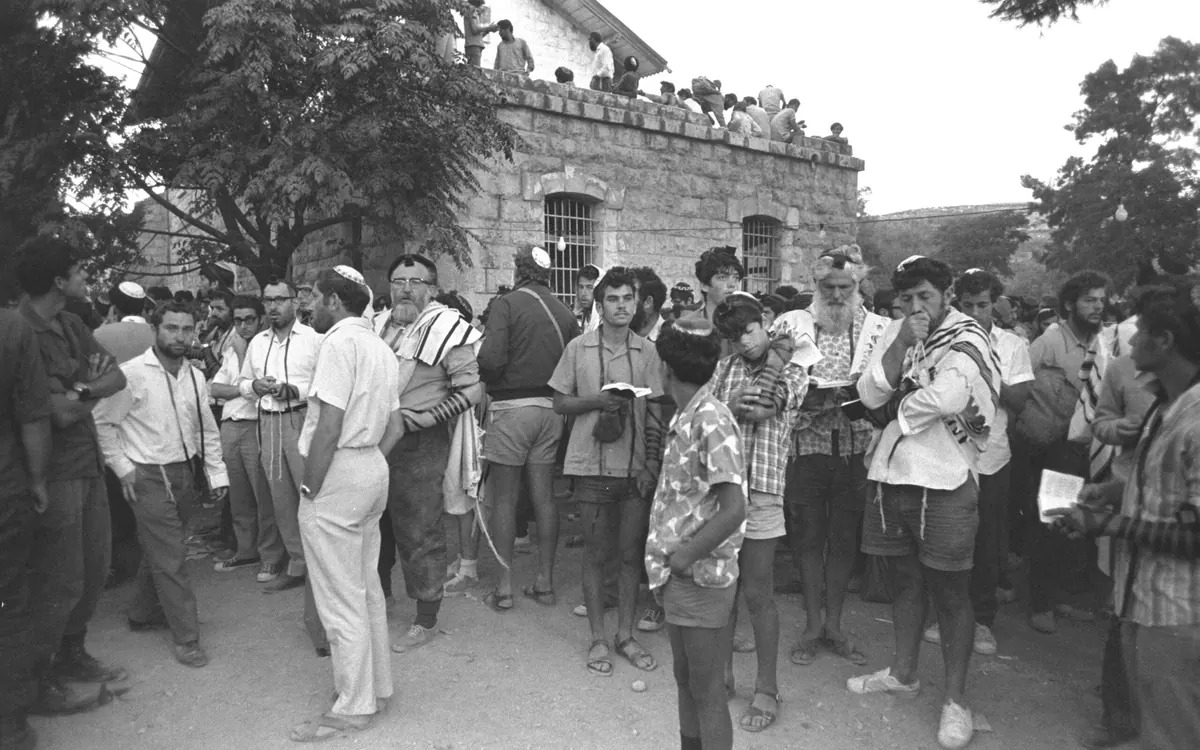
Many things within Israeli society were threatened with collapse in the wake of the Yom Kippur War, and perhaps the most profound danger was a loss of spirit. This episodes explores the rise of the 'bloc of the faithful,' vanguard of today's "settlement movement" who moved to inherit the pioneering spirit of Israel in this difficult time.
About this episode
After the Yom Kippur War, Israelis called what had happened HaMechdal, the failure. The Agranat Commission rolled heads, Golda Meir resigned, more than two and a half thousand soldiers were dead, and with them died the euphoric, almost messianic confidence Israel had placed in its army. Rav Mike is interested in a different casualty: the pioneering spirit itself. From Abraham’s lech lecha to the Second Aliyah, the pioneer has been the heroic model of the Zionist project, and in 1973 that model was in question.
He goes back to a 1949 argument between Ben-Gurion and Martin Buber about absorbing the flood of immigrants, and to Ben-Gurion’s line that he prayed the Messiah would never come, because the moment he arrives he ceases to be the Messiah. Redemption, on this view, needs a pioneering elite that keeps pushing. In his last public address in 1971 the old man named the state’s two unfinished objectives, the Law of Return and public education, and said Israel’s standing would be judged by the moral lustre of its mission. By the end of 1973 that belief was badly shaken, and the spirit needed new people to carry it and a new vessel for its expression.
The vessel was Mercaz HaRav, the yeshiva Rav Avraham Yitzchak HaKohen Kook began in his own home in 1921. Rav Mike lays out Rav Kook’s political theology: the particular rebirth of Israel in its land fulfils a universal mission; history is the unfolding of divine consciousness; and the mundane is the substance of the holy, so that the stronger the state, the greater its potential for sanctity. Secular Zionism could build the vessel but could not sanctify it. Rav Kook died in 1935 and never saw the state he dreamed of as the foundation of God’s throne in the world. His son, Rav Tzvi Yehuda, brought those teachings down to earth for the Gachelet group of Bnei Akiva graduates, and after 1967 taught that the state itself is divine, that there is no room for retreat, and that we shall conquer and liberate more.
Then the story of how a movement was born. Two weeks after the war, Devorah Artziel of Yad Binyamin sat with Golda Meir and proposed Jewish settlement in Shechem. The Prime Minister said: you are right, it is ours, and this is not the time. That meeting told the activists the government would not lead. Meetings in the rebuilt Kfar Etzion, with Hanan Porat, Rav Levinger, the Gachelet rabbis and Rav Tzvi Yehuda’s blessing, produced Gush Emunim, whose charter spoke of a new old message, an echo of Herzl’s Altneuland, and whose aim was to sanctify the vessel of the state, never to break it. Hanan Porat called it redemption Zionism rather than safe haven Zionism. Orthodox soldiers in knitted kippot had fought in regular units for the first time in 1973, and that gave the movement both confidence and legitimacy.
On June 5, 1974 a caravan left Mehola in the Jordan Valley, with Rav Tzvi Yehuda and Ariel Sharon among the hundred, and climbed to a hilltop near Shechem they named Elon Moreh after Abraham’s first stop in the land. Fences went up, tents, a flag, the Shehecheyanu blessing. Then the army came. Sharon told a soldier to disobey an immoral order; Hanan Porat, still recovering from war wounds, was beaten; and Rav Tzvi Yehuda opened his coat and told the soldiers to take a machine gun and kill him, because they would no more move him than make him eat pork. It looked like a defeat. Rav Mike calls it the opening round of a war that has not ended; Elon Moreh has nearly two thousand residents today.
Key ideas
- HaMechdal, the failure, was more than a military and political collapse. It threatened the pioneering spirit that had driven Zionism since the Second Aliyah.
- Ben-Gurion prayed the Messiah would never come: redemption is a process that needs a pioneering elite always pushing forward.
- Rav Kook’s political theology holds that the mundane is the substance of the holy and that the state, built by secular hands, is the vessel for redemption.
- Rav Tzvi Yehuda turned his father’s abstractions into actionable politics: the state is divine, and there is no retreat.
- Gush Emunim was founded in Kfar Etzion to sanctify the vessel of the state rather than break it. Its Zionism was redemption Zionism.
- Elon Moreh, June 5, 1974: the first eviction was the opening round of a struggle that is still going on.
Chapters
- 0:00 The failure: Israel after the Yom Kippur War
- 2:14 A potential collapse of spirit
- 3:19 Abraham the first pioneer; the pioneering model
- 4:28 Ben-Gurion, Buber and the Messiah who must never come
- 7:48 Ben-Gurion's last address: return and education
- 10:05 Toynbee: ancestors or pioneers
- 11:12 Mercaz HaRav and Rav Kook
- 13:27 Rav Kook's political theology: universal and particular
- 15:35 Sanctifying the mundane; the state as vessel
- 19:01 Rav Kook never saw the state
- 21:18 Gachelet and Rav Tzvi Yehuda
- 23:33 From abstraction to action: the state is divine
- 25:53 A note to Golda Meir, 1973
- 28:05 Why the government could not lead
- 30:23 Facts on the ground; Gush Emunim is founded
- 32:33 Redemption Zionism
- 34:49 Why Gush Emunim succeeded
- 37:00 June 5, 1974: the caravan to Elon Moreh
- 39:13 The army arrives; Sharon says disobey
- 40:18 Rav Tzvi Yehuda: take a machine gun and kill me
- 42:36 Only the beginning
Who, where and when
People
Rav Avraham Yitzchak HaKohen Kook, Rav Tzvi Yehuda Kook, David Ben-Gurion, Martin Buber, Golda Meir, Devorah Artziel, Hanan Porat, Rav Moshe Levinger, Ariel Sharon, Shimon Peres, Yehuda Etzion, Rav Chaim Druckman, Arnold Toynbee
Places
Mercaz HaRav, Jerusalem, Kfar Etzion, Shechem, Elon Moreh, Mehola, Jordan Valley, Kuneitra, Hevron
Ideas
HaMechdal, Political theology, Redemption Zionism, Altneuland, the new old, Yeshivot Hesder
When
1921: Mercaz HaRav founded, 1935: Rav Kook dies, 1949: Ben-Gurion and Buber, Independence Day 1967, Late 1973: the note to Golda Meir, June 5, 1974: Elon Moreh
Read the transcript
Those who say religion has nothing to do with politics, said Mahatma Gandhi, do not know what religion is. Well, I'm not really sure how to put politics and religion together, but I can say when you do, it makes for good telling. I'm Rav Mike Feuer, and this is the Jewish story. There were many things within Israeli society which collapsed in the wake of the Yom Kippur war, some immediately and some over time. That's why the period following the war is known as HaMechdal. Back in season 4, I translated that world as the fiasco, a terrible situation in which the military and political leadership had failed the nation, which was really only saved by the sacrifice of its children. But I think when I look back at that translation of the fiasco, I was just trying to be too sophisticated, really, it's simply the failure.
We spoke back then about how the Agranat Commission set up post-war past a limited judgment on the failures of the government. Prime Minister Golda Meir was eventually forced to resign, but her labor alignment still held the government. Moshe Dayan would no longer be defense minister, but he has a bright political future ahead. In a later episode, we'll trace the aftershocks on down through the political system, through the first rebeying government all the way to Menachem Begin's revolution. But for now, I also want to say that the Agranat Commission passed a greater degree of judgment on Tzahal, the Israeli army that is, than it did on the government, at least more and bigger heads were made to roll, but the real casualty of war in the military realm weren't the generals.
It was the soldiers, more than two and a half thousand killed and countless wounded. And with them, died the europhoric, dare I say, messianic sense of confidence with which Israeli society had been filled when it looked at the army. This loss of morale was only deepened by the extreme economic and social burdens the average citizen was made to bear in order to hold up the wall of the Israeli military power following the 73 war. And we'll speak about the details of that problem in episodes to come. But you need to keep that collapse of easy confidence in the strength of our own hands in the back of your mind for what lies ahead. Because in this episode, I want to talk not about breakdowns in politics or failures of military nerve or even economic burdens.
I want to touch on a potential collapse of spirit. You know, the Zionist project has been driven by a pioneering spirit since its inception. In fact, it's not exaggeration to go all the way back to Abraham and say that he was the first pioneer when God said lech lecha, leave your home, your father's land and everything you know. And go to the land which I will show you. What could be more of a pioneering motion than that as an aside, by the way, I've noticed in the media lately that the indigenous discourse has begun to take over certain corners of the conversation about Israel. I got to just throw my hat into the ring and say, I don't buy it Abraham didn't come from here. He explicitly came from over the river.
And of course, that is an important part of our story all along. Frankly, I think that the whole indigenous discourse thing is actually a conceptual framework which belongs to a colonialist perspective and we're just stepping into a mess, but I digress. All that aside, in a more grounded sense, since the second aliyah 1904 to 1914 for those who have gotten the pioneer has been the heroic leadership model for first the issue of the Jews living within the land of Israel and then Israeli society once the state was born. And not just the model, actual pioneers through the conquest of labor, the Hebrew renaissance of pioneering a living language, the army, the kibbutz movement, they have led the country.
But in the wake of the Yom Kippur War, it wasn't just the institutions built by labor Zionism which were threatened with collapse, it was the pioneering spirit that created and upheld them. However, this isn't the first time the pioneering spirit seemed to be in question. In my live class, having me every Sunday night, never too late to sign up, send me email ravmikefeuer@gmail.com, I'm happy to share the details, but in that class this week, we spoke about a 1949 symposium convened by Prime Minister Ben-Gurion, on the question of what he called the spiritual cultural absorption of the masses of immigrants who had already begun the flood the country two weeks after its founding. And then, in that class, we focused on Ben-Gurion's argument with Martin Buber, exposing the Prime Minister as the Messianic realist and the mystic as the Messianic idealist, no surprise there.
But what matters to me at the moment is that both Ben-Gurion and Boober saw the danger of a massive influx of immigrants and refugees into a country which they deemed to be the product of pioneers, the spiritual cultural danger of the pioneering spirit being drowned in that flood. And no matter how they envisioned the process absorption, both saw in it a critical role for a pioneering elite. This by the way is the form in which Ben-Gurion made his famous statement, I say that the Messiah has not yet come, and I pray that he will never come, the moment he arrives, he will cease to be the Messiah. Now there are many ways to understand this perpetual process orientation to redemption, where the Messianic ideal should never be realized but to remain on the rise and drawing us ever onwards to more powerful futures.
But no matter how you understand Ben-Gurion's usage of the term, you can see that it requires a pioneering spirit, you must push forward if the ideal is ever retreating. Am Yisrael must be moving boldly forward in pursuit of that dream in order to bring redemption, never resting secure in its attainment, be they ever so vast or blessed. At the time, in 49, Ben-Gurion was focused on how he was going to harness this inflow of humanity, in a way which would not only shape them, but make them into shapers of the very vessel of state his generation had birthed. That pragmatism led him to focus on how state building should be done, rather than Buber's, why should we build it? But Ben-Gurion's Messianism helped him to believe that the act of building would itself be the vessel to bring about the redemption of the people, he called the state a precious vessel, one whose value was found in livnot ulehibanot to build and to be built through that process of building.
And by the way, it worked. The state of Israel will be open to Jewish immigration and in gathering of the website. It will devote itself to developing the land for the booths of all inhabitants, it will rest upon the foundations of liberty, justice and peace as envisioned by the prophets of Israel. No matter what you may think of Ben-Gurion, Labor Zionism, Pioneers etc, they and the social model which they crafted and pursued, built a very strong vessel, I mean, I'm looking at out my window right now, love it, hate it, you must be impressed by its power. And the question is, as always, what spirit feels that vessel? Now it's interesting that at the end of his life, Ben-Gurion remained focused on the need for that pioneering ethos in his last public address given in 1971.
The former Prime Minister said many things, but one that caught my attention when I was recently reading it, was the following, where despite this process approach to the Messianic ideal, the old man actually gave us a target, he says the state of Israel has two central objectives, articulated in the Declaration of Independence in the form of special laws, so long as these laws have not been fully implemented he says, the work of state is not complete, the first is the law of return, which embodies the objective of the in-gathering of exiles. This law stipulates that it is not the state that confers upon a Jew the right to settle in the land, rather this right is inherently his by virtue of his Jewishness if only he wishes to participate in settling the land.
Ben-Gurion goes on to say that the Declaration of Independence does indeed affirm that the state of Israel will maintain complete equality of social political rights for all its citizens without regard to religion, race or sex, he's noting what seems to be a contradiction. Then he says the Jews' right to return to the land is deemed to have preceded the founding of the state. The source of this right is the historic bond never broken between the Jews and their ancient land. In fact, he says that the law of return spells out the political principle under which the state of Israel was brought to light. The state is a vessel for settling the land and embodies our past. The second law that Ben-Gurion identifies as the objective of the state, he says stipulates the social direction of the state and the character with which we want the people in Israel to be endowed.
It's the law for public education. He quotes, the aim of public education is to ground the basic education the state provides in Israeli cultural values and scientific achievements, love of the motherland and fidelity to the state of Israel and the people in Israel in training and agricultural work in settling and improving the land aspiring to a society founded on liberty, equality, tolerance, mutual aid and love of humanity. Now we've spoken many times in the past about the great British historian Arnold Toynbee who in his work the study of history offers some wisdom and a little bit of a warning on how societies relate to their ancestors and their pioneers. In brief what he says is societies that worship their past that look to their ancestors as ideal models have basically already left the stage of history, their dead men walking, only those who look forward who venerate their pioneers who see the future as the source of their power continue to live.
So what pioneering spirit exactly was it that Ben-Gurion was seeking at the end of his life? He says our position in the world will be termed not only by our apparent material wealth or our military valor but by the moral luster of our mission, our culture and our society. Although there are no few shadows in our lives at present among them some very dark shadows he adds we have cause enough to believe that it is within our power to be an exceptional people. Now in 1971 I can't say with confidence to what degree his belief may have been shared by his really society but I can say that wherever it lay in 1971 by the end of 73 it was deeply shaken. The pioneering spirit was badly in need of people to pick up its call and of a vessel for its expression.
There are certain institutions which leave an outsized mark on history and the Mercaz HaRav yeshiva and Jerusalem happens to be one of them. It had very humble beginnings lacking even the funds to launch a full institution of Avraham Yitzchak HaKohen Kook instead gathered students into his own home to start in 1921. Now we met Rav Kook back in season 2, episode 26, we want a bit of his biography. But just know that even in his own time the Rav's charisma, his vast Torah knowledge, his supreme legal authority and the rich spiritual world which he shared made him a sacred personality. And his writings, particularly those that touch on questions of Torah, people and land, serve as the basis for a powerful religious and political community down to this day.
In fact, they are far more influential now than they ever were when Rav Kook was alive to teach them and for full disclosure I have to say that I am a chussid of the writings of the Rob. Now no matter how small the physical foundation, the central universally as Shiva, as Mercaz HaRav is officially known, aspired to nothing less than the spiritual revitalization of the entire Jewish people. And if that sounds somewhat messianic in aspiration, well then you're listening right. Rav Kook's teaching are rich and varied and one of the reasons for their tremendous impact on Jewish life is among other things he opened a new phase of political theology for Jewish thought. In general, we use the term political theology refers to the ways in which theological concepts or ways of thinking relate to politics.
And in particular for Rav Kook, there were two primary questions, theological concepts weighed on practical politics. The first was how we negotiate the tension between the universal and the particular. The root of the universal is clear, it's the knowledge that God is master of the world, that everything comes from one hand. And that universal message of God's oneness has always been the particular province of Am Yisrael since the beginning, or at least as a people. As Rav Kook says, among the nations of the world, the disposition to universality exists only in the hearts of refined individuals. Klaali Israel, the spiritual sum total of Israel however, by its very nature fulfills the universality of being a light to the nations precisely through its existence as an organic collective.
Did you hear it? The importance of the rebirth of the Jewish people as a sovereign nation in its homeland, a particular project, if there ever were one, is actually in its ability to fulfill a universalist division. Now another key point for understanding Rav Kook's Torah and its impact on the politics of our story ahead is the role that history plays in his eyes. The events of the world are certainly not random to Rav Kook, nor is the stage of history some Darwinian proving ground on which only the fit survive. To Rav Kook, the historical drama is nothing less than an unfolding of divine consciousness within physical reality, with all of its conflict and contradiction being expressions of the awesome complexity and unity that creation struggles the manifest.
And the rebuilding of Am Yisrael in Eretz, the Jewish people within our land is the inflection point in the process of redemption. Now the grandeur of Rav Kook's historical vision was matched by the breath of his aspirations for the Mercaz HaRav yeshiva. He said the goal of Yashiva is that the name of God, the name of the Torah, the name of Israel and the name of the land of Israel would be sanctified in the world. And sanctification of the world is another critical aspect of Rav Kook's thought, one that we must understand as opposed to the classic Christian and Western philosophical views. Rav Kook saw the goal of godly creation, not as the separation out of the sacred and the mundane, but rather as the cultivation of the mundane into a vessel for the emergence of the sacred.
He says the holy should be grounded in the mundane. The mundane is the substance of the holy, while the holy serves as its form, the more solid the substance, the more solid the form, and ultimately the stronger the state, the greater its potential for sanctity. And even deeper, he held that true mystics vision that there is no separation in the mundane is only the external manifestation of the inner holy foundations that give it light. Now despite the lofty and somewhat abstract rhetoric, this relationship between the sacred and the mundane actually lends itself potentially at least to a powerful political vision, one that can differ profoundly from the liberal democratic vision which rests on divorcing the two.
In fact, the impact of Mercaz HaRav on history is perhaps greatest as an incubator of the most profound political theology of our time, both in relation to the state of Israel, to the Jewish story and frankly, to the world as a whole. Basically, the backbone of the vision is that redemption is a divine process, and thus inevitable, somewhat deterministic even. However, we as the Jewish people are partners in the unfolding of redemption, our task is to build the worldly vessels which can express the sacred divine reality. And to Rav Kook, the secular Zionist movement was the first step in the revival first of Israel's national spirit, and then in the building of a vessel which could uphold its fullness and grandeur, and the deep synthesis between the holy and the mundane, between the unfolding spiritual and the earthly political dimensions of reality hinges on the union of Am Yisrael with Eretz Yisrael.
And of course, Torat Yisrael, Rav Kook, can only really be called a Zionist for the purposes of what we call broad historical taxonomy. He differed from secular Zionism in many ways, as a Western product, secular Zionism strove to sever nationality from religion in the political realm. It was fit to build the vessel, perhaps, but not really to sanctify it. Rav Kook's vision of redeem politics was far more idealistic. As he says, the exile purified the nationality of Israel from its dross, refining it from the impure material elements that result in violence and physical conquest. The return of the Jewish people to political life is forthcoming because the time has come to practice a completely different kind of politics.
And of course, this type of redemptive vision is never purely local, as he says, the building of the Israelite nation will bring along with it the renewal of all the world's civilizations. That's a potentially very inspiring vision, and one which Rav Kook brought to his students this idea of sanctifying the vessel of state. He dreamed that Mercaz HaRav and the Revenant, which he helped to establish, would be the first steps toward restoring not only the crown of Torah, but kingship in Israel. Now for all his aspirations of sanctifying the state, it's important to remember that Rav Kook never actually saw it. He died in 1935, knowing Hitler's name, but nothing of the holocaust, witnessing the gestation of Jewish politics, but not their birth.
In fact, there's only one passage in which Rav Kook uses the term Medinat Yisrael, which is how we name the state of Israel today, and it perfectly expresses his messianic idealism, a vision which remained lofty because he was never forced to actually descend into the level of political theology that would amount to backing a particular party's policies in Knesset, a challenge which lays ahead. He says the state is not the highest joy of humanity. This can be said about a normal state whose value doesn't really rise higher than that of a large mutual assistance society, not so a state in whose existence is engraved, the most supernal, idealistic content which is in truth the highest joy of the individual.
This state is our state, the state of Israel, the foundation of the throne of God in the world whose entire desire is that God be one and God's name one which is in truth the highest joy. Now for the first years of the state of Israel, leading religious Zionist rabbis drew upon Rav Kook's approach to give religious legitimacy to the secular government of the state of Israel and the task of building the vessel for redemption. Back in season 4, specifically episode 6 and 7, we spoke about the evolution of religious Zionist thought in its world up to and through the Six-Day War, it's worth going back there for a bit of review if you want to get the depth of this episode, but for now, just know that soon after Rav Kook's death, Mercaz HaRav basically slipped in stature, in fact, it barely managed to survive as an institution into the 60s, sometimes fewer than 20 students.
And by the mid 60s, Rav Tzvi Yehuda Kook, the only son of the Rav, was Rosh Hashiba, and he began to attract a small but fervent following from among a group of graduates of the Bnei Akiva youth movement. They called themselves Gachelet, Gachelet is an acronym for Gush, Chaluzay, Lomed Torah, I would translate that as the block of the pioneers who in learning Torah, notice the pioneering language, their initial goal was to stoke the fires of Torah learning within the religious Zionist community, fires which they felt had become somewhat dim. And not surprisingly, we find among the original members of Gachelet, some of today's leading religious Zionist rabbis, Rav Chaim Druckman, Rav Moshe Levinger, Rav Shlomo Aviner, Rav Eliezer Waldman, having absorbed all the Torah which they could, from the students of Rav Kook's still teaching out there in the world, and having their leadership aspirations basically rebuffed by both the Bnei Akiva movement and the national religious party, the members of Gachelet sought refuge in the Mercaz HaRav yeshiva, and here they began to absorb Rav Kook's Torah through the lens of his son, and doing so to form a political vision which would actually shake the foundations of Israeli society, and frankly, even the world.
If you've been listening for a while, do you remember where is our chevron? Where is our Shechemar Jericho, where have we forgotten them? Have we the right to give up even one grain of the land of Israel? Those were the words that Rav Tzvi Yehuda spoke on the night of Israeli Independence Day 1967, only weeks before the Six-Day War, and we spoke back in season 4 about how they impacted Hanan Porat and the first settlers that returned to Gush Etzion and Hevron. The students of Mercaz HaRav and visitors like Hanan Porat were immediately captivated, but what they felt to be Rav Tzvi Yehuda's prophetic vision, I mean after all, only weeks from hearing these words and against all rational calculus, Israel had returned to Hevron, Shechem and Jericho.
However, Hanan Porat's rebuilding of Kfar Etzion and even Rav Moshe Levinger's returning of Jews to Hevron were not an attempt to offer a comprehensive political vision for this date. They were acts of inspired students, important though they may have been. A large part of Rav Tzvi Yehuda's genius was in his ability and his authority to bring his father's lofty teachings down to earth to transform them from abstractions into actionable ideas, particularly in the realm of politics. He after all taught that the Master of the Universe has his own political agenda, according to which politics here are conducted. The state, to Rav Tzvi Yehuda, was no longer his father's vision from afar, the foundation of the throne of God from the world, a vessel which does not yet exist and therefore we're simply waiting for a sacred spirit to feel like, no, to Rav Tzvi Yehuda, the state of Israel is divine.
Not only must there be no retreat, but on the contrary, we shall conquer and liberate more and more, as in the spiritual, as in the physical sense. He goes on to say, we're stronger than America, stronger than Russia, with all the troubles and delays, our position in the world, the world of history, the cosmic world is stronger and more secure in its timelessness than theirs. There are nations that know this and there are nations of uncircumcised heart that do not know it, but they shall gradually come to know it, haven't protect us from weakness and timidity. In our divine world-encompassing undertaking, there is no room for retreat. But political visions, even driven by such powerful theology, have to negotiate the real world of politics, which means, in some sense, timing is everything.
In October of 1973, as the Yom Kippur War raised, Prime Minister Golda Meir received a cryptic note. It read, the topic we want to discuss with you, is too important to put into writing, and it was signed a group of women whose husbands have been called up and who want to do something for the country. Now, the letter came to the Prime Minister from one Devorah Artziel of Yad Binyamin, and so it was to her that the Prime Minister's office reached out to set up a meeting. You know, for me, the very fact that this meeting took place tells you all you need to know about Israel in 1973, or of an extended family reunion than a well-organized state. I mean, in what other country would someone get a meeting with the Prime Minister from such a note during wartime?
I mean, it was actually two weeks after the war's end when Prime Minister Meir sat facing Devorah Artziel and the commandant who she brought along for moral support, and the curiosity, which had led her to accept the invitation quickly turned to astonishment when she heard why they come. We've come to suggest something which might give the people a glimmer of hope during these difficult times at Artziel, almost without introduction, something that says, we're still going forward, Jewish settlement in Shechem. Now, if you're unaware, Shechem is in the heart of the mountains of the Shomron, Samaria as it's known, and is one of the largest Arab towns that you can find there. So you can understand that after a moment of stunned silence, the Prime Minister responded carefully, you're right.
It really is ours, but the time to realize this is not right. You went on to suggest that perhaps the women whom Artziel represented will be willing to go to work toward boosting the morale of other women whose husbands were away at war. But these would-be pioneers were not to be easily dismissed. I mean, Golda Meir had been formed by her cumulative experience, and they knew well they were speaking to a kindred soul, but you too did it once they insisted you went to settle in a place full of Arabs. Yes, but the times were different than now it's not relevant, was the Prime Minister's respond. The meeting ended quickly and seemingly without results, but in reality it had one very definite outcome. Now, Golda Meir was well aware of how Hanan Porat had played upon Prime Minister Levy Eshkol's agricultural heartstrings to persuade him to back the rebuilding of Kfar Etzion by the children of the original setters.
And she also knew how Rav Moshe Levinger had masterfully played the elements of the labor party off one against another in order to gain approval for the facts on the ground which he created in Hevron. But this was 1973, not 1968, and the feeling in Israeli society after the Yom Kippur War was almost diametrically opposed to that following 1967. Therefore it was clear to Prime Minister Meir that she had bigger issues with which to grapple. That was one result of the meeting, but it was also equally clear to the leadership of the budding settlement movement that it was useless to look to the government to lead in the next phase of history. In five short years, the passion of the Gachelet group and the activism of people like Hanan Porat and Rav Levinger had begun to coalesce into the outlines of a political movement, driven, of course, by the teachings of Rav Tzvi Yehuda.
Now that great victory of 1967 had driven the rabbi to double down on the terministic element within his father's historical vision, that which was carrying us inexolably toward redemption, as he said, part of this redemption is the conquest and settlement of the land. This is dictated by divine politics and no earthly politics can supersede it. Those are words fueled by the euphoria of the summer of 1967. But as the winter of 1973 arrived and his students began to return to the Ashiva from the front, everyone carried with them a feeling of demoralization that reflected the wave sweeping the country. More than anything else, it seemed to be the direction that even the army was moving. I mean, after all, the government called them separation of forces agreements, but to many who had fought on the front lines and to the families of those whose blood was left behind, the path ahead felt more like retreat than separation.
And the students of Mercaz HaRav certainly knew the expression from the Gemara in Sotah, techilat nefila nisa, that failure begins with running away. Their fear was that once Israel pulled back from the lands conquered in 73, it was only a matter of time before those taken in 67 were put on the table. Unless that is, there were facts on the ground which could point in a different direction. What is the purpose of this group's being here? We intend to go back home. The land is waiting for us for 2,000 years, it's about time to get into it and to settle. Do you have permission from the government to settle? Permission from the government. I don't think that a Jew needs permission from anyone. A series of gatherings took place in the rebuilt Kfar Etzion.
Hanan Porat was there, along of course with Rav Moshe Levinger and the rabbis of the Gachelet group, members of Knesset from the National Religious Party were in attendance, and Ralph's view who does a blessing hovered over them all. The result was Gush Emunim, literally known as the Block of the Faithful. It was what we might call a political activist group, originally conceived as a body within the National Religious Party, whose mission was, quote, to project a new old message with existing tools and patterns in order to awaken the people of Israel toward full Zionist fulfillment in act and spirit. Now you'll listen closely. You can hear many things, especially the effort to sanctify the vessel rather than break it.
A new old is alt-neu, a clear reference to Herzl's original Zionist vision that he laid out in his novel, Altneuland, the old new land, and that commitment to existing tools and patterns meant that this was not a questioning of legitimacy of the state, or even a lack of respect for it. I mean, Rav Tzvi Yehuda taught them that the state itself was holy, their aim was to get it back on track. When it was Hanan Porat, who declared that their mission should be redemption Zionism, rather than the old political Zionist vision of safe haven Zionism, and in saying this, he was really echoing his teacher Rav Tzvi Yehuda, who said the great movement of the Israelite nation does not originate in seeking a safe haven with legal protection against anti-Semitism.
Rather, it results from the vitality of its life, as well as its national self-revival, which freely comes from within the positive self-wish to return to the land of its life, to its God to itself. And true to the father cook, as well as the son, Gush Emunim's charter was universal, as well as particular, calling for action, quote, in recognition that the source of vision is the heritage and roots of Judaism, and that its purpose is the full redemption of the people of Israel and the whole world. Now that may sound a little bit above the heads of a bunch of Shiva students with knitted kippot that read the news, they certainly have succeeded in making waves around the world over the last five decades.
In the beginning, Gush Emunim imagined it would confine itself to two types of activities. Practically, right now, they were organizing mass demonstrations against the separation of forces agreements on the Golan Heights, in particular, they were opposed to their treat from the town of Kuneitra that had been conquered by the IDF in the war. And on a larger political scale, they were focused on establishing themselves as the leading voice of national vision within the political sphere of Israel. The Yom Kippura War, by the way, was the first in which substantial numbers of Orthodox Jews fought within regular combat units, and they were easily identified by their classic knitted kippot, coming mainly from the recently created Yeshivot Hesder, the Yashivot, which combined serious tour learning with serious army service.
And that participation did two things. It gave the people who would become the backbone of Gush Emunim, a new self-confidence, and in fact, a vision of themselves as people who could replace the old secular labor, Kibbutznik model of leadership, and it also gave them a greater legitimacy within wider Israeli society, nothing conferred that, like being brothers and arms. Finally, the clarity of vision, which Rav Tzvi Yehuda's teachings allowed them to project, made them right to lead amid the atmosphere of psychological confusion, feeling Israeli society in the wake of the Yom Kippur War, that collapse of spirit created a vacuum into which they could step. Now it's astonishing how quickly the Gush Emunim was able to eclipse the movement for the whole land of Israel.
We spoke about them back in a previous episode, the secular nationalist group, that had been founded in the wake of the Six-Day War, associated with the old guard labor movement. But the Gush Emunim was not only more religious and more dynamic. They quickly proved themselves to be far more effective in politics. One of their first steps was to challenge the older, more moderate leadership of the National Religious Party, hoping to transform the flagship religious Zionist party from an unquestioning partner of labor alignment, as it had been since before the state was born, into a visionary leader on questions of territory, Zionism, and nationalist vision, which it did spend quite a bit of time doing before it collapsed in recent times.
When Prime Minister Golda Meir's second government, elected postwar, and frankly, brief on the political scene, promised to call new elections before any decision was made regarding handing over territories to Israel's Arab neighbors. This was seen as a victory for Gush Emunim, there are first of many. But with all their understanding of politics and their lofty vision and idealism, this remained an activist movement. The War Artziel had come to Prime Minister Golda Meir, not with some broad, grand scheme, but with a very specific, physical plan, the return of masses of Jews to the mountains of the Shomron, the heart of the ancient kingdom of Israel. Representatives of Gush Emunim continued to meet with government officials, including Defense Minister Shimon Peres in hopes of gaining official approval to move into the Shomron.
But after six months of futile efforts, and after breaking their official ties with the National Religious Party, the core group decided that this old new vision could no longer wait, it was time to go up. On June 5th, 1974, a caravan left the settlement of Mehola in the Jordan Valley and headed west into the mountains of Shomron. Only one hundred men went more packed into old cars and dusty pickup trucks, and among them, Marosh Hashiva of Mercaz HaRav, Rav Tzvi Yehuda Kook, and Member of Knesset Ariel Sharon, hero of the recent Yom Kippur War. Despite the lack of government approval for their activity, the settlement group had given the Israeli Defense Force's advance warning of their plan, nevertheless, the decision to lead from Mehola and travel east to west to arrive the mountains, surprised the army.
Their destination was Hawara, a mountain top about two-and-a-half miles south of the city of Shechem, except they didn't call it that. The new old name, which these settlers had chosen, was Elon Moreh, the name of Avraham's first settling place after he crossed the Jordan River, and, not by coincidence, the location in where God had promised him, to your descendants, will I give this land. In moments of arrival, the noise of pile-divers filled the air, and before long, those fence steaks were joined by barbed wire, sixteen pence were set up within the perimeter, and the Israeli flag was raised. Rav Tzvi Yehuda Kook wandered from one person to the next, mostly his students, reciting the Shehecheyanu blessing, the expression of gratitude to God for having been allowed to live to see this day.
Sharon stood in the middle and delivered an impromptu lecture on the strategic value of the mountain top, and why settling it was essential to Israel's security, redemption seemed to fill the air, and anything felt possible, until that is the army arrived. And though Rav Tzvi Yehuda Kook pleaded with the soldiers to move slowly, their orders were to be swift and merciless, the tents were torn down, the fence destroyed, the flag lowered, and the settlers removed. Some refused to go, and passively resisted, being dragged away, Hanan Porat, still recovering from injuries sustained in the recent war, was beaten, and when a dozen soldiers pounced on Yehuda Etzion, who I mentioned now, because we need to tell his story later, a hooking bear of a man jumped into scatter them, it was no one else then, Ariel Sharon.
Arik, you cried one of the soldiers, when you ordered me to cross the Suez, I followed you through hellfire and didn't ask questions, now here I got an order, do I obey it or not? True to form, Sharon didn't hesitate. Disabay, he said, you can't obey an order like this, it's an immoral command. But Arik was no longer in charge, his hero status wasn't enough to stop the operation, and while some of the soldiers stood aside and wept, others followed orders, except that none dared lay a hand on Rav Tzvi Yehuda, as they approached, he pulled open, his black coat, if you wish, take a machine gun and kill me he said, repeating it twice in case they hadn't heard. And then he added a message, which is echoed down to our days in very real political terms, just as it's impossible to force me to eat pork and desecrate the Shabbat, you won't force me to move from here.
As the eviction continued, the rabbi went from one officer to the next, warning, you'll be remembered forever for the disgrace of it, a perpetual disgrace, a Jewish army evicting settlers from the land of Israel. When dark finally fell, Rav Tzvi Yehuda was alone on the hilltop. His students awaited him, bruised and exhausted, in the army transports below, and at last Commander Yona Efrat went to the rabbi, and took his hand gently, leading him to Arik Sharon's car. He himself was taking full advantage of his parliamentary immunity, moving from bust of bus, giving encouragement to the settlers, and inmonishing the soldiers. As a major line dismened up in formal ranks to depart the mountain top, he called out, for things like this you don't line up your men, that's for war, from here we ought to go out in the morning with our heads bowed.
Now it may have seemed like a defeat, but in reality, this was only the opening round of war, one declared weeks before by Rav Tzvi Yehuda, when he was speaking to his students once again on Israeli Independence Day. If he said the obligation he shall dispossess the inhabitants of the land and dwell in it, as from numbers 33-53, requires that the land be entirely in Jewish hands, that to this land, with all its borders, we are to be committed to the extent of self-sacrifice. In case of coercion, whether on the part of Gentiles or God forbid, on the part of Jews. We must all be killed rather than transgress. As far as Judea and Samaria in the Golan Heights are concerned, this shall not happen without a war.
I was asked whether I'm willing to engage in a civil war, I don't want to get involved in terminology, and I'm not going to name this thing, but it is a fact, this is not going to work, this is not going to happen without a war over our dead bodies, there is no way that either the Gentiles or political entanglements of our own can make it work. Strong words. Even though his students would later point to the fact that Rav Tzvi Yehuda did not choose to die on that hilltop, but rather meant that our commitment to success should be absolute. You should know today that the war has not ended for information's sake, Elon Moreh has nearly 2,000 inhabitants right now, and people are still trying to tear it down.
So like I said, this isn't the end, it's only the beginning. I want to thank a few folks before I sign off, I want to thank all the folks that give their hard earned money to make this show possible to keep it free and widely available, I want to ask you to join them right now, you can go to my website, jewishstory.co, you'll see a button, the upper right hand corner that says be a patron, you can click on that to give a little bit of per podcast support. Or you can send me an email, ravmikefeuer@gmail.com, and I'll share with you the information how you can dedicate a show, you want to make a one-time payment, PayPal, ravmikefeuer@gmail.com, send me direct message on Facebook, and I'll be in touch with you as well.
I also want to thank the Land of Israel Network, that's thelandofisrael.com, creating a center for global spirituality in the heart of Judea. I want to thank the Pardes Institute, pardes.org.il, for throwing the doors of the Beit Midrash open as wide as possible, and I want to thank you for listening, I'm Rav Mike Feuer, and this is the JewishStory.
More from Season 5
TJS S5E4 -Zionism is Racism
If Israel is meant to be a light to the nations, then how they see us offers illuminating insights. In this episode we meet the Non-Aligned Movement, Israel's...
Play Episode
TJS S5 Interlude - interview with Gil Troy
Historian and author Gil Troy joins me for a follow up to the 'Zionism is Racism' episode. We talk 'Moynihan's Moment,' the rise of the PLO, the mental...
Play Episode
TJS S5E6: Yitzhak Rabin's first term
When most people think about Yitzhak Rabin as Israel's Prime Minister they focus on the Oslo Accords and his tragic murder, but many are unaware that Rabin's assassination...
Play Episode