
TJS S5E6: Yitzhak Rabin's first term
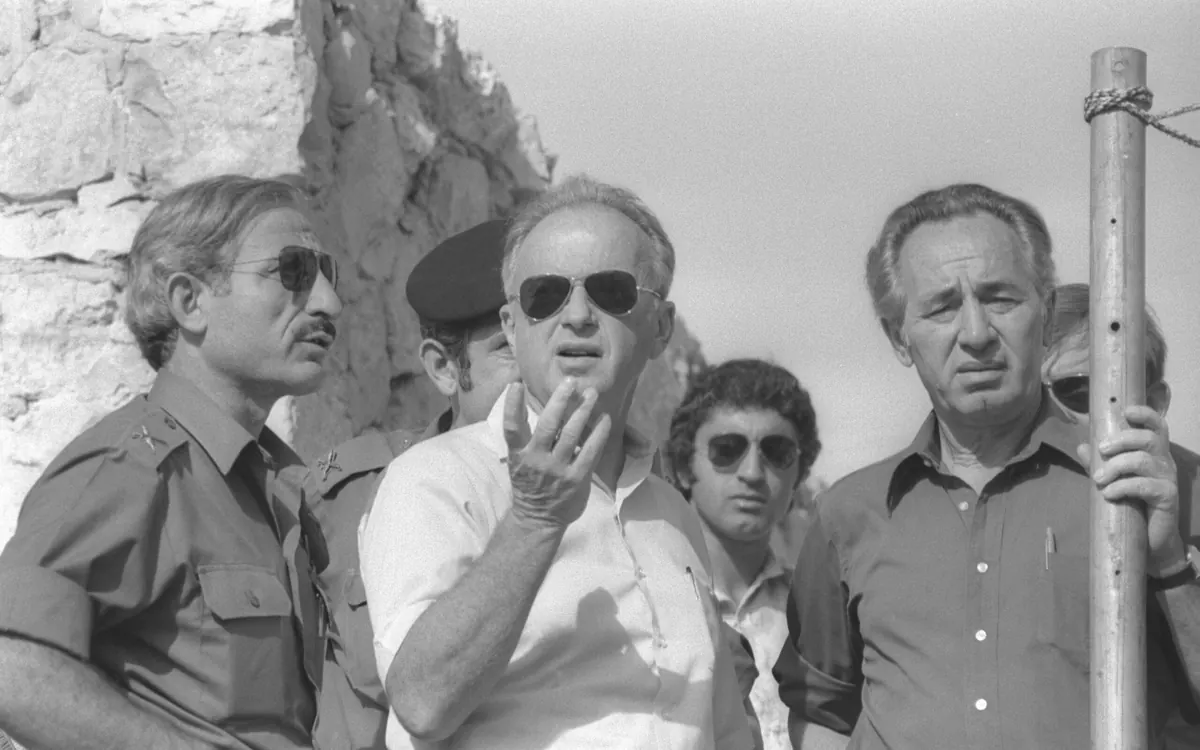
When most people think about Yitzhak Rabin as Israel's Prime Minister they focus on the Oslo Accords and his tragic murder, but many are unaware that Rabin's assassination ended his second term. Here is an episode on his opening round as Prime Minister, when Rabin's choice as the first native born Israeli to head the government opened a new era. We will see him face down US Secretary of State Henry Kissinger on the international scene, but in the end a handful of religious idealists will force him to compromise on the domestic front.
About this episode
People remember Yitzhak Rabin for Oslo and his assassination, which cut short his second term, and forget that his first term was an end of an era too. The labor Zionist camp had led the country since before the state, and with Rabin it would hand the reins to Menachem Begin in 1977. Even entering office he marked a new epoch, the first native-born prime minister, a blunt sabra, the first general to run the system, which Ben-Gurion had fought against. Rav Mike asks for some sympathy, since Rabin was dealt a hard hand in 1974, a society still reeling from the Yom Kippur War, a culture shock reaching down to black and white television, masses of soldiers kept on duty by the slow disengagement, the challenge of Gush Emunim, and the rise of an activist Palestinian identity.
Rabin got the job in large part because he was an outsider. He had returned from a political posting as ambassador to Washington in 1973 and sat twentieth on Golda Meir's list, and when war canceled the elections he found himself without position, ending up running an emergency loan fund. That meant the Agranat Commission touched neither his military nor his political record, and his one public comment, a reservation about pinning full blame on the chief of staff, resonated with the public mood. When Golda was forced to resign, Rabin became a surprise candidate, pushed forward by the Mapai old guard over more obvious men, which earned him Shimon Peres's undying enmity. His opening speech warned that causeless hatred had destroyed Jerusalem and pleaded for national unity.
The international story gathers at a Sunday brunch in June 1975, where Kissinger addressed the big Jews of the Klutznik group at the Hotel Pierre. Security Council Resolution 338 had promised negotiations toward a just and durable peace, but the Geneva Conference produced only icy rhetoric, and into the vacuum stepped Kissinger with his shuttle diplomacy. A first separation of forces had been signed in January 1974, yet by March 1975 the talks ground to a halt when Kissinger pressed Rabin to pull back east of the strategic Mitla and Giddi passes for only a vague five-year pledge of non-belligerency. Rabin balked, Kissinger left almost in tears and blamed Israel, and Ford announced a public reassessment of policy. Rabin's critics at home mocked the salami approach, in which every slice seemed cut from Israel alone.
Rabin and his foreign minister Yigal Allon had a plan they called a piece of territory for a piece of peace, and they held firm against enormous pressure. They had watched Vietnam reach its tragic end and knew not to undermine their strategic position without buying real peace, and they understood that Sadat's economy needed peace even more than Israel did. The American reassessment proved a bluff, made irrelevant by the arms already shipped after the war and by the shared interest in keeping the Soviets out, and seventy-six senators signed a letter of full support for Israel. At the brunch Kissinger warned the big Jews that financing a stalemate would turn the Arabs back to radicalism, and said that when they needed a Rothschild they had a soldier peasant. The soldier peasant stalled and forced the price up.
When the interim agreement was finalized in September it cost over two billion dollars in aid and high-tech weaponry, opened the Suez Canal, and brought a memorandum of understanding and an Israeli veto over American contact with the PLO, an all-around win. The domestic front went differently. Rabin followed the Allon Plan, which held the mountains of the Shomron, including Shechem, free of Jewish settlement in anticipation of handing them to Arab rule, while the idealists of Gush Emunim settled from a messianic momentum. He insisted the real question was sovereignty, who rules rather than who lives where, and that a government tolerating such a violation ceases to be sovereign. The struggle came to a head at the Sebastia station on Hanukkah 1975, where thousands gathered in drenching rain and the poet Haim Gouri carried Rabin's compromise note, a toehold Rabin wrongly believed would empty in three weeks.
Key ideas
- Rabin's first term was an end of an era, closing more than forty years of labor Zionist rule before the handoff to Begin in 1977.
- He was the first sabra prime minister and first general to lead the system, dealt a hard hand by the trauma of the Yom Kippur War.
- Rabin got the job as an outsider untouched by the Agranat Commission, pushed forward by the old guard and earning Peres's enmity.
- Against Kissinger's pressure over the Mitla and Giddi passes, Rabin held firm, and the American reassessment proved a bluff.
- The September interim agreement won over two billion in aid, opened the Suez Canal, and brought a memorandum of understanding.
- On settlement Rabin followed the Allon Plan and insisted the real question was sovereignty, a struggle that came to a head at Sebastia.
Chapters
- 0:01 The end of an era
- 4:29 How Rabin got the job
- 6:40 A surprise candidate
- 7:47 The opening speech; causeless hatred
- 8:50 Kissinger at the Klutznik brunch
- 11:01 Geneva and shuttle diplomacy
- 13:14 The passes; Rabin balks
- 14:17 A piece of territory for a piece of peace
- 16:32 The reassessment was a bluff
- 18:48 The soldier peasant
- 22:10 Settlement and the Allon Plan
- 24:28 Shechem off limits; Gush Emunim
- 26:52 Rule of law or sovereignty
- 34:34 Sebastia; the Hanukkah showdown
- 37:49 The compromise; Gouri the bridge
- 40:00 In three weeks they'll go home
Who, where and when
People
Yitzhak Rabin, Golda Meir, Henry Kissinger, Menachem Begin, Shimon Peres, Yigal Allon, Anwar Sadat, Gerald Ford, Haim Gouri, Naomi Shemer, Rav Moshe Levinger, Hanan Porat
Places
Washington, The Hotel Pierre, The Mitla and Giddi passes, The Sinai, Shechem, Sebastia
Texts
Resolution 338, The Agranat Commission report, The Allon Plan, The interim agreement
When
1974 CE: Rabin becomes prime minister, January 1974 CE: the separation of forces, March 1975 CE: the breakdown over the passes, September 1975 CE: the interim agreement, December 1975 CE: the Sebastia showdown
Read the transcript
If there is no struggle, said Frederick Douglass, there is no progress. And since I'm looking to move things forward, I'm willing to grapple with whatever may come. I'm Rav Mike Foyer, and this is The Jewish Story. Season 5, Episode 6, Yitzhak Rabin's First Term. You know, when I ask people about Yitzhak Rabin's term as Prime Minister, Most start to speak about the Oslo Accords. Some will mention the peace treaty with Jordan. And of course, everyone remembers his assassination. But the majority of them, or at least the non-Israelis in the bunch, are unaware that Rabin's murder, the end of an era in Israeli politics, as we say, actually cut short his second term as prime minister. And they're also unaware that his first term was the end of an era as well.
Because the coalition of parties known as the Labor Zionist Camp has been in charge of Israel at this point for quite some time. They first gained decisive control of the politics more than a decade before the birth of the state, way back in Season 2, Episode 29. I told the story of how David Ben-Gurion united the political fragments of the labor movement into one party, which he called Nifleget Polei Eretz Yisrael, the Party of the Workers of the Land of Israel, or MAPAI for short, and then moved on to the leadership of the Zionist movement in its 17th World Congress in 1931. And since the organs of that Zionist movement became the provisional government in 1948, which then declared themselves the first Knesset during the Constituent Assembly of 1949.
And after that, all the various iterations of Ben-Gurion's original Mapai coalition led those governments. They've been in charge for quite some time. Quite some time, in fact, right up until Yitzhak Rabin, Prime Minister for the Labor Party, will hand off the reins to Menachem Begin in 1977, which is an exciting story that lies not too far ahead in this season, if I'm not wrong. Now, Rabin's first term wasn't just the end of an era, in the sense that when he left office, he took with him an unbroken streak of more than four decades of labor Zionist rule. Even when he entered office, he represented a new epoch. Rabin was the first native-born prime minister, and true to Sabreform, was known for a leadership style that was blunt and direct to the point of rudeness.
It was often misunderstood by those not born in the land. He was also the first general to run the political system, and as such, heralded the post-67 phase of Israeli politics, in which generals were popular and political heroes, a development which, by the way, Ben-Gurion had fought heroically against. Rabin was also seen to be somewhat of a political knafe, certainly in comparison to Golda Meir and the other lifelong politicians who preceded him. But I have to say, in all fairness, even if Rabin did preside over the breaking of a 40-plus year winning streak, he's hardly to be blamed. He was dealt a pretty tough hand. I mean, Israeli society was in upheaval in 1974 when it took office. And not only from the shock of the Yom Kippur War that we've been outlining in previous episodes, there's a culture shock going on as well, which we haven't really touched, just to give you a tip of the iceberg.
Remember, television only arrived in Israel officially in 1966, and it remained black and white until 77. The import of color TV was opposed by the government as frivolous and encouraging of a social gap. That gives you a sense of the type of upheaval which was going on on the non-political level. Furthermore, the initial shock and trauma of the Yom Kippur War is only going to deepen during Rabin's term, as the slow process of disengagement of forces will keep masses of soldiers on active duty. That itself will represent enormous political burdens for society, and of course, his government, not to mention the challenges to national morale that flow from the feeling of an unending war on one hand and a creeping sense of retreat on the other.
Add to this the test the government legitimacy will be faced with by the religious settlers of Gush Emonim, to be discussed ahead, and the rise amongst many Arabs of a more activist Palestinian national entity, which we're going to have to get to next episode. So perhaps I can be a little bit more sympathetic than just calling him the loser that broke the streak. Now, as I said, Yitzhak Rabin was a career soldier, not a political party insider, and certainly not a powerhouse like those who preceded him. And that's actually how he got the job in many ways. In March of 1973, Rubin turned from a highly successful and highly political five-year posting as ambassador to Washington. You can go check back in The War of Attrition, I think it was like Season 4, Episode 10, for a taste of what that was like.
And upon arrival, he joined up with the Labor Party, and the elections committee placed him 20th on Prime Minister Golda Meir's list. A guaranteed seat in those days of labor alignment power, but not a particularly impressive one. But of course, the elections planned for October 73 were canceled due to war. And when the war broke out, Rabin found himself without position or authority, perhaps for the first time since he was a boy too young to join the Palmach. His attempts to enlist as an assistant to one of the commanders on the front failed. I mean, who really wants a former chief of staff looking over his shoulder? And so he quickly agreed to Finance Minister Pinchas Sapir's request that he had the emergency loan fund to raise money to cover the war expenses.
This less-than-glorious posting actually meant that when the Ogrenok Commission passed its partial judgment on the political and military leadership in the wake of the war, Rabin was involved with neither. The only comments he made during the entire public storm that followed the report were some reservations at the decision to place full responsibility on Chief of Staff David Eleazar. as opposed to the political echelon, words that resonated with public sentiment. And so, when on April 11th, Prime Minister Golda Meir was finally forced to resign, Rabin became a surprise candidate to replace her. Despite his youth, his political inexperience, and relatively minor stature within the party, he was supported by a significant coalition of the Mapai Old Guard, and thus pushed forward over more obvious candidates.
Now there's a whole story that we could go into around the changing of the guard within the labor alignment. I'm not really going to do that right now. Suffice it to say that for now, many of the young guard who were looking to get ahead with the leaving of Golda and her compatriot resented Rabin's sudden elevation. And in particular, he earned Shimon Peres' undying enmity. But such party tensions were not enough to overwhelm the fact that Rabin was the hero of 67, blameless in 73, close to the government in Washington, and a trusted soldier in the eyes of the public. And so on June 3, 1974, the Knesset heard the following opening speech from Prime Minister Yitzhak Rabin as he presented his government.
Mr. Speaker, members of Knesset, something has happened to this country since the Yom Kippur War. Even though we scored one of our greatest victories in that war, many of us have deeply troubled hearts. He goes on to say that there were those who exploited this feeling of depression in order to increase confusion and spread weakness and perplexity, who have tried to turn legitimate differences of opinion into a dialogue of the death. Some have forgotten the ancient historic lesson that because of causeless hatred, Jerusalem was destroyed. And as we'll see before the end of the episode, those are more than empty words. He goes on to say, we must shake off our despondency. If we look about us, we will see that we are not in the veil of tears.
Our cause is just. Our strength has increased. Our full rights and spiritual vigor have not lost their momentum. We must reinforce our self-confidence and restore our faiths in ourselves. Let us respect the opinions of others, even when we differ. Let us show respect to each other, even during vehement controversies. let us not impair the most important element in our lives, our national unity, a unity based on a common destiny, on faith in our cause, and on our determination to build. Now many things lie ahead, and many things will be built during Rabin's first term, though not all of them will promote that spirit of unity. On June 15, 1975, Secretary of State for the United States Henry Kissinger met with the Sunday Brunch Group in Hotel Pierre, New York City for an informal talk between the American government and America's big Jews This gathering was also known as the Klutznik Group, named after Philip Klutznik Chicago investment banker and businessman.
Now Klutznik was more than a money maker. As a former UN delegate, future president of the World Jewish Congress and eventually Secretary of Commerce in the Carter administration, he was an up-and-coming political powerhouse in 75, and we might have to trace his role further in an episode to come. For now, he presided over the Sunday brunch for the really big Jews, and the Secretary of State was facing presidents of universities, heads of banks, senior partners, academics, even some major industrialists around the table on this Sunday morning. But he was more than happy to do so. As I've noted before, Kissinger favored these types of forums, not only for their insight and importance on the domestic political front, but in particular for the potential as informal diplomatic forums which he could use to push his policies in the Middle East.
Hence the fact that the primary topic of discussion this Sunday morning was the ongoing post-war disengagement negotiations between Israel and Egypt, a process that had recently ground to a violent halt though thank God not in the shooting sense Security Council Resolution 338 which officially ended the Yom Kippur War promises that the ceasefire will be followed by, quote, negotiations leading to a just and durable peace in the Middle East. And back in Season 4, Episode 20, we touched on the first phase of that process, the so-called Geneva Conference, hosted by the United Nations, attended by Egypt, Jordan, Israel, U.S., and the USSR. and the guest list is kind of all you need to know about how it played out.
Relations were cold to the point of icy, rhetoric was fiery, and the results frankly non-existent. Except for the real fact that Arab and Israeli delegates sat in the same room, their first direct meeting since the road conference of 1949 that ended the War of Independence. After only one day, the conference was, by prearrangement, temporarily adjourned, with the understanding that the talks between Israel and Egypt in particular would continue at the military level. But as it turned out, even this lower degree of direct negotiation quickly collapsed. Into the vacuum stepped Henry Kissinger, and his willingness to fly tirelessly back and forth between Cairo and Jerusalem in pursuit of a deal quickly became known as shuttle diplomacy.
The initial result was the Israeli-Egyptian separation of forces agreement signed on January 19, 1974. The details really don't matter at this moment. Just know that from Israel's perspective, all of her concessions, including unilateral withdrawals, the abandoning of hopes for direct negotiation, and many other points that Rabin was hard-pressed to sell to his domestic constituency, they were all made on the basis of U.S. security guarantees and on the hopes that they were the first step for progress to come. After all, the final kodosal of that agreement repeats what had been said in the Security Council resolution. This agreement is not regarded by Egypt and Israel as a final peace agreement. It constitutes a first step toward, once again, final, just, and durable peace.
Kissinger became a miracle man in both Egypt and Israel. Truth is, his status was elevated around the world, since his success in bringing an end to the open hostilities between Israel and Egypt, and the promise that he would be able to do so between Israel and Syria on the Golan, actually persuaded the Arab oil-producing nations to end their embargo and take a serious weight off the world economy. But the feeling in June of 1975 was quite different than that of January 74. and hence the tone around the table of the Klutznik group was not entirely cozy. When he took office, Prime Minister Yitzhak Rabin was under no illusion that a comprehensive peace in the Middle East, or even peace with Egypt, was in the air.
The drama of direct talks in Geneva had failed, but like I said, Kissinger's indirect, step-by-step approach had at least produced tangible results. And that's even though the very indirect nature of the negotiations itself was a loss in the eyes of Israel. And the incremental approach to peace was criticized by many of Rabin's domestic opponents as shitat salami, right? The salami approach, one in which all the slices, so it means instead of taking the whole thing at once, you take it slice by slice. But in this case, the accusation was that all the slices would come from Israel, cut off by American pressure and receiving nothing in return. Now, despite the risks, Rabin and his foreign minister, Yigal alone had a plan.
They called it a piece of territory for a piece of peace. Slices of withdrawal of Israeli forces from the Sinai in return for slices of Egyptian political concession. It was a good plan until the pressure pushed America and Egyptian President Amor Sadat to cut too deep, which is exactly what happened back in March of 75, when Kissinger attempted to get Prime Minister Rabin to agree to pull Israeli forces back east of the strategic Mitla and Giddy passes. They're in the center and they control the Sinai. In return, the best the Egyptians were willing to offer was a five-year pledge of what they called non-belligerency, a vague notion of peace at best. Rabin balked. And when he did, Kissinger left Tel Aviv almost in tears.
But his sorrow quickly turned to anger as he placed the blame for the breakdown in talks squarely on the Israelis and Rabin personally berating them for their short-sighted vision. The Secretary of State even had President Ford announce in a news conference that as a result of Israel's so-called intransigence, the United States would now be reassessing its policy in the Middle East. Privately, Kissinger railed against Rabin to anyone who would listen, accusing him of, quote, bringing the world to the edge of war for three kilometers in the Giddey and eight kilometers in the Mitla. Well, that's easy to say from Washington. but as we know here in the Middle East, a little bit of space can make a lot of difference.
But here he is, explaining now to the Klutznik group. He said, We told the Israelis all along that non-belligerency was unattainable. When Sadat agreed to a conditional non-use of force, I thought we were halfway there. But what the Israelis wanted was complete removal of all the conditions that stand between the present situation and perfectly normal relations. Imagine that. Well, Sadat's answer to this was, if I have to give up everything just to get them out of the passes, what will I have to give to get my land back altogether? Now, despite enormous pressure from the Americans, Rabin and his government held firm. They had watched, along with the whole world, while in recent weeks, the U.S. failure in Vietnam came to its tragic conclusion.
And beyond feeling for the Americans, as a small state dependent for a good chunk of its security on American support, the implications were obvious. Don't be too quick to undermine your strategic position, unless you're buying with it a very large slice of peace with your opponent. Rubin also knew that despite Sadat's hardline stance, the Egyptian economy was in freefall. He needed peace even more than Israel did. And you know what? The Prime Minister succeeded. In the end, the American reassessment proved to be a bluff. It was first of all made irrelevant by the massive quantities of arms that they had shipped to Israel in the immediate aftermath of the Yom Kippur War. And frankly, neither Egypt nor the United States were interested in returning to a comprehensive Geneva framework which would only empower the USSR and the more intransigent states of the Arab world, they knew that shuttle diplomacy led by Kissinger was the only real option.
Finally, in late May of that year, the Israel lobby managed to flex its political muscle by delivering to the White House a letter signed by 76 out of 100 senators advocating full U.S. support for Israel. And within a week, the diplomatic ball was rolling again. President Gerald Ford met with President Anwar Sadat in Salzburg, Austria on June 1st, and Prime Minister Rabin came to Washington for parallel talks on the 11th. And now the Secretary of State was at breakfast in the Pierre Hotel, aiming to head off any opportunities for the opponents of disengagement to rally further support in the U.S. now that the Sinai negotiations were finally moving again. And here was his warning, which I'm sure he hoped would be conveyed to all relevant ears.
Now Israel wants $2.6 billion, Kissinger said. But we have to ask, for what? Where are we going to go from here? If the U.S. is seen as financing a Middle East stalemate with $2.6 billion, the Arabs will turn back toward radicalism. And then you'll have the Arabs putting oil pressure on the Europeans and the Japanese and eventually on the U.S. At first, Congress will be tough, said the Secretary of State. They will say we won't yield to blackmail. But after five years, I ask you, will we be so tough? And when this situation comes and the Jews in America put themselves up as being the spokesmen for Israel, they'll have to explain why the United States is in such a state. Those are the words of a threat, by the way.
He goes on to say anybody can survive for six months, but the real art to diplomacy is to survive over a longer time frame. If we fail now, there will be an explosion. I don't know when, but there will be one. And even if Israel takes Damascus, Cairo, and Amman, the basic political problems will remain. And he wasn't wrong. Not only did the big Jews of America know that Kissinger wasn't wrong, the government in Jerusalem did as well. Or at least, so Kissinger hoped. Lawrence Tisch, Wall Street investor, future billionaire, and CEO of CBS, raised his hand. Now he asks, what's Rabin's answer to the logic you've presented today? And Kissinger's reply was, well, I think that if we met alone, he would probably agree with 98% of what I've said.
But you have to remember, the advocates of short-term solutions always have the upper hand. He's referring to the conflict within Rabin's cabinet. One of the tragedies of history, it seems to me, is that the Jews have been persecuted for having a cosmopolitan outlook. But now it seems they worry too much about their own particular problem. It's an interesting analysis. He finishes by saying, just that one small part of the world. You see, just now, when they really need a Rothschild, they have a soldier peasant. You know, as much as that may sound like an insult, and frankly, a fair analysis of Rubin's world outlook, soldier peasants can be surprisingly shrewd in negotiation. And Rustic, though he may have been, Rubin was hardly lacking in an understanding of the international situation.
The world that the U.S. led was shaking, and not just because of their defeat in Vietnam. King Faisal of Saudi Arabia had been assassinated in late March. Revolutionary upheavals were shaking Africa. Relations with Turkey were on the ropes. Rabin well knew that the U.S. in general, and Henry Kissinger in particular, needed a clear and unequivocal win in these Egypt negotiations and thus his strategy stall negotiations as long as possible and force the U to pay dearly, both politically and materially. And lo and behold, it worked. When an agreement was finalized in September, the price tag was over $2.3 billion in aid, including massive amounts of high-tech weaponry and the placement of U.S. technicians in Sinai observation posts.
Rabin also achieved a host of U.S. commitments, ranging from guarantees of oil supplies to an Israeli veto over any U.S. contact with the PLO. And in a final, politically decisive victory, the first memorandum of understanding was signed between the government of Israel and the United States, ensuring American support for Israeli interests in the international arena and continuing American aid. The so-called interim agreement with Egypt opened the Suez Canal to Israel and the world. It reduced the threat of war with Egypt and frankly in the region as a whole. It codified American support and paved way for the peace treaty which Menachem Begum's government would sign only a few years later. It's an all-around win for Rabin's government.
But I have to wonder if he was left feeling quite so victorious at the end of 1975 in his battles on the domestic front. Once again, imagining that I'm speaking to the average person, and I ask them about Yitzhak Rabin's stance on building settlement. My guess is that most would say he was unequivocally opposed. After all, Rabin was the face of the Oslo process on the Israeli side, And he built his domestic political base in no small part on vilifying the religious Zionist community, which is the core of the settlement movement. But that was the 90s. It was his second term. Listen to the following statement from an interview, which Rabin gave to the Israeli Daily Idiot Ahonot on July 26, 1974. The question is, what is the government's policy on the issue of settlement in the administered territories?
Where is it permissible to settle, and by whom? And the Prime Minister answered, The government is continuing with the policy of settlement in accordance with the possibilities and needs that arise from time to time. Okay, diplo-speak. I think the areas which will have priority in the future will be the Rafiach salient, that's today the border between the Gaza Strip and Egypt, the Golan Heights, and certain places in Judea and Samaria. At this stage, I am not in favor of settlement in Shechem, nor is it by accident that settlement in that area has been prevented for the past seven years by the various governments. The reality is that Rabin was an advocate of what's known as the Alone Plan. It was a settlement strategy developed by his mentor and foreign minister, Yigal Allon, in the wake of the victory in 67.
If you want the details, go back to Season 4, Episode 6. For now, just know that the basic concept was to control the minimum strategic points needed to defend Israel's borders while maintaining maximum separation between Arabs and Jews. Which is why, even though the interviewer didn't mention Shechem by name, Rabin felt the need to exclude it from consideration for settlement. Now, Shechem has a rich biblical history. It once even served as the capital of the northern Israelite kingdom. But in the 70s, it was mainly seen as a major urban center in the heart of the Sumerian mountains, and thus off-limit to Jews. at least in Prime Minister Rabin's eyes. But as we saw last episode, the idealists of Gush Emunim were not interested in Yigala alone's plan.
Their mission was settling the land from a messianic momentum. It was a response in the world here below, inspired by the redemptive victory of 67 driven in their eyes by God's will above and in defiance of the national depression they saw settling in post-1973. And so, when that interviewer asked Rabin not only where it's permissible to settle, but also by whom, it was a politically pointed question, and one I imagine that hurt. The attempt to create Elon Moray on a mountaintop above Shechem, which we talked about last episode, occurred only six weeks before this interview. And the momentum for settlement had only grown since. And in fact, Gush members would make eight attempts in the coming months to evade army roadblocks and establish a settlement in the Shem area.
In addition to that practical desire to settle the land, those efforts were part of an emerging political vision. In accordance with that alone plan, Labor Party policy was to keep this particular area, the mountains of the Shomron, as well as a corridor through Jericho in the center of the Shomron, between the Shomron and the mountains of Yudah, free of Jewish settlement in anticipation of handing it over to Arab rule. And from mid-1974 until Rabin's resignation in late 1976, Ghosh Amunin's primary effort was directed toward challenging that policy, laying the groundwork for a Jewish settler presence in precisely those areas from which the government aimed to retreat. In that same interview, Prime Minister Rabin stressed that outposts and settlements in the administered territories are established solely according to the decisions of the government.
The government will prevent any attempt to occupy a location or establish a settlement without its approval and decision. Those are tough sounding words. And I might add, he was willing to do so by any means necessary. But as we'll see, that doesn't always mean he was able to succeed. In a statement given to Knesset a week or so after a particularly intense confrontation, one in which it took the army five days to dislodge the settlement group, the Prime Minister had the following to say, words that sound quite familiar in our own time. He said, today, after the events of last week, the Knesset must make clear once again that in the State of Israel, the procedures of the rule of law shall be maintained and no one shall be permitted to violate them.
members of the group, referring to the Gushem Unim met me before they decided on this inadmissible act trying to settle above Shechem during the meetings, principal proposals were made to them and other locations designated where the population is sparse and its reinforcement vital meaning he wanted them to be part of the alone plan from the course of the meetings, it was clear that according to their concepts they were entitled to decide where and when settlement should take place meaning they were following the call of God The people knew that the government would use its authority, and nevertheless, they believed that they would create an accomplished fact, and the government of Israel would say Amen.
Thus, the argument today is not over settlement, but over the maintenance of state responsibility and authority, over the foundations of the democratic system, over the authority of the government. Meaning, Rabin recognized well that the question at hand wasn't about who lives where. It was about who is sovereign. He goes on to say, Now, whether Agriya's opinions about who should settle where or not, he's correct. any government that tolerates such a violation ceases to be sovereign. Now, these are strong words from a strong leader. After all, this is just about the same time he's facing down the Secretary of State of the United States government. But politics always look different between the domestic and the international fronts.
And in particular, when it comes to Am Yisrael, a leader who finds himself with the power of a king while facing the nations of the world can suddenly discover he's only a pawn when facing his own people. So like I said, there were eight attempts by the Gush Emunim activists to settle above Shechem in 1974 and 1975. Seven failed, but only one needed to succeed. And all those numbers don't really adequately tell the tale. Because with each attempt, the numbers involved in the effort, the extent of media attention and the level of public support, therefore, grew. Influential political personalities like Menachem Begin, Ariel Sharon, and Geul Akon began to appear at the temporary encampments which they created before they were pulled down.
They were there for ideological and practical political reasons. And perhaps most importantly, the struggle to settle in the Shomron allowed the activists of Gush Emunin to capture the imagination of a critical part of the nation. It was very easy to link their efforts to the original pioneering spirit of the pre-state days, taking up the mantle of the farmer idealists that had created the state, and projecting a posture of moral clarity and vision in a time of national confusion and even despair. Furthermore, Prime Minister Rabin's criticism that it was intolerable that any group of people, whatever its motives, should take the law into its own hands, was easily turned on its head. I mean, the British government was resisted by the Zionist founding fathers, and so the state came to be.
Now, settlement in the Shomron may have been declared illegal by the Israeli government, but it was as illegitimate as the early illegal Jewish settlement in Palestine in the minds of many. In fact, government declarations, in their eyes, didn't delegitimize the efforts of Gush Emunim. On the contrary, the efforts of Gush Emunim illuminated the questionable legitimacy of a government attempting to prevent Jews from settling in the land of Israel. And let's not forget that during the 1970s, many of Israel's political leaders had experienced their formative years in the pre-state kibbutzim. They were settlers themselves. How could someone, like Foreign Minister Yigal Allon, strong supporter of the resettlement of Hevron not equate the desires of Gush Emonim with his own past For many despite their defiance or perhaps because of it the settlers represented the idealism and self-sacrifice of the good old days.
Furthermore, let's be clear here. The willingness of the labor Zionists to create facts on the ground, in questionable legal fashion, didn't die with the birth of the state. The raising of the Mugrabi quarter in the old city of Jerusalem to make way for what you now know as the Kotel Plaza immediately after the 1967 war, and the rebirth of the Jewish president in Gush Etzion in Hevron seemed to make any attempt at insisting on the rule of law appear as nothing other than sheer hypocrisy. Add to this the problems of domestic politics in Israel in general. at the best of times, Israel's coalition governments are factious, and for Rabin in the mid-70s the situation was worse than usual, to be kind. Despite official allegiance to the alone plan, there couldn't be a united policy toward these newly conquered territories, and Rabin knew well that any attempt to decide on exactly what territorial compromise and defensible borders meant would bring his government down.
And thus the activists of Gush Amunim were able to exploit these splits within the government to pursue their aims. In the face of uncertainty, those with clarity will always have power. I mean, there were three leading personalities within Rubin's cabinet that all worked closely with Gush Amunim one way or another. Rubin's special advisor for defense was Ariel Sharon, and we told his attitude in the episode last week. Shimron Perez's personal aide, Yuval Neiman, openly supported the Gush operations from within the defense ministry. And as I said, Foreign Minister Yigal Allon was the patron of Hevron and Kiryat Arba. As a lifelong soldier, Prime Minister Rabin surely knew that this was not the way to wage a war.
And whether he liked it or not, war it was. Remember how he ended last episode with what sounded like Rav Tzvi Yehuda's call for a civil war over the issue of settlement? As far as Judea and Samaria and the Golan Heights are concerned, he declared, this shall not happen without a war over our dead bodies. There's no way that either the Gentiles or political entanglements of our own can make it work. It's true that his students insisted that the violence of the rabbi's statement was hyperbole. Ezra Zalman Malamed would later explain what war did the rabbi have in mind when he said that there was going to be war over Judea and Samaria? In my humble opinion, it seems to me, indeed, he meant that it was totally forbidden to assist in the withdrawal.
that any command to withdraw or evacuate settlements is contrary to the Torah, to morality, and to justice. We should not obey it, and we must fight back by resorting to all public means to the extent of declaring non-violent civil rebellion. Now, that may have been a sidestepping from violence, but it was certainly a call to arms, one which in this chapter of our story culminated in the winter of 1975. When people think of buildings that mark the course of Jewish history, they might mention the temples, perhaps the city of Beitar, maybe the great synagogue of Warsaw or the academies in Babylon. Few, I think, would identify the train station at Sebastia. But depending on how the rest of this century plays out, that might be a very big omission.
Now, in all fairness, the station itself was built by the Ottomans in early 20th century, so therefore it could hardly claim an old role in Jewish history. But the location where it's built has a rich history, extending all the way back to Shomron, the second and enduring capital of the northern Israelite kingdom. But I'm not interested in the glories of its past. In our story, the appeal of Sebastian actually comes in Hanukkah of 1975. And it came as the building that provided shelter and a rallying point. It was the station that became the destination of all those attempts I listed by the activists of Grush Emunim to settle in the Shomron. In fact, one of those more violent confrontations between the army and the activists in the spring of 75 led to them barricading themselves in the loft until the soldiers began to destroy it from below.
In that round, it was only the intervention of Rabbi Tzvi Yehuda, who named the soldiers as evildoers capable of shedding blood, which prevented bloodshed from occurring. In December of 1975, advertisements began to appear in newspapers across Israel, calling on people to, quote, join the great procession. The people of Israel are coming home again and advising people to reach the Sebastian station by any means possible. Gush activists loaded two mammoth trucks with supplies and they set out for the Sebastia station. They managed to evade most of the roadblocks set by the government along the way. And the ones that stopped them, they were let pass with a wink and a smile by soldiers sympathetic to their cause.
Despite drenching rain, which lasted for days, thousands gathered at the station. And when another advertisement on Hanukkah itself announced, let's meet at the train station, a thousand people set out on foot from Kfar Saba, marching 15 miles in the wet and cold, led by poet Naomi Shemmer of Jerusalem of Gold fame. This time, it appeared that the government would surely crack. The Gush activists were confident that not only was God on their side, but the people were with them as well. And it was indicative of how the government viewed this effort, that it was Defense Minister Shimon Peres brought in on helicopter to lead the negotiations. The roaring of the rotors was deafening as he descended into the mud, but everyone within the station heard Perez's initial demand, shouted upon entrance, Get out now!
If they try to evict us, we'll defend this place as we would our homes, was the initial reply. Things kind of deteriorated from there. Ramosh Levenger, who'd left his home in Cabron to join the effort, stormed out of the building, shouting, For something like this, you've got to tear your shirt in mourning! and he was joined in doing so by many others around him, sitting in the mud. Sensing the crisis, Hanan Perat also stepped out of the station and he asked the legendary poet Chaim Guri, who was there nominally as a journalist on behalf of the Davar newspaper, to join the meeting inside. Now Guri was there not only on behalf of his employer, but on behalf of his government as well. He was part of the labor old guard and yet had much empathy in particular for the settlement efforts within Gush Etzion, and it was felt that he could be a bridge between the two sides.
In his pocket, along with his pencils and newspaper's notebook, was a handwritten note from Prime Minister Yitzhak Rabin that detailed a compromise proposal. The idea wasn't new. In fact, it was almost word for word the same proposal, which had been rejected by Rav Tzvi Yehuda during the last attempt to settle the Sebastia station. Nonetheless, this Hanukkah was a show of force beyond which anything Gush Emunim had managed to achieve up to now. In Guri's sense that despite the tension and heated rhetoric, they felt victorious already. And he knew that both sides needed a compromise in order to avoid a terrible confrontation that neither really wanted. Pulling the crumpled paper from his pocket, the poet read, all the settlers are to evacuate Sebastia immediately.
Thirty people will remain in the adjacent army camp under army control and will wait there until the government resumes deliberation of the settlement issue. Once the note had been read, Defense Minister Peres returned to his chopper and took off for his office in Tel Aviv, while the leaders of the activists gathered for an all-night debate, huddled in a cubby off in one corner, which could only be entered through a crawlspace. Rav Levenger insisted that victory was within grasp, that the thousands outside the station proved that the activists of Grush Emunim should hold out and accept nothing less than a government declaration permitting settlement anywhere in the land of Israel. His voice, however powerful, was nonetheless in the minority.
Many others saw the compromise as a breakthrough for which they had fought. It was a toehold in the Shomron which would allow them to build, and they saw no need to push the government to the brink. The government, said Hanan Perat, cannot afford a total surrender. We have to provide it an honorable way out. And in the end, with a show of hands, the vote was for compromise. Now, unbeknownst to the Gush activists, at the very same time, a meeting of Prime Minister Rabin's government was taking place, albeit in a location far more warm and dry. As they voted to ratify the compromise, the Prime Minister told his cabinet, the evictions only make them stronger. Let's permit them to stay in the kadom camp.
In three weeks, they'll all go home. Now, Prime Minister Rabin may have been able to face down the American Secretary of State by calling his bluff, but boy was he wrong about this one. Before I sign off, I want to thank some folks. I just want to thank all the folks that give their hard-earned money to make this show happen, keep it free and widely available. I want to ask you to join them right now. Go to my website, jewishstory.co. In the upper right-hand corner, you'll see a button that says Be a Patron, and you can click on that for a little bit of per-podcast support. Or, if you'd like to give a one-time donation, you can do it on PayPal, robmikepoir at gmail.com is the associated email. You can also send me an email there or a message on Facebook.
I'm happy to share with you details on how you can dedicate a show to your loved ones who are with you today or who have moved on to a better world. I also want to thank the Land of Israel Network. That's thelandofisrael.com creating a center for global spirituality in the heart of the Judean mountains. I want to thank the Pardes Institute P-A-R-D-E-S dot org dot I-L for throwing the doors of the Beit Midrash open as wide as possible. And I want to thank you for listening. I'm Rav Mike Foyer and this is The Jewish Story.
More from Season 5
TJS S5 Interlude - interview with Gil Troy
Historian and author Gil Troy joins me for a follow up to the 'Zionism is Racism' episode. We talk 'Moynihan's Moment,' the rise of the PLO, the mental...
Play Episode
TJS S5E5 - Gush Emunim
Many things within Israeli society were threatened with collapse in the wake of the Yom Kippur War, and perhaps the most profound danger was a loss of spirit....
Play Episode
TJS S5E7 Yitzhak Rabin's first term - part II
Prime Minister Yitzhak Rabin in the 1970s faced conflicts on all three fronts of Jewish history - within Am Yisrael, between Israel and the nations, and as a...
Play Episode