
TJS S5E8 Yoni Netanyahu and the Raid on Entebbe
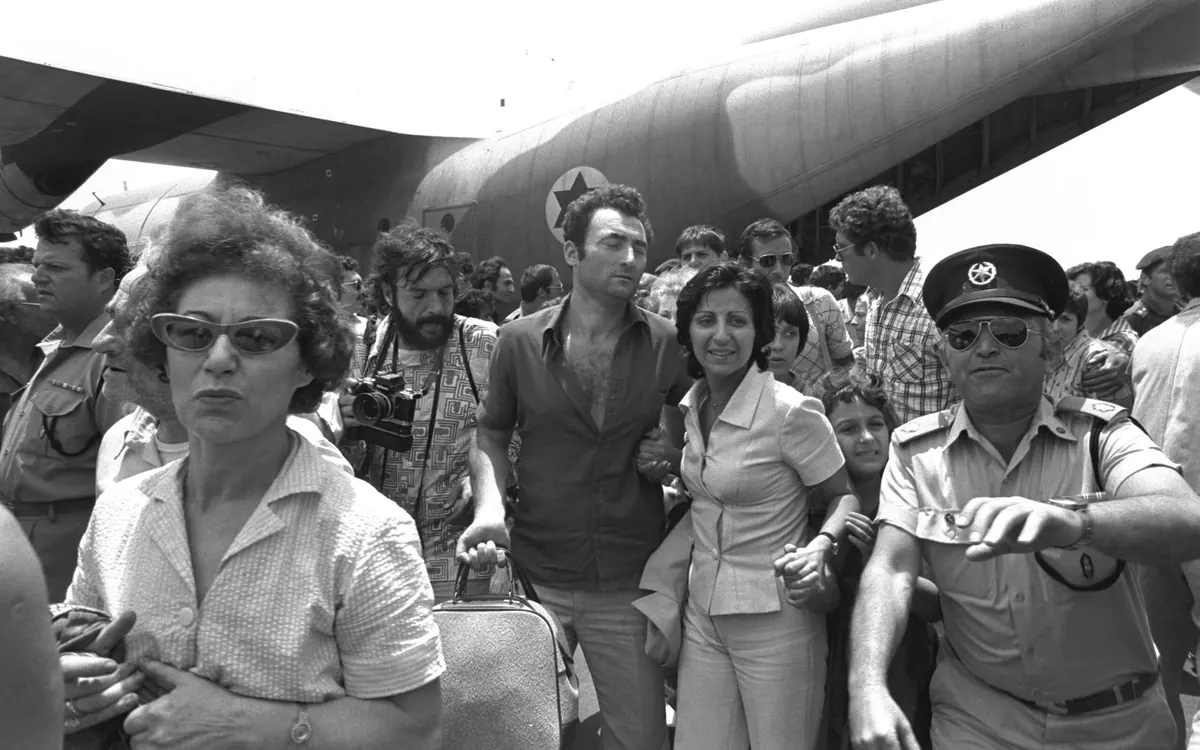
Heroism is a precious quality, and one strong enough to change the world. Here is the story of the Israeli mission to free hostages held by Arab terrorists in Entebbe, Uganda perhaps the most heroic mission of its time. At its heart lies a person who in many ways embodies the qualities of his generation - Yonatan Netanyahu.
Photo credit: Moshe Milner, Israeli Government Press Office July 4, 1976.
About this episode
Heroes carry a story forward. They act in a way that channels the deep narratives underneath a people’s life, and then, in the retelling, they come to embody those narratives. Rav Mike opens with that claim and with a worry: no age has needed heroes more or disparaged them more than ours, where a hero is treated as a villain with good PR. The Torah’s heroes are flawed and their flaws are part of the tale, which is exactly why they can be models. Yoni Netanyahu is the quintessential Israeli hero of the Jewish Story, the Sabra made real, thorny outside and sweet within, and what psychologists call an ordained hero, someone compelled to become what he already imagines himself to be.
The episode follows him from New York, where he was born in 1946 while his father Benzion was in academic exile, to Jerusalem, to a second exile in America in his junior year of high school that left him writing to friends that he lived in a world that was shattered and ruined. He enlisted in the paratroopers the moment he graduated, was wounded behind enemy lines in the Six-Day War, tried Harvard and left it, and rose through Sayeret Matkal, the unit, at the moment it was turning from intelligence raids to counter-terror. On Yom Kippur 1973 he stood up at the battle for Nafah on the Golan as if it were an exercise, and his men followed. He then took over a decimated armored battalion and made it the best on the Golan before returning to command the unit in 1975, with the failure at Ma’alot still fresh.
Then the hijacking. On Sunday June 27, 1976 a note reached Prime Minister Rabin in the middle of a cabinet meeting: Air France 139 from Tel Aviv to Paris, taken after a stopover in Athens. Rav Mike tells the week that followed through what Israel did not know and slowly learned: Patricia Martell faking a miscarriage in Benghazi so she could get off the plane and talk, the four hijackers from Wadie Haddad’s PFLP faction and the German Revolutionary Cells, the landing at Entebbe, Idi Amin’s collusion, the separation of the Israelis from the other hostages, and the deadline. Rabin and Peres, who disliked each other, fought over negotiation and rescue, and Menachem Begin promised the opposition’s support either way.
The plan that emerged, four Hercules transports flying 100 feet above the ground with a black Mercedes in the lead plane, looked to the Chief of Staff like wishful thinking. Rav Mike walks through the rehearsals, the cabinet vote taken while the planes were already in the air, and the fifty-one minutes on the ground at Entebbe: the Ugandan sentries, the firefight that broke surprise fifty yards short of the terminal, the German terrorist who turned his gun away from the hostages at the last moment, and Yoni, shot from the control tower as he set up his command post. One hundred and one hostages came home. Four did not, and one soldier.
What stunned the world, he suggests, was that it was attempted at all. There is a kind of heroism that flows from ein breira, no other choice. The episode closes with a poem a childhood friend published days after the raid: Yoni is everything that is beyond words.
Key ideas
- Heroes matter because they carry the story forward, in their actions and then in how the story is told afterwards.
- Our age has deconstructed the hero into a villain with good PR. The Torah’s heroes are flawed and still models for emulation.
- Yoni Netanyahu is the Sabra ideal and an ordained hero, shaped by exile from Israel as a teenager and by a refusal to live a life without purpose.
- Sayeret Matkal was built to operate like a spy and strike like a soldier. Ma’alot in 1974 taught the unit to train and to ignore governmental waffling.
- The rescue at Entebbe took fifty-one minutes on the ground. Yoni was its only fallen soldier, and his death turned a personal and family legend into a national one.
- Ein breira: a heroism that comes from the clear-eyed sense that there is no other option than to go forward.
Chapters
- 0:00 Why heroes matter, and why they are disparaged today
- 3:26 Yoni and the Sabra ideal
- 5:40 The ordained hero
- 6:47 The Netanyahu family and Benzion
- 10:05 Yom Kippur 1973: the battle for Nafah
- 11:10 Born in New York, raised in Jerusalem, exiled to America
- 13:26 Paratroopers, the Six-Day War, Harvard
- 15:34 Sayeret Matkal: the unit
- 19:53 Ma'alot, 1974: the lesson
- 22:10 June 27, 1976: Air France 139 is hijacked
- 25:23 Patricia Martell's gambit; who the hijackers were
- 27:38 Rabin and Peres; the plane lands at Entebbe
- 29:52 The deadline, Begin, and a plan that looked absurd
- 33:23 Operation Thunderbolt: four Hercules
- 35:34 The cabinet votes while the planes fly
- 36:46 The Mercedes on the tarmac
- 38:57 Fifty-one minutes
- 40:01 The cost, the UN, and ein breira
- 43:14 Yoni is everything that is beyond words
Who, where and when
People
Yoni Netanyahu, Benzion Netanyahu, Benjamin Netanyahu, Yitzhak Rabin, Shimon Peres, Motta Gur, Menachem Begin, Ehud Barak, Muki Betzer, Idi Amin, Wadie Haddad, Wilfried Boese, Patricia Martell, Dora Bloch
Places
Entebbe, Uganda, Benghazi, Nafah, Golan Heights, Ma'alot, Jerusalem, Harvard
When
June 27, 1976: Air France 139 hijacked, July 4, 1976: Operation Thunderbolt, October 6, 1973: the battle for Nafah, May 1974: Ma'alot, 1972: Sabena and Munich
Read the transcript
Sometimes, said Yoni Netanyahu, it is good to believe that a man is a giant, a force before whom nothing can stand. Well, I don't know if I'm a giant, but I like to believe I'm a little bit larger than life. I'm Rav Mike Feuer, and this is the Jewish story. Season 5 Episode 8 The Raid on Entebbe You know, heroes are important. In so many ways, and to me, one of the most powerful is in how they carry a story forward. I'm not now speaking of the great man theory of history and all the questions that revolve around that strange human capacity for making decisions which actually matter on historical scale. Right now, I'm referring to the role heroes play in how the story of those events take definitive form, how we come to understand life and history after the fact.
We tell ourselves about our lives in order to strengthen certain aspects, even to give them a sustaining power beyond the events which they communicate. That quality of heroism, in which it first channels the essential topographic elements of those great stories which underlie life through their actions, and then comes to embody those same elements in the retelling of the events is the real power that people have to create historic realities, especially heroes. And I have to admit, I also feel that there's been no other time when heroes were so desperately needed and so deeply disparage as much as they are in our day. Now certainly, there were plenty of times before ours that called for heroism and didn't get an answer, but those times weren't saturated with an almost complete skepticism toward the genuine heroic figure at all, the way in which our day is.
We have deconstructed everything, not only our heroes, we picked apart their flaws, their motivations, until we claim to know better than they, who and why they were. We've called heroism as a quality itself into question, and frankly, that frightens me. A little binary of victim versus perpetrator, which is getting so much traction in our culture today, in which those who have power by definition must have taken it from others in service of themselves. That definition has very little room for heroes, because a hero is one who uses their power in the name of that which is right and good. And just by saying, right and good, I raise the eye of those postmodern skeptics to whom really a hero is just a villain with good PR, just like everybody else, at best you might get them to admit that we're dealing with a Marvel comic book type character, someone who might be able to stab off disaster through their miraculous strength, but lacks any leadership toward an actual vision of the right and good.
Now the Jewish story is a story of heroism almost by definition, because the Torah itself rests in part on that quality, and no small part at that. And if you've ever read the Torah, then you know that every hero with which it presents us has their flaws and failures, and not just as sidelines, their actions define the story, their character shapes how we tell that story, and therefore their flaws and failures are an intrinsic part of our tale. And that's why the heroic figures in Torah are actually examples for emulation, their models for understanding, and their also constant reminders of the gritty complex and sometimes ugly nature of human existence even as it moves forward. So today I want to tell a story of heroism, which of course is the best done through the life of a particular hero, but I don't want to over focus on the particular.
I'm actually interested more in the heroic than in the hero himself, I mean as if the two could be separated, but I want you to keep it in mind as we go forward. Because Yonatan Netanyahu, Yoni, is the quintessential Israeli hero of the Jewish story, at least that we've had up until now. Yoni represents the Sabah, the Sabrah, that native cactus fruit, which gave its name to the native Jews of the third commonwealth here, the Sabras, thorny on the outside, but sweet and juicy once the skin is removed. The Sabrah is the new Jew of Zionist dreams made real, standing in deep contrast to how they viewed the soft, passive, religiosity of the Jew in exile. There are elements in there of military achievement, conquest, liberation, daring courage in the crafting of that native identity, as well don't forget of the socialist peace, which elevated solidarity and camaraderie above personal considerations.
The Sabrah is fearless and independent, and at the same time willing it's not eager to sacrifice everything for the whole, and in all it's a powerful new way of being, and one which both produces and thrives on the heroes which it produces. Now I have to admit I spent a little bit of time in theory here, and psychological studies of heroism break down the types of people we call heroes into many sub-categories. It's an interesting rabbit hole to go down if you ever had time, but one of them I found is called the ordained hero. These are the people who harbor a deep desire and even an expectation of becoming a hero. They have a self-representation and inner identity that's saturated with heroic models, content, it can be inspired by family, society, faith, culture, there are all kinds of places from which we can draw that heroic inspiration.
And this understanding of self is so powerful that the ordained are in a sense compelled to become that which they imagine themselves to already be, and because heroic acts are almost invariably risky, they're often forced to live under the shadow of a constant threat to their life and those of the people closest around them. And as we'll see, this model fits you only personally like a glove. But his is a story of more than personal heroism. When I say that he embodied the heroic model of Israeli society, that he is the quintessential Sabra hero, I mean more than that he's a particular example of a general phenomenon, no matter how well he demonstrates what the ideal Sabra might look like. The way in which his story continued to shape the Israeli story well after he left it bespeaks something more profound than just the plot and call the particular and the general is at play here.
You may or may not know that Netanyahu family is often held up as the royal family of the Israeli right. I mean, BB, clearly crown prince and then king, and Yoni has tragic heroine inspiration. And the truth is, their royal pedigree begins well before, at least with father Benzion. He was close with Aba Akhimeir of the breed Habironim theme, if you don't remember that, go back to season two, episode 32. But certainly, I hope you recall revisionist leader Zeb Shabbatinsky, to whom Benzion Netanyahu served as private secretary until Shabbatinsky's untimely death. And as a fan, I can't resist adding that Benzion was also an important historian whose revisionism wasn't living to his politics and played a real role in shaping how we understand the Jewish story.
Origins of the Inquisition in 15th century Spain overturned centuries of orthodoxy, demonstrating that limpieza disangri, that notion of purity of blood was the real issue explaining the attack on the Conversoes in Spain. They were tortured, killed, property seized, not for practicing secret Judaism as many claim, and for which there's really very little evidence, but because of the inescapable otherness of being a Jew. So like I said, Benzion the father is a foundational element of the story in his own right, and it's well known that Yoni's life and death gave BB significant encouragement to enter into politics, which has obvious ramifications for our story. So this is a personal and a familial legend.
It became a national one when Yoni's death made him into a public figure. The story of how the hostages at Entebbe were saved through Operation Thunderbolt, which we'll tell shortly, became the story of Operation Yonatan, told through movies, documentaries, books, art exhibitions, everything you can imagine. Within a year of Yoni's death, his brothers BB and Edo gathered various letters he'd written to people close to him, organized them chronologically, and published them. The letters of Yoni Netanyahu became a best seller. Even now it's routinely distributed to young soldiers and officer training. Yoni, important Israeli politicians and military leaders, point to the book as having had a profound influence on their career path.
I myself found it to be the core element of my secular side of my Zionist inspiration. So Yoni's heroic story extends backwards and forwards from his death, and it was founded forged even around the ideals of courage, sacrifice, patriotism, it extends even beyond the borders of Israel, because as we'll see, his name became linked with the fight against international terrorism, and so ultimately, and posthumously, Yoni has become one of Israel's most influential public figures. But every story, no matter how grand and heroic, has to start somewhere. We were in fact the last force to defend the place. We were standing on the road looking for the enemy when suddenly heavy fire was open on us, killing one of our officers.
The Syrians caught us with themselves behind cover while we were exposed in the field. These are the words of an officer at the Battle for Nafah. The Israeli army's headquarters in the Golan, which were at that very moment, all but fallen into the hands of the first surprise Syrian wave on October 6, 1973, the Yom Kippur War. When someone hadn't begun giving clear commands, things would have been grim. But in the near silence which followed the first Syrian braj, quote, was kind of a feeling that you were waiting for someone to do something, and fear, lots of fear. What I saw then was a picture I'll remember all my life he continues. Suddenly, I saw Yoni stand up quite calmly, as if nothing had happened.
To hand movements, he signaled to the men to get up, and he began to go forward as if it were a fire exercise. He walked upright, giving out orders right and left. I remember my thoughts then as a soldier, hell, if he can do it, so can I. I got up and started to fight. Acharai, follow me, is the name of a powerful documentary that records Yoni's life and it was well named, because his tendency to step out in front of a situation marked him from the very beginning. Though Yoni's parents were as dyed in mules, he was actually born in 1946 in New York City. From the outset, Benzion had face difficulties in finding a university position in the small and highly politicized field of the mandate, and so he was forced to pursue studies and teaching in America.
Nonetheless, independence drew Netanyahu family back home to Jerusalem in 1948, so Yoni had the good grace to grow up in the newly liberated land, along with his two younger brothers, Edo and Benjamin. In those years, Yoni appears as the ideal Israeli youth, and I can imagine he lived them as somewhat idyllic, a bright student, charismatic, well loved, a passionate leader in the scout movement, where he invested much of his energy outside of school, and had his first real taste of leadership. But this idol was shattered when Benzion's career once again drew the family back to the United States in 1963 in Yoni's junior year of high school, leaving such a well-loved and well-known environment was devastating.
As he wrote to a friend back in Israel, I lived, but in a world that shattered and ruined, I studied, but I don't learn a thing. Now Yoni was talented enough to survive anywhere, but there are certain plants that cannot thrive other than in their native soil. I feel he wrote, I belong to a different world, I'm remote from them, and the distance does not diminish as time passes, but quite the reverse. There isn't a moment here that it would not sacrifice it once for my immediate return to Israel, my friends in Israel, my social life, and above all, the land itself. I miss very much. Standing outside of the world in which he lived was painful and alienating, but it also gave Yoni a perspective on himself and the society around him, which is worth reflecting on.
I only know he wrote, that I don't want to reach a certain age. Look around me and suddenly discover that I've created nothing, that I'm like all the other human beings who dash about like so many insects back and forth, never accomplishing anything, endlessly repeating the routine of their existence, only to descend into their graves. With this said, it was no surprise that immediately upon a graduation, Yoni returned to Israel to enlist in the paratroopers. He got his wings and moved up into the officer's training course where, of course, he excelled. In one of his letters from the states, Yoni had reassured his friend Rina that he didn't fear death, quote, because I attribute little value to a life without purpose, and if I should have to sacrifice my life to attain its goal, I'll do so willingly.
Well Yoni had found his goal, his calling even in the Israeli army, and his lack of fear at the ultimate sacrifice served him well as he grew to be known as a daring diligent and extremely bright commander. Those around him said, and only half joking way, that from the outset he was a future Ramatkal, a chief of staff. During the Six-Day War, Yoni was seriously wounded while on a search and rescue mission behind enemy lines, bringing him his first decoration for valor, and a little bit of time off to heal. He married his girlfriend Tirza, and they moved back to the U.S. to attend Harvard. But though he excelled in his studies, college life surrounded by what he called shaggy men and bearded women was not for Yoni.
He was interested in winning a war in the Middle East, not stopping one in Vietnam. So the uncouple was back in Israel by 1968, where despite his injuries, Yoni was certified fit to return to combat by the army. It was a stroke of fortune, and at least in my eyes a bit of historic irony. The examining doctor was a recent immigrant with a non-existent grasp of Hebrew that led to him examining Yoni's leg, paying no attention to the attribute state of his wounded arm. Now nothing so small as a flesh wound was going to hold Yoni back. When his rise in the ranks, and by 1970, he was serving as a squad leader in Sayeret Matkal, the command of force, which was answered directly to the general staff, also known as HaYechida, the unit.
The unit was established in 57, drawing together Palmach veterans from the pre-state days, activist elements of the intelligence world, and survivors of our Ariel Sharon's legendary unit 101, or I should say infamous for its cross-border raids. Now initially, the unit's mission was intelligence gathering in foreign country. Many were Mizrahi Jews, Jews of Middle Eastern and North African descent. They inherited the Palmach's tradition of mista'arvim, appearing as Arabs to mingle amongst the enemy in order to gather intelligence, and they'd added to it the sophistication of the Mossad and the unhesitating ruthlessness of the unit 101. As founder Avraham Arnan told his men, the Palmach is gone, and so is the 101.
Now it is only us. We are the tip of Israel's spear, chod hachanit. Unlike other commando units, which tend to rely on overwhelming strength and sophisticated weaponry, the unit operates in that twilight realm between the military and the intelligence services, trained to operate like a spy and strike like a soldier. And that's why even today in Israel and around the world, they are a living legend, a secret fraternity of soldiers, who in their never-ending war and Israel's enemies strike out of nowhere and then disappear to wherever they came from. Yoni Rose quickly up the unit's chain of command, at a time when the events of the world were forcing them to shift focus from commando raids and intelligence work to anti-terror pursuits.
And we spoke last season, it was in 11 and 12, about the rise of Palestinian terror, the Munich massacre, the wave of hijackings that Israel faced in the early 70s. And by the time Black September struck at the Olympics in Germany, Yoni was deputed to the unit's commander, Ehud Barak, future prime minister and chief of staff himself. Yoni participated in countless operations in those years, including a hijacking rescue operation, which the unit executed after Black September a terrorist landed her hijacked Sabina airliner at the Tel Aviv airport itself. It was the first time the world had seen an operation of this type. And though Yoni didn't serve in the field in that operation, he watched, as his younger brother BB, also a commander of the unit, was wounded on the tarmac.
As the bloody year of 1972 passed through the Olympics and Israel's revenge operations, the unit became known around the world as the new standard in anti-terror operations. When the Yom Kippur War broke out, Yoni was actually back at Harvard trying to complete his studies. He quickly returned and took command of Sayeret Matkal Squad in the Golan Heights, with heroic results as we heard above. As a reward for this valor, he received the distinguished service medal. And as an expression of his heroism, Yoni left the unit to join the armored brigade, which had lost many of its officers and men during the war. He quickly graduated from the armor school, as usual, with honors. And within two months, he was given charge of the armored brigade that had been decimated during the war.
Within another few months, the brigade came to be considered the number one armored unit on the Golan. And this is what he said to the unit on the eve of assuming command. I believe that there can be no compromise with results, never accept results that are less than the best possible, and even then look for ways to improve and perfect them. I believe that the greatest danger in the life of a unit is to lapse into self-satisfaction. I would like the men of this battalion always to be a bit worried. Perhaps there's something else we might have done, something we might have improved and did not. Yoni was known, as you can hear, as a hard-driving perfectionist, and frankly many found him personally difficult to deal with, critical, uncompromising sometimes beyond all reason.
But he drove himself harder than any man who served under him, and no one questioned his ability to lead. Though amazingly, sometimes he apparently questioned himself. As he wrote to his father in the winter of 75, every now and then I ask myself whether I'm personally contributing anything to Israel's defense beyond words, and my answer, and it's small comfort, is that in my own way I'm doing a great deal. It's not the mere fact that I'm serving in Israel's army, but the specific task I'm fulfilling and the positive results accompanying it. While those positive results took a big step up when in June of 1975, Yoni returned to Sayeret Matkal as a lieutenant colonel with command over the unit. The commandos faced a series of difficult and messy operations in the intervening years while he was in the armor, some of which, really they considered a failure in particular, the disastrous failed attempt to free more than 100 high schoolers and their teachers from terrorists in Ma'alot a year earlier in May of 74.
In the town of Ma'alot itself, a lot of people gathered outside the schoolhouse where the battle took place. Inside the blood stains, the bullet-scarred walls, and the damaged ceiling told their own story. There were more emotional scenes in Ma'alot at the funeral of the Cohen family, shot by the guerrillas as they made their way to the school. The father, Joseph Cohen, his four-year-old son and his seven-month pregnant wife were gunned down in their apartment, only the 18-month-old baby, a deaf mute, escaped. The terrorists had demanded the release of 23 comrades from Israeli jails, and while the Israeli government held firm to a no-negotiations policy, they nonetheless wavered in the face of a such potentially awful consequence.
When the green light was finally given to the unit to go in, Dark had already fallen, and they found themselves in the words of one veteran without any formal doctrine to guide them, and so they improvised. The results were disaster. The initial cypress strike failed to neutralize the terrorists and they turned their guns and grenades and the mahasages before the commandos could enter. Dozens lay dead when the shooting finally ceased. It was an image which would haunt many of them in the years to come. And so, the only came into the unit determined to learn the lessons, not the least of which was to ignore governmental waffling over negotiations, and oh, to train, train, train, because a real weapon is ready to hand before you even know you need it.
5. Prime Minister Yitzhak Rabin received first word of the hijacking of Air France flight 139. When his military aid handed him a note in the midst of the weekly cabinet meeting on Sunday June 27, 1976. Now, I can imagine at first, Rabin was pleased by the interruption. There's only so long one can listen to a minister rant about the rising price of bread, but his face blanched when he read the contents. He'd said, an Air France plane flight 139 from Tel Aviv to Paris has been hijacked after taking off from a stopover in Athens. For a moment, Rabin just stared at the words, now he was no stranger to war or terror, and risen from a commando in the pre-state Palmach to chief of staff during the Six-Day War, and presided over the last two bloody years of terror war.
Nonetheless, crisis was never Rabin's strong suit, and it took him more than a moment to compose himself before he could turn the note over and write three simple questions handing it back to his aid. Freuka, meaning Brigadier General Efraim Poran to you and I, Freuka, find out one, how many Israelis are on board. Two, how many hijekers are on board. Three, where the plane is heading. Meaning we know nothing. As Poran left the room, Rabin pounded his gavel for intention, and without any introduction shared with the cabinet the shocking news. He told the ministers that when they were through a special task force, from the relevant ministries would gather to consider the government's response. As the meeting broke up, Prime Minister ordered that word be sent to assemble, Sayeret Matkal at, Ben-Gurion Airport.
Less the hijekers tried to land the plane there in a repeat of the Sabina hostage situation. Yonin is a deputy, we're actually in the signing on a training excise, and so it was duty officer Major Muki Betzer, who received the message in his tiny office within the bomb-proof concrete maze known as the pit, which housed the defense ministry in Tel Aviv. Betzer himself was no stranger to the war on terror, or to it's sometimes difficult intersection with politics. He had been there, leading one of the teams in the Ma'alot disaster, and two years later, still felt that half the failure could be laid to the government's hesitation around negotiation. Nonetheless, Prime Minister Rabin had already put his finger on the primary problem which they all faced in the days ahead, lack of good intelligence.
As the initial meeting of the Prime Minister's task force unfolded, certain issues became clear. Legally, Israel was not alone. The passengers of an era France flight were under French sovereign protection, but practically most knew that this would prove to be irrelevant. The truth is, they recognized that Israelis had only themselves to rely on. The ministers soon also knew that there were 230 passengers aboard the flight, 83 of whom were Israeli, along with 12 crew members. Furthermore, they knew that the Libyan government had allowed the plane to land in Benghazi for refueling, so it seems that they had not yet reached their final destination. The meeting broke up with many questions, but only one resolution that Israel would not submit to blackmail on part of the hijackers.
The situation was unfolding quickly, although almost completely in the dark. The government didn't know who the hijackers were, what they wanted, or even where they were headed. But unbeknownst to the ministers, the hostages themselves had begun to make their own efforts. While the plane was on the ground in Libya, Patricia Martell, 30-year-old British Jew and recent immigrant to Israel, began to twist and turn and cry with pain, I'm pregnant! A second month thinks something's happening to me, but there is search out a doctor amongst the passengers, finding David Bass, US-born surgeon, and now Israeli citizen. Bass could see right away, the Martell wasn't pregnant. And when she whispered to him, I'm ploughing, I must get out of here!
She was a gas, you're better off on the plane than in Libya insisted, but Martell was not to be deterred. And she convinced the Libyan doctor brought a board for a second opinion that she was indeed in danger of losing her unborn child. Amazingly, Martell was released into the hands of British diplomats, and within hours she told British and Israeli intelligence everything which she knew, it was the first crucial piece of information. There were four hijackers, three men and a woman, and they were part of a rogue offshoot of the PFLP, the popular front, for the liberation of Palestine, led by Wadie Haddad. In point of fact, only two of them were Haddad's men, the other were Wilfried Boese and Brigitte Kuhlmann, founding members of a left-wing West German terrorist group, which called itself the revolutionary cells, they joined the PFLP in its revolutionary struggle against the Zionist entity.
But for now, that was all she knew, and therefore all the Israeli knew. And that night, the refueled plane left Benghazi, destination unknown. I do not envy anyone who faces a choice between too bad alternative, especially if you know little about either one, now I've done a fair amount of leadership in the back country. And as is the nature of the pursuit, have often been forced to make decisions that held a significant element of risk. But remember, there can't be risk management without risk assessment, and you can't have risk assessment without information to insist on action without risk assessment, that's not courage, it's foolishness. Which may be why the coming days were marked by a struggle within Israel's government, based around Prime Minister Yitzhak Rabin and Defense Minister Shimon Peres.
Now the two had never liked each other, and as I noted a couple episodes ago, Rabin's rapid elevation to Prime Minister had probably poisoned the water between them forever. It certainly didn't help, that Rabin was then forced by party politics to appoint Peres Defense Minister, despite seeing him as unfit for the job, a feeling which he didn't bother to hide. But now, their disagreement about how to respond to the air of France hijacking was at least one part ideological, one part personal, and also reflection of their different responsibilities. That information began to trickle in during the first couple of days following the hijacking, that the plane had actually landed at the Entebbe Airport, Uganda, that more terrorists had joined the hijackers, and that the Ugandan dictator, Idi Amin, was in league with them?
The Prime Minister was forced to focus on the political dimension of the problem which they faced. It was his responsibility to press the French and the international community for some sort of action, and it was also his responsibility to manage the domestic challenge posed by the families of the hostages and their supporters demanding that the government negotiate. And as much as Rabin believed, it was a mistake to bargain with terrorists, as well as a dangerous precedent, he also knew that even Israel had done so in the past. By day three, information arrived that chilled the blood of the entire cabinet. The hostages had been divided into two groups, Israelis and non-Israelis, though the truth of the matter was a handful of orthodox Jews were included in the former.
Who could not hear in this echoes of the Nazi selections in 1976? They also received the hijackers demands. They were asking for the release of 53 freedom fighters in prison in five different country, including 40 in Israel by noon on Thursday, if not, the killing would begin. At this point Rabin felt a sense of the inevitable, and knowing the politically explosive nature of the coming decision, he approached opposition leader Menachem Begin to request that he support the government's decision to negotiate with the terrorists. Begin's response was, Mr. Prime Minister, you can expect the full support of the opposition, the nation is united in a timeless like this. Meanwhile, the Defense Minister had been pushing the IDF Chief of Staff, Lieutenant General Motta Gur, to develop any sort of plan possible which could rescue the hostages.
On paper, it looked like an impossible task. Storing planes on the tarmac in Tel Aviv had been risky enough to launch a rescue mission 5,000 kilometers away in a hostile country against an unknown number of forces simply seemed absurd. Because of this, the suggestions ranged from the banal to the insane amongst the wilder ones, where a naval assault launched in rubber racks across Lake Victoria, they had to drop that one because they discovered the waters were infected with crocodiles, and the Air Force's suggestion of landing a thousand pair of troopers in the entire region around Entebbe, basically, to conquer half of the country. Every option carried a potentially deadly political price not to mention the obvious risk to life and limb.
In cabinet meetings, Peres continued to insist that despite the growing sense that military option was impossible, the Prime Minister must stand firm against negotiations. He said, if we give into the hijackers demands, everyone will understand us, but no one will respect us. If on the other hand, we conduct a military operation, it is possible that no one will understand us, but everyone will respect us. And his voice dropped to a whisper, depending, of course, on the outcome. On day 4, the terrorists released 47 of the vulnerable non-Israeli hostages. Mungland was 12-year-old Olivier Cojot, who upon reaching Paris that night, gave more vital information about the location of the hostages in the airport, the number and disposition of the terrorists in the building, and the attitude of the Ugandan troop.
But it was still not enough to strike, and so negotiations began through the agency of dictator Idi Amin. Now there's a backstory about a mean, and Israel's, let's say, less than savory military relationship at the large parts of Africa, it deserves to be told. He was, after all, wearing an Israeli paratroopers' wings amongst his chest full of metals, and it was the former Israeli military liaison to Uganda who opened the negotiation channel with him. But for now, just know that Israel did manage to push back the deadline to a few days, in fact, to the 4th of July, getting precious time for the Defense Minister and Chief of Staff together with the commanders of the unit to develop some sort of rescue mission.
Aware that Amine was helping the terrorists, they knew that their only option was to go in, free the hostages, and fly out, and that what eventually emerged was either going to be the boldest or the most foolish rescue operation perhaps ever undertaken. This is what it looked like, for C-130 Hercules transport planes, where they dispatched from bases in the Sinai, the nearest point on Israeli territory, the first would hold the unit to salt force along with three vehicles, including a Mercedes-Blaque limousine. The other three would hold reinforcements, armored cars to surround the terminal, and medical personnel, and of course enough empty seats to bring the hostages home. The Defense Minister Peres approved the mission right away, calling it Operation Thunderbolt.
The Chief of Staff was less impressed. He was worried that it amounted to nothing more than wishful thinking, and was more likely to result in a military and political disaster than in saving Israeli lives. To check that the lead plane could even land in darkness, Gur went on a dry run in the Sinai that must have knocked a few years off his life, it almost ended in disaster when the pilot mistook a perimeter fence from the runway, and nearly drove the plane straight into the dirt. Next came a full-scale dress rehearsal of the rescue. Even though one senior officer labeled it as very bad, and called the plan unrealistic, suddenly the idea of Chief of Staff Gur went was now satisfied, the rehearsal went well I think the plan will work.
As day 6 unfolded, tension and uncertainty ran high. One of the unit's junior officers considered repealing to the Prime Minister to stop the operation quote before it ends in disaster, and voiced their concerns to their commander, Yoni, he dispelled them one by one. Once brief, the Prime Minister called the operation the riskiest we've known. Nonetheless, when the full cabinet met on Saturday, July 3rd, only 24 hours before the deadline, Rabin announced, we have a military option. It has been thoroughly examined and recommended by the Chief of Staff, we have to take it, even if the price is heavy. Each minister had their say, and many were pessimistic, Rabin knew that it would be a long debate, therefore he had authorized the assault team to launch already from nearby Lod air force base, even as the discussion was ongoing, only this would give them enough time to beat the deadline.
That's Minister Peres, briefed the ministers on the mission, and then voiced his personal opinion that there was no choice, and then he quickly left with Motta Gur to watch the four heavily laid in Hercules planes, carrying 200 Israeli commandos for armored cars and medical team take off. After brief refueling stop in the Sinai, the C-130's flew at barely 100 feet above the ground to evade radar detection and kept radio silence. There was only one message at this point. 50 minutes into the flight, it came word from Tel Aviv, the mission had been approved. At one minute after midnight, on Sunday, July 4th, the first Israeli plane landed at Entebbe Airport. As the pilot reduced power, paratroopers with electric lanterns for the follow-up plane jumped off and scattered behind him.
The plane then taxied toward the access strip, which led to the old terminal where the hostages were being held, and stopped lowering its ramp. A black Mercedes and two escorting land-rovers rolled out onto the tarmac, packed not with Idi Amin and his escorts, but rather with Yoni Netanyahu, Muki Betzer and 30 elite commandos of the Sayeret Matkal, the unit had arrived. Now the details of what follows really depend on who you ask, which come as no surprise in a complex operation such as this. I'll just say the following, the vehicles were soon converted by two Ugandan centuries, and when Yoni ordered the driver to cut to the right and will finish him off, their initial silence round only wounded the century, and thus allowed firefight commence.
The hostages, meanwhile, were in the old terminal, surrounded by heavily armed terrorists, who had already been threatened to slaughter them many times, and their safety and that of the rescue operation itself had depended on complete surprise. But now, more than 50 yards short of the target, the cat was out of the bag. Yoni ordered his men out of the vehicles, and the breaking teams raced for the terminal's main hall, praying they would arrive in time. Bullets flew in the darkness and for a moment, confusion rained, and it was in this initial chaos that Yoni was struck down by a bullet from the control tower as he was setting up his command post, though his soldiers were almost entirely unaware they'd lost their commander.
For funerals in both Israel and Uganda today, the results of Israel's weekend raid to rescue more than 100 hostages from pro-Palestinian hijackers at Entebbe Airport in Uganda. But there were other results too, from the rescue operation, which has been hailed as audacious and as a blow to terrorists around the world. Israel is keeping some of the details secret, but it's known that three American-made transports flew two and a half thousand miles to Uganda, carrying Israeli combatos armed and ready for combat. In 36 minutes, they killed seven hijackers and 20 Ugandan soldiers, reportedly also destroying mig fighters of the Ugandan Air Force, and they helped the hostages to the waiting planes and took off from Nairobi in Kenya.
There they were refueled, sent their wounded to a hospital, and took off again for the long flight back to Israel. The sound of gunfire had driven the hijackers back inside the main hall and woken the hostages. One watched, as German terrorists Wilfried Boese lifted his collation cough to point it at the hostages nearest to him, seemingly ready to carry out his orders. But something stayed Boese's hand. You can call it a loss of will, or you can call it a moment of conscience, but rather than fulfill his job of murdering the hostages before the rescue could take place, Boese turned his gun on the attackers, and within moments he laid down on the floor. Seconds later, Israeli commandos burst into the building, cutting down three more hijackers, while on the floor above their comrades killed the other three Palestinians in terrorists and any Ugandans who were foolish enough to get in their way.
By 12.07, barely six minutes after landing, the old terminal was secure. While troops from the other three planes secured a perimeter, the hostages were loaded onto the fourth Hercules and took off at 12.52am, the rescue had taken just 51 minutes. Or the rest of history, depending on whose story that we're telling. Because it was a miraculous victory, but not without cost. There was definitely was. We were not in Uganda by chance. When we arrived in Uganda, the terrorists were met by Ebert Harris, as well as men from Uganda. They had weapons waiting for them, they had clothes waiting for them. It was very obvious that it wasn't by chance that they found an African country to land in, that it was planned ahead of time that we should go to Uganda.
Former freed hostages described the drama of the lightning Israeli rescue operation. And at the beginning, so more and more shooting, I heard some people crying, maybe people injured, and I don't know, I heard this. And then I watched somebody like an angel, I really think like an angel, some of the jumping into our room like this, like it looked up, something like this, and it was really something like an angel. And he came down, took a loud speak on his hand and started to talk in Hebrew and say, you everybody, don't move and lie on the ground on the floor. It is quite possible that an overwhelming majority of members of the United Nations Security Council will condemn Israel for the way it rescued its hostages.
It is even conceivable that the United States will avoid vetoing the denunciation, although President Ford publicly congratulated Israel yesterday for the success of its unprecedented grade. On the night of the 3rd and 4th of July 1976, the Israel Defense Forces mounted a most remarkable operation which will go down in history, rescued the hostages, and escorted them to safety. As the President, the weight of evidence before us reveals prior knowledge and active connivance on the part of the government of Uganda in this whole episode. Of the 105 hostages, three were killed by the incoming troops during the rescue, and a fourth, grandmother Dora Bloch, who was recuperating in a Kampala hospital at the time of the raid, was later murdered by Idi Amin's, men.
Only one Israeli soldier failed to return from the mission, and that was Yoni Netanyahu. The 101 hostages were met at Ben-Gurion Airport by cheering crowds and weeping families, and the whole world stood in awe of the operation. Prime Minister Yitzhak Rabin later described it as bold, resourceful, and sophisticated, and one of the IDF's most exemplary victories from both the human and moral and the military operational points of view. Now that may all be true, but what all the world more than anything else was the fact that it had been undertaken at all. And I think perhaps there was a particular quality of Israeli and of Jewish history at play here, one which many knew but couldn't really fathom in Breira.
There is no other choice. There's a certain type of heroism that flows from a clear eyeed sense that there's no other option than to go forward, no matter what lies ahead, or what we risk leading behind. And what about the hero of the story, who poured out his blood on the tarmac at Entebbe, whether that heroism was rooted in the events in which he participated, or how he tell his story afterwards? Well, I'll end with a poem written by Yoni's childhood friend, Alisa Bremer, published in the Israeli newspaper only days after the operation was complete. Yoni is everything that is different. Yoni is everything that is beyond words. First and foremost, Jerusalem and scenery and thorns and deadlocks, sunsets and sunrises in hell, challenges no one has ever presented, missions, no one has ever accomplished, competitions of stamina, exhaustion of the last bit of ability.
Deserts without water, huge mountains, small kids in distant houses, rooms for hour, after sleepless nights, chess games, a smoking pipe, Edgar Allan Poe, Chikoski 1814, Alterman. Yoni is few friends, friendships without words, words at heart with a shy smile. Yoni is a constant war against sleep, fatigue, luxury, forgetfulness, incompetence, helplessness, lying. Yoni is making the impossible, possible in studying physics, in studying navigation routes. Yoni, all the beauty that we do not have. Yoni, the eternity of Israel. Just want to thank a few folks. I want to thank the ones that give their hard earned money to make this show possible to keep it free and widely available and I want to invite you to join them right now.
Go to my website, jewishstory.co, in the upper right hand corner you'll see a button that says be a patron. You can click on that to give you a little bit of per podcast support. If you'd like to make a one-time donation, I'm happy to receive it on PayPal. The associated email is ravmikefeuer@gmail.com. You can also send me an email there or a personal message at Rav Mike Feuer on Facebook and I'll share with you details of how you can dedicate a show. I also want to thank the land of Israel Network, that's thelandofisrael.com. They're building a center for global transcendence in the heart of Judea. I want to thank the Pardes Institute, pardes.org.il for throwing the doors of the Beit Midrash as wide open as possible.
And I want to thank you for listening, I'm Rav Mike Feuer, and this is the JewishStory.
More from Season 5
TJS S5E6: Yitzhak Rabin's first term
When most people think about Yitzhak Rabin as Israel's Prime Minister they focus on the Oslo Accords and his tragic murder, but many are unaware that Rabin's assassination...
Play Episode
TJS S5E7 Yitzhak Rabin's first term - part II
Prime Minister Yitzhak Rabin in the 1970s faced conflicts on all three fronts of Jewish history - within Am Yisrael, between Israel and the nations, and as a...
Play Episode
The Jewish Story: Interlude - Hanukkah: Who Knows Eight?
Have you ever wondered why exactly Hanukkah lasts eight days? You may be familiar with the 'jar of oil' answer, but this interlude will give you a lot...
Play Episode