
TJS S5 Interlude - Interview with Settler Leader Daniella Weiss
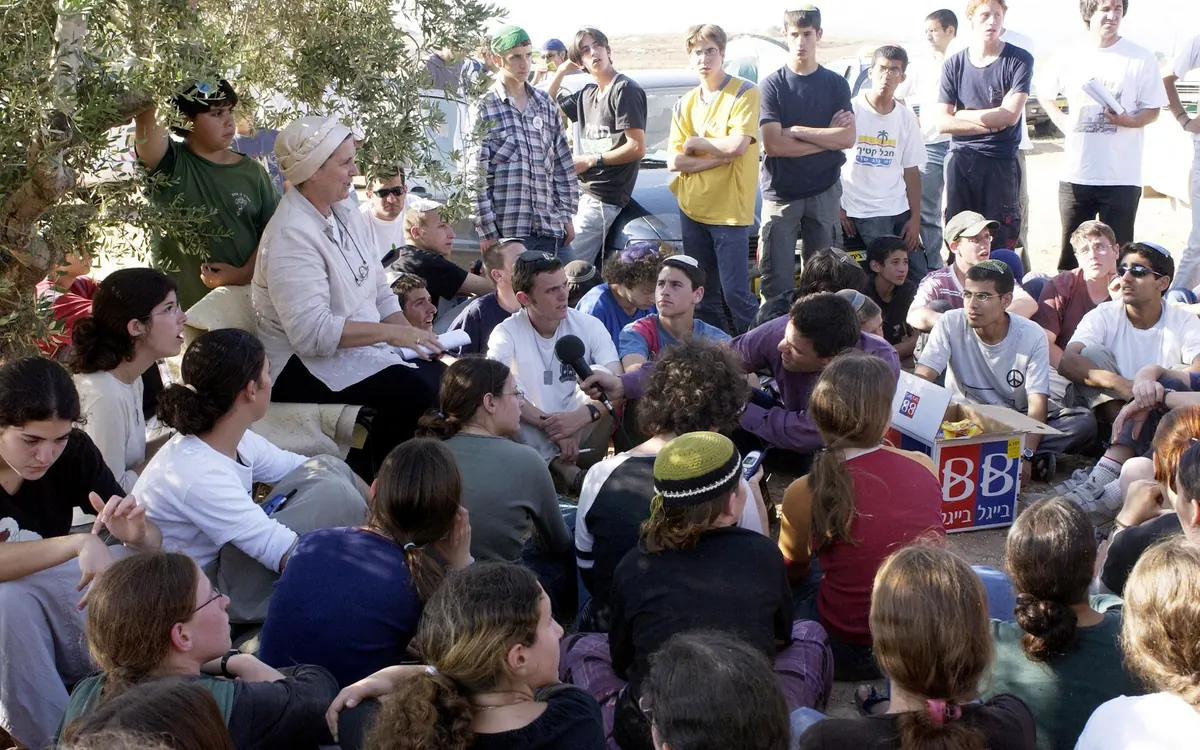
It is rare that someone who begins a movement is still leading strong fifty years later. Daniella Weiss was part of the original settlement of Judea and Samaria in the early 1970s, specifically Elon Moreh and Kedumim where she served as mayor. She remains an outspoken force within the Jewish settlement movement today with the new Nachala group. Rav Mike Feuer interviews her about her experience of past and present, as well as her views of the future. Learn about her parent’s involvement in the Lehi – Lohamei Herut Yisrael, and the religious Torah Zionist outlook that inspires her today.
Photo credit: Daniella Weiss with young Israelis, June 10, 2003. Moshe Milner, Israeli Government Press Office.
About this episode
Rav Mike sits with Daniella Weiss, a leader of the settlement movement in Judah and Shomron since 1973, whose actions, he says, created the world in which he lives. Born in 1945 to parents who hid Lechi ammunition in their orange grove, Weiss sums up her background in one word, patriotism. The deepest fact of her life is that the Jewish people have an independent state of their own, with its own army, agriculture, and industry, a miraculous phenomenon of the ingathering. She can criticize any government, Begin, Peres, Netanyahu, or Bennett, while seeing them all as part of that miracle. When Rav Mike asks what would revive the nation, she answers that the nation is already very much awake, pointing to the cranes, the roads, and the sheer vitality everywhere.
She reads the present through the past. Driving from the Galilee to Jerusalem, she thinks of Sarah Aaronsohn of the Nili underground, who described a road where there was nothing, and marvels at how green and alive the land has become. Rav Mike hears in her the heart of Torah, u'vacharta ba'chaim, choosing life, learning to see the conflicts around us as life rather than as problems dragging us down. Weiss grew up in Bnei Brak in a traditional home that chose religious schooling, and became deeply religious through Bnei Akiva, in faith rather than only intellect. Her activism, she insists, flows from Torah, from doing the word of God and what Moses expected of the nation, even when such explicit language detaches her from many listeners.
Weiss describes standing at Mount Sinai when Moses brought the Torah, a picture she says she sees, a spiritual experience that accompanies her whole life and her children and grandchildren. She does the word of God rather than act for strategic, security, or political reasons, and Rav Mike reframes it beautifully, that the Jews are often felt to play by different rules when really they are playing a different game on a different plane. Her motivation in the early 1970s was gratitude. God gave Shiloh, Beit El, Shechem, and Hebron of the Bible in the Six-Day War, and the Jews were slow to say thank you, so when the guns of Yom Kippur sounded in 1973, she took her backpack, her husband, and two little girls and moved to Shomron.
The first ten families began in a tent in Hanukkah of 1975, moving to a shack, a trailer, a building, and finally a home. The task passes down the generations. When her daughters left Ma'alei Adumim to found new communities, her eldest told her husband that the children do to him what he did to his parents, who left Hungary a day after their wedding for Eretz Israel. Weiss tells the story of the group knocking on Begin's door early one morning, finding the modest prime minister in his pajamas, who kissed her hand and agreed to come to the only Jewish community in Shomron, arriving the next day in a storm of world media. He declared there would be more.
Then Begin went to America, spoke of Beit El, Jericho, and Bethlehem, and returned with more of the same, a dark disappointment she calls the hardest thing in forty-six years, that no government, right or left, makes it easy to build. Rav Mike turns to sovereignty, Max Weber's monopoly on the legitimate use of force, and asks how she balances the messianic opportunity with breaking the law. Weiss rejects the modern terms of power and force, calling the clashes legal, democratic confrontations within an independent state. She defends the Jewish underground of the 1980s as forced self-defense against Arab committees planning to annihilate Jewish life, and closes with Joshua and Caleb, trusting that God will guide the lovers of the land in how to redeem it.
Key ideas
- Daniella Weiss sums up her Lechi childhood in one word, patriotism, rooted in the miracle of an independent Jewish state.
- She answers that the nation is already awake, pointing to the cranes, the roads, and the vitality of the land.
- Reading the present through the Nili underground, she marvels at how green and alive the once-empty land has become.
- Her activism flows from Torah and from standing at Sinai, doing the word of God rather than acting for strategy.
- The first ten families began in a tent in 1975, and the task of settlement passes down the generations.
- She defends the 1980s Jewish underground as forced self-defense and trusts God to guide the redeeming of the land.
Chapters
- 0:00 Meeting Daniella Weiss
- 1:09 Growing up with the Lechi
- 2:12 Patriotism as the one word
- 5:32 A nation very much awake
- 8:41 From the Nili underground to green roads
- 11:53 Torah as the engine of her activism
- 15:00 Standing at Sinai
- 18:13 Motivation; thanking God for the gift
- 20:16 The first ten families in Shomron
- 22:22 The children carry on the task
- 25:35 Knocking on Begin's door
- 30:55 Euphoria and then disappointment
- 34:05 Sovereignty and legitimate force
- 37:36 On messianism and breaking the law
- 40:06 The question of violence
- 46:34 Joshua, Caleb, and redeeming the land
Who, where and when
People
Daniella Weiss, Rav Mike Foyer, Sarah Aaronsohn, Menachem Begin, Shimon Peres, Rav Tzvi Yehuda Kook, Joshua and Caleb
Places
Judah and Shomron, Bnei Brak, Ma'alei Adumim, Hebron, The Galilee
Texts
The eighteen principles of rebirth, The Torah given at Sinai, The Book of Joshua
When
1945 CE: Weiss is born, 1973 CE: the move to Shomron, 1975 CE: the first ten families, 1980 CE: the Jewish underground
Read the transcript
Sometimes you pursue the word, and sometimes it fills you all of a sudden. Either way, without it, life isn't much. And when you have it, anything is possible. Those are my words. I'm Rav Mike Foyer, and this is The Jewish Story. Season 5 interlude, an interview with Daniela Weiss. Okay, I am here with Daniela Weiss, one of the most prominent leaders of the settlement movement in Yudah and Shomron, from its origins back in 1973 and actually through to this very day. Ms. White, thank you so much for joining me here. You're most welcome. Thank you for the title. I'm pretty excited. As someone who actually lives in the Binyamin region, your actions have created the world in which I live. And so aside from the importance of your story for the larger picture of what I'm doing in the Jewish story, I actually want to start with a point of personal curiosity, if I may.
When I was looking at your history, I saw that you grew up in a home where your parents were involved with the Lechi. My listeners back in season two, we spent quite a bit of time speaking about the power of the Lechi as a revolutionary movement. And I just would like to know, what was it like growing up with parents who were so committed to a revolutionary movement? And how do you think that sort of militant approach to the Jewish story affects your stance toward the settlement movement even today? Mike, if I have to choose one word to explain my background, the one word is patriotism. my parents you mentioned we had in our orange grove in Neibrak we had the slick the machsan of ammunition and guns of the lechi the important thing about my background as you mentioned the personal aspect is that my parents always gave me the feeling through words, through experiences, that the fact that we have, the Jewish people have an independent state of our own, that we have Eretz Israel and the state of Israel is the most important factor in my life.
that I am an individual and a Jew in Eretz Israel, and I was lucky. Well, I was born before the State of Israel. I was born in 1945, but I grew up, and I got the atmosphere and the education and the feeling that the most important factor in my life and in the life of the nation is that we have our own state, our own industry, our own agriculture, our own army, and that we raise children in an independent Jewish state. And this was the basis and the fact. And this was around me all the time, up to this day. So this is why when people criticize the government in the course of years, all the time, I can criticize this government or that government. I can criticize Bibi. I can criticize Bennett. I can criticize Menachem Begin and Shimon Peres.
But I see all of them as part of this miraculous phenomenon of Jews of the ingathering of the Jews and the establishment of an independent, strong state for the Jewish nation. So this is the thing that actually accompanies me all through my activity. This is a very powerful combination, I hear, of a deep commitment based in a recognition of the miracle of being born in this time, but at the same time, not being satisfied. I mean, there's a critical perspective perspective that there's always more to be done. And in that light, I was going back over the 18 principles of the rebirth, just because I got excited when I saw that your parents were part of the Lehi. And you may recall that the first three, and I hope my listeners are going to do a little review, the first three of those principles for Yair and the Lehi were the redemption of the land, the establishment of sovereignty, and the revival of the nation.
Now, we're going to talk about the land and sovereignty shortly, but I'm actually curious to hear from you because there's a lot of talk today about how we've lost energy while many people have ceased to be excited. I'm curious, what do you think needs to be done today for the revival of the nation to wake people up in order to engage the issues which are so important for us today? Is there something that you would suggest? I'll tell you, your premise that we have to wake. I think we live in a nation that is very much awake. Okay, great, tell me. The energy that I see everywhere. I know of Corona, we talk Corona, we suffer from Corona, we also learn lessons from Corona. But when I look at our nation, and I'm speaking now specifically in Eretz Israel, in Eretz Israel with us, with our nation having an independent state.
I see a lot of positive energy. And I see this above the political clashes. Because whenever I go, wherever I go in Israel, whenever I go to Tel Aviv and I see this, the manofim, the manofim cranes. Cranes. So you know what I do? I count them 3, 4, 5, 6, 7, 8, 9, 10 in one corner then I go to Netanya and I see another again and again and again and I see the huge roads and people complain complain complain of traffic jams but each of each of these people each one of them has a car and I want to change my car so the lady I have a pajero so the lady there she says if you don't decide now then you have to wait half a year okay okay okay I'm not standing in lines not for bed there's rat Hashem never in my life not for food and not for cars so I see this vitality even the clashes I hear Netanyahu criticizing Bennett and Bennett criticizing Netanyahu I feel that that, I mean, he is right and the other one is right, but still there's energy going on, going on.
Not that I don't see the flaws. I see the problems. I see them. But when you speak in terms of how can we do in order to give more ruchaniyut, more spirit, more enthusiasm, I don't know. I think we live in a very special era. Well, really, that's an answer to my question, which is we need to look at the positive. Maybe that so much of what I hear you saying is, to me, the centerpiece of Torah is Ubecharta B'chaim. B'chaim. Choosing life. And what I hear you saying is that there's life all around us. And if we choose not to see it, maybe that's the problem. And maybe it's the conflicts. you know I speak a lot to an audience that doesn't live in the land of Israel or the state of Israel and perhaps from the distance those conflicts look like problems that are drawing us down but what your point is is that life is about conflict and that in fact what we're looking at is a tremendous amount of life I think that's its own answer we need to learn to see that as life you know sometimes I drive from the Galilee through even to Haifa and then to Jerusalem.
I do a lot of driving for the settlements and for Zionistic reasons. And also just with my family, with my husband, who's also very active in the group. He was. Now he supports me. And I thank God when he doesn't complain about my endless efforts for building, establishing new communities. We know that you're a woman of legendary energy. but actually my husband was one of the founders of the Gush Munim, the settlement movement when I drive from Galilee to Hypop and then I go to Jerusalem then I say to myself I read about a Nili underground that was striving and succeeded in my opinion in influencing the fact that the Turkish, the Ottoman Empire seized its rule over Eretz Israel and the introduction of the British mandate, I don't want to go into the Nili underground, but I do want to go back to season two and listen to it.
No, but I do want you to know, and the listeners, Mike, I want your listeners to know that my perception of the present is connected of my perceptions of the past. So when I speak about the Nili underground and I speak of Sarah Aronson of the underground and I think of the route that she made because she described this route that she's going all the way from Zichron to Jerusalem for a very important meeting and she says there was nothing on the road and I say to myself God, God, God how come I deserve to see so much good, so much green because if you try to visualize the roots that I just mentioned there was nothing on this roof it's all green flowers, trees animals, so many roads so many cars, so many traffic jams, so much so much life so I said wow I cannot complain all that I do I thank God for everything that he gave to our nation and also to me personally, that my eyes see so much revival in the Holy Land, that we have a lot more to do?
Yes, I know. Well, you know, this is very important to me. It's close to my heart because the way I approach telling the Jewish story, sort of my tagline, if you will, is telling a story of the past that can create a people in the present ready to build the future. You're aware of what it used to look like and that gives you inspiration for what you want it to be. Exactly. One more personal question before we dive into history proper. I personally, I came to Israel as part of my process of juva. I grew up in a family that was very Jewish but was not so religious. And when I began to be more religious, more Shomer Torah, Mitzvot, it seemed obvious to me that I belonged in Israel and that this is where the Torah wanted me to be, etc.
I don't want to go into my story too much. And this is, by the way, despite the fact that I came at the height of the Second Intifada or the Oslo War, as some of us still like to call it. And rational calculus and the people around me were saying, not now, don't go. But it was sort of all I could do. So I'm curious because I know that you grew up here, as you said, in a religious. I was born here. Yeah, born here. In the religious world. But how do you feel that your education in Torah is part of your activism What role does the Torah play do you feel in what you do and what you think Am Yisrael should be doing You touched a very meaningful element in my thinking and my approach to everything that is around.
My parents were Mesotim, as we say, traditional. Today we have the expression, the tea light. So they were traditional light. They had it. But, I mean, on the outside, but inwardly, they were very religious. How was it expressed that we are three sisters and my parents insisted on it, that we get religious education? although in the Nebrak that I was born to, I was born to Tel Aviv but then right away moved to Nebrak there were religious schools and non-religious, secular schools, so actually my parents could choose between the two and they chose the religious education and I got Chinook Mam Lahtidati and I was a member of the Bnei Akiva movement, which affected me, I mean, from top to toe. I was very much a loyal member of the Bnei Akiva movement, and I, from school, I got the long prayers, and the long Birkat Mazon, and Mishnahh, and Torah, and Navi, and as I was a very, I must say, I confess, very good people.
So I absorbed it all, but not in the intellectual aspect, in the face of faith, emunah. So I became very, very religious. You cannot judge it, as far as I'm concerned, by outward things, although I am wearing a scarf on my head and I dress up as a religious nikkenechelet. A Jewish settler. A Jewish settler, right. but what I wanted to say what went deep deep deep into my heart and soul was that I was present at Mahamad Ar Sinai when Moses came with the Torah and gave it to Am Yisrael when I say it I'm telling you I see the picture I was there and there was a lot of crowd it was a spiritual experience and it accompanies me all my life and so it was my children, my great children my grandchildren and great grandchildren because I was like all Jews some people maybe tend to forget I never forget and I'll tell you something very personal when I am being interviewed on the Israeli media or foreign media as well.
So I speak about people ask about, of course, my background, and I say I'm influenced by Torah Moshe. I don't say tradition. I don't say history. I also tradition, history, and so on and so forth. So my husband often says to me, when you speak about Torah, when you speak about religion in such concrete, tough, explicit expressions, then you detach yourself from so many people. So I said, this is not what is in my mind. I want as a Jew, and as an Israeli, and now as a settler in Shemron, who's always bringing the word, trying to bring the word of Eretz Israel, I want people to know that I do it not because of strategic reasons, not because of security reasons, not because of pioneering reasons, not because of historical reasons, not because of political reasons.
Because I do, I try, I do my best to do the word of God, to do what Moshe, Moses, expected of the Jewish nation. You're giving voice to something which, in my own life and I think in my learning and especially in the work I do with others is so difficult to communicate, I think, because often people experience the Jews. Not just now experience the settlers or the state of Israel, but when I look back through history, they experience us as playing by different rules. People say that all the time. The Jews play by since Haman, right? There was a people who doesn't. But I think what I hear you saying is that what people misunderstand is we're not playing by different rules. We're actually playing a different game, so to speak, that there's a different plane and that that's what I hear driving you.
And that's a very powerful perspective. I'd like to take that perspective now to help flesh out the conversation I'm having with my listeners in the Jewish story about a specific time in history. A few episodes ago, I told some of the story in the struggle to settle in El Moray and the beginnings of the settlement movement. And I offered some ideas, both my own ideas and from historians, about what was maybe driving the people who eventually created the movement, like yourself, of Gush Emunim. I know you were part of these efforts from the very beginning. So I'd love to hear from you. Can you tell us a little bit about what it was like in the early 1970s? What was motivating you to defy a government, to overcome what sounded like profound obstacles, to build a new home?
Mike, if you ask me what motivated me this means I did not explain I understand that you already answered that if I don't come to a clash with you in this interview then something very important is missing from the interview so I want to come to a clash with you I've got my hard questions at the end so motivation I mean once God gave us Shiloh of the Bible Beit El of the Bible Shechem of the Bible Hevron of the Bible then God gave us we say thank you for the present how do we thank God for this unbelievable present that came to us in 67 in the 60s war actually we were a bit slow. I mean, Rabbi Levenger was very quick in Chedron. Rabbi Hanan Porat was very quick in Gush Etzion. Even the Labour Party was quite quick in the Jordan Valley, the valley.
But here the huge area of Shomron was neglected. So, when the guns of war were heard, Yom Kippur, 1973, two o'clock in the holiest of days, Yom Kippur. Then I took my backpack and I came with my husband and my two little girls to Shemron. And since then, I'm here. So motivation, we got a present. We were too slow in saying, thank you, God, for giving us this biblical present. So this was the motivation. It is religious. It is my answer, together with the answer of Buxemunim, to the miraculous present that God gave the Jewish nation in the Six-Day War. Then there was a shake of the 73 war, of Yom Kippur. Move, move, move to the mountains. And we moved. And then we started with a tent. I was there with my husband, two little ones, and another nine families, the first ten families in Shomron, in Hanukkah, Tav Shin La Medvav, December 1975.
We started with a tent. We moved to a shack. We moved to a trailer. We moved to a little, another big kind of building. And then we built a home. And then my children, they came to my husband. they didn't have to come to me because I gave them all the blessings in the world before they even started they said daddy Abba we want to move from Pudumim where I live now and where I took I was one of the founders of the place then they came my children came to my husband Amnon and they said Abba we want to establish a new Yishuv a new community so my husband said your mother, she influenced you to live here and to establish another place I was standing there in the corner like some stage theater presentation, I said no, no, no, no I'm not connected to it, don't tell me I know you influenced them yes, the truth of the matter I influence all the time that I say all the time the most important thing is to build new communities in Eretz Israel.
So here they come, when they can do it, they move from Dumim to establish new communities. So my eldest daughter said to my husband, one of the key sentences in the past 50 years in our families, my daughter, Yaeli, my eldest, she said to Amnon, to my husband, Abba, they do to you, this is my second and my third I have four daughters so she said my eldest says to my husband Abba Shira my sister does to you what you did to your parents what your parents did to their parents and she continues what did they do my husband's parents they left home in Hungary they left home one day after the wedding they came to on boat to Palestine to Egypt to Palestine to Eretz Israel and then when my husband and myself we decided to leave our beautiful home in Ramat Gan to move to a tiny shack in the mud there, it was winter then we took our parents by surprise my parents and my husband's bat, bat, bat by surprise because it was instant.
Not by surprise in the sense that really we continued in the footsteps of pioneers of the generations of the awakening of Zionism. And then when my daughters decided they'd go to another to establish or to strengthen another weaker community or father community, then that was continuing in the footsteps of the family. Which is also Torah Moshe, this idea that the children carry on the task of the parents. It's very beautiful what you're saying. So it's to say in history, I've also spoken recently to my listeners about the 1977 election of Prime Minister Menachem Begin, known as the mapah, the upheaver, or the earthquake in the Israeli political history. And we've spoken also about how So perhaps there were expectations on the behalf of the political right in general and Gusha Munin and the settlement movement in particular.
I curious what are your thoughts on former Prime Minister Begin Do you recall your reaction to his election and to the changes that came afterwards which led to the Camp David Accords Mike you're asking what I think about Begin? Or either what you think about him now or what you remember then. I remember and I think both. I can give you both. But I think your listeners deserve a good story connected with Begin. Forget my listeners, I want to hear it. We were here a group of 40 families, the only Jewish community in the huge area of Samaria, of Shemol. And we felt that we were the center of the world. Indeed, in a way, we were the center of the world. Because when Menachem Begin came here, and I'll soon make one step back, But there were media people from Japan, from North America, South America, from the Mediterranean, from all over.
And I said to myself, why? From Japan, from Canada, from South America, from Africa, from everywhere. So this was a proof for me that we are in the center of the world. In addition to what our elders said all the time, the Eretz Yisrael to borosh taborosh of the world, the center of the world. It literally would be the belly button of the world, but it doesn't quite sound as powerful in English. You see in ancient maps, so we said to ourselves, well, there's such a big, important historical, political change, we must go to the home of Menachem Begin and invite him to celebrate this important historical political change from Labour Party to Likud by coming to the mountain to the settlers in the mountains of Shomron.
Doesn't it make sense? It doesn't. you say he does I guess to me it makes sense but I think yeah I understand what you mean why would he do it it didn't make sense but it was you mentioned before the historical perceptions and their influence on our present acts and future dreams dreams of so we had our understanding that there is a key issue here in Shomron and if we come instantly, early in the morning, when the new Prime Minister Menachem Begin was in his pajamas, I'm in it. I'm trying to picture it. With a wardrobe on it, but we saw the pajamas. So there we go to Menachem Begin's home, and we knock on the door. Those were the days in 1975, beginning of 1976, that you could just knock on the door of a prime minister and enter.
At that whole, a different time, totally different. More of Benachem Begin was a very modest person in spite of his leadership and his long tradition of being a leader. And then he was a real prime minister. But we were knocking on the door. He opened the door with his pajamas, with the bedroom on. that was really I mean his door wasn't locked just like this we entered and as we were activists of the Bush and Huni movement he had Menachem and he had Benny and he had Abba and then he took my hand like a real novel and he kissed my hand on the top on the top of my hand and then and come and all of a sudden we understood how naive we were. Who are we? Settlers on a hill over there. At that time, it was called Beyond the Dark Hills.
So that was Arayi Khosheh, night, darkness. Yes, there were Arab villages here, but very small, very much not developed. Even for the Arabs at the time, and it was a place that just was beyond where people went. It was like a biblical site. Nothing, no light. Not to me, nothing. So once you left Tel Aviv area and you went up the hills, you couldn't see anything. Then when we came to our tiny settlement, then there was a generator that worked and didn't work. Chiefs. A little bit of light beyond the dark hills. What did the Prime Minister say to you? I mean, I hear you're surprised that you were so naive to go, but he obviously brought you in. Once we realized how naive the thing is, we didn't have the guts to say what we wanted.
So Rabbi Felix, he was the most courageous of us all. And he said, we came to invite a new prime minister to celebrate this historical change, to celebrate it in the new first Jewish settlement on the hills of Shimon. So he said, I'll come. And he came the next day with world media around him from all over the world. Canada, US, Great Britain, France, Japan. It was like a storm of media. I always feel that the media does have this dramatic sense, dramatic sense. They realize that something different is happening, and that was really euphoria. And he declared there will be more, more issues. But then after a short while, he went to the US and then when they said there is Shino in the US, there is Shino here, Right, I gave that quote to my listeners last week.
He called Be'el, Jericho, Be'etlehem. But then he returned. And I want to tell you, dear listeners, you cannot imagine what a fall, what a disappointment, what a dark realization that it's not a new life. It's more or less more of the same. it's so sad people ask me what was the most difficult thing in all these 46 years since you came here since the war since the long before the most difficult thing and it is still the most difficult thing that no matter whether it is right wing or left wing politicians or coalition it is always very difficult to build new communities to advance we can never do it like great I read that Brazil was planned and there were cities in the world that were planned and built this is what I wanted we had Gushemunin the settlement movement we had our groups were ready to settle right away just as we as Nachala today the movement that I'm having now we have 10 groups and I'm praying all the time that I was praying that Netanyahu will do it, now I pray that Bennett will call me in the middle of the night and say Daniela, you're General Secretary of a very important settlement movement, do you really have people right away who can settle 10 communities right away I said, what do you mean?
What do you mean of course? What are we if not pioneers that are following the footsteps of our parents and great-great-great-great-parents who came to Eretz Israel before there was a state. And we are ready to continue to do the same thing. So our children, our grandchildren, great-grandchildren, they dream of Eretz Israel. They want to settle Eretz Israel. So this is my dream. I'm waiting for the call from the prime minister. and like this I feel that I accelerate this dream so it's a very powerful image both the the excitement and the disappointment and that sense of naivete like the innocence that goes with the ecstasy of feeling but also I think you pointed out something critical there but it wasn't you were just naive and nothing was true the world media came Meaning, like you said, the media has a very important sense of the dramatic and the significance sometimes in ways that other people don't grasp.
And I want to hone in for the last part of our talk on the relationship to government, like you're saying, waiting for that phone call. Because in the opening, you made a very beautiful statement about how important it is, in fact, to sort of criticize this government or that government. But that essentially you recognize the miraculous nature of the time in which we live, in which there's an independent, I would say, sovereign Jewish state. And I spend a lot of time thinking about sovereignty. I also speak about it on the show and in my own teaching. And I return again and again to a definition, which was given by the great sociologist Max Weber. He says that what a nation state is, is a monopoly on the legitimate use of force to maintain order.
On some level, a nation state, they keep order. They're the ones that have the ability to do this. And, you know, that sounds nice. But the question, of course, is what's legitimate? It's all well and good that a state keeps order. We all want that. But sometimes we don't. Sometimes we feel what the state is doing wrong or it's not legitimate. There's a challenge in what it means to be sovereign. And in the story that I see, especially in the Shnotz Shivim in the 70s and 80s, the state of Israel struggled to be sovereign for two reasons. Yeah, I'm talking about in Yudan Shimon now. In Yudan Shimon. one was that messianic excitement you're speaking about where you wanted to pull the story forward whether the state was willing to or not right and the other one was the independent aspirations of the arabs living in yudan shimon whether through terror whether through just simple claiming that they're a different nation called the palestinians that that was a challenge to israel's ability to be sovereign so i in the world i live in here settlement sometimes it's seen like specifically messianic, like you said, and sometimes it's seen as violent or illegal.
And I know that in your life you've had many confrontations with police, you know, been arrested a number of times. I'm curious how you balance between that sense of the messianic opportunity, a miraculous, sorry, that here's an independent Jewish government, and when you feel that you have to break the law in order to actually push the story for it, to do what it is you think that state needs to be doing. Am I clear? How do you balance between those? I think you apply modern, even progressive terms in our new world, new world I mean of the past 10 years. you apply it to another time that you speak about the 60s, 70s, 80s and the terms that you're using were not relevant there so I want people to know the modern terms of applying power applying force power breaking law it wasn anything of our world I have to explain this very clearly.
Speaking of a messianic wave or waves means we came to the heart of Eretz Israel in the footsteps of Abraham, Isaac and Jacob. Abraham, Isaac and Jacob. We were fulfilling the word of God. And we were followers of the great rabbi, Rabbi Cook, who was the first chief rabbi of the settlements before the establishment of the state of Israel. So we had our guidance and we knew that Rabbi Kuk was a father and then his son, Ratzvi Yudah Kuk, who lived in the state of Israel and saw the state of Israel as the fulfillment of the word of God, of the ingathering from the diaspora and Jewish independence. So everything went hand in hand. When we went in big marches to Shomron, to Samaria, and then Menachem Begin marched with us, and even before he marched with us, Shimon Peres from the Labour Party gave us the permission to stay, and they then gave us the trailers and built a factory.
because we saw that from right and left there was an effort to help enhance the messianic process of the growth of Elat Israel and the building of Elat Israel. So you may ask, then how come you came to clash with the army? And how come you yourself, Daniela, I'm speaking here, that I was arrested, that I was brought to trial, I had my charges against them. Yes, there were conflicts, but they were on the level of legal, democratic confrontations on an important issue within the framework of an independent state of Israel. No more than that. And so what would you say to the voices today that want to paint the whole settlement movement as violent? And I'm curious because I know some of the voices even within my own community that are in extreme frustration or extreme vision, not afraid of at least speaking about violence.
I would never accuse anybody of doing anything unless I saw it with my own eyes. What do you say to that? What do I say to what? The existence of violence or calls for violence. Violence is only, only, only from the sight of the errors. I just showed my husband before a clip of a bus driving in one of the rows that I drive every day with children. Wait, hang on. You really honestly think that there's never violence? No, no, no. There's never time. One of the stories that we're going to be telling in the Jewish story going forward is the story of the Makhteret, of the so-called Jewish underground, and speak about some of the vision and the challenges there. I mean, these are people who don't shy away from speaking about violence.
You speak about the underground of the 80s? From the 80s, but also even I'm looking right now to find people to speak to today who are not shy to speak about whether it's the Hilltop Youth or other voices who feel that violence has become legitimate. That's why I asked you the question, because my sense is that your experience of the miraculous state and your dedication to the state and let it go in what you believe to be the right direction is a cleat. It's a vessel that lets you really sit on the edge. What I'm wondering is how you make that line clear when maybe people don't share your sense of the miraculous state or are just younger and more prone to doing crazy things. I have teenage kids. Not every child makes kids.
Let me relate to two points that you brought up. The first underground of the 80s. In the 80s, there was a situation where there were 10,000 Jews in Judea and Samaria. And the Arabs, there were special committees called the special committees of the Palestinians. I'll tell people the details of the story. And they were planning and carrying out murderous effects on Jews. This is why I say Jews are not violent. There are no Jewish terrorists. After the murder of six students, Talmidei Yeshiva, in the Hadassah in Khebron, indeed, there was a Jewish underground that really damaged and killed the heads of the Arab committees who were planning to annihilate the Jewish population. I hear that piece. I wouldn't use this diminutive, this lowering term just because I don't want to sound apologetic because I do not apologize for it.
I admire the act and I think that I owe my life to the courage of the people who at this crucial moment, when we were attacked violently and there was a chance, a terrible chance, that as a result of this attack and others, they would annihilate Jewish life in Judea and Samaria. So they did something which they were forced to do, not because we are violent, just because we want to live. The violence is from the side of the Arabs who kill us and initiate always a new conflict. The violence is not from us. week. So maybe that's actually an important place to shift toward the last couple of questions because I need to start to wrap up. One is well actually maybe I'll just give you the last invitation open.
The Jewish story has a very broad audience. Jews, non-Jews, religious, not religious, Christians, conservatives, progressives. I would like to give you the opportunity to just share some piece of vision, something you feel that that world needs to understand something either about your vision or personally something in history but knowing, take the last few minutes to just make sure it's very clear what it is you want to say You mean directing my look at the future, my vision Great That would be fantastic, I would love I didn't even want to pin you but the future is, I think, always important. Okay, we spoke a lot about the past. At the present, we continue. Our movement, Nachala, continues in the footsteps of Kushe Momin, the first settlement movement in the Judaism area, and our movement, Nachala, homeland, continues.
So this is the present. I'll say the future. Beautiful. As I started explaining in the beginning of this pleasant conversation Indeed, it is very enriching for me. I think always in terms of the Bible. Always. And I always think about Joshua, the first settlers I call him, and Kalev. I always think I see myself just as I was in Sinai when we received the Torah from Moses. from God. And Moses the prophet was the greatest of prophets received. So I was when there were 12 leaders shouting, screaming, we don't want to go to heaven because we are afraid of the strong peoples of the strong nations that live there. They live in huge fortresses in big cities. We don't want. And that was when God directed them to Eretz Israel.
To the Eretz, Zavad, Halav, Odrash, Milk and Honey. Oh, we don't want. They were not just, as we say today, Norvo, the Hiltokyut. They were the leaders. They didn't want to enter the Holy Land. so there came Joshua and Kalev they say there were other people there were Girgashi and Yevusi and Phelistines and they were all here so no wonder in Israel they were afraid but there were leaders who said we'll over let's go up We can do it. Yes, we can. And they did. And then Joshua, Joshua, he managed. In seven years, he had wars and wars. And I don't wish myself wars. I don't wish my family. I don't wish Am Yisrael wars. I don't wish wars at all. But I know that God guides the lovers of Eretz Yisrael and in the ways that are necessary for redeeming the land.
So God will guide us today how to proceed with redeeming the land. I feel that God chose me and my friends, the settlers, to fulfill the most important mitzvah, The most important decree and the most important decree in our time is to redeem the land through settling it. Settling, buying, paying for it and to continue to develop the land in the most physical way. Facts on the ground. This is what I do, and I believe we will redeem the entire promised land. So this is a very powerful image, not only for you, but I think that even in the broadest sense, because I heard that if a person commits to loving the land and developing the land, then God will guide them in the way in which they need to go. And so even if there are people out there, and I trust that some of my listeners will be a little shocked by the militant stance, which is good.
People need to hear things that they're not familiar with. But nonetheless, I think everybody could take to heart your vision of the future there, which is that if a person loves the land and commits to developing it, then God will guide them. In God I trust. Yes, also the dollars. But in God I trust. I think we can't do better than that. So I want to thank you very much for working through with this with me and making sure it happens. And I'm really grateful to your time. I also want to thank all the folks who give their hard-earned money to make this show happen to keep it free and widely available. I want to invite you to join right now. If you can, go to our website, jewishstory.co. You see a button in the upper right-hand corner.
Click on that to give a little bit of podcast support. I also want to thank the Land of Israel Network. That's thelandofisrael.com. They're building a center for global transcendence in the heart of Judea. I want to thank the Pardes Institute, p-a-r-d-s.org.il, for throwing the doors of the Beit Midrash as wide open as possible. And I want to thank you for listening. I'm Rav Mike Foyer, and this is The Jewish Story.
More from Season 5
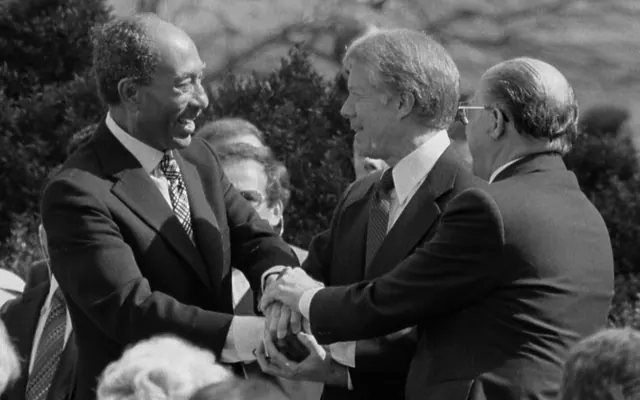
TJS S5E11 - The Camp David Accords
The domestic political upheaval of the Menachem Begin victory in 1977 was followed quickly by an international earthquake in 1978 when Israel and Egypt agree to make peace....
Play Episode
TJS S5 Interlude - Don't lose the thread
Is anyone else feeling a little frayed around the edges? Here is an interlude where I give some insight on how to avoid snapping under the pressure of...
Play Episode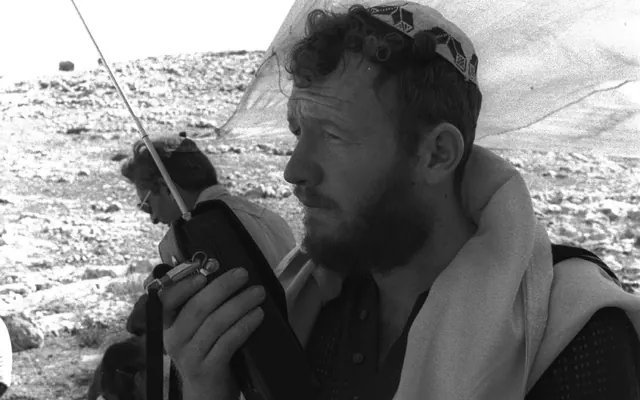
TJS S5E12 The Jewish Underground part I
In politics as in physics - for every action there is an equal and opposite reaction. Prime Minister Menachem Begin's signing of the Camp David Accords with Egypt's...
Play Episode