
TJS S5E14 - The Evacuation of the Sinai Peninsula
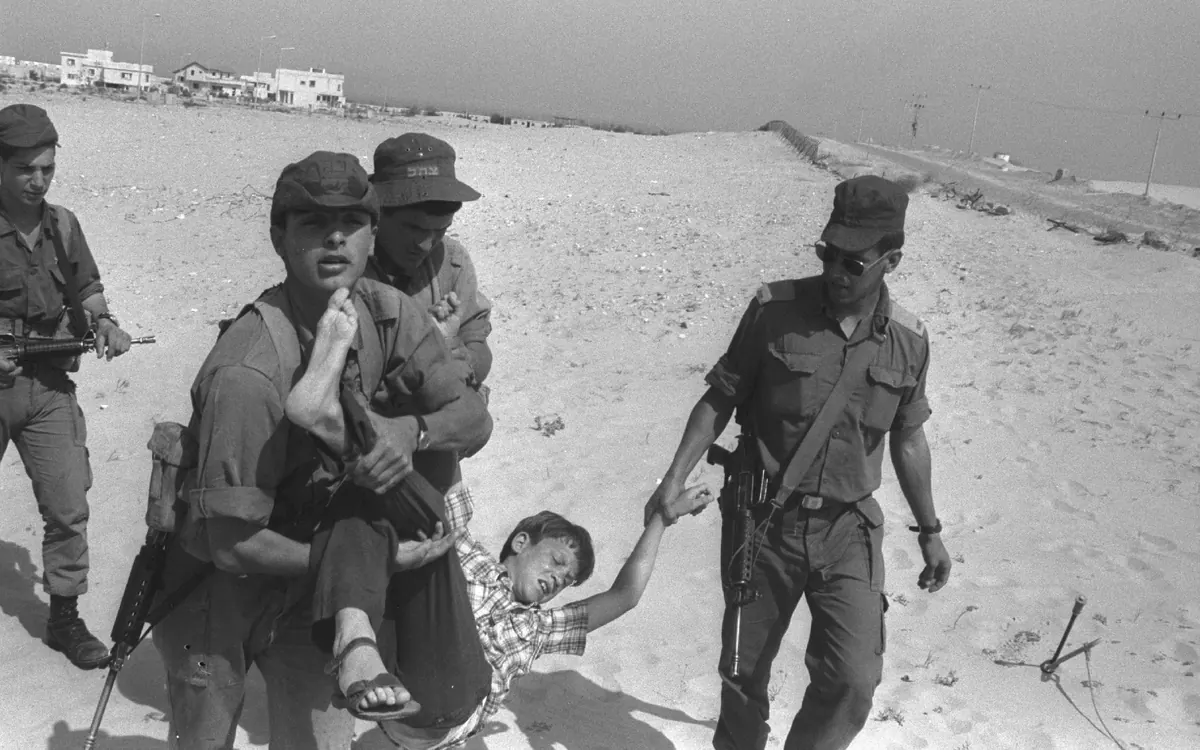
People like to talk about the price of peace, but they rarely define what peace actually means. This makes evaluating the price impossible. In April of 1982 Israel withdrew from the Sinai Peninsula and for the first time destroyed established Jewish homes in the name of peace. This episode explores the price.
Learn about the Camp David Accords, the assassination of Egyptian President Anwar Sadat, the Coastal Road massacre and Operation Litani against the PLO in Lebanon.
Photo credit: Beni Tal Or, Israeli Government Press Office April 20, 1982
About this episode
The care of human life, said Jefferson, is the first object of good government, and Rav Mike asks what peace actually meant to the men who made it. For three decades Israel heard peace as the Arab world accepting a Jewish state, then 1967 introduced land for peace and Dayan's preference for Sharm el-Sheikh without peace over peace without it. The three no's of Khartoum buried the idea until Anwar Sadat came to Jerusalem in 1977, speaking of a peace based on justice fourteen times and demanding full withdrawal. Begin answered from the depths of Jewish memory, we took no foreign land, we returned to our homeland. Out of that clash came the Camp David Accords, and with them a paradigm that handing land for peace was the way forward for Israel.
The PLO met this breaking of the rejectionist front with violence from Lebanon, where Black September and the Cairo Agreement had turned the refugee camps into a state within a state the IDF called Fatahland. In March 1978 thirteen Fatah fighters landed near Kibbutz Ma'agan Michael, murdered an American photographer, and hijacked buses down the coastal road, leaving thirty-seven Israelis and one American dead in the deadliest terror attack in Israel's history. Begin named the PLO the basest organization since the Nazis and pressed on toward Washington, since Fatah's hope of scuttling the talks had failed. Israel answered with Operation Litani, driving Fatah north of the river alongside Major Saad Haddad's Christian militia, which birthed the UN force UNIFIL and a quiet that never fully held.
The withdrawal unfolded in phases, and each one carried a price. Israel handed back the Alma oil fields its own engineers had developed, fields that might have made the country an exporter, along with the Abu Rudeis wells that once supplied more than half its consumption. The Sinai held nearly ninety percent of the land taken in 1967, and the air force lost its vast training grounds and the bases at Etam and Etzion, replaced in the Negev with American help at great cost. Repositioning the military ran to some 4.8 billion dollars, a fraction of the roads, pipelines and settlements left behind. As Arab states armed with AWACS and new fighters, Israel could ill afford another blow to the qualitative edge that keeps a small country alive.
Egypt paid as well. Sadat was branded a traitor the moment he announced his journey, and once the treaty was signed the Arab League imposed sanctions, suspended Egypt's membership, and moved its headquarters from Cairo to Tunis. The economic damage proved minimal, offset by massive American aid, yet the deepest cost came due on Sadat's own life. On October 6, 1981, at a parade marking his crossing of the Suez, assassins in army uniform led by Khalid Islambouli opened fire, and the president who had been branded an infidel by the blind Sheikh fell dead with ten others. His murder was cheered across the rejectionist world, Syria's paper bidding farewell to the ultimate traitor, yet the withdrawal rolled forward and the phase of the bulldozer began.
Yamit was meant to be the crown jewel of Sinai, a port city for two hundred thousand, and idealists like Gary Mazal and Avi Farhan built a community where the Bedouin welcomed them for the work and the trade. When word of Camp David reached them, the pain was all consuming, eight suicides and fifty divorces among the broken families, and those who bargained for compensation were smeared as gold diggers and enemies of peace. Ariel Sharon, who had helped build the towns, now bulldozed them, declaring Israel wiped Yamit off the earth with its own hands to honor the treaty without shedding Jewish blood. At the end Rav Yoel Bin Nun read the prophecy of the dry bones, the people swore the oath to Yamit, and no Jew has returned since.
Key ideas
- Peace meant different things to each side, Sadat demanding justice and full withdrawal while Begin answered that Israel returned to its homeland rather than taking foreign land.
- The Coastal Road Massacre of 1978, launched from Fatahland in Lebanon, remains the deadliest terror attack in Israel's history and drew Operation Litani in response.
- The withdrawal cost Israel the Alma and Abu Rudeis oil fields, vast air force training grounds, and billions in abandoned investment.
- Egypt's economic punishment was offset by American aid, but Sadat paid for the peace with his life at the hands of radical Islamists in 1981.
- Yamit's settlers built a community alongside the Bedouin, and its destruction brought suicides, divorces, and accusations of being enemies of peace.
- Begin uprooted Yamit to honor the treaty without Jewish blood, and the settlers closed with the prophecy of the dry bones and the oath to return.
Chapters
- 0:00 What peace meant; good government
- 2:12 Land for peace; the three no's
- 3:18 Sadat in Jerusalem; peace and justice
- 5:29 We returned to our homeland
- 8:49 The PLO answers from Lebanon
- 11:11 The Coastal Road Massacre
- 14:27 Begin names the Nazis; Operation Litani
- 16:44 The phases of withdrawal; the oil fields
- 18:54 The military cost; lost air bases
- 21:15 Egypt's price; the Arab League
- 24:46 Sadat assassinated at the parade
- 28:07 Yamit; the crown jewel of Sinai
- 30:23 Mazal, Farhan and the Bedouin
- 33:42 The bulldozer destroys what it built
- 39:10 The oath to Yamit; the dry bones
- 44:44 No Jew has returned since
Who, where and when
People
Anwar Sadat, Menachem Begin, Moshe Dayan, Ariel Sharon, Gary Mazal, Avi Farhan, Yasser Arafat, Khalid Islambouli, Rav Yoel Bin Nun, Hanan Porat
Places
The Sinai Peninsula, Yamit, Kibbutz Ma'agan Michael, The Rafiah Plain, Cairo and Tunis
Texts
Sadat's Knesset speech, The Camp David Accords, Ezekiel 37, The oath to Yamit
When
1977 CE: Sadat comes to Jerusalem, March 1978 CE: the Coastal Road Massacre, 1979 CE: the peace treaty signed, October 1981 CE: Sadat assassinated, April 1982 CE: Yamit evacuated
Read the transcript
The care of human life and happiness, and not their destruction, said Thomas Jefferson, is the first and only object of good government. I don't know much about government, but I can say we're in the world to build and not to destroy, even though it can be quite hard to tell the difference. I'm Rav Mike Foyer, and this is The Jewish Story. Season 5, Episode 14 The Evacuation of the Sinai You know, I think if there's anything at all that the world can agree on is that we want peace. Yes, sure, there are some so-called warmongers out there but if you listen to what they say you often find that even the most aggressive European expansionists will tell you they're really only after quiet if not peace itself.
The problem, of course, lies in defining what exactly the word means and therefore how it is to be pursued. For his first three decades, the broad consensus in Israeli society was that peace meant the Arab world accepting the existence of a Jewish state. On the practical front, it meant an end to wars and a recognition of borders through formal peace treaties with the neighboring states. It was a vision made much more complicated, however, by the victory of 1967. that sense of a greater Israel out there seemed to offer a new idea of peace through strength. Hence Moshe Dayan's famous quote about preferring Sharm el-Sheikh without peace to peace without Sharm el-Sheikh. What he really meant was, if we're in a strong enough position, we don't need treaties to live in peace.
Add to that the messianic ferment, which began to bubble up within the religious Zionist world we've spent so much time discussing, It may have had its practical expression in the move to settle the lands conquered in Six-Day War, but its vision was much broader, because peace to the students of Ra'atzvah Yehuda would always be the result of the redemptive process spreading its light over all creation, not just the state of Israel. Last but certainly not least, 1967 introduced the notion of land for peace into the Israeli discourse. Not that the idea was new. I mean, since Israel's victory in 1948, her Arab neighbors and various voices of international diplomacy have been trying to whittle way at her independent territory in return for promises of peace or, really, non-belligerency for decades.
In particular, there were a number of efforts to get the Israeli leadership to trade large parts of the Negev for an Egyptian agreement to cease and desist, even though, of course, the Negev had never been in any way connected to Egyptian sovereignty. Pre-67, the idea of land for peace was simply a non-starter, rejected outright by almost every Israeli. When Abba Ibn labeled the 48 armistice lines as Auschwitz borders, the world may have heard it as exaggerated rhetoric, but in Tel Aviv, it was all too real. In a country where space feels scarce, no one was interested in bargaining over the little which they'd managed to grab. But the Six-Day War brought an embarrassment of riches in terms of land.
And as we've discussed a few times since Season 3, basically, the leadership of the Labour Party was more than willing to consider trading some of this newfound wealth for peace. The rejectionist stance embodied in those famous three no's of the Khartoum Conference, No peace, no recognition, no negotiation being broadcast by almost all voices in the Arab world effectively killed the land for peace paradigm in 67. It was an attitude, really, that culminated in the surprise attack of 1973, the last attempt by the Arab states to gain by war what they might have tried to get through negotiation. All this changed when Egyptian President Anwar Sadat came to Jerusalem in 1977. I come to you today on solid ground, he announced, to shape a new life, to establish peace.
And what did peace mean to Sadat? Well, as a leader who fought his entire life, it certainly meant the cessation of war. As he said, I said that I wanted to save all the Arab people the horrors of shocking and destructive wars. I most sincerely declare before you I have the same feelings and bear the same responsibility towards all and every man on earth, and certainly towards the Israeli people. No more war was something that he and Begin could agree on. But if you look closely at his famous speech there in the Knesset, you'll find that the phrase peace based on justice appears 14 times. That makes it the centerpiece of Sadat's message. And if peace is a tough term, justice, oy vavoy, good luck with that one.
Let me tell you, he said, without the slightest hesitation, I did not come to you to make a request that your troops evacuate the occupied territories. Complete withdrawal from Arab territories occupied in 1967 is a logical and undisputed fact. He said any talk about permanent peace based on justice would become meaningless while you occupy Arab territories by force of arms. In his response, Prime Minister Begin also expressed the desire for peace. He said, therefore, allow me today to define the meaning of peace as we understand it. Absolute reconciliation between the Jewish people and the Arab people. Let us not be daunted by memories of the past, said Begin, even if they are bitter to us all. We must overcome them and focus on what lies ahead, on our peoples, on our children, on our common future.
For in this region we shall all live together, the great Arab nation in its states and countries, and the Jewish people in its land, Eretz Yisrael, forever and ever. It sounds good, but what about Sadat's question of justice and the so-called occupation? In 1977, Begin's response was a classic, taken from the depths of Jewish memory. No, sir, he said, we took no foreign land. We returned to our homeland. The bond between our people and this land is eternal. It was created at the dawn of human history. It was never severed. They were tough words in the context. And indeed, as we've seen, there was a difficult process ahead for the two leaders. But in the end, they managed to hammer out a peace treaty. And now listen to the Prime Minister's words on the lawn of the White House as he signed the Camp David Accords less than two years later.
Peace is the beauty of life, said Begin. It is sunshine, it's the smile of a child, the love of a mother, the joy of a father, the togetherness of a family. It is the advancement of man, the victory of a just cause, The triumph of truth. He does have a way with words. But there's that term, justice again, a just cause. Now, much of the Arab world condemned Egyptian President Sadat for daring to sign a peace treaty with Israel. They claimed that for all his high-blown rhetoric about the impossibility of a peace based on justice while Israel occupied Arab land, he got the Sinai and left the Palestinians under Israeli rule. and as we'll see later, Sadat paid for that perception with his life. And we've spoken about the challenges that Begin's willingness to retreat from the Sinai posed to his political base, not to mention his own personal vision of a greater Israel.
Though in the end, it will be the invasion of Lebanon that drains away his life force. But I haven't yet really put my finger on the paradigm shift, that whether he intended it to or not, When Prime Minister Begin uprooted the Jewish communities of the Sinai and handed the land over to Egyptian rule, he declared that the land for peace paradigm is the way forward for Israel in the region. And that has had consequences down to our day. Now nearly four years will pass between the signing of the Camp David Accords and the final withdrawal from Sinai. And they will present many challenges to peace. We'll touch on them shortly. And when that day comes, that the Sinai is emptied of its new inhabitants, we'll see that many children won't be smiling as they watch their fathers weep and their families broken.
And I can only hope that their sacrifice was for a just cause, as Prime Minister Begin called it, and contributed, as he said, to the advancement of man. But without a question, it advanced the idea of land for peace. The notion that Egyptian President Anwar Sadat was breaking the rejectionist stance with which the Arab world had faced Israel for three decades was met with violent opposition. And nowhere more true than amongst the Palestinian terror organization whose raison d'etre was the destruction of the Zionist entity in its entirety, let's remember, and its replacement, of course, by a Palestinian state. Back in Season 4, Episode 11, we spoke about the brutal and failed Black September uprising in September of 1970.
If you remember, PLO forces were crushed by the Jordanian Legion. Estimates were that 900 fighters and 3,500 civilians were killed in the month of September 1970 alone. And already, back in 1969, under pressure from then-Egyptian President Nasser, Lebanon had been forced to sign the Cairo Agreement with PLO leader Yasser Arafat, removing the refugee camps from the jurisdiction of the Lebanese armies and placing them under the PLO's control. And that's why, with Black September, an estimated 100,000 refugees and guerrilla fighters joined the nearly 300 already in Lebanon, fleeing the Jordanian Legion. Now the Israeli leadership watched as Lebanon began to cede daily more of its sovereignty to PLO, allowing the opening of what's called the Arafat Route, a supply line of arms originating in Damascus and ending north of the Hermon, where they established their base, a new state within a state similar to what they built in Jordan that Israel dubbed Fatahlan, after the main element of the PLO, Yasser Arafat's Fatah.
By granting a free hand to the PLO, Lebanon had stepped far deeper into the Arab-Israeli conflict than it had been before. And Christian leaders in particular were filled with fear about what this might bring. And, in all honesty, those fears would be proven all too clear with the eruption of the Third Lebanese Civil War in 1975. We're going to have to dip into the complexity of Lebanon's fragile, multicultural society and its pyrrhic descent into horrific civil war when we look at Israel's 1982 invasion head-on. But for purposes of the present story, suffice it to say that the surge in dramatic and blood-soaked terror aimed at Jews around the world that we discussed back in the episode on the Munich Massacre in the previous season all flowed from Fatah land, along with a steady stream of mortars and Ketusha rockets over Israel's northern border.
And so it was that when the PLO decided to register its opposition to the peace developing between Israel and Egypt, they did so from Lebanon. On March 9, 1978, only months after Sadat's historic speech in the Knesset, and just half a year before he and Begin would retreat to Maryland to iron out their different visions of peace, 13 Fatah terrorists left southern Lebanon in a boat headed for Tel Aviv Now the seas were particularly rough and two days later when they transferred to smaller Zodiac landing craft two of the terrorists were drowned Nonetheless, the survivors were determined to carry out their deadly mission, and so continued on to a landing at the beach of Kibbutz Ma'agen Mikhail, north of Tel Aviv.
Realizing that they'd missed their target, the terrorists approached an American nature photographer, snapping pictures nearby, who naively gave them directions to Tel Aviv. In return, they shot and killed her before walking to the nearby Tel Aviv-Haifa Highway. Reaching that coastal road, the murderers flagged down and hijacked a passing taxi, killed its occupants, and headed south, leaving a trail of carnage in their wake. They then stopped a northbound Eged bus, hijacked that, and turned it around toward Tel Aviv. They then headed down the highway, shooting, throwing grenades at passing cars at one point, throwing a body out onto the road. They managed to stop yet another bus, adding its passengers to the first, and then, with over 70 hostages aboard, plowed through the first roadblock the now alerted police had set up.
The attack had developed so quickly that anti-terror forces were unable to mobilize before a much larger roadblock finally halted the bus at the Glilot Junction just on the northern edge of Tel Aviv. As the vehicle came to a stop, the terrorists turned their submachine gun grenades and explosives on the lightly armed police, and soon the whole area was inflamed. By the time the fight was finished, 37 Israelis and one American were dead and more than 70 wounded. To this day, the Coastal Road Massacre stands as the single deadliest terror attack in the horrible history of murder that Israel has withstood. The very next day, Prime Minister Begin not only mourned their deaths in a press conference, but pointed his finger squarely at the perpetrators.
For years, he said, we tried to explain to free public opinion in the world that this organization called Fatah, or the PLO, is one of the meanest, basest armed organizations ever in the annals of mankind since the days of the Nazis. Their purpose is to kill the Jews, man, woman, and child. He went on to say, let the free world stop for a while and think. It was only a short time ago that Yasser Arafat, the commander of El Fatah, the so-called PLO, was received enthusiastically by the General Assembly of the United Nations. And we must also not forget that at the Rabat conference, all the Arab countries around decided to declare that murderous Nazi organization the so-called legitimate and only representative of the Palestinian Arabs.
We shall not forget, thundered Begin. and I can only call upon other nations not to forget the Nazi atrocity that was perpetrated upon our people yesterday. Now the attack was well-timed. Just as Begin was preparing to travel to Washington in order to push forward the negotiations with Egypt, and indeed a Fatah communication would soon make it clear that the timing was no coincidence. When asked by one reporter, will the negotiations currently being conducted with Egypt be influenced by yesterday's events? The Prime Minister's response was simple, that Fatah's hope of stopping the negotiations had failed. He said, if there is a desire in Egypt to conclude an agreement with Israel and bring about peace between us, if there is such a desire, this bloody event should not preclude through negotiations signing a peace treaty.
Now, Israel's response to Lebanon was far less simple. On March 14th, only a few days later, the IDF launched Operation Litani, sending nearly 25,000 soldiers north across the border with the goal of destroying the Fatah infrastructure everywhere south of the Litani River. The IDF worked in coordination with the Army of South Lebanon, a Christian force led by Major Saad Haddad, to push those forces north. And after a week of fighting that resulted in the death of 300 Fatah fighters and 18 IDF soldiers, Israel withdrew. The immediate result was the formation of UNIFIL, that's the United Nations interim force in Lebanon, to separate the combatants. And some quiet was indeed gained. But cross-border attacks did not cease.
And in a sense the Lebanon war, which officially started four years later, had actually just begun with Fatah's attempt to scuttle negotiations between Israel and Egypt. So the attempt by the PLO terrorists to make the price for peace too high to pay had failed, but the bill was far from over. It's generally said that the Israeli withdrawal from Sinai took place in three phases between the signing of the treaty in 1979 and their final exit in April of 1982. But truth be told, we could break it up into far more, because the process of trading land for at least Egyptian non-aggression, if not peace, began five years earlier under the Rabin government. You may remember from earlier episodes how Kissinger's shuttle diplomacy managed to disengage the Israeli and Egyptian forces left entangled after the Yom Kippur War.
And while it's true that those agreements were primarily military, and didn't deal really with a political question of sovereignty over the peninsula, nonetheless, they set the mold for what to come, that peace always has a price. For instance, on November 5th, 1979, Israel completed a key first phase of withdrawal, handing over the Alma oil fields in the Gulf of Suez. These fields had been discovered and developed by Israeli engineers. And government officials believed that with further exploitation, they could have transformed Israel from an energy-insecure consumer nation into an oil exporter. Now, they were left in the hands of Egypt, and their only guarantee being a clause in the treaty that promised Egyptian sales of oil to Israel at market prices.
Those Alma fields actually joined the Abu Rudis oil fields Israel had given back to Egypt already with the second interim agreement in 1975. Those fields had actually been taken from Egyptian forces in 1967, and they were supplying more than 50% of Israel's consumption when they were returned. It is impossible to estimate the monetary value of what was lost from these resources. Suffice it to say that since 1979, energy security has returned as a real Achille heel for Israel and remains as such even with the recent discoveries of natural gas off our Mediterranean coast. That's one cost. Another conventional cost of the withdrawal would be borne by Israel's military. It goes without saying that there's no replacement for space and the Sinai was big.
At nearly 90% of the territory captured by Israel in the Six-Day War, the military was losing the lion's share of its practice grounds, and no one felt that loss more than the Air Force. The Nege Desert may appear huge when you head south to Mitz Per-Ramon and gaze out on the mountains, but for air maneuvers, its 26,000 square kilometers were no comparison to the 61,000 square kilometers of the Sinai, And restrictions on overflight of populated areas actually make the space of the Negev even smaller. But it's not just an issue of space. In leaving the Sinai, Israel was abandoning several key air force bases, in particular the Etam base in northern Sinai, near the edge of the Gaza Strip, and Etzion on the Gulf of Akba.
Now part of the accords meant that the United States had undertaken to help Israel build replacement bases in the Negev. And in fact, even as the withdrawal pushed forward, U.S. contracts were rushing to have them done before the final phase. Israel received a grant of $800 million to cover most of the $1.04 billion costs. But we all know, money doesn't fix everything. Between 1977 and 1980, the heart and soul of this phase of withdrawal, There were five nations around the world that bought one-third of all the major weapons imported by developing countries. And you can guess who they were. Saudi Arabia, Syria, Jordan, Iraq, and Iran. None of them with any love lost for Israel. Now, those purchases included Senate-approved sale of the Airborne Warning and Control System, also known as AWACS, with a deal with the Saudis, and the sale of Hawk surface-to-surface missiles and new F-5 fighters to Jordan, both of whom could easily be turned on Israel.
And thus, Israel could ill afford another blow to her qualitative edge. Remember, air power is about more than the raw number of planes, or even their sophistication. It's a lot about the bases used to house, maintain, and deploy those weapons. Overall, the total cost for repositioning Israel's military was estimated at about $4.8 billion, itself only a fraction of the $17 billion worth of roads, pipeline, electric lines, and other immovable investments which were left behind in the Sinai. Israel also lost the sophisticated American manned early warning stations perched high in the Sinai mountains that had replaced their military presence during the original disengagement under the Rabin government.
Now, it's true that the Egyptian presence in Sinai was to be demilitarized nearly to civil guard levels, which would leave the vast peninsula as a buffer between the Israeli and Egyptian militaries, and that the treaty provided for a multinational observer force whose soldiers from 13 nations would actually be housed in the former Etzion airbase. But in the eyes of many Israelis, the costs just kept mounting. And what about the price that the Egyptians had to pay? It was, after all, a two-way street. Well, first of all, it's not a small thing that President Sadat was labeled as a traitor to the Arab world as soon as he announced his intention to break ranks and even go to Jerusalem. And when the Camp David Accords were signed, and the question of Palestinian self-rule was relegated to an annex on autonomy, he was accused of abandoning the central cause of the Arab world.
The political and economic response from the Arab states was swift, if not exactly devastating. The Arab League held its ninth conference in Baghdad, at the behest of Iraq, in November of 1978, with the express purpose of warning Egypt against following through on the Camp David Accords they'd signed only two months earlier, calling on her to abandon what they called the path of a separate peace. Once that treaty was actually signed, in March of 1979, the Arab League foreign and economic ministers met to impose the following sanctions. An end to all economic aid, technical assistance, and oil exports to Egypt, and even a moratorium on making loans and deposits in Egyptian banks by private individuals.
They also suspended Egypt's membership in the 22-member Arab League and transferred its headquarters from Cairo, where it had been since 1945, to Tunis, quote, until appropriate political conditions occur. Now there was some real diplomatic damage done here, but in the end, Sadat scoffed at the claim by the Arab League that he'd been cut off from the Arab nation, pointing out that together with his neighbor to the south, Sudan, who maintained a very careful moderate stance, Egypt made up two of the Arab nation So who was cut off from whom now economically though it sounded impressive the damage was minimal as well Egypt was an oil exporter not importer And as part of the treaty negotiations with Israel, the U.S.
had undertaken to provide massive annual assistance with easily offset the Arab boycott. We're talking about $850 million in economic and $1.3 billion in military aid every year, to be exact. It was the equal to 10% of Egypt's gross national product. And when I looked it up, in the 1998 U.S. economy dollars, it is equivalent of $750 billion. Now, the scale of aid to both Egypt and Israel has remained more or less steady ever since. And in Egypt's case in particular, proved crucial to keeping the peace treaty alive in the face of crises yet to come. And there were many, not the least of which was the Lebanon War, which broke out before this process could really be completed. Like I said, we'll discuss that in a coming episode.
For now, the immediate price Egypt paid came directly on Sadat Bill. Because we might fairly characterize the reaction of the Egyptian populace in general to peace with Israel as somewhere between sullen resignation and cautious optimism. the crushing poverty that dominated the life of most people in the country was the average person's greatest concern in the eyes of many, Sadat was simply cementing the aura of heroism he had gained by crossing the Suez Canal in October of 1973 I mean, after all, it was quite easy to see the Camp David Accord as finishing through politics what he had begun through war and thus regaining not only Egyptian honor, but her territory as well But, at a celebration for that victorious day in October, Sadat paid the ultimate price for peace.
On October 6, 1981, the Egyptian president was attending a victory parade in Cairo, commemorating the 8th anniversary of Egypt's crossing of the Suez. Now, Sadat may have been a popular hero, but he was no fool. Rumors abounded about threats to his life from radical Islamic elements within Egypt, And so even at such a parade, he was protected by four layers of security. Early in his presidency, Sadat had actually gained the favor of many Islamists, both for his personal attachment to Islam and his willingness to release from prison Muslim activists jailed under Nasser in what was dubbed the Rectification Revolution, meaning they'd been jailed under the revolution, and now Sadat was rectifying that.
But recent events had turned the tide against him, and he'd been branded an infidel fit for death by no less an authority than Sheikh Omar Abdul Rahman. He's better known today as the blind Sheikh, spiritual mentor of Al-Qaeda. And so it was that as Sadat reviewed the troops, a small group of assassins in army uniform, led by an actual lieutenant, Khalid Islambuli, approached the reviewing stand and opened fire. Thinking at first that they were part of the show, the president saluted. But as bullets rained down and grenades began to explode around him, the truth became quickly apparent. The attack lasted only two minutes, and when the firing ceased, President Sadat and ten others around him were dead.
At the same time, a planned insurrection was launched in Upper Egypt, and for a few days, rebels hoping to create an Islamic government in all of the country controlled the city of Asyut. They killed 68 policemen and soldiers in the process. But after a while, the government proved it would stand. Paratroopers were sent south to restore order, and Vice President Hosni Mubarak moved swiftly to take control in Cairo. Egypt's President Anwar Sadat shot today in Cairo while he was attending a military parade on the 8th anniversary of the October 1973 war. President Sadat and a number of others who were in attendance with him in the reviewing stand were wounded. The shots came from what appeared to be Egyptian soldiers coming out of the back of a military vehicle that had passed in review.
I should like them to write on my tomb. He has lived for peace and he has died for principles. Anwar Sadat, peacemaker of Egypt, killed in a military assassination. Tonight, in a special extended edition of Nightline, we'll focus on what lies ahead. for Egypt, for the Middle East, and for the United States. Sadat's murder was greeted with enthusiasm by many in the Muslim world. The state newspaper of Syria, always the leader of the Rejectionist Front, carried the headline, Egypt Today Bids Farewell to the Ultimate Traitor. And most leaders boycotted his funeral. But despite the bloody events of October 6, 1981, paralleling bloody events of October 6, 1973, the withdrawal from Sinai moved forward, and the phase of the bulldozer was about to begin.
Yamit offers unparalleled opportunity for enterprising American and Canadian Olim, read one government brochure. A rare chance to build a wholesome future in a new model community, especially in these times of economic difficulty, Yamit offers the security of a solid group reinforced by government backing. Now, you might think it would be a tough sell getting someone to make the jump from suburban America to the sand dunes of the northern Sinai, even if it was on the Mediterranean coast. But for some, it proved to be exactly what they were looking for. Gary Mazal, born Meisels, was one. He was part of the American Garin, the seed group, who made Aliyah specifically in order to build the new city of Yamit.
Located, as I said, on the Mediterranean shore of what's known as the Rafiach Plain, just southwest of Gaza Strip, Yamit was intended to be the crown jewel of planned Sinai settlement. It was in fact projected to be a port city hosting 200,000 people by the dawn of the 21st century. And though it proved to be the largest of 18 towns that Israel built throughout the Sinai, Yamit's peak population never passed 300 before its destruction only seven years after Mazal arrived. Nonetheless, no one who lived there, or as I've heard, even saw it, was left untouched by the unique community. We were all different, Mazal said, describing his group. We came from different states. Most were married, about half had kids.
Two of us were single guys. We ranged from secular to very observant. we had different levels of education and divergent interests, except when it came to Yamit. There, we were all united. We would create a completely unique community, one where anyone from any walk of life would be welcome. Now, in the eyes of most Israelis, idealists like Gary Mazal were the exception in the Sinai, not the rule. The image that they had of Sinai settlers was young couples seeking cheap housing or bohemians in search of the beach life. Now this couldn't be further from the truth, as far as Avi Farhan, another of Yamit's founding members, was concerned. The son of Libyan immigrants, Farhan had first come to the Sinai as a major in the tank corps in 1967, and to him, establishing a home there was a way of connecting directly with Jewish history.
Sinai gave me a lot of memories, because it was the place where the people of Israel came together as a nation in the Bible, he told a BBC reporter just before his home was destroyed. The settlers who came there were ideological. They were pioneers, said Farhan, just like the first people who settled in Israel. When did the water stop to come to your fields? A week before. What did you grow here? Vegetables. What kind? For export. And what are you going to grow now? Now? Only sand. How long are you going to stay in this spot? As long as it will be needed. Now, despite Gary Mazal's first look at what would become his home, he said we had a picnic in the sand. There was nothing else there, just sand. Like most places worth living, the Rafiach Plain had not been empty before Israel arrived.
It was here and in the Gaza Strip to the northeast that Ariel Sharon earned his legendary nickname of the Bulldozer, driving heavy machinery through the Bedouin settlements of the region in the name of security and to clear the way for the new building. But, as in Gaza before the outbreak of civil strife in the 80s, life between the new Jewish town and the Bedouin quickly found a harmonious path, despite the lawsuits brought by some Israelis and local leaders against the building of Yamit. The Arabs were glad to see us, said Mazal years later. they knew our presence meant jobs, and that we'd bring economic benefits. Mazal became known as the meat man of Yomit for his role in bringing beef down from Israel, and he recalled fondly how he formed a partnership with a local Bedouin chief to sell grilled meat to Shabbat beachgoers, despite himself being strictly orthodox.
I told the Bedouin, he said, you could just go and help yourself to the meat from my house. He did, and it worked well. Everyone was happy. If someone asked about the meat, he'd reassure them, it's not only kosher, it's glot kosher. You don't have to worry. It was a different time, recalled Mazal. I never carried a weapon. I never needed one. We depended on each other. We got along. One can't help but wonder what might have emerged if Mazal, Farhan, and the neighbors had stayed. But the footsteps of history were approaching. Back in episode 11, we spoke about the intense retreat at Camp David and how the moment of truth came when Prime Minister Menachem Begin insisted no Jewish town be uprooted. In fact, it almost scuttled the chance of peace with Egypt altogether.
And you also may recall it was Ariel, Bulldozer Sharon, who convinced Begin that if push came to shove, the Jews would have to go. Later, as the defense minister overseeing the destruction of what he himself had built, Sharon would tell the assembled press of the world, we are not retreating from Sinai. We are demonstrating our desire to move forward toward peace. Of course, it goes without saying that when a bulldozer moves forward, it knocks down everything in its path, good, bad, or otherwise. When word of the deal that had been cut at Camp David reached the residents of Yamit, and that they were now going to be asked to sacrifice what they had just built, The pain and disillusionment were all consuming.
It was horrific, described Mazal. We had eight suicides and 50 divorces, mine amongst them. You can't imagine the despair, he said. One day, just after Mincha, the afternoon prayers, I was sitting in my living room when the guy in the house next to mine, an army guy with three boys, shot himself. The bullet went through his window, through my bedroom window, and lodged in my closet. We were losing everything we've dreamed and worked for. To make things worse, as those threatened with the loss of their homes, and often their entire life savings, began to negotiate for compensation from the government, they were accused of being gold diggers by many voices within Israel. Some even claimed that the settlers had never been idealists, but rather calculating opportunists that moved to Sinai knowing it would be returned to Egypt, and anticipating the payout they'd get for leaving.
Worst of all for many Israelis ecstatic by Begin about and statementship anyone who dared fight to keep their home was automatically an enemy of peace And by the by, there were those who fought. The first piece of civilian ground was handed back to the Egyptians in early 1981. It was a vegetable field, a part of Moshav Neot Sinai, and it set the pattern in many ways for what was to come. A few hundred farmers gathered in the field, rejecting the help of the Gush Emunim activists who had begun to pour into Sinai from Udan Shemron, looking to prevent the retreat. No thank you, they told the radical newcomers. There are things which only a farmer defending his land may do. They hung a sign on one of the buildings, announcing in bold black letters, here our blood will be spilt.
But while the violence of their resistance shocked many, barrels, watermelons, even insecticide, were thrown at the IDF forces. that dire prediction was not fulfilled. In the end, both sides wept, but the fields were emptied of their farmers without any bloodshed. The border advances. At Neot Sinai, the new lines cut through the settlement, making the vegetable patch foreign territory. Not all the settlers are ready to evacuate. The army must remove them by force. They have questions concerning the price of peace. This blood was shed by the government of Israel. The same government did not understand. It was not moving settlements. It was moving human beings. You thought of territories. You missed the point.
A vegetable garden? A laundry? Didn't you understand? It was more than a laundry. As Avi Farhan, who had become a leader in the movement to stop the withdrawal, later told reporters, look, I know that if Israel leaves this place, we'll be back in a few months or a few years. There'll be another war and we'll have to take it all back. So what's the point of leaving now? Nonetheless, while he vowed that his families would stay in their home until they come and carry us out, he also swore that no harm would come to the soldiers, given the job of pulling him out. Gary Mazal left Yamit on February 8th, 1982, two months before the final evacuation. Together with hundreds of his neighbors, really almost everyone, he'd made the decision to take what the government was offering and leave on his own terms.
As he said, I wasn't a protester. I couldn't afford it. I had a three-year-old son to raise. I accepted the government offer. I was lucky. I had a job, and I was in Israel for the long haul. They could destroy my home, but I'd never let them destroy my soul. True to his word, Aviv Farhan held out for a miracle right up to the last minute. The final evacuation of Yamit took place a little more than a week after Passover. And by the time the holiday came, Farhan was almost alone in the town that he'd helped to build, except for the activists who'd gathered to keep the struggle alive. The house he'd built with his own hands had become somewhat of a pilgrimage site, visited by rabbis, members of Knesset, even cabinet ministers, none of whom could stop the tide.
And when the final moment came, Farhan asked the soldiers for only one thing, a last moment to lay on the floor of his home and weep. And then he told the officer in charge that he couldn't bear to lower the Israeli flag flying over his house. And so, forming his men into an honor guard, they lowered it and, folding the flag with reverence, placed it into Farhan's hand. Then, together with his wife and daughter, he headed north on foot. Four days later, after walking to Jerusalem, he presented the flag to the Rav of the Kotel in Jerusalem as a pledge to await the rebuilding of Yamit. It was a noble gesture, and in some ways, deeply Jewish, but not every Jew was willing to let Yamit be destroyed without a fight.
When I look back over the last century, I see the Jewish people fighting a hundred-year war to return to our land. And as with every war, there are moments both ugly and proud, and there are the principles which carry us through both. Perhaps the first formal battle of this century of struggle was at Tel Chai, and as he lay dying, Aaron Sher, one of its earliest casualties, declared, one does not desert a place nor give up that which has been built. And now, 62 years after that battle for a northern outpost, Defense Minister Ariel Sharon stood in Sinai and responded with his order of the day to the soldiers' task with evacuating the holdouts of Yamit. And if you know, by the way, Sharon's history from 2005, listen close.
In Yamit, he said, we have reached the limits of our concessions. The ruins of Yamit will serve as a testimony that we have done the unimaginable to honor the peace agreement, so that our children will not point an accusing finger at us and say we missed the chance. No Arab army has ever succeeded, or will succeed, in destroying an Israeli city. Only we ourselves have been forced to destroy Yamit with our own hands. We've been forced to wipe it off the face of the earth in order to implement the peace treaty on time and without shedding Jewish blood. Not that it didn't come close to bloodshed. Korgush Emunim activists, like Rav Yol Bin Nun, Hanan Porat, had taken up residence in the empty apartments of Yamit over the preceding month.
Their plan was to hold fast to the land no matter what, as we've discussed. and they spent much of the time learning, praying, and debating the limits to which their resistance might go. But, despite Rabbi Moshe Levenger's call that they even martyr themselves, rather than allow the army to carry out its orders, most opposed violence, even to themselves. The last protesters clung to the rooftops and threw everything they could reach at the soldiers, until blinded by foam they were moved in metal cranes. sometimes with surprising gentleness. the resistors. Then just as the fight was expected on this perilous little platform, a remarkable thing happened. As one of the protesters waved the Israeli flag, the soldier stopped and saluted, while the Hatikvah, the national anthem, played.
The conflict was diffused. The erstwhile diehards came down peacefully one by one. Tears replaced anger, enemies were friends. And this is what they could see from the top. Yamit, the town, now devastation. Soon within hours, it's intended even the rubble will be buried. So they'll just be desert to give back to the Egyptians on Sunday. Derek Taylor, News at One, Israel. The most radical resistance came from a group of 11 young men and women who barricaded themselves in a bomb shelter and threaten mass suicide. For eight days, the army negotiated with them, even flying their spiritual mentor Rav Meir Kahana from the U.S. to try and convince them to choose life. In the end, he did. And the anti-terror forces broke through the walls and dragged them out alive.
The last Jews left Yamit, only hours before the first Egyptians arrived. Some 300 people, mostly young members of Gush Amunim, who had crept once again back into town, gathered at 6 a.m. near the ruins of an IDF memorial. It was meant to preserve forever the memory of the soldiers who had fallen in the battle for the Sinai in 67, but now it was nothing more than a high point amongst the rubble of the ruined town. An army jeep approached and shouted, shattering the sullen silence of those gathered, don't start again, get out of here! But whether it was a plea or a command, it fell on death ears. With tears in his eyes, Rav Yobanun began to read the 37th chapter of Ezekiel, the prophecy of the dry bones.
And when he was finished, the crowd around him recited Psalm 129. Unless the Lord built the house, its builders labor in vain. Unless the Lord watched over the city, the watchman keeps vigil in vain. Their voices echoed through the silence. And finally, the oath to Yamit was read. This region is part of Eretz Israel as spelled out in the Torah. We will not leave it to any nation besides ourselves, nor will we leave it a wasteland, until what is written shall come to pass. I will restore my people Israel. They shall rebuild ruined cities and inhabit them. They shall plant vineyards and drink their wine. They shall till gardens and eat their fruits, and I will plant them upon their soil, never more to be uprooted from the soil I have given him, said the Lord your God.
Then they sang together haktikvah, the Israeli anthem, meaning hope, and the crowd proceeded to the only building which was left standing in Yamit, the Sephardic synagogue. Weeping, they recited aloud the Avina Malkenu prayer before removing the last two Torah scrolls from the ark, and then everyone tore their clothes in mourning, as is decreed not only by halakha, but by reality when a Jewish city is destroyed. His eyes overflowing with tears, Hanan Porat began to describe what had been lost. A town of schools, he said, a shopping center, a town of crowds of children of Torah and faith of love and hope. His voice choking on the last word, he gasped out a last bitter sentence. The people who did this will not go unpunished.
and then, led by the Torah scrolls they turned to go and no Jew has returned since to Yomit I just want to thank some folks I want to thank all the folks who give their hard-earned money to make this show possible to keep it free and make it widely available I want to call on you to join them now you can go to my website that's jewishstory.co in the upper right-hand corner you'll see a button that says be a patron you can click on that to give a little bit of per-podcast support I want to thank the Land of Israel Network. That's thelandofisrael.com. They're building a center for global transcendence in the heart of Judea. I want to thank the Pardes Institute, pardes.org.il, for throwing the doors of the Beit Midrash open as wide as possible.
And I want to thank you for listening. I'm Rav Mike Foyer, and this is The Jewish Story.
More from Season 5
TJS S5E13 - Settler Violence? The Jewish Underground of the 1980s part II
Today the media loves to discuss "settler violence," but it is rarely interested in its historical origins. This episode picks up the story of Yehuda Etzion and Menachem...
Play Episode
TJS S5 Interlude - A conversation on violence with Rabbi Yehuda HaKohen
There are some conversations which Am Yisrael is just not having. As a follow up to some of the issues raised in the last few episodes Rav Mike...
Play Episode
TJS S5E15 - Bombing of the Iraqi Nuclear Reactor
Israel's leadership came to be part by never forgetting the principal of "when one comes to kill you, rise early and kill first." Israel Prime Minister Menachem Begin's...
Play Episode