
TJS S6E3 Electoral Dysfunction part II
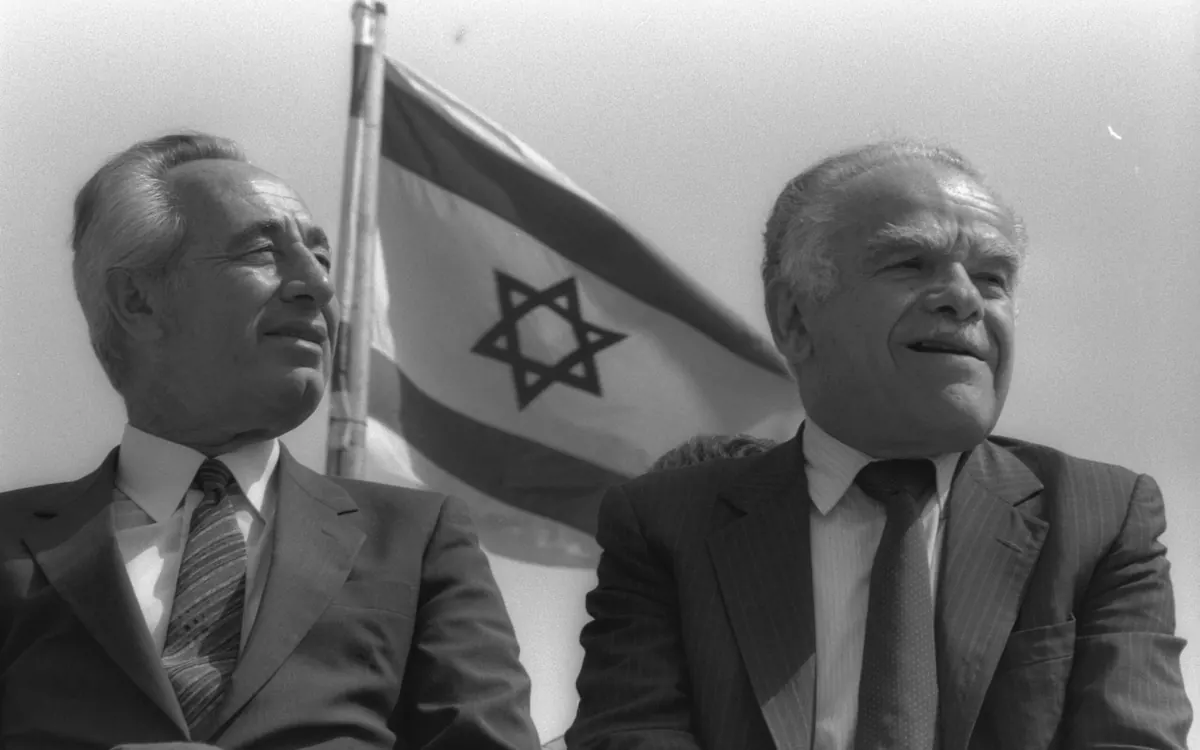
The unity government wasn't born yesterday, it has a long history in Israel. Tune in to this ongoing exploration of the evolution of Israel's electoral system to learn about the government shared by ex-underground fighter Yitzhak Shamir of Likud and Shimon Peres of Labor through the 1980s, how it held together Mizrachi pride, religious tension and territorial confusion. A government that withdrew from Lebanon, tamed hyperinflation and faced the First Intifada before being brought down by the infamous "dirty trick."
About this episode
A party without a moral foundation, Eisenhower said, is merely a conspiracy to seize power. Rav Mike dwells on seventy, a rich number in Jewish tradition. Seventy souls went down to Egypt, seventy nations make up the world, and the united kingdom of David and Solomon lasted seventy years before it broke apart. Israel's third commonwealth is remarkably strong, so strong that the real problem is not knowing what to do with its potential. When Begin abandoned the scene he took with him the hour of leadership held only by founding warriors, and Daniel Gordas called him the last of Israel's biblical statesmen, a man who read the world through a biblical lens with a generosity of spirit the field now badly lacks.
Yitzhak Shamir took the reins, far from Begin's public personality yet no less biblical in worldview, with the god of vengeance close to his heart. Born Yitzhak Yezernitsky in 1915 in Poland, he joined Beitar, made aliyah in 1935 and became Shamir, a thorn that stabs and a rock that cuts steel. He joined the Etzel, then went with the militant Lehi under Avraham Stern, and as operational leader took the name Michael after Michael Collins. He orchestrated the assassinations of Lord Moyne and Count Bernadotte, carrying his father's vow of revenge from Poland. Later, through the Mossad, he ran Operation Damocles against the German scientists working on Egypt's missile program.
Shamir joined Begin's Herut in 1969, entered Knesset with Likud in 1973, served as Speaker in 1977 and foreign minister in 1980, quietly leading the hardliners who abstained on Camp David. When Begin left, Shamir had no base and little charisma, yet he became the third longest serving prime minister in Israel's history. The 1984 unity government was the first rotating one, Shamir and Peres trading the premiership every two years, with a ten-seat inner cabinet designed so each side could block the other. Against every expectation, it proved remarkably stable and effective, pulling the troops back to a security zone in Lebanon and taming the economic crisis across a full four-year term.
The electoral map had become bipolar. Mid-sized parties were absorbed into labor and Likud, while small satellite parties multiplied, each tied to one of the two blocs. Left and right, borrowed from the French Assembly of 1789, fit poorly, as labor became the urban elite and Likud the home of working people. What dealt the final blow to Begin's government was the economy. Hyperinflation reached four hundred percent in May 1983, savings evaporated as citizens scrambled for dollars, and the crisis became known as Israel's economic Yom Kippur. When the votes were counted in 1984 the deadlock resolved nothing, Likud dropping to forty-one and labor to forty-four, with their losses kept inside their own blocs.
The 1984 vote also saw the birth of Shas under the Torah giant Rav Ovadia Yosef, which succeeded where earlier Mizrahi parties failed by taking the posture of a full religious party strengthening Torah and Mizrahi identity, quickly becoming a key element of the right-wing bloc. The 1988 election produced another deadlock and another power-sharing deal, this time with Shamir keeping the premiership on a one-vote edge. The Intifada had erupted in December 1987, pushing the future of the territories to the center of the campaign. Then in the spring of 1990 Shimon Peres pulled the stinking trick, toppling the unity government he himself had built, only for Shamir to out-maneuver him and form a narrow government of his own.
Key ideas
- Seventy is a rich number, and Israel's third commonwealth is so strong that its real problem is not knowing what to do with its potential.
- Begin's exit took the hour of founding leadership with it, and Gordas called him the last of Israel's biblical statesmen.
- Shamir rose from the Lehi underground, orchestrating the Moyne and Bernadotte killings, to become the third longest serving prime minister.
- The 1984 unity government was the first rotating one, with an inner cabinet built to block, yet it proved remarkably stable.
- The bipolar map and 400 percent inflation, an economic Yom Kippur, ended Begin's Likud government and resolved nothing in 1984.
- Shas was born in 1984 under Rav Ovadia Yosef, and in 1990 Peres pulled the stinking trick only for Shamir to out-maneuver him.
Chapters
- 0:00 Seventy years; the kernel of a whole
- 2:19 A state strong in its potential
- 4:37 Begin, the last biblical statesman
- 6:54 Shamir takes the reins
- 8:00 Yezernitsky; Beitar and aliyah
- 9:03 Michael; Moyne and Bernadotte
- 10:24 The father's vow; Operation Damocles
- 11:31 Herut, Likud, and the hardliners
- 13:45 Shamir replaces Begin
- 16:11 The first rotating unity government
- 17:19 The bipolar map
- 20:03 Left and right from 1789
- 23:21 The economic Yom Kippur
- 25:36 1984 resolves nothing
- 26:39 Shas and Rav Ovadia Yosef
- 37:44 The stinking trick
Who, where and when
People
Dwight Eisenhower, Menachem Begin, Daniel Gordas, Yitzhak Shamir, Avraham Stern, Michael Collins, Lord Moyne, Count Bernadotte, Shimon Peres, Rav Ovadia Yosef, Yitzhak Rabin
Places
Poland, The land of Israel, Lebanon, Tel Aviv, The Lebanese security zone
Texts
The Camp David Accords, The peace treaty with Egypt
When
1915 CE: Shamir born in Poland, 1944 CE: the assassination of Lord Moyne, 1983 CE: the economic Yom Kippur, 1984 CE: Shas is born and the first rotation, December 1987 CE: the Intifada erupts, 1990 CE: the stinking trick
Read the transcript
If a political party, said Dwight D. Eisenhower, does not have its foundation in the determination to advance a cause that is right and that is moral, then it is not a political party. It is merely a conspiracy to seize power. Those are words to contemplate in our time and hour. I'm Rav Mike Foyer, and this is The Jewish Story. Season 6, Episode 3, Electoral Dysfunction, Part 2 So like I said, my goal this season is to learn to read the writing on the wall. It's not that I've become a fabulous, God forbid. Nothing ties the hands of God, Hakol Yachol. But so much of what will be is already right here with us now in the world. And as we say, God helps those who help themselves. If we can't derive some wisdom and practical guidance by looking at how we got into our current electoral mess, then perhaps we don't merit any desistance, divine or otherwise, in extracting ourselves from it.
And the thing that hits me right between the eyes when I look at our current situation is that we've basically been in a perpetual election cycle since the state of Israel turned 70, about three years ago. Seventy, if you don't know, is a rich number in Jewish tradition, which, like many ancient cultures, is as focused on the symbolic meaning of numbers as much as, or perhaps even more than, on their mathematical significance. Seventy people went down with our father Jacob to Egypt. 70 nations make up the world. 70 language comprise communication. 70 faces of the Torah. In a simple sense, 70 represents the kernel of completeness from which a true whole can emerge. Call it the DNA of any given situation.
And, more specifically, to our current political malaise, The United Kingdom founded by David and continued by his son Shlomo lasted for 70 years before it broke apart. Not, God forbid, that I see civil war on the horizon. I mean, truth be told, that's low on my list of worries. On the contrary, when I look around, the third commonwealth in which we live, God willing, someday the third kingdom is remarkably strong. strong. So strong, in fact, that I believe our biggest problem is not knowing what to do with all the potential of this great state, right? When I look at the challenges we face as a society, both domestic and foreign, they make an imposing list, but each one also represents an incredible opportunity, opportunities to renew our culture, to re-engage the Torah and bring it into the world in a fantastically new and powerful fashion, to reshape our region, maybe even the world.
all that we need to do so is social will and the leaders who can help turn that will into concrete action. Now, I know that's no small tax, but if recent history is an indicator, the first 70 years of our state and surely decades before that, it's one of which we are entirely capable of accomplishing. The question of how to awaken social will through vision lies ahead in this season, And much of it will come obliquely through the interviews I plan on doing. By the way, I hope you enjoyed the thoughts that Ariel Levy shared with us. I want to hear your feedback. Send me emails, robmikefoyer at gmail.com, or shoot me a personal message at robmikefoyer at Facebook. I want to know what you think. And I also, again, want to hear whose vision you'd like me to engage.
Because truth be told, questions of vision and even questions of leadership are not exactly our focus at the moment. I'm a believer in the profound importance of structure. And when it comes to the political mechanism that allows social will to gain focus through leadership in order to garner enough power to make change, that means, at least in a democracy, the electoral process. And though my goal right now is to trace the evolution of Israel's electoral dysfunction on that structural level, Of course, personality can never be ignored in politics. We left off the last episode really with an end of an era. Menachem Begin had been part of every electoral cycle since the birth of the State of Israel and, of course, deeply involved in Zionist politics for decades before that.
And his passing raised many questions, both practical and mythic, for lack of a better term. Practically speaking, there were many who wanted to dismiss the Likud's rise to power under his leadership as a flash in the pan. Their victory over the old guard leadership being driven largely by Begin's charismatic personality and, frankly, labor corruption. Before Begin's seat was even cold, the infighting had begun within his own party to see who would replace him. And it also, in the opposition leadership, the assumption was that Begin out of the way means leadership is theirs again for the taking. So that's the practical front that we'll see. But on the level of national mythos, Begin took with him the hour of leadership, which is only ever held by founding warriors of a nation.
You might recall my interview with Daniel Gordas from last May. When we spoke about Begin's life in retrospect, he paints a picture of Menachem Begin as the last of Israel's biblical statesmen. Begin was certainly a man of deep faith, though not fully religious in the traditional sense. What it came down to is that the essence of his worldview, and of course, his political approach, was looking at the world through an almost entirely biblical lens. Now, certainly, the Tanakh, the Hebrew Bible, constitutes our deed to the land in Menachem Begin's eyes, and it fueled his adoration for the generation of Jewish fighters he helped to create. It also gave him a broad worldview, which in no way lessened his intensity.
He was deeply devoted to Am Yisrael, whose story unfolds not only in the Bible, but here in the land, while also believing with all his heart that every human being is created in the image of God, that everyone can find their story within our own. And if there's anything our political field lacks today, it's that combination of a biblical worldview together with real generosity of spirit. Instead, in my eyes, we largely face ideologues who are combining their ideology with interests. I mean, it's not uncommon, but it's not what we need. Now, Gordas' observations are worth reviewing. and maybe truth is, when I think about it, I'll go back and reach out to him and see if he wants to share further thoughts on our current electoral dysfunction.
But for right now, I have to note that though Begin may have taken a certain mantle with him when he abruptly abandoned the political scene, he was not actually the last of Israel's founders to serve as prime minister. Yitzhak Shamir was the one who took the reins of power from Begin's hands. And though he was far from the towering public personality Begin had become, his worldview was no less biblical in its own right. Shamir may have struck most as quiet and effective, by the way, always a type to be watched, but those close to him knew that, at the very least, the god of vengeance was close to his heart. Future Prime Minister Yitzhak Shamir was born Yitzhak Yezernitsky in 1915 in the village of Rozenoy, then part of Russia, soon after Poland again, you know this story.
And like many of his fellow Polish Jews, as soon as he was old enough, Yitzchak joined Beitar, the revisionist Zionist movement founded by Zev Jabotinsky and not long after moved to Warsaw to pursue his studies in law. Now apparently there he decided the world needed another Jewish lawyer, like I need a hole in my head. And in 1935, young Yitzchak made Aliyah, going up to the land of Israel in order to help liberate it from British colonial rule. Upon arrival, he became Shamir, a word that means a thorn which stabs and a rock that can cut steel. A prescient name change, considering the hard stance he was going to take on almost every decision until the day he died. Shamir joined the Etzel, the revisionist underground army, in its very earliest days.
And when the organization split in 1940, he went with the more militant Leche faction under the leadership of Avraham Yair Stern. In less than two years, Shamir was captured and Stern murdered by British security forces. Escaping from prison, Shamir joined Natan Yellen Moore and Israel Eldad in reorganizing the Lechi into a ruthless fighting force. Some would say terrorist operation. They themselves own that title with pride. As operational leader of the Lechi, Shamir took the nickname of Michael after the Irish Republican leader Michael Collins. He was a great admirer of their national struggle and pulled off operations like the 1944 assassination of Lord Moyne, British Minister for Middle East Affairs, and the 1948 assassination of UN Representative of the Middle East, Count Volk Bernadotte, among many less well-known others.
A guardian of law and order looks out over the old walled city of Jerusalem as once again the irresistible force of Zionism meets the immovable object of Arab nationalism among the blood-stained hills of the Holy Land. Armored cars with reinforced screams patrol the road from Jerusalem to Bethlehem when arson, murder, and wanton destruction were making the Holy Land a land of terror. Family legend tells that when Shamir father back in Poland realized that the Nazi extermination of the Jews had already begun and that it was too late to escape he declared I have a son in the land of Israel and he will exact my revenge on them True words whether he said them or not Now Shamir managed to avoid the persecution to which many Lehi members were subjected after the founding of the state.
And after a brief time outside of the political world, in 1955, he returned to join the Mossad. There, as director of Operation Damocles, he put his underground skills to work, fulfilling his father's vow as he coordinated the assassination of German rocket scientists working on the Egyptian missile program. In 1969, Shamir put aside his pre-state political grudges and joined Menachem Begin's Heyrut party. And when the party made its real entry into the political scene in 1973 as Likud, Shamir became a member of Knesset for the first time. Known as a man of intense efficiency and absolute integrity, He was widely welcomed, despite his radical reputation as Speaker of the Knesset in 1977, when Begin's Likud won the premiership in the upheaval, and he became Foreign Minister in 1980.
Now, despite his presence in the cabinet, or perhaps because of it, Shamir was the unofficial head of the Likud hardliners. Though as Speaker he had presided over Egyptian President Anwar Sadat's visit to the Knesset, Shamir abstained in the votes to approve the Camp David Accords and the peace treaty with Egypt, which flowed from there. He was also a quiet but firm voice for bombing the PLO into submission, no matter what cost to Lebanon or Beirut. And when Menachem Begin announced his sudden retirement from politics, he left no obvious successor, and perhaps the least obvious amongst the cabinet was actually Yitzhak Shamir. I mean, Shamir lacked any independent political base. He was hated by many people, in fact.
And he also lacked the charisma to garner one. He wasn't a member of Begin's inner circle that was made up largely of veterans of the Irgun underground, many of whom still saw Shamir as a rebel for seceding along with Stern and his lucky faction more than 30 years ago. Nonetheless, Shamir was universally known for his toughness, his unwavering refusal to compromise over territory, and above all, for his honesty. His appointment as foreign minister had actually caused much worry on the international scene because of his hardline views. But despite that, Shamir's quiet manner and his distaste for empty rhetoric actually allowed him to restore Israel's relations with many countries in the United States, all over Western Europe, South America, Africa, after the trauma that the Lebanon War had done to those relations.
As the New York Times put it when he was appointed, he's apt to be rather taciturn, a refreshing attribute in a country where foreign policy pronouncements have sometimes shot off in all directions, like popcorn. Ugh, can't say it better than that. Another testament to Shamir's skills as a diplomat was actually that he had very few enemies in the cabinet and a number of strong supporters when Begin left. One crucial supporter proved to be Ariel Sharon, who would have himself been a leading contender for the premiership if he hadn't fallen into disgrace after the massacres in Sabra and Shetila. So after five days of heated competition, there was a culminating secret ballot amongst Cherut party members.
And when the leadership emerged from eight hours of voting in the Tel Aviv Ohel Shem theater, they announced Shamir as the new party leader, and thus as the replacement for Begin as Prime Minister. Shamir's manager contender had been Deputy Prime Minister David Levy, a young and very popular Moroccan with a strong following amongst the poor and working classes, a core Likud constituency. Nonetheless, Levy had been deemed too much of a newcomer and therefore a risk for the old guard leadership. Shamir struck an immediate Begin-esque note upon being announced as a new party leader, promising to continue his policies and declaring that we must bring peace to all the borders of Israel so that no enemy will dare attack us.
But neither of those accomplishments looked to be simple in September of 1983. The IDF was still heavily bogged down in Lebanon. The economy was increasingly in crisis, and Shamir's own coalition was restless to say the least. Three liberal members of Knesset in the Likud party actually threatened to rebel when news of Shamir's victory was announced. The ultra-Orthodox Agudat Israel party, that held four decisive seats in his ruling coalition, promised they wouldn't, quote, sign a blank check for the new prime minister, an indication generally that they were going to press for a stricter enforcement of religious law. The North Afghan immigrants' Tammy party, holding three seats and a cabinet post, also let Shamir know that their restlessness was real around the proposed cuts in welfare budgets that the economy might demand.
Faced with such a mountain of challenges, not to mention his advanced age of 68 and complete lack of popular appeal, most assume that Shamir was really a caretaker prime minister. The truth is, though, he stands as the third longest serving prime minister in Israel's history. He would have been second only to Ben-Gurion if Bibi hadn't come along and overtaken them both. The type of unity government that we know and love, or know and loathe as the case may be, was first formed in 1984. In point of fact, that was not the first unity government Israel had ever seen. The first one came in the lead-up to the 1967 Six-Day War, and in various iterations lasted until Begin pulled his Heirut faction out of Golda Meir's government in 1970.
You can go back to Season 4, Episode 10 for the story of that breakup. And by the way, if you want the full picture, check out Season 3 on the Six-Day War just to get a round view. But for now, the real goal is to understand how the political culture has evolved since then. So, I'll just ask. What made that first unity government different than the type of scrabbling around in the middle ground we see in our Knesset today? Well, the first thing is the presumption of power. And that really may be the main thing. In 1967, the labor alignment had been firmly in power under various names since before the founding of the state. And therefore, unity meant inviting the opposition to join their government. Hence the fact that when Begin pulled out of the Union government, Golda Meir remained in charge right through the Yom Kippur War, and if it weren't for that disaster, perhaps beyond.
The political situation in the mid-80s was fundamentally different. By that point, the two-party dynamic, which began to emerge after the formation of the Likud and its gains in the 1973 election, had become a defining feature of the electoral field. Begin broke the mold of labor rule in 1977, which I hope you recall. And he consolidated Likud's power with his repeat victory in 1981. But the bipolar structure which emerged from his victory wasn't the two-party structure which Americans know. Because that phenomenon of proportional election managed to keep so many small parties in the electoral field. and that's why I call it bipolar instead of two-party. What essentially happened was a consolidation of camps in which the mid-sized parties were all but absorbed on the left into labor and on the right into Likud.
For instance, the National Religious Party, NRP, had traditionally won between 10 and 12 seats but in 1981 dropped to 6 and in the 84 election down to 4. At the same time as these mid-sized parties basically were absorbed, the number of small parties, meaning between two or three seats, not only remained, it actually increased. And there was, together with this, an increasing identification between those small parties and one of the two major blocks, hence a bipolar system, each which has a large party as its center and what we might call satellite parties. There were a few parties that remain beyond the political pale, like Meir Kahane's Koch party that would be banned in 1988, and also the communist Hadash and the Arab Jewish progressive list for peace.
It's interesting to note, by the way, that each of these seems to be having a political moment in our day, between the first entry of an Arab political party into the government in our last phase, and the impending surge in support for the new iteration of the Kahanist vision coming in the soon-to-be elections. Now, since Begin's election in 77, in addition to this structural problem, the electorate itself has been battered by increasingly polarizing issues. The Sinai Agreement, the Lebanon War, the question of settlement policy in Yudah, Shomron, and Aza. And that fragmentation, of course, fed the realignment of the electorate into right-wing and left-wing blocks. Now, you couldn't hear the air quotes I put around the words right and left in that sentence, but it is worth taking a moment to note the somewhat absurd attempt to make our political system line up with terms which originate in the French National Assembly in 1789.
It's true. Left and right generally refer to the progressive and conservative ends of the political spectrum and may have matched the social, economic, and even political differences that distinguished the early generations of Israel's electorate. By the 1980s, the Labor Party had begun to evolve into a stronghold of the urban elite, no longer the rural socialist kibbutz of its old days and the Likud was now quite firmly the representative of working people And though the right is in general a more religious electorate issues of religion and state are utterly negotiable in the Israeli political scene. And finally, once violence will begin to shake Israel's hold on Gaza, Yudah, and Shomron in 1987, issues of national vision are going to push politicians across the aisle in ever more confusing fashions.
Take just for an example the fact that the three most fiercely nationalist parties in the right-wing bloc in the 80s, Moledet, Tzomet, and Tchiyah, were founded by Rehavam Zevi and Rafi Eitan, who are two old Palmach leaders, the Palmach being, of course, a strongly left-wing, militant organization, and also by the sons of Yitzhak Tabenkin, founder of the Kibbutz movement. Basically what we'll see is that the ideological heirs of the Marxist Ahdut Ha'avodah party of the early 40s will become the far right of the late 80s. Maybe later we'll speak about how rather than right or left, it might be better to speak of the consolidation in the Israeli electorate between a peace camp and a victory camp.
Oh, and by the way, just you wait until you see what a messy tangle the Oslo process will add to that equation. For now, clearly the electoral map which gave birth to the unity government of the early 80s was vastly different from the one that fostered its first origins in the late 60s. The other element that distinguishes these two processes were the very distinct natures of the crises that drove their formation. In 1967, basically, if Israel's political leadership couldn't unite in the face of an imminent multi-front war only 20 years after the Holocaust, then it was clear to everyone that the alternative was total destruction. That pressure didn't exist in 1983. And the result was a unity government born out of indecisiveness, rather than one born out of the need to rally round in times of trouble.
And that's not to say that Israel lacked a sense of existential crisis in the mid-80s. The withdrawal from Sinai had seemingly produced nothing but scars on the national psyche. The peace frugality operation in Lebanon had morphed into a protracted and increasingly ugly war, but it was actually the economy that dealt the final blow to Bacon's Likud government. As a reward to its supporters, both Likud governments of 77 and 81 had poured resources into the development towns and underdeveloped neighborhoods in the big cities and in small peripheral towns, a program, by the way, supported by the vast majority of Israelis. The same time, they'd launched a major building drive in Yudash Ramon and Aza, which was far less popular, though no less expensive, and to these two, a mushrooming defense budget as a result of both the withdrawal from Sinai and the Lebanon War, plus Likud's inability to fight the Hesterroot Union's demands for cost-of-living linked salary adjustments every single year.
And whether you followed all those details or not, just know that together these policies triggered a hyperinflation which was unprecedented in Israel's economic history. In May of 1983, at the very end of Begin's premiership, the annual inflation rate was announced to be 400%. That news set off a panic on the Tel Aviv Stock Exchange, and in the coming months, citizens at every level of the economy withdrew billions of shekels in savings to try and purchase dollars or other durable goods to save their savings. Despite government efforts to intervene, the situation spiraled, and by October of 83, hundreds of millions of dollars in private savings had evaporated like that, while the shekel was increasingly worthless.
Peaking almost exactly 10 years after the war, the events became known as Israel's economic Yom Kippur, and the Likud ruling coalition was far from its only casualty. Having failed to offer any realistic plan for disengagement from Lebanon, and lacking even Begin's personal charisma to fall back on, the new Prime Minister Yitzhak Shamir seemed helpless in the face of this crisis. Public support for the Likud began to drop almost as fast as the value of the shekel, and the opposition smelled the blood in the water. Their moment of opportunity came when Tammy, a Mizrahi-dominated breakaway from the National Religious Party, defected the coalition and gave Shimon Pres' labor alignment enough votes to force early elections, set for July of 1984.
But, surprise, surprise, when the votes for the 11th Knesset were tallied, it was quickly apparent that that vote had resolved absolutely nothing. Now, it was to be expected that the Likud would be punished at the polls, and indeed, they dropped from 48 seats to 41. But most of that loss was actually absorbed by the small parties firmly aligned with their right-wing bloc, like Tchia and Kach. And thus, the votes were kept within the family, as it were, if not within the party. Furthermore, in every election since the establishment of the state, the religious camp had taken between 12 and 18 seats, in this election proved no different. Despite that vote being fragmented amongst five parties, collectively these religious parties gained a total of 14 seats.
And no matter how hostile the relationships were amongst them, and they were quite fierce, all five agreed to stay within the right-wing bloc. There was a newcomer, actually, to the religious camp in the 84 elections, and they deserve a quick word at this point, because the 1984 election saw the birth of the Schatz party under the ages of Torah giant, Rav Avadiyah Yosef. The Shas name is an acronym, Shomrei Torah Svardayim, the Svardi observers of Torah. And it's also a reference to Shisha Sidra, the six orders, which is a general term for the compendium of oral law. And that indicates the base of their power. The social roots of Shas as an empowerment movement will deserve their own discussion. You know, I'll never forget reading the English party statements in the Jerusalem Post before the 2003 elections.
And the line that stands out to me from the Shas blurb was, only a strong Shas can curb white aggression. That's a quote. But that's a whole episode in that comment. But in the current context, what I want to note is you need to understand that Shas succeeded where previous Mizrahi power parties had failed by taking the posture of a full-blown religious party. They left it to the Likud to represent the discontent of their voters from North Africa and Middle East with the share they were receiving from the public pie and focused instead on strengthening Torah and Mizrahi culture and identity. That was a winning combination and proves so to this day. Shas not only presented a viable alternative to Ashkenazi Torah leadership of the Haredi world, I mean, Ravavad Yosef was second to none, Zecher Tzadik Le Bracha, they quickly became a key element of the right-wing bloc, although not a lockstep partner, as we will see.
Despite all these factors, Likud leader Yitzhak Shamir still had no clear way to form a majority coalition. But opposition leader Shimon Peres had just as dim prospects. In fairness, having given Shamir his due, I should also mention that Perez also had one foot in the world of the Founding Fathers. You can get his backstory from Season 3, Episode 13. I mean, just the location there, unless you know how old he is. But for now, just know that since his rise as Ben-Gurion's chief protege, Perez has missed gaining the premiership multiple times, perhaps most painfully when he was passed over in 1976 for the young and untested Yitzhak Rabin. Now it seemed that the prize might actually be in his reach, but the math simply didn't work out.
Even though Labour had captured 44 seats, three more than Likud, that was still down three from their previous count. Votes once again lost to smaller parties in their left-wing bloc, and Perez had no viable coalition. The Orthodox parties had historically been kingmakers, both on the left and on the right, But as I said, they were now firmly committed to the right-wing bloc, where they're more or less state to this very day. Shamir's nationalist religious Mizrahi camp may no longer have been able to rule, but it could certainly stop labor from doing so. It wasn't just the parity of labor in Likud, which made coalition formation all but impossible. A whopping 13 small parties had gained at least one Knesset seat in the 83 election, adding massive instability to the situation.
By the way, this is where structure comes in, because the threshold for election was 1% of the electorate. We'll speak in the coming episode about how the first real reform of Israel's electoral system was simply to raise that threshold. This might sound like a familiar problem. Now, none of this is to say that either Shamir or Perez simply gave up hopes of forming a government. But by late September, after months of attempted horse trading, neither had even vaguely succeeded. And that's when the two large parties decided that a unity government was their only option. Mr. Shamir and myself dealt this afternoon without sending issues, dividing the labor alignment and the Likud party. We have found our differences as very serious ones We shall try to see if we can overcome them Due to the divided nature of the electoral map an unprecedented agreement was reached whereby Likud and Labour would actually divide the administration with Shamir and Perez trading off two-year stints as Prime Minister and Foreign Minister, respectively.
And even more unique was the creation of a ten-seat so-called inner cabinet, divided equally between the Labour and Likud. It was meant to ensure that each party could simply block the initiatives of their rival. Now, from today's perspective, that sounds like a formula for political gridlock and endless elections, or at least national stagnation. But the reality is, is the government that took office in September of 1984 was remarkably stable and effective. Resting on the votes of 97 members of Knesset, President Shamir put aside their differences to withdraw Israeli troops into a security zone along the Lebanese border and to tame the economic crisis. this new fangled national unit government actually completed its full four year term and just for context in its first 60 years Israel saw 32 governments in power do the math a four year term was a rare accomplishment to say the least oh halavai that we should see such a thing in our day now for four years the Shamir Perez government was able to put aside their most divisive issue what to do with the future of Yudah, Shomron, and Gaza.
They put it on ice, but soon enough, the situation in the territories began to heat up nonetheless. One of the stranger things in life is that there can just be too much of a good thing. If that's true in general, it's all the more so in politics. The unity government elected in 1984 served its full four-year term, And President Shamir even managed a peaceful trade-off as foreign minister and prime minister, which meant that Yitzhak Shamir was back in the driver's seat when the season began for the 1988 elections. Now, there was certainly too much of a good thing in these elections. Twenty-seven parties registered in the race for the 12th Knesset, fielding a combined list of 1,900 candidates. And, by the way, in a truly positive sign, voter turnout was nearly 80%.
Just for context, voter registration in the United States in 1988 was only 67%. And the actual percentage of those who cast their ballot, far lower. Now, the downside of this too much of a good thing was that 15 of those 27 parties crossed the 1% threshold, managing to gain at least one actual seat in Knesset. and that meant that the political map was more or less identical to the one of 1984. Deadlock was again the flavor of the season. Labor took 39 seats, down 5 from the previous Knesset, while Likud lost only one to settle at 40. The religious bloc of Shas, National Religious Party, Degelator, and Tichyia collectively held 18. They'd gone up, and both Perez and Shamir tried their almighty best to court that bloc as a base for a stable coalition, but to no avail.
In the end, Labor and Likud chose to adopt another power-sharing agreement. But, unlike the 1984 agreement, Shamir's one-vote edge kept him in the Prime Minister's seat. Also unlike in 1984, the issue of the Arab-Israeli conflict was no longer on the back burner. The two-month election campaign had actually focused largely on ways and means of achieving a peaceful solution to the decades-old conflict. The Likud promoted the autonomy plan, which had been written into the 1979 Camp David Accords, and Shamir took an absolutist stance in opposition to any contact with the PLO. The labor alignment pushed the idea of an international Middle East conference as the only way forward, and breaking with his previous ambiguity, we'll call it, Shimon Peres came out and stated his willingness to trade land for peace in Yudah, Shomron, and Gaza.
Now, more than anything else, it was the eruption of the Intifada in December of 1987 that forced this shift in the conversation. Intifada means the shaking off, and it marked a revolution in the hundred-year war between Israel and the Arabs both inside the land and without. It will obviously require its own detailed discussion. Have no fear. But right now, the focus is on the evolution of Israel's electoral system. And here, it has a very specific impact. The renewed eruption of violence in late 87 and early 88, coinciding with the approach to 1988 elections, forced many Israelis to pay attention, perhaps for the first time, to the reality on the ground in Yudan, Shomron, and Gaza, in a way that many had happily avoided up until now.
For point of reference, by 1990, there would be almost 10,000 IDF troops employed in those territories in a new role of riot police and population suppressant. All of those troops, remember, are the sons, brothers, fathers, husbands, and sisters, mothers, wives of families. And of course, all of them are of voting age. This new awareness created a polarization with which we are sadly familiar today. Back then, it was between labor's call for a negotiated settlement, as labyrinthian as their policy proposals about autonomy, Jordanian stewardship, etc., may have been, and between a widespread visceral public reaction calling for harsher punishment simply to suppress and restore public order. Despite this polarization, a poll conducted in late 1988 by the Israel Institute for Applied Social Research found what they called a slow dovish trend within the nation with, quote, each year showing a slight softening of attitudes.
Or, it's perhaps better put in the words of respected Israeli novelist Yitzhak Smilansky. He said, I am not blind to the fact that there are two sides to this painful situation. That is not a question of evil oppressors persecuting the righteous oppressed. But neither am I blind to the fact that there is a way out of this quagmire. That in the end, there will be no choice but to talk and to negotiate peace. So why not do it now instead of later? After another death and another and another, the Jew in me is crying out. this subtle shift within the electorate was accompanied by a much less subtle shift in pressure from the American administration and its willingness to push Israel I mean, they might have been related after all, President Bush the elder and his Secretary of State James Baker could certainly read Israeli polls as well as Perez and Shamir under such pressure even a hardliner like Shamir whose famous negotiation strategy amounted to no, no, no, he was forced to make some sort of gesture.
So in May of 1989, the Shamir government presented plans to proceed with negotiations on what they called Palestinian autonomy. Those plans, however, were wildly divergent from what the Americans were demanding. And that's when labor leader Shimon Peres saw his chance to return to his role as prime minister without having to wait his turn in their power-sharing agreement. In March of 1990, using his authority as finance minister, Paris blocked funds that had been allocated to eight settlement projects in Udan Shomron under the 1988 Likud Labor Coalition deal already, meaning it was supposed to be signed and sealed. Then Paris threw down the gauntlet, virtually inviting Shamir to demand his resignation, which indeed the Prime Minister did do.
Now, Paris didn't resign alone from the cabinet. He was joined by all the other labor ministers. It was a bold move, and in the background was a promise Paris had received from the Shas faction. They had promised him that they would throw their six votes behind a no confidence vote in Shamir's government, and thus help Paris topple a unity government that he himself had helped create. It was a maneuver, actually, that Perez's rival Yitzhak Rabin later named the Stinking Trick, and it backfired. You know, the Knesset did indeed express its lack of confidence in the present government, and therefore, President Chaim Herzog nominated Perez to succeed Shamir without elections, but he was unable to form a coalition.
When Shamir then received the secondary nod from Herzog. He put his considerable political skills into play. And lo and behold, by June 11, 1990, a narrow majority of 62 members had approved a new Shamir government. The era of unity governments seemed to have passed for now. But the underlying electoral issues, not to mention the structural ones, are far from over. The Israeli populace is split in its vision of the future. and with the Intifada raging, Operation Desert Storm on the horizon, the Oslo Accords, in the not-so-distant future, the electoral system is going to face many tests to come. I want to thank everybody that I can write. I want to thank the folks who give their hard-earned money to make this show happen, keep it free, widely available.
I want to call on you to join them now. It's not too late. Put your money down on Season 6. Go to my website, jewishstory.co. In the upper right-hand corner, you'll see a button that says Be a Patron. You can click on that to give a little bit of her podcast support. I want to thank the Land of Israel Network. That's thelandofisrael.com. They're building a center for global transcendence in the heart of the Judean Mountains. I want to thank the Pardes Institute, pardes.org.il, for throwing the doors of the Beit Midrash open as wide as possible. And I want to thank you for listening. I'm Rav Mike Foyer, and this is The Jewish Story.
More from Season 6
TJS S6E2 Electoral dysfunction part I
Part one of an in-depth look at the historical sources of the present issues in the Israeli elections for Knesset.
Play Episode
TJS S6 Interview with Rabbi Aharon Ariel Lavi
Here is an interview with Rabbi Aharon Ariel Lavi, of Hakhel: The Jewish Intentional Communities Incubator in the Diaspora, an expert on the biblical sabbatical year - shemitta....
Play Episode
TJS S6 Sukkot interlude - A matter of faith
The Zohar calls the Sukkah "the shade of faith." Here are some impromptu thoughts from me to you as I sit in the shade of my sukkah -...
Play Episode