
TJS S5E22 Soviet Jewry - the end game
Here is the third and culminating episode in a story that we have been following since season four. The Eighties saw a welding together of American Cold War policies and the struggle for Soviet Jewry in a dramatic fashion. Super power summits, glasnost, the release of Natan Sharansky and the Freedom Sunday march all came together to achieve one purpose - let my people go!
About this episode
Goethe on earning freedom anew each day. Rav Mike brings to a close the struggle for Soviet Jewry, whose first phase from 1970 to 1989 freed 330,000 Jews while the second, after the Soviet collapse, poured out a million and a half. The early grassroots phase had peaked with the Jackson-Vanik Amendment of 1974, which tied trade to human rights, pushed over the line by Sakharov's open letter to Congress. Natan Sharansky, awakened by reading Sakharov's underground essay, would carry that message into a life in Israel, teaching that human rights belong to no single class or nation but to the eradicable longing of all humanity to be free, and that to avoid a life of lies you must speak your mind.
The Lubavitcher Rebbe opposed the protest ethos, less from disagreement than from a street-level view through Chabad's underground network, fearing that demonstrations provoked Soviet harassment of committed Jews. In 1971 he tried to cancel the pre-Pesach rally outside the UN when a hundred families had their visas in hand, and when they lost them anyway he burst out asking whether the protests had freed even one Jew. Yet no tension dimmed his love, and he sent young Shlomo Riskin into the USSR to organize underground yeshivot and Hebrew classes, outfitted with shoes whose false heels hid rolls of cash for Jews made unemployable by their refusal to work on Shabbat.
Quiet diplomacy faded under Carter's open linkage and seemed doomed when Reagan called the USSR an evil empire, yet the cause could catch fire in that White House. Senator Chic Hecht, taken to the Rebbe and told that his top priority should be getting the Jews out through quiet diplomacy, later handed Reagan a list of twelve hundred refuseniks, and within weeks of the Reykjavik meeting the people on that list began to be released. Years later Nancy Reagan explained that Gorbachev had warned any publicity would halt the outflow, so the president kept silent and never once mentioned it in public, the very words the Rebbe had spoken to Hecht years before.
Not everyone worked behind the scenes. At the 1985 Geneva summit Jesse Jackson held Gorbachev for forty-five minutes on the test ban and Soviet Jews, part of his path of contrition after the Hymietown remark. Before Geneva Reagan pledged in his address to speak for those who cannot speak for themselves, and Shimon Peres rose in the Knesset to cry let our people go while insisting Israel did not seek to undermine the USSR. At the center stood Avital Sharansky, who for seven years made her husband's face the face of Soviet Jewry, while Natan served his sentence in the Gulag repeating that nothing they do can humiliate me, I alone can humiliate myself, buoyed by the freedom of his spirit.
In February 1986 Sharansky was freed in a spy exchange, zigzagging across the Potsdam bridge to defy his captors and apologizing to Avital for being late. On December 6, 1987, a quarter million Jews filled the Washington Mall for Freedom Sunday, the largest Jewish gathering in American history, where Rav Mike himself stood at thirteen. The next day Reagan opened his summit with Gorbachev by handing him a card listing Soviet citizens he wanted granted exit visas. Caught off balance, Gorbachev refused to sit as the accused, but the pressure told. By 1988 the rallies were cancelled as glasnost opened, the Berlin Wall fell, and in 1990 alone more than two hundred thousand Jews left, with a million and a half to follow after them.
Key ideas
- The first phase of escape freed 330,000 Jews, while the Soviet collapse would pour out a million and a half more.
- The Rebbe opposed the protests from a street-level view, holding that quiet diplomacy served Soviet Jewry best.
- Senator Chic Hecht handed Reagan a list of refuseniks, and within weeks of Reykjavik the people on it began to be released.
- Avital Sharansky made her husband's face the face of Soviet Jewry across seven years of ceaseless campaigning.
- Natan Sharansky zigzagged across the Potsdam bridge to freedom in 1986 and apologized to Avital for being late.
- Freedom Sunday drew a quarter million to the Washington Mall, and Reagan opened his summit with a list handed to Gorbachev.
Chapters
- 0:00 The longing to be free
- 2:10 The phases of escape
- 3:17 Jackson-Vanik and Sakharov
- 6:36 The Rebbe against the protests
- 9:48 A demonstration he tried to stop
- 10:59 Riskin sent into the USSR
- 13:09 Senator Hecht and the list
- 16:29 Jesse Jackson at Geneva
- 19:51 Reagan speaks for the voiceless
- 22:04 Peres appeals in the Knesset
- 24:14 Avital and Natan Sharansky
- 27:41 The Gulag; I alone can humiliate myself
- 31:08 The zigzag across the bridge
- 33:21 Freedom Sunday on the Mall
- 36:40 The card handed to Gorbachev
- 40:08 Glasnost; the gates open
Who, where and when
People
Natan Sharansky, Avital Sharansky, Andrei Sakharov, The Lubavitcher Rebbe, Shlomo Riskin, Chic Hecht, Ronald Reagan, Mikhail Gorbachev, Jesse Jackson, Shimon Peres
Places
Moscow, Geneva, The Washington Mall, The Potsdam bridge, Reykjavik
Texts
The Jackson-Vanik Amendment, Fear No Evil, The Helsinki Accords
When
1974 CE: the Jackson-Vanik Amendment, 1977 CE: Sharansky arrested, 1985 CE: the Geneva summit, 1986 CE: Sharansky freed, 1987 CE: Freedom Sunday, 1990 CE: the gates open
Read the transcript
He alone is worthy of life and freedom, said Goethe, who each day does battle for them anew. Well, bring it on, because I'm spoiling for a fight. I'm Rav Mike Foyer, and this is The Jewish Story. Season 5, Episode 22, Soviet Jewry, The End of the Struggle. Well, you know, when I look around, I see that the world is struggling. And with all the challenges that humanity faces, whether in its wholeness or in its parts, deep down inside, I believe that every individual most yearns to be free. What's that mean? Well, free from want, free from fear, free from outside oppression and inner, free to exercise their rights, free to pursue their dreams, free to have the things that many of us already have. And you might say to me, well, yeah, Mike, that sounds cool, but such an expansive definition of freedom is meaningless, not to mention impossible to achieve.
Well, first and foremost, I'll say, I have no doubt about the need for boundaries and definitions that can provide a base of meaning in the struggle to be free because without meaning, freedom is, of course, meaningless. And I'll also say that, yeah, it might be impossible to achieve such a universally expansive vision of freedom. Nonetheless, to hope for anything else is somehow a little bit of touch of Avodah Zarah. It's a little bit of ideology, in the same way that when I pray, I have to pray to God, but I have to do so knowing that my notion of God is only just a construct. And it's time to bring to close a story that I've been telling off and on for quite some time, the struggle for freedom of Soviet Jewry.
And since that struggle began, which for us at least was way back in the early 1970s, the Jews have left the USSR in fits and spurts. It was a flow driven by the vagaries of the Cold War, internal Soviet policy, and frankly, the situation in the Middle East. That first phase in the escape of Russian Jewry was basically between 1970 and 1989, and it saw 330,000 Jews eventually reach freedom, slightly more than half of them in Israel and most of the rest to the U.S. The second phase, which followed the collapse of the Soviet Union, between 1990 and 2000 saw 1.5 million Jews pour out of the country. That's more a story of the struggle for finding place than achieving freedom, and it will lie in Season 3.
The 80s phase that I want to touch on now is going to be very different than the early days of the struggle, one that began grassroots and was highly activist. We spoke about the student struggle for Soviet Jewry, the JDL, the Jewish Defense League, refusing hijacking planes and having high-profile trials. that phase of struggle hit its height of political impact with the Jackson-Vanick Amendment to the Trade Act of 1974. I hope you remember it. It placed limitations on U.S. trade based on human rights issues with non-market economies. And practically, it meant that it was punishing the communist bloc that wouldn't let its Jews out. Now, tying foreign policy to trade relations and issues of human rights was largely a novelty in the world in the early 70s.
You may recall from episode two of this season, an open letter to the U.S. Congress from Soviet dissident scientist Andrei Sakharov, godfather of Cold War human rights activists. Not only did that letter tip the scales in favor of the amendment, in the eyes of then Secretary of State Henry Kissinger, it forced a shift in American foreign policy, as liberal groups who had formerly supported his policy of detente now reverse course and called for a tougher stance toward the USSR, specifically because of issues of human rights. The 80s will see a further welding between American Cold War politics and the struggle for Soviet Jewry as President Ronald Reagan begins to engage the USSR in a series of high-stakes summits.
The Reagan administration will swing lists of names of Jews refused exit visas like a moral stick at their Soviet counterparts. And certain refuseniks, like Anatoly Natan Sharansky, will become issues of negotiation. More of Sharansky's story will be told later in this episode, because for many, his 1986 release marked the beginning of victory in their 20-year struggle against a superpower. But just to make a nod toward my aspirations for next season, I want to quote for you something that Natan Trotsky said just about a year ago, because, of course, he's a present part of the Jewish story and not just part of its past. And knowing his backstory in the struggle for freedom ought to give special weight to his words and actions today.
Trotsky was speaking at an event marking the 100th anniversary of the birth of Andrei Sakharov, and it was devoted to stressing the ever-increasing importance of his message in our world. Shoransky not only came to work with Sakharov in the 70s, he saw reading the physicist's 1968 underground essay, Thoughts on Progress, Peaceful Coexistence, and Intellectual Freedom, as a moment of personal awakening. Sakharov's message couldn't be denied in Shoransky's eyes. There's only one way to avoid a life of lies. In order to be truly free, you must speak your mind. That single thought launched Natan Shoransky on a path which led him through nine years in the Soviet Gulag and out into a life in the land of Israel to say nothing of his political, personal, and social achievements since.
And where did Cheransky see those same words pointing today, just a year ago? He said the following, The lessons that Sakharov taught us are no less relevant today. Human rights do not belong to a single class, race, nation, or political party. Democratic dissidents remind us of what unites humanity, the eradicable longing to be free. When we talk about American values, the freedom to practice our religion is pretty foundational. And we could go down the rabbit hole of whether the Constitution guarantees freedom of religion or freedom from public religion and so on, but I'm not really interested in that right now. The simple reality is that the Jews have never in their history found a better place for their practice to flourish.
And if you need proof of that, you need go no further than looking at the Chabad Lubavitch movement. For those who don't know, the word Chabad in that phrase is an acronym. It stands for Chochma, Bina, and Da'at. Those are three essential elements of consciousness which serve as the foundation for this particular stream of thought in Torah. and the name Lubavitch drives from the town in which the leaders of that Hasidic court lived during the 19th century. Now how it became the movement with which I'm guessing you're at least somewhat familiar today, unless you've been hiding under a rock for 20 years, that's going to have to be a subject for discussion of next season. And furthermore, unless you've been blind as well as hiding, you know that last Lubavitcher Rebbe at least by face.
So right now, I want to talk about the role that he and the movement he led played in the final setting free of Soviet Jewry. And not surprisingly, of course, it went counter to the dominant culture. From the outset, the Rebbe opposed the protest ethos of groups that we've discussed, like the student struggle for Soviet Jewry that sprang up in the 60s and early 70s. It wasn't that he disagreed fundamentally with the protesters. I mean, the Rebbe shared their deep sense that it was desperately important to act now. It was just that he saw their efforts as wasted and even counterproductive. Unlike any other organization, Chabad maintained a network of underground education in the Soviet Union. It was as deep as facilitating the mitzvot of tefillin or going to the mikvah, and as simple as teaching a Jewish child to say Shema Yisrael or read the Aleph Bet.
And the Rebbe maintained that the demonstrations, which were bringing so much energy out of American Jewry, were actually harming Soviet Jewry. Because when the authorities saw these demonstrations, they responded to this foreign agitation, as they called it, through harassment and even imprisonment of committed Jews within the USSR. Chabad had more of a street-level view of the lives of Soviet Jewry than any other American organization. And they saw that behind the scenes, quiet diplomacy was the most effective means in helping them. That stance led to real tensions with some American Jewish activists. And as early as 1971, the Rebbe, who had high political context in both Israel and the United States, again, a story for next season, the Rebbe tried to use his influence to get one large demonstration canceled or at least postponed.
The situation was this. A group of a hundred or more families had attained their visa, a pass to freedom, and the Rebbe feared that the annual pre-Pessah, let my people go demonstration, held outside the United Nations in New York City, would do nothing more than provoke Soviet ire, and potentially prevent those families from actually getting free. He didn't succeed in stopping the demonstration that time, and the families also did not succeed in leaving, though no reason was given why their visas were revoked. But not long after, the Rebbe burst out during a Fabrengen speech, saying, tell the truth! Can they show that the demonstrations have led to even one Jew being allowed to leave the Soviet Union?
But don't let that anger fool you. No tension could stand in the way of the Rebbe's sense of common mission, not to speak of his love for all Jews. He maintained close relations even with those with whom he differed, like Washington diplomat and Mossad agent Nehemia Levinon, who was the Israeli leader for the struggle for Soviet Jewry, and young Shlomo Riskin, not yet Rav, one of the founders of the student struggle for Soviet Jewry In fact not long after the Rebbe failed request to cancel that demonstration he called Rav Rishkin in to see him But the conflict between loud and quiet diplomacy was actually not what he wanted to discuss. Knowing Rishkin's great love for Torah, the Rebbe wanted him to go to the USSR and help organize four underground yeshivot there in the Soviet Union, a request to which he agreed immediately, despite the personal risk.
And as soon as the Rebbe heard him say the word yes, he pulled the telephone out of his desk, dialed it up, and when the line connected said nothing more than, Nehemia, Rizkin, maskin. Nehemia, Rizkin agrees, before handing over the phone. And then, young Shlomo Rizkin found himself speaking with Nehemia Lebanon, who tasked him with setting up not only those yeshivot, but underground uponot, Hebrew classes, while he was there in the Soviet Union. From there in the Rebbe's office, Rizkin was taken by a handler, and over the next few days memorized names and addresses, received specific instruction. He was even outfitted with a pair of shoes that had false heels in which he could hide rolls of cash.
That cash, by the way, went to support needy Jews in Leningrad who'd become unemployable because of the refusal to work on Shabbat. He took them off in the mikvah, and when he came back, he knew the money would be gone. The Rebbe may have been a political consultant to a range of powerful people, but he didn't have the ear of the White House. And therefore, I can only imagine that he wept as he watched his hopes for quiet diplomacy fade during the Carter administration. Because when Jimmy Carter became president, he pushed those linkage policies like the Jackson-Vanick Amendment even further, openly condemning the Soviet human rights record and making any American concessions dependent upon change.
The Soviets on their side saw this as a gross meddling in their internal affairs, and the result was a spiral of antagonism and mistrust, which led to an almost complete breakdown of the type of back-channel talks in which the Rebbe and many others placed their hopes for Soviet Jewry. When Ronald Reagan took office in 81, it looked like things would go from bad to worse. I mean, Reagan may not have been overly focused on the issue of human rights, not like Carter, but he did label the Soviet Union an evil empire, calling it the focus of evil in the modern world. Reagan rejected the notion that the U.S. and USSR were equally responsible for the Cold War, and rather framed it as a battle between good and evil.
And that's why, even though by 1982, Soviet Jewish immigration had all but come to a halt, the potential of their cause to catch fire in the White House was quite real. In the summer of 83, Lubavitch Revy publicly appealed to the president to act on behalf of the millions of Jews caught behind the Iron Curtain. As usual, though, he warned that noise and propaganda, as he called it, only created opposition and stubbornness, and even advised that human rights should not be linked with other matters, meaning the Cold War. Not long after, Senator Jacob Chick Hecht of Nevada was taken to visit the Rebbe by his brother and nephew. Hecht had been elected senator just a few months ago in 1982. And in his meeting, he told the Rebbe how his trip to the Senate floor actually began when his own mother had fled for her life from Kiev early in the 20th century.
Moved, the Rebbe told Hecht in no uncertain terms, your top priority should be to get the Jews out of Russia. And then he added, with special emphasis, the key is quiet diplomacy. Now, seeing as foreign policy is really the realm of the executive branch, Hecht figured he wouldn't be able to do so much on behalf of the mission that the Rebbe had given him. But it turns out he was entirely wrong. Later that very year, Hecht supplied a crucial vote on a bill that mattered greatly to President Reagan. And when the President came to personally express his gratitude, the Senator asked if he could raise an issue. And he told Reagan how it was only by the grace of God he'd been there on the Senate floor to support the bill that day, because his mother had succeeded in fleeing Russia so many decades before.
Those who are allowed to leave the Soviet Union, Mr. President, he said, should not be just elderly, but children, teenagers, doctors, and scientists, all should be allowed the basic human right of freedom. Now, Chick knew that freedom was dear to the President's heart, and he handed him a list of 1,200 Soviet Jews who had refused the right to immigrate, pleading with the president to act during his upcoming summit with the Soviet premier. Now, within weeks after Reagan met with Gorbachev in Iceland, the people on that list began to be released. There's an epilogue to the story. Years later, Hecht was ambassador to the Bahamas, and now former president Ronald Reagan and his wife Nancy were there on vacation.
Hecht held a reception in their honor, and at some point in the evening, he asked why the president hadn't made a bigger deal of the issue at the time when he could have helped him and his party in their quest to capture the Jewish vote to speak out loud about how he'd held up the issue of Soviet Jewry in his first meeting with the Soviet premier. And in fact, far from trumpeting that action in the press Reagan had actually never once mentioned it in public. Nancy replied on his behalf that Gorbachev had responded to the president's request by saying he was surrounded in the Kremlin by many who did not want to let the Jews go, and that any publicity on the matter would result in a halt to their outflow.
Therefore, her husband realized that the only way to save these people was quiet diplomacy, the very same words the Rebbe had said to Hecht years before. It's a powerful story, but many forces were required to tear down the Iron Curtain, and not all of them were interested in working behind the scenes. In 1985, the White House announced an upcoming summit between President Reagan and newly elected President Mikhail Gorbachev to take place at the end of the year in Geneva. To many activists on behalf of the Soviet jury, this first superpower summit of the 80s seemed an opportune time to go for broke. Through the early years of the decade, the National Conference on Soviet Jewry had been working feverishly to make the plight of Russian Jews a national issue, broadening its constituency and seeking allies outside its natural geographic boundaries and even outside of its faith.
One unexpected consequence of their effort was the direct advocacy of Reverend Jesse Jackson on behalf of the issue. The Reverend attended the Geneva Summit on behalf of a coalition of groups calling for a ban on nuclear tests. He was holding a petition with over a million signatures that he hoped to present to Mr. Gorbachev in private. But instead, the two ended up meeting in a crowded lobby of the Soviet mission for what Gorbachev assumed would be a brief handshake session for the cameras and a soundbite for the Moscow Evening TV News. But boy, was he wrong. Because when Reverend Jackson realized that there would be no meeting after their handshake, he not only handed over the petition, he held the Soviet president there for 45 minutes, talking about the test ban, South Africa, and Soviet Jews.
Jackson even emphasized that, quote, the great anxiety amongst the American people felt about the problems of the Jews of the USSR. Gorbachev brought that topic to a close, saying, we would like to say that the Jews are part of the Soviet people. Therefore, the so-called problem of Jews in the Soviet Union does not exist. Now, Jackson had been briefed by the National Conference on Soviet Jewry and had their materials with him in Geneva, so it was not a surprise. Not to mention the fact that he was genuinely concerned about human rights, in all fairness. So it wasn't a total surprise he took that stand. But it was also, of course, a bit of consensus building and healing for the Reverend. You know, that's a great 80s story.
His barrier-breaking presidential run just the year before in 84 had been all but derailed after he referred to New York City as Jaime Town. In private conversation, if you're not familiar, Jaime is a derogatory term for a Jew. Now at first, Jackson had denied it. Then he counterattacked with that classic accusation of a Jewish conspiracy to ruin his campaign. But ultimately, he admitted the remarks. And there at Geneva was still on his path of contrition. Jesse Jackson wasn't the only public figure on board with the issue of Soviet Jewry by 1985. Before President Reagan left for Geneva, the National Council on Soviet Jewry presented him with a letter signed by all 100 members of the Senate, declaring that the treatment of Jews in the USSR was a fundamental human rights issue.
That's why the whole Jewish world waited with bated breath to see if President Reagan would raise the issue in his address to the nation on November 14th, just before he left for the summit. Good morning, everyone. The moment is at hand. The president will meet this morning with Mikhail Gorbachev of the Soviet Union, the first meeting between the leaders of the two most powerful forces in the history of civilization in more than six years now. Most, Jew and non-Jew alike, felt that the real issue at stake in Switzerland was going to be avoiding nuclear oblivion. I mean, it was, after all, the first meeting between an American president and a Soviet leader in six years. But nonetheless, the lobbying for Soviet Jewry had been so intense, and freedom was so central to Reagan's thought that it wasn't impossible that he'd bring up the topic.
My mission, stated the President, stated simply, is a mission for peace. And in order that he wouldn't be misunderstood, Reagan went on to identify the dangers of arms race, the need for cooperation in ending conflicts around the world, and the core American values which he was ready to defend. It was that last which ultimately offered the Jews of the Soviet Union their best hope. He said, freedom and democracy are the best guarantors of peace. The rights of the individual and the rule of law are as fundamental to peace as arms control. A government which does not respect its citizens' rights and its international commitments to protect those rights is not likely to respect its other international undertakings.
And that's why we must speak and will speak in Geneva on behalf of those who cannot speak for themselves It wasn exactly an explicit mention but in 1985 a commitment by the American president to speak on behalf of those who cannot speak for themselves was far more than a nod to Soviet jury On November 19th the very eve of the superpower meeting Israeli Prime Minister Shimon Peres added his voice to the public appeal with an impassioned speech before the Knesset. First, Speaker Shlomo Hillel opened the session with a direct appeal to Reagan on behalf of the parliament and the nation, noting that this was an issue which united virtually the entire political spectrum. Then, Peres took the lectern.
Tomorrow, he said, millions of people will turn their eyes to Geneva in the hope that the leaders of the two superpowers will place on their agenda humane items as well, and not just their own self-evident national interests. A bit unfair, maybe, concerning avoiding nuclear war is unquestionably in everybody's interest. Nonetheless, though Peres had been born in Poland and was himself a leader of a country in the Middle East, his appeal was quite personal on behalf of Soviet Jewry. I call on the leaders of the Soviet Union, he said. Remember the suffering of individuals, the divided families, the motherless children, the longing of women for the imprisoned husbands. Let our people go. And knowing that as Israel's leader, he was putting its own national interests at stake by pushing against the superpower, which was none too well inclined toward her in the first place, Paris declared at the end of his appeal, We do not regard the USSR as an enemy.
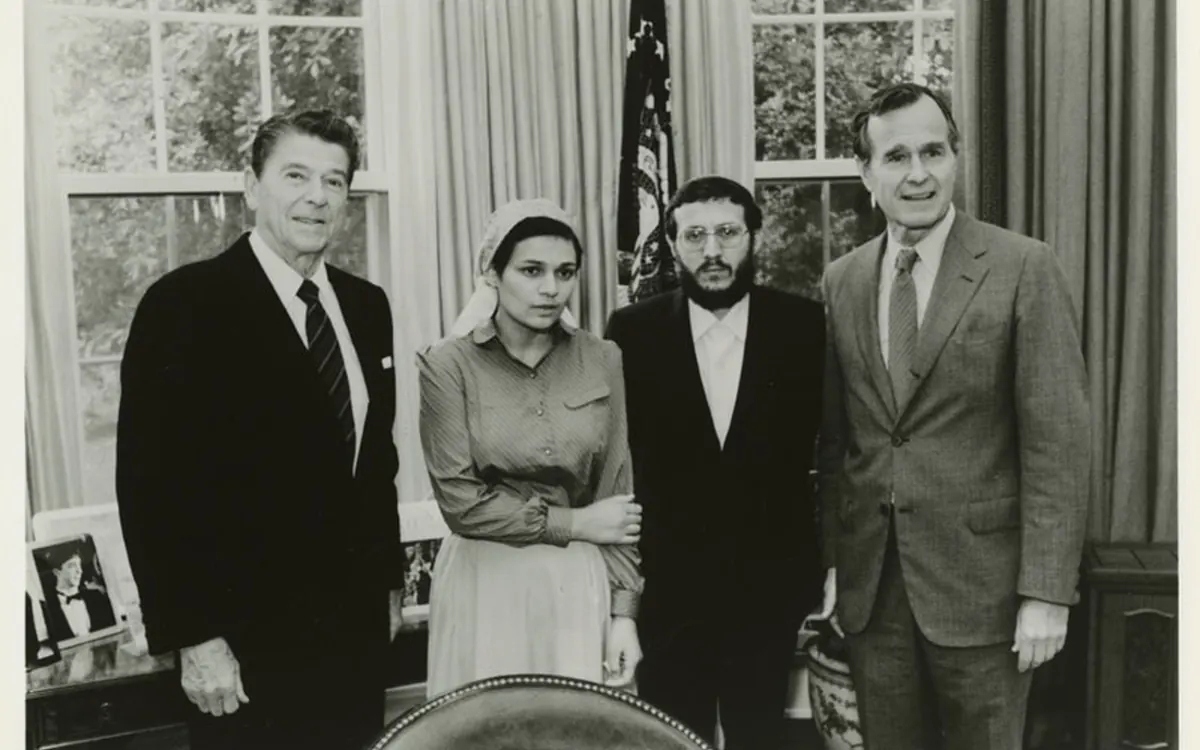
While we disagree with its political system, we do not seek to fight it or undermine it. We have but one concern, Jews and Judaism. So he, and all those concerned with Jews and Judaism, would rejoice as the Soviet Union indeed began to let our people go. On December 11, 1984, the front page photo of the New York Times showed President Ronald Reagan at a ceremony marking International Human Rights Day. He was meeting with 12 human rights activists from around the world, and the photo itself was snapped just as the president leaned down to take the hands of one of them in his own. It was a young woman, Avital Sharansky, who had to look up in order to meet the eyes of the six-foot-tall Reagan. Simply dressed as always, hair covered by a kerchief, her face shows pleading, hope, and lines of exhaustion.
None of which should come as a surprise, seeing as she'd been fighting for the freedom of her husband, and through him, of all Soviet Jewry, without rest for seven years. Avital Sharansky was born Natalia Steglitz in Ukraine in 1950. And it was not until she was 14 years old that she even learned she was Jew. Though, after more than three decades of Soviet rule, there were few people around her who could tell her what that really meant. In 1973, her brother was arrested, and desperate for help, she went to a Moscow synagogue to seek anyone who could assist her. There she was directed to Anatoly Sharansky, soon to be Natan, whose visa rejection had recently thrown him body and soul into activist life on behalf of the refuseniks, Soviet Jews who had been denied exit from the Soviet Union.
He invited Natalia to join him in his underground Hebrew lessons, and a month later, she joined him in his apartment. In his autobiography, Fear No Evil, Shransky wrote, From the day we met, I felt we were kindred spirits, destined to be together, and I was transformed. I saw her as a sign from God that I was on the right path, and that this new life I had recently entered into was my true destiny. Soon after, Natalia applied for her own visa to immigrate, though without much hope. But not only was it granted, the visa was only good for one week. And so the young couple quickly arranged a religious wedding, their application for a civil marriage having been denied. And the very next morning after they were married, Avital was on a flight to Israel.
The parting words that they made were a vow to one another. L'shana ha-ba'ah biru shalim, next year in Jerusalem. Though Anatoly's original application had been rejected for what the state called security reasons, The couple's hope was that he would now be allowed to leave under the Soviet regime's family reunification policy, but it was not to be. And so upon arrival in Israel, Avital Sharansky began to contact friends and acquaintances there in the U.S. and throughout Europe, pressing them to take whatever action they could to secure her husband's right to leave. She wrote countless letters, held endless meetings, and received numerous expressions of sympathy and concern. But at that point, Anatoly Natan Sharansky was just another name on a frighteningly long list of refuseniks.
But that changed in March of 1977, when Sharansky and several friends were arrested for having formed an unofficial Helsinki Accord watch group. The 75 of Helsinki Accords were a landmark of international diplomacy for many reasons, not the least of which was the unique emphasis which they placed on the importance of human rights in the international legal discourse. For many reasons, it was also an enormous diplomatic boost to the USSR, and therefore refuseniks and other dissidents were determined to use it as a lever to force change within their society, an activity that the Soviets were not about to take lying down. The charges the young men faced included espionage, And by the end of a prolonged period of interrogation, it became quite clear that Nathan Sharansky had been singled out to serve as an example.
Now, within hours of her husband's arrest, Avital Sharansky and her supporters had convened a large-scale press conference determined to keep a spotlight on what they considered to be a political show trial. They succeeded, and by the time the trial was actually held in 1978, Avital Sharansky was joined in Paris by a crowd of nearly 10,000 people who took to the streets to rally for her husband and all Soviet Jewry. While every level of the U.S. government denied the accusation that Sharansky was collaborating with the CIA, nonetheless, he was convicted of treason and espionage and sentenced to 13 years in prison. Though he had faced a possible death sentence, with characteristic fearlessness, Transky had insisted on serving as his own defense attorney, and thus, prior to the verdict, he was allowed to address the court.
Five years ago, he said, I submitted my application for exit to Israel. Now I am further than ever from my dream. It would seem to be a cause for regret, but it is absolutely the other way around. I am happy. I am happy that I lived honorably at peace with my conscience. I never compromised my soul, even under the threat of death. I am fortunate to have been witness to the process of the liberation of the Jews of the USSR. I hope that the absurd accusation against me and the entire Jewish immigration movement will not hinder the liberation of my people. My near ones and friends know how I wanted to exchange activity in the immigration movement for a life with my wife, Avital, in Israel. For more than 2,000 years, the Jewish people, my people, have been dispersed.
But wherever they are, wherever Jews are found, every year, they've repeated, next year in Jerusalem. Now, when I am further than ever from my people, from Avital, facing many arduous years of imprisonment, I say, turning to my people, my Avital, next year in Jerusalem. And now I turn to you, he went to conclude, the court, who were required to confirm a predetermined sentence, to you, I have nothing to say. Trance's sentence was served in Perm 35, one of the chain of Siberian camps known today as the Gulag. He spent more than a year of that sentence in solitary confinement, playing chess in his mind to cling to his sanity, and buoyed by the belief of the freedom of his spirit, repeating endlessly the mantra, nothing they do can humiliate me.
I alone can humiliate myself. As he writes, once I had absorbed that idea, nothing, not searches, not punishments, and five years later, not even several attempts to force feed me through the rectum during extended hugger strike, nothing could deprive me of my self-respect. But even when he was in solitary, Sharansky was not alone. he had something that no other Soviet prisoner had, Avital. She traveled the world on his behalf, making his face the face of Soviet Jewry. In 1978, Sharansky's picture accompanied the crumbling word détente on the cover of Time magazine. And through Avital's effort, his name became a sort of shorthand for all that was corrupt and repressive about the Soviet regime. The nature of their relationship helped as well.
It was the stuff of love stories that the media just eats up. Washington Post's Sally Quinn even called Avital Shransky an Israeli Audrey Hepburn. Above all else, the world was awed by her strength and determination never to rest until her husband was free. Addressing Canada's House of Commons in 83, she declared, if he has the courage to fight from there, he is sending us a message that we have to continue to fight. Rabbi Avi Weiss, one of the founders of the student struggle for Soviet Jewry and a close friend of the Sharanskis, still speaks of the commitment to Torah and the nation of Israel which he saw sustaining Avital. He witnessed that faith firsthand, spending nearly three years trekking back and forth with her all over North America, helping raise funds and providing moral support.
Avital knew that her husband's release could inspire all the Jews of the Soviet Union. She was seeking their freedom as well. Now, it's a rare story that has a fairytale ending, but this one actually does. As Avital Sharansky's efforts reached a fever pitch and international pressure mounted, her husband's early release was finally secured as part of a spy exchange. Natan Sharansky was flown to East Berlin on February 11, 1986, and told to walk in a straight line directly across the bridge. Never one to miss a chance to defy his oppressors, Stransky zigzagged his way to freedom. And there on the other side of the bridge connecting Potsdam and Berlin stood Avital They joined in a tearful embrace reminding each other of their pledge next year in Jerusalem and then Natan with a wry smile, apologized for being late.
The couple's arrival back in Israel was nothing short of a national celebration, and the late, great Israeli poet Yehud Amichai captured the spirit of the country when he proclaimed, I hope they don't ruin him. He's the last man who belongs to all of us. Avital Sharansky retired from public life almost immediately after Nathan's release, feeling that her part was done. But her husband continued to fight on behalf of the millions of his brothers and sisters still trapped behind the Iron Curtain. His release was a turning point. And in a little more than a year, Nathan Sharansky would stand in front of a quarter million people in the mall of Washington, D.C. and declare to the whole world, Let my people go.
The first summit meeting between U.S. President Reagan and Soviet Premier Gorbachev to take place on American soil was scheduled for December 7, 1987, and American Jewry was determined to be there. Later, it would be clear that the near quarter million Jews who gathered for the Freedom Sunday rally for Soviet Jewry on December 6 was the largest Jewish gathering ever held in Washington. It was a who's who of big-name politicians, Jewish activists, and public figures. The opening shofar blast was followed by the famous actress Pearl Bailey singing the gospel song, Let My People Go. Then, Vice President George Bush got up to declare that the human rights issue is now a permanent part of U.S.-Soviet agenda and promising, I will personally raise it with Mr.
Gorbachev. I will not be satisfied until the promise of Helsinki is a reality. Now everybody knows the old joke about two Jews and three opinions. And so this event, possibly the first time that every American Jewish organization cooperated in a single effort, was nothing to laugh at. As Pamela Cohen, president of the Union of Councils for Soviet Jews, said, the Jewish people is a diverse people, that all those who oppress us know that there are issues on which we stand as one. Let's see not five or six or ten or twenty refuseniks released at a time, but tens of thousands, hundreds of thousands, all those who want to go. Mr. Gorbachev, let these people go. Let them go. Let them go. How many times I heard that it is impossible to make American Jews to come in hundreds of thousands to Washington in winter.
And here you came and winter retreated. How many times from the very beginning of our struggle we heard that it is impossible to open the gates of the Soviet Union. And we didn't listen to these voices. And we struggled, and you demonstrated, and you struggled, and that's why quarter of a million Jews were released, and that's why I and other prisoners of Zion today are free, today are here. Mr. Gorbachev today destroyed one more Jewish demonstration in Moscow. But Soviets for us have to know that no missiles and tanks, no camps and prisons can extinguish the light of candle of freedom. Personally, I will never forget that Sunday. I was 13 in 1987, and so the overnight bus ride from Cleveland to D.C.
was memorable enough. Not to mention the sense of a massive crowd. People who had come together with a single voice to declare, Let my people go. Natan Sharansky was there as well. And I can only imagine the sense of holy joy he felt. that time had arrived for his personal dream to become a national reality. And it worked. The next day, as the leaders of the world's superpowers sat face to face, President Reagan opened their meeting by presenting the General Secretary with a gift, a pair of cufflinks made by an American jeweler, with the image of swords being beaten into plowshares. Gorbachev responded that it was indeed an appropriate symbol for the disarmament efforts that they were pioneering there that day.
But, you know, an image, which was really a quote from the book of Isaiah, had more than war behind it. Because contrary to Gorbachev's expectation, nuclear arms were not the first item on Reagan's agenda. He asked that the following words be off the record, and then pulled a card from his pocket and handed it to Gorbachev. On it was a list of Soviet citizens who he wanted granted exit visas. Surprised at such an opening, the Soviet leader said that human rights were, of course, a priority issue for the USSR, and began to lecture the president on the multicultural nature of Soviet society. 15 national republics, 38 autonomous ethnic groups, pointing out the challenges of maintaining the social fabric in such a complex situation.
Reagan agreed. and nonetheless pointed out that there were half a million Jews who wanted nothing more than to leave the USSR for reasons of religious and cultural freedom. Gorbachev, clearly caught off balance by this unexpectedly direct approach, pushed back, insisting these figures are completely unconfirmed, and then asking the president whether there weren't human rights issues in the U.S. as well. Well, said Reagan, we have our problems because people are people, But he pointed out that the Constitution protects basic rights like freedom of worship and leaving the country. And then, straight to the point, Reagan said that more than 200,000 American citizens had rallied that very weekend in Washington to demand human rights for Soviet Jewry.
After a bit more push and pull, Gorbachev finally declared, I will not sit as the accused before the prosecutor, and insisted they drop this unscheduled point and move on. And because in reality, they had come together to talk about the risk of reducing global nuclear catastrophe, they did move on. But don't think that the rally and the president's advocacy were without effect. A few months later, the White House announced that the president would be attending another summit, this time in Moscow in May of 1988. And in a surprise move, in April of that year, rather than doubling down on the success of the Freedom Sunday, the Coalition to Free Soviet Jews announced that its annual Solidarity Sunday demonstration held in front of the United Nations building in New York City was cancelled.
Now for 16 years, since 1972, the supporters of Soviet Jewry had gathered there to cry, Let my people go. But the 80s were not the 70s. Most of the organizations involved in the coalition felt that the new Soviet policy, this cultural opening called glasnost, had made the strategy of mass rallies obsolete, if not counterproductive. As the coalition's director explained, you don't hold the demonstration just because you have nothing to do. Instead, leaders of the coalition met with President Reagan just before he left from Moscow, and they received from him a pledge that the human rights issue would be high on his agenda, which in fact it was. You'll recall, of course, that the Lubavitcher Rebbe had been a strong advocate of quiet diplomacy all along.
And in fact, in this case, he'd worked together with Senator Daniel Patrick Moynihan to use his influence to have the Solidarity Sunday rally canceled in 88. Not everybody was on board. Students' struggle for Soviet Jewry leader Avi Weiss insisted on rallying nonetheless. declaring from the platform that Glasnost was a hoax and saying, tell Gorbachev we will not be fooled. We will not be silent. Despite that, two weeks after the canceled rally, Soviet Foreign Minister Edwars Vardanez told Edgar Bronfman of the World Jewish Congress in light of what he called the new positive atmosphere, the Kremlin would no longer oppose Jewish immigration. And from here, our story approaches a rapid and happy ending.
In January of 1989, at the meeting of the Conference on Security and Economic Cooperation in Vienna, the Soviet delegation actually approved its final declaration, which included the right to leave and the principle of family unification. Before the year's end, the Berlin Wall had fallen, and those words on paper quickly became a reality. In 1990 alone, more than 200,000 Jews left the former Soviet Union. And in the decade that followed, more than a million and a half came after them. There are more chapters to this story. Where did those Soviet Jews go? How were they received? And who ultimately did they choose to become when given the freedom to do so? Important questions, but ones for the future. for now, let's just take a moment to bask in the victory because after a long, hard fight they let my people go I just want to thank some folks I want to thank all the folks who give their hard-earned money to make this show happen keep it free and widely available bringing it to you I want to ask you to join them right now go to my website, jewishstory.co you'll see a button in the upper right-hand corner that says be a patron you can click on that to give a little bit of per-podcast support or send me an email at robmikeforia.gmail.com and I'll explain to you how you can dedicate a show or give a one-time donation.
I'd also like to thank the Land of Israel Network. That's thelandofisrael.com. They're building a center for global transcendence in the heart of Judea. I want to thank the Pardes Institute, pardes.org.il, for throwing the doors of the Beit Midrash open as wide as possible. And I want to thank you for listening. I'm Rav Mike Foyer, and this is The Jewish Story.
More from Season 5
TJS S5 Interlude - Jerusalem Day with Rav Aaron Leibowitz
Jerusalem Day (Yom Yerushalayim) is a time when past and present come sharply together, and have the potential to define our future. Social activist and former Jerusalem city...
Play Episode
TJS S5E21 American Jewry circa 1984
As we circle in toward the end of season five, it is time to check back in with American Jewry. The 1980s were a time of economic and...
Play Episode
TJS S5E23 The Jonathan Pollard affair
The 1980s saw many seismic shifts in the fabric of American Jewish society, and among them was the earthquake of the Jonathan Pollard affair. The 1985 arrest of...
Play Episode