
TJS S6E5 Boundary Issues part I
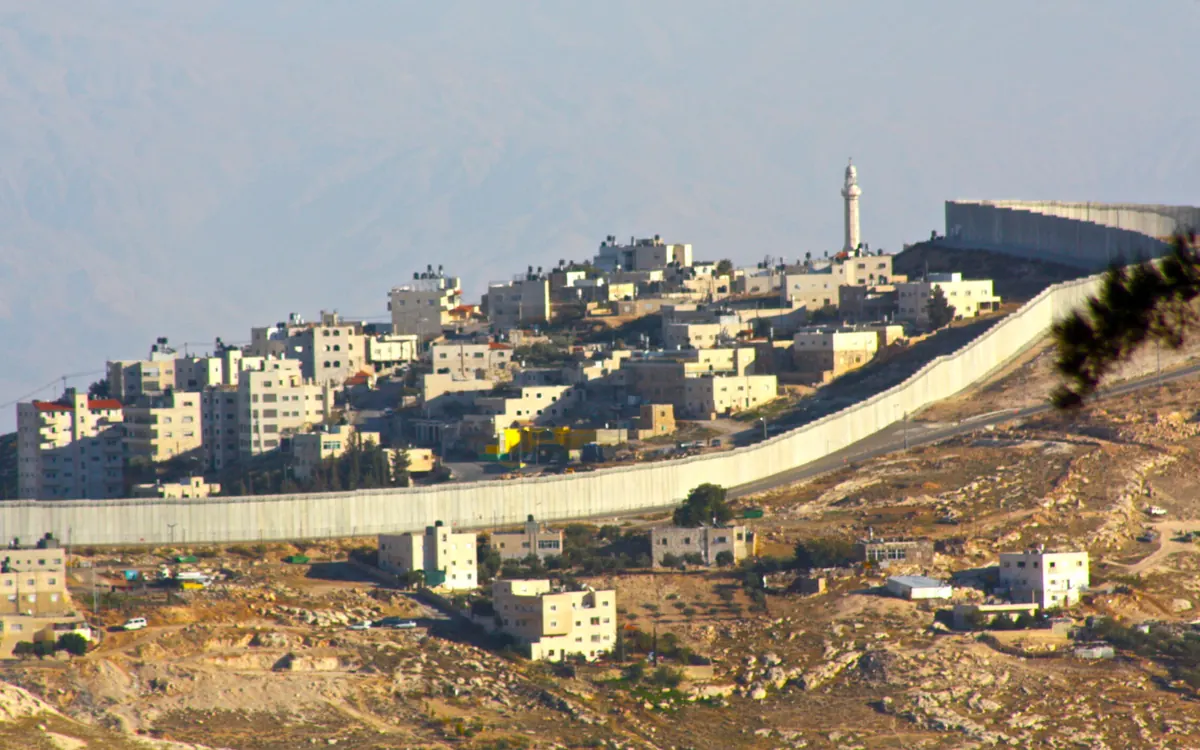
Almost two thousand years ago the Sages determined that Am Yisrael was bound in exile by an oath not to go up to the land "like a wall." Now two millennia later there is a wall built by the Israeli government running through the heart of our biblical homeland. Here is the introductory episode to a new series that aims to break down the evolution of Israel's security wall.
About this episode
Let not the houseless, said Lincoln, pull down another's house. Rav Mike turns from his couples work to a simple truth: everyone is territorial, and where we place our boundaries reflects what we protect. There is an inner territorialism too, the no-go topics, the hurts and dreams we hold within, and all the more so for a nation. Am Yisrael has major boundary issues, a posture territorial in the extreme because the inner wounds run so deep. Who is a Jew, who is an Israeli, and then the spatial questions of conquest and armistice lines that fill the news. His focus for this round is the one scar he cannot ignore, the barrier he will simply call the wall.
He will call it the wall, though separation barrier is the most factual label, and he dreams of the day this ugly scar is healed. The question of a wall runs back to the Bible. Song of Songs chapter two holds a triple oath, read in Ketubot through Rabbi Yossi as three oaths: that Israel not ascend to the land as a wall, that we not rebel against the nations, and that the nations not oppress us overmuch. From the second temple's destruction, any mass militant return was forbidden, and the failure to come up as a wall under Ezra and Nehemiah actually set up the second exile. This issue of a yes wall or no wall goes very deep.
The Gemara became the cultural matrix binding the people across their scattered exile, and the three oaths framed history for Jews everywhere. When persecution rose in Yemen, the Rambam answered in 1173 with his Epistle to Yemen, counseling them to abide by the oath and warning that those who seek to leave exile before its time will perish or meet disaster, which helps explain why most God-fearing Jews rejected Zionism. Jabotinsky's 1923 Iron Wall declared that militarists and vegetarians alike demand an iron wall. Religious Zionists justify the return on two grounds, that it was no rebellion once the League of Nations and the UN had voted, and that Auschwitz was far more than enough oppression.
Rav Mike is less interested in justification, and wonders whether the disaster the Rambam foresaw was a consequence of the violence of return rather than a punishment for it. He rejects the occupation accusation as a whitewash of a four-thousand-year bond, yet pokes at what he calls occupational fallacies, since in Yudah and Shomron he sees no sovereign people. Sovereignty means legitimate force accepted as just, comprehensive responsibility for all people, land and resource, and a social vision, and we lack these. Rashi's first comment on creation explains that God gave the land to whom he pleased, a message aimed at us, so that we the Jews should know we are not thieves and act accordingly.
As for history, after 1967 a decision was made not to decide. Moshe Dayan's Open Bridges policy integrated the economies while keeping the link to Jordan, hoping prosperity would win acceptance and quietly make money. Shlomo Gazit's The Carrot and the Stick admits Israel protected its own products and built no local infrastructure, creating a captive market and a pool of cheap labor, so that by 1987 more than forty percent of the West Bank and Gaza workforce labored in Israel without benefits. That rising tide receded in the eighties with the Iran-Iraq war, Soviet immigration and the doubling settlements, and after the Yom Kippur War shattered the aura of invincibility, a wave of stabbings presaged the Intifada.
Key ideas
- Everyone is territorial, and Am Yisrael's extreme territorial posture reflects how deep the inner wounds run.
- The three oaths of the Song of Songs, read in Ketubot, forbade a mass militant return as a wall from the second temple's fall.
- The Rambam's Epistle to Yemen told the Jews to abide by the oath, warning that leaving exile too early brings disaster.
- Rav Mike rejects the occupation accusation yet names occupational fallacies, since sovereignty means power wed to justice, responsibility and vision.
- Rashi's first comment is aimed at us, so that we the Jews know we are not thieves and act accordingly.
- Dayan's Open Bridges built a captive economy, and the receding tide of the eighties helped set the stage for the Intifada.
Chapters
- 0:00 Everyone is territorial
- 2:18 Inner territorialism; the wall
- 4:27 Naming the wall; the dream of healing
- 6:42 The three oaths begin
- 8:55 Song of Songs; the triple oath
- 10:03 Not to ascend as a wall
- 11:21 Failing to come up under Ezra
- 12:27 The Gemara as cultural matrix
- 13:34 The Rambam's Epistle to Yemen
- 15:42 Jabotinsky's Iron Wall
- 19:04 The occupation accusation
- 20:13 Occupational fallacies; sovereignty
- 24:51 Rashi; we are not thieves
- 28:06 A decision not to decide
- 30:23 Dayan's Open Bridges
- 32:35 The carrot and the stick
Who, where and when
People
Abraham Lincoln, Rabbi Yossi son of Hanina, The Rambam, Zev Jabotinsky, Rashi, Moshe Dayan, Shlomo Gazit, Yehuda Cohen
Places
The land of Israel, Yemen, Yudah and Shomron, Gaza, Jordan, Gush Katif
Texts
The Song of Songs, Ketubot on the three oaths, The Epistle to Yemen, The Iron Wall, The Carrot and the Stick, Rashi on Genesis
When
70 CE: the second temple destroyed, 1173 CE: the Epistle to Yemen, 1923 CE: the Iron Wall, 1967 CE: the Six-Day War, 1987 CE: forty percent working in Israel
Read the transcript
Let not him who is houseless, said Abraham Lincoln, pull down the house of another, but let him work diligently and build one for himself, thus by example assuring that his own shall be safe from violence when built. Well, I don't really think I need to add any wisdom to that thought. I'm Rav Mike Foyer, and this is The Jewish Story. Season 6, Episode 5, Foundry Issues, Part 1. You know, in my counseling practice, I get the privilege of doing quite a bit of couples work. It's always an educational process, certainly for myself and I'd like to believe, for all involved. And among the many things I've learned over time is that everyone is territorial. All that differs is where we place our boundaries.
That itself is generally a function of what we're protecting. Now we could talk about people's difficulty in sharing space, the need for solo downtime, a cave to sulking, or why personally I get livid when people leave things on my bed. But territorialism and the boundaries that we erect to protect ourselves actually has a core inner aspect. We all put up walls, draw lines, mark boundaries within. There are no-go topics we don't want to talk about, issues that can bring us to tears just by being mentioned, and even memories we can't really recall. This inner territorialism, as I've come to think of it, is a function of the fact that everyone has places within them which are sensitive in the extreme.
Sometimes, those are the genuine, unsullied parts of our loving nature, waiting tentatively to be shared with the right person. Often, there's some hurt or fear that we're nursing, or it could simply be our dreams that we're hesitant to share. And when you build a life together with another person, more often than not, the issues that seem to be sticking out territory in space and time are really a function of the boundaries that we're holding within. I'll leave the depth of that discussion on the personal level for some other time. By the way, be in touch, RobMikeFoyer, gmail.com. Find me on Facebook, RobMikeFoyer. Be in touch about spiritual counseling if you want to have that talk, or perhaps a three-way discussion if you and someone else in your life could benefit from having it together.
For now, to paraphrase my spiritual teacher, Rav Avramitzchak Hakon Cook, if this is true for the individual, then Allah hat kama v'kama, all the more so it's true for the nation. And boy, oh boy, does Am Yisrael have some major boundary issues. You know, in particular, right now, our posture is territorial in the extreme. And I would say, in light of what I just told you, it's because of the scale of the inner wounds is so profound. And when you add to those massive scars we're toting around, the unfathomable depths of a well of a love creation, we're still holding, please God, unsullied inside, then together, those inner forces are so big and frankly, so frightening that their outward manifestation actually goes way beyond simple territorialism.
We've got every kind of major boundary issue you can really imagine. I mean, who's a Jew? Who's an Israeli? What's a semi? Are Jews just like everybody else or are we another species, be it lower or higher? Simulation, intermarriage, endogamy, and those are just the identity questions. I'll spare you the full confusion and wrath of the legal face of our boundary issues and just quote my friend Matt Mausner, saying that one could see the entire rabbinic tradition as 2,000 years of ways of saying you're not doing it right. Cultural, social boundaries, issues up the wazoo, if you'll forgive me, internal, external, Sephardi, Ashkenazi, Mizrahi, West, East, North, South, appropriating, assimilating, cultural genius and depravity.
And then, of course, there are the actual spatial territorial issues, which tend to grab attention in the news. I mean, outside the land, we can talk about cosmopolitans, ghettos, suburbs, Jew York City, gated communities, and Jürgen Rhein. And here at home, conquests, occupation, nationalists, tribalists, armistice lines, maritime treaties. You've read the news. So yeah, yeah, we've got boundary issues, and they deserve a broad and serious consideration. But have no fear. My goal for this season is actually very specific. And this is round two. I'm committed to identifying particular items or elements shaping our world today and ideally amenable to being reshaped or at least retold and to breaking down their evolution from the 80s until now.
So I have to pick a particular focus for this exploration of our boundary issues. and looking around, I'd have to be blind not to see that there's no better thing to point to than the wall. I've heard it maligned as the apartheid wall, mourned as the wall that Hamas built, and sanitized as the separation barrier. But I'm assuming that no matter what I call it, you know what I'm talking about. Which is not to say that the varying labels stuck to this mass of concrete and metal don't matter. On the contrary, all in all, they're just linguistic bricks in the wall. Yeah, these are the words that frame and describe a physical barrier. And they're pieces in the narratives which hold it up and aim to tear it down.
So they absolutely matter. Now that being true, for the sake of communication, from here on out, I'll mostly just call it the wall. Although, I mean, separation barrier is actually the most factual characterization. Regardless, however, of what we call it, I dream of the day when this ugly scar running through our land has been healed. And in order to hasten its coming over the next few episodes, I want to break it down from both the left and the right, so to speak. That way, you can join me from whichever side you please. Now, I've warned many times that you know a storyteller by where he begins. And so I feel the need to be very careful where I start the narrative about this wall, and thus what I end up relegating to the backstory.
But for the sake of the present season, I'm clearly committed to pick up somewhere in the 80s. And we'll see, by the way, before this is over, that even that is far less simple than I would like. Nonetheless, before I dive into recent events, I can't help but recall that while there may be subplots, side narrative, mainstreams, and even divergence, There's really only one Jewish story, at least insofar as I can tell it. And the wall, with everything it represents, both physically and symbolically, inside and out, is one of the best examples I can think of to illustrate the type of titanic themes that can hope to tie our history together. We've touched a few times since way back in Season 2 on the rich story of how the Torah world and the Zionist movement intersected from its emergence up to and through the birth of the State of Israel.
And don't worry, by the way, a look at religious Zionism today is certainly on the horizon. For now, you may know that a key question in the conceptual frame that hopes to hold these two strange bedfellows of political nationalism and divine service together actually hinges on the question of a wall. And that takes us all the way back to season one in the rabbinic era, believe it or not. I mean, truth is, the question of what role a wall is meant to play is so deep, it's actually rooted in the Bible. It all begins with a verse from the Song of Songs, not surprisingly, Because as a passionate love poem about God and Israel, its erotic tension has always been held to express the deepest secrets of redemption.
And what's tension about if not the things which divide us? There are actually three verses in question, but they're more or less all the same, so I'll give you the first. Shira Shirim, Song of Songs, chapter 2, line 7 reads, That's an oath. I cause you to swear or adjure you in that wonderful King James English. And it's an oath which bears with it, hints at two names of God. Tzavot is a reference to Hashem Tzavot, the Lord of Hosts. And Ayolot HaSadeh is resonant with El Shaddai, another name of God. That gives this oath extra weight. And it's repeated in both the third and eighth chapter of the Song of Songs. A triple oath. No matter how obscurely formulated, was too much for our sages to ignore. After all, three is the magic number.
I got the tune today, I can't help it. So in the Genara and Ketuvot, we find an exploration of what such a triple repetition of an oath might mean. And after a little bit of back and forth, the sages settle on the opinion of Rabbi Yossi, son of Rabbi Hanina. They say, Why do we have these three oaths? One, That the Jews should not ascend to the land of Israel as a wall. Another is that God bound us with an oath that we shouldn't rebel against the nations of the world. And last but not least, bound the nations, that they shouldn't oppress us or subjugate us over much. Now, Rabbi Yossi's reading of these verses as three oaths actually laid a foundation on which the sages built an understanding of history.
In their eyes, from the time the second temple was destroyed, Israel was bound by an oath to remain in exile. That's not to say that returning to land as individuals was excluded, but it means that any mass movement was forbidden. That to ascend like a wall, to come together in order to reassert our sovereign rule over the land, was forbidden by a divine oath. You know, in my Sunday night TGS Live class, we've been discussing the failure of Am Yisrael to come up like a wall during the first return to Zion under Ezra and Nehemia way back in the 5th century BCE And that actually when the sages judged we had an obligation to come up like a wall to hear the voice of God in the words of the Declaration of Cyrus and to return en masse from Babylonian exile to reestablish Jewish sovereignty in the land of Israel.
And the fact that we failed to do so way back then actually set up the second exile. And thus, Rabbi Yossi's reading that a militant mass return is henceforth forbidden, like I said, actually has biblical roots. So, you can see that this issue of a yes wall, no wall, runs very deep and goes way further back than Operation Defensive Shield in 2002. Don't worry, it'll take a couple episodes, but we'll get there. Now, Rabbi Yossi's reading also gave us a definition of what exile is. Beyond being scattered physically from the land and forbidden to return en masse, it means that the nations are legitimately in charge. No rebellion allowed. And while that third oath did promise to restrain the cruelty of their rule, keep in mind, it allowed for the Spanish expulsion and had to wait until the Holocaust, until a real debate over what you tear me die too much, would actually mean.
Now, I want you to understand, there is way more at play here than textual analysis. Because the Gemara became the cultural matrix which bound Am Yisrael together as a people, even in our scattered exile. And through the centuries, these three oaths came to frame history for Jews around the globe. For instance, in the late 12th century, life got particularly bad for the Jews of Yemen, a community, by the way, which by then had had more than a thousand years of exile under its belt. And the leaders of that community sent a letter to the Rambam, Maimonides, right, 12th century sage, asking for support in the face of rising Islamic persecution, growing heresy, and a budding false messianic movement.
And the great eagle, Neshach Agadol, that's my favorite nickname for the Rambam, he responded in 1173 with what's known as the Rambam's Epistle to Yemen. Now you have to be a special kind of famous before they call your letters epistles. And that letter deals with many things, all of which are worth considering in their own. And I highly recommend you Google it and go read it all, but not right at the moment. Because for present purposes, the Rambam offered the Jews of Yemen the following comfort and support. In the face of that messianic call to return to Zion, they deemed to be premature at best and destructive at worst. He wrote, Solomon of blessed memory foresaw with divine inspiration that the prolonged duration of the exile would incite some of our people to seek it to terminate it before the appointed time.
And as a consequence, they would perish or meet with disaster. Therefore he admonished and adjured them in metaphorical language to desist as we read, I adjure you, all daughters of Jerusalem, by the gazelles and by the hinds of the field, that ye awaken not nor stir up love until it please. Now, brethren and friends, finishes the Rambam, abide by the oath and stir not up love until it please. That's the Rambam using the Gemara as a frame, not just to analyze the present event in Yemen, where, of course, he's never been. He's also offering an understanding of the problems that they face and an argument for why they should hold fast. Abide by the oath, he says. You know, one phrase there really strikes me every time I read this passage.
He says, those who seek to leave exile before its time will perish or meet with disaster. Now, the Gemara never said that. It just said we were bound in exile by an oath not to come up as a wall. But it's reasonable to assume that this perishing or meeting with disaster is the punishment the Rambam foresaw for oath breakers. And now you can understand a little bit of why Zionism, certainly a messianic movement, aiming to hasten the return, if not the actual end of days, and more than a little bit heretical in its own right, to be honest, you can see why it was so quickly rejected by the vast majority of God-fearing Jews in the late 19th, early 20th century. Now, though Zionists differed on almost every aspect of the movement, from methods to goals.
All of them recognized that in order to reestablish ourselves in the land once again, we needed some sort of wall. Now, imagine the reaction of the Jews, who felt bound not to go up like a wall, to Zev Jabotinsky's classic 1923 essay entitled, literally, The Iron Wall. He says, in this matter, there is no difference between what he calls our militarists and our vegetarians, except that the first prefer the Iron Wall should consist of Jewish soldiers and the others are content that they should be British. We all demand that there should be an Iron Wall. You know, to make a long story short, we who call ourselves religious Zionists and those of you out there who may think of yourselves as fellow travelers justify breaking this ban on the militant return for two reasons.
First, that it wasn't a rebellion against the nations. I mean, the League of Nations voted unanimously in 1920 for a mandate meant to pave the way for a Jewish national home in Zion. And in 1947, the UN voted for the partition of the land to include a Jewish state. Now, no matter what you personally think of those events, they can be easily understood as indicative that Jewish sovereignty in the land of Israel is not fundamentally an act of rebellion against the nations, whatever they may try to claim today after the fact. And even if you want to argue that point with me, Auschwitz was certainly Jotar Midae. It was way more than enough. Oppression at the hands of the nations on that level means that if anyone was the oathbreaker first, it was God.
Now, from that perspective, we came up like a wall because we had no other choice, driven by the necessity of history which stripped away all other options. Here's the thing, though. I'm not interested in making justifications or arguments. I'm wondering, what if the elements of disaster that the Rambam associated with the process of reestablishing a beachhead in our homeland, and then fighting for every inch of coming up like a wall, were simply a consequence of the violence we would have to use, and not a punishment for it? As I said earlier, any discussion of the wall is bound up with profound issues of language. And so despite my desire to get this story started, I recognize it still requires a bit more frame.
And even as I speak, I'm wondering how much narrative we'll really get to. In specific, we need to talk about the occupation. That's right. I said the O word. You can either double your pledge right now on Patreon or cancel me. Either way, I have a story to tell. By the way, if you want to do that, jewishstory.co, upper right-hand corner. Do it, people. I need your help for season six. You know, my friend Yishai likes to talk about what he calls the occupation accusation. The very phrase fits his chosen role as a member of the shock troops, always on the front line in our war for return. And he's particularly fierce, by the by, when it comes to the narrative warfare. I might even call him a soldier pioneer on that front.
I right now am not about to break down the huge questions of history, sociology, and factuality that lie behind the accusation that we've seized and are somehow occupying someone else's land at least I'm not going to do it at this point in time and frankly, if you've been listening to the Jewish story since the beginning then I hope you have some sense of why I might consider such an accusation to be absurdly simplistic at best That's why, by the way, when anti-Zionists tell us to go back where we came from, I'm more than happy to oblige. The occupation accusation is an attempt to whitewash past and present, to reduce our 4,000-year-old relationship to this land into a simplistic and manipulative presentation of the events of the last 100 years.
So, I'm not interested in that discussion, not right now, and frankly, not in general. However, since I'm more prone to observe from the side than dive into the combat zone, I would like to poke around a bit in what I think of as occupational fallacies. Because while I reject out of hand the notion that Israel is a colonial settler state, a white supremacist European construct occupying Arab land, I still have a whole heap of issues with how we Jews are acting here in our homeland. Because on some level, if it looks like a duck, walks like a duck, quacks like a duck, well then, what else could it be? And when I look at our national posture, particularly in Yudah and Shomron, the so-called West Bank, I don't see a sovereign people.
I'm sorry. Sovereignty means legitimate use of force to maintain order. And by legitimate, I mean accepted by the populace based generally on some sense of justice. It also means taking responsibility for all people, all land, and all resources under your rule. Sovereignty means, more than anything else to me, having a vision for the development of a society that can create one reflective of the core values which uphold the physical aspects of our society. And to say that Israel lacks these things when it comes to the land with which God gifted us after the Six-Day War is a kind and gentle way of putting it. And because of that, everyone loses out on some level. Although, life being what it is, of course, some more than others.
And that's why I like to talk about occupational fallacies. You know, our sages were fond of saying, Sheker Einlo Reglaim, a real lie has nothing to stand on, and therefore will collapse under the weight of its own unreality. But you may have noticed that the idea of the occupation is alive and kicking, gaining strength in a number of circles even. And while I said I don't accept the falsehood that we're fundamentally occupiers in a land to which we tied by biblical historical cultural political and blood bonds I do see us giving the occupation and accusation a truth to stand on by taking the stance of an occupier in our own land There is a vast disjunction between justice and how we exercise power.
There's a stunning lack of comprehensive responsibility being taken for people, land, and resource. and the paucity of social vision I see around me is so profound, I just, I want to cry. Instead of all these things, what we have is a wall. And by the by, most Israelis support it. It's only the far left and the far right who have competing visions of one whole land, be it a state for all its citizens or some other fantasy of Jewish rule. The middle left and the middle right share, actually, fundamentally the same slogan, us here, them there. All they differ on is where to put the wall. Now, that's an issue that we're going to return to again and again in the coming series. But for the sake of this initial framing, you need to know that it's an issue which runs much deeper than the political, historical, economic processes that people point to and call the occupation.
The wall that bisects a land, which is fundamentally meant to be whole, is built on the trauma and confusion of 2,000 years. Whatever present-day interests are there to hold it up, it runs through the heart of what it means to be a people in our land, of why it is we've returned, of what we've come home to do and who we're aiming to be. Or I should say it runs through the heart of the fact that we're not really willing to talk about those fundamental issues. You know, I'm feeling off the rails, so I might as well go all the way. Last week, we started the annual Torah cycle reading again. And I love it. I love it. And every year, even though I see the same thing over and over, every year, I marvel at the ongoing relevance of the first Rashi on the Torah.
Point of fact, if you don't know, Rashi was the archetypical biblical commentator, 11th century sage, primary bridge, across which the knowledge of late antiquity passed into the Middle Ages and witness to the First Crusade. And it's worth reflecting in full on what he wrote, you know, every single year. But for now, I want to pull out a specific point. Rashi quotes a midrash right there at the beginning from the sages asking, why does the Torah, which is essentially a book of divine instruction, begin with an account of creation? It seems to be superfluous. Just tell me the mitzvah, the commandments of what we need to do. Why do I need the backstory? And the answer the Midrash provides is actually a quote from Psalms, from Tehillim.
It says that God declared to his people the strength of his works, meaning he gave an account of creation, in order that he might give them the heritage of the nations. And what's the connection exactly between an account of creation in Am Yisrael inheriting the land which had once belonged to the seven nations, we're talking biblically, of course, any parallel to the present circumstances is purely coincidental. So Rashi explains. He says, If the people of the world should say to Israel, Listimatem, you're thieves, because you took by force the lands of the seven nations of Canaan, Israel may reply to them, Listen. He doesn't say listen. He says, All the earth belongs to the Holy One. Blessed be he.
He created it and gave it to whom he pleased. Right? Koch Masav, he gidlamo. Right? Look, we know how everything came into being. And therefore, when God willed, God gave it to them. And when God wills, God took it from them and gave it to us. We know how the world works, says Rashi. God's in charge. And therefore, if God gives us this land, God created everything. Sounds great, right? Now, those of us who have maybe tried to present the nations with this argument, Getting up and singing, this land is mine, God gave this land to me. We know that with the exception of people who are already on board, it's not an argument that carries a terrible amount of weight. I mean, standing up on CNN or in front of the General Assembly and waving a Bible is more likely to get you written off as a messianic nutcase and reinforce the occupational fallacies than it is to convince anyone that were actually coming home as opposed to being thieves.
And you know what? I'm willing to bet that Rashi knew that. I mean, after all, he was facing a Christian world in the process through the Crusades of taking the land from the Muslims, which the Muslims had taken from the Christians, which the Christians had taken from the Romans, the Romans had taken from the Jews. He was facing a world that believed God had actively rejected the Jews, that our covenant was null and void, and with it, any claim we might make to the land. So why was Rashi tacking this thought onto the beginning of the Torah? Because the message is for us, not for our opponents. We, the Jews, need to know that we're not thieves. And we need to act accordingly. If we fail to appreciate what it means to be sovereign, to wield power with justice, to take responsibility for everything under our rule, and to propagate a vision for society, well then, the only other options will be exile or a wall.
I guess I'm a little bit obligated to talk about some history before this episode runs out of time. Now, we've been tracing the relationship between the state of Israel and Yudah Shomron and Gaza for more than two seasons. There's no way I can recap the entire story for you. That being said, we still need some backstory and to understand how that evolving relationship between Israel and a conquered land and conquered people resulted in a barrier more than 700 kilometers long, winding through the heartland. Now that's twice as long as the Green Line, Armistice Line, which separated Israeli and Jordanian forces in 1949 after the War of Independence. And in some places, it's a border no less sealed than those with other nation states.
And in others, it's a sieve that lets people in, be it officially through permits or unofficially through holes in the fence. because as much as spokesmen like to call it a separation barrier, in my eyes, I see the wall really as meant to regulate, not separate, and it upholds a relationship between Jews and Arabs which needs to be critically examined. You may recall from back in season four that in the immediate aftermath of the Six-Day War, Israeli politicians and policymakers were split on what to do with these territories they'd won in such a stunning fashion. Jerusalem. Israeli Prime Minister Levi Eshkol must be the proudest man in the world, especially when he entered into the Jordanian sector of Jerusalem and to stand before the Wailing Wall.
To world Jewry, a deeply emotional occasion of great historic importance. Hero today of the Jewish peoples, General Moshe Dayan, defense minister and architect of the swiftest, most overwhelming victory of all time. Now our focus right now is on Yudah and Shomron, although Gaza will come quickly back into the story. And there at least we can say that within two years a decision had been made not to make a decision. I mean, the options seem to be clear. You could take that biblical heartland and make it part of the state of Israel, or you could give it over to the rule of some other political entity that you were looking to find. Jordan, Palestinians, I mean even the UN for goodness sake. Go back to season four and you can trace the full process of avoiding that decision and some of its consequences.
But for now, suffice it to say that it was duly avoided. I'm tempted to rework Abba Ibn's famous quote about the Arabs never missing an opportunity to miss an opportunity and say that when it comes to Yudan Shomrung, the Israeli government has never avoided the decision to avoid a decision. Now, there may have been no clear political plan, but life being what it is, the economic divisions between Israel and the newly conquered West Bank of the Jordan River began to dissolve almost overnight. Officially, following the war, Defense Minister Moshe Dayan championed what he called the Open Bridges Policy. It was an economic integration between the State of Israel and the territories, which aimed to maintain their link to Jordan at the same time.
It was a bit of a having your cake and eat it too policy. Hence he called it open bridges because even as the new Arab populace could travel into Israel, the bridges across the Jordan allowed goods and people to continue moving back and forth with Jordan. There were two parts, and some would say two inherently contradictory parts to Dayan's vision. He wanted, on one hand, to install a new awareness of Israel's existence as a legitimate, permanent reality in the region. On the other hand, he wanted to make it as easy as possible for as many Arabs as possible to go one way across that bridge and not come back. Oh, and by the way, he and the state wanted to make money. I mean, not personally. We're talking on the economic scale.
Dayan, if I wanted to judge him favorably, believed deeply that a rising tide lifts all ships and that if the economy of the new territories flourished under Israeli rule, then that rule would be accepted with or without a political horizon. And on some level, he was right. But the turning point that's out there on the horizon, when I really have to pick up the story in detail, is 1987. And before we can get there, I just got to lay some facts out there in the best fashion as I can. Between 1967 and the early 80s, Dayan's policy seemed to bear real fruit. per capita income in Gaza went from $80 to $1,700 a year. And in the West Bank, the GDP more than tripled. Cars increased tenfold, phones by six, tractors ninefold.
Those are real markers. Growth rates in Gaza and the West Bank were actually more than twice that of the state of Israel in the first decade following the Six-Day War. For example, in 1967, only 18% of Gaza had access to electricity. By 1981, it was 89%. Healthcare was so dramatically approved across the board that it led to a baby boom, which by 1987 was sustaining a birth rate twice the pace of new housing construction in the already crowded Gaza Strip But to call Diane open bridges policy a kindly sort of free market capitalism would be a mistake First of all recall that Israel was still a socialist economy at least structurally post-1967, and thus no stranger to centralized command planning. Furthermore, many policymakers feared real economic integration.
They thought it would damage what were already protected industries in Israel, and they were joined by those who wanted the local economy of Yudan, Shemron, and Gaza curtailed for political and security reasons. The result was more or less a complete subordination of these new economies, a captive market for Israeli goods and a ready pool of cheap labor for Israeli industries. General Shlomo Gazit, who was the first coordinator of activities in the territories, as his title was under Dayan as the defense minister, wrote the following in his book titled The Carrot and the Stick. He wrote, Israeli policy in the administered territories led to a strange combination of relative economic prosperity accompanied by a rapid rise in the standard of living of the average Arab resident.
Economic prosperity was achieved by the simple expedient of importing labor services from the territories into the Israeli economy. But, he warned, at the same time, the Israeli authorities and the military government did little to develop the local economic infrastructure. Further on, he's even more blunt, writing, the desire to protect Israeli-made products was so great that Israel even attempted to prevent the establishment or reactivation of Arab-owned factories if there was any danger their products might compete with Israeli products. The result was that by 1987, more than 40% of the labor force in the West Bank and Gaza, 120,000 people were employed in Israel, mostly in low-wage jobs without any social benefits.
Every single university and most of the institutions of higher education in Udash Ramon and Gaza were actually built post-1967. But the economic development which was allowed by the military administration prevented the emergence of any local economy which could employ their graduates. and they couldn't compete within Israel. And that's why beginning already in the early 70s, tens of thousands of Palestinians began to leave home annually to work in the Gulf states or elsewhere in the Middle East or the West. And the remittances they sent back home became a crucial pillar of the economy in Udash, Shomu, and Gaza. And in a sense, that's where this open bridges policy really began to fall apart. because I could conjecture about when the social impact of this unequal relationship reached its tipping point.
I mean, after all, fairly quickly, Palestinians working in Israel ceased to compare their standards of living to others in the Arab world and began to see themselves in light of the average Israeli's life. I mean, after all, they were working side by side. Furthermore, as open as the boundaries between pre- and post-67 Israel may have been under Dayan's policy, Traveling back and forth from the territories of Israel was often bound up with humiliating experiences of their own social and political inequality. But if I want to talk about numeric turning points, the rising economic tide, which had kept this imbalanced relationship afloat, began to recede in the 80s. First came the Iran-Iraq War. It broke out in September of 1980.
It's a whole story unto itself. Maybe at some point we're going to have to touch it. But for present, what it did was force thousands and thousands of Palestinians to leave their jobs in the Persian Gulf, cutting off a vital influx of hard currency into their economy. Then, at the end of the 80s, came the massive wave of Soviet Jews, certainly something which I celebrate to this very day, but life being what it is, it had unintended consequences, one of which was immigrants who offered fierce competition for those low-wage jobs. in the Israeli economy, thus further damaging the economy of Uda, Shomron, and Aza. And to that, the rapid rise of Jewish life in Yehuda, Shomron and Gaza, the settlements, which nearly doubled between 1984 and 1988.
That's a story, hopefully, you recall from previous episodes. But just as an example, by 1987, the few thousand Jews who lived in the Gaza Strip, mostly in Nevei de Kalim, in what's called Gush Katif, controlled 28% of the state land available for development and they used on average 12 times as much water. That taste of the economic pressures and unequal relationships is a small part of the big picture. Call it a necessary but insufficient background for understanding where the wall came from. You know, these comments, I'll think of them as a down payment because we're going to have to come back to the economic story. This story is far from over, but for the moment, I'm almost done because my goal right now is framing.
I want to put out there some of the practical and conceptual pieces we need to understand in order to trace the evolution of the wall. I want to remind you, robmikefoyer, gmail.com. Send me a Facebook message. I want to hear your questions and your thoughts. And by the way, I do want to say I need your support. Season 6 is pulling a lot of energy out of me. Think about going to my website, jewishstory.co, hitting that button in the upper right-hand corner, make a little pledge, a little bit of per-podcast support. But before I sign off, there's one more thing we have to talk about, or at least mention, and that's violence. Now I know it's a big topic in our story. We could stretch it all the way from the internal Jewish question, the Zionist vision of shaping a new muscular Jew, in order to negate exile without and within.
We can stretch it from there to a detailed explanation of the Hundred Years' War we've been fighting since our return began. Now, I'm aiming to record a coming episode with my good friend Yehudah Cohen, where we'll engage the sort of theoretical issues of violence, colonialism, post-colonialism, and the role that it's played in our own internal development coming out of exile. And of course, if you want the details of the Hundred Years' War, you can review seasons two through five. But for present purposes, I just need to note that in the immediate aftermath of the Six-Day War, there was an aura of invincibility which Israelis felt and managed to project. And it actually kept the level of violence in Udash Ramon and Gaza to a minimum.
If you recall that image of Rabbi Gorin, the chief military rabbi of the Israeli army, riding in the Hevron with nothing but a jeep escort and blowing his shofar widely and people fleeing before him, it was that kind of aura. Well, that myth was shattered by the 1973 Yom Kippur War. Even though Israel was victorious, it was a breaking that was followed quickly by the emergence of Gush Emonim and the movement of Jews, if not en masse, certainly a little bit more like a wall, into Yudah, Shomron, and Aza. And practically speaking, once the Jews were living side by side with the Arabs of Gaza and the West Bank, there was a new burden placed on the security apparatus. And though Moshe Dayan and his ideological inheritors loved to speak about what they called an enlightened occupation, Israel's demands for personal security translated into identity checks, body searches, and sometimes even personal abuse for the Arab populace.
Remember also that the PLO, the Palestine Liberation Organization, was quite active at this stage, not just from their base in Lebanon in cross-border raids, but still trying to stir up that local anti-colonial revolution that Arafat had been calling for for two decades. And therefore, any act of terror which they managed to achieve within Udash and Shomun and Gaza was followed by even harsher responses on the populace. Curfews, house searches, mass detention. Now, I'm not going to start talking about the cycle of violence. But you may recall, in season 5, we spoke about the emergence of a Jewish underground, driven in part by the feeling held by Jews living in Yudan Shimon that their only guarantee of safety was to strike fear in the hearts of their Arab neighbors.
Now, that movement was broken up in the mid-80s, but by that time, Arabs had begun to feel that the Israeli army could no longer protect them from radical Jews. And Jews had begun to feel that the army couldn't protect them from radical Arabs. That's a recipe for disaster. And the slide toward chaos on the ground was accelerated even more so by the Lebanon War of the 80s. Because whatever Israeli politicians may have claimed about treaties, strategic withdrawals, military objectives, the Arab populace who dashed from running Gaza was watching as the Shiite guerrilla campaign of suicide bombings, which gave birth to the Hezbollah movement, drove the IDF out of their country. Now, Israeli security forces worked furiously to hold back the rising tide, but it seemed to be of no avail.
A wave of personal stabbing of Israelis, civilian and military, swept the country 20 in 1985, 17 in 1986, 15 in 1987. They presaged an eruption which is coming, and it's known as the Intifada. I'll pick up that story and how it laid the foundation for the wall in the next episode, but for now, I leave you with an image. Everybody knows that if you put a pot of water on the stove, after some time, it's going to come to a boil. And you're probably familiar with the fact that if you put a lid on that pot and crank up the heat, it will pop its top and boil over. But how many people are aware that if they try hard enough to hold that lid in place, say, welding it on, but continue nonetheless to pour energy in?
well what they've done is create a bomb and eventually it will explode I just want to thank some folks before I sign off I want to thank all the folks who give their hard earned money to make this show happen keep it free, widely available I want to call on you to join them right now go to my website, jewishstory.co upper right hand corner you see a button that says be a patron you can click on that to give a little bit of per podcast support I also want to thank the Land of Israel Network that's thelandofisrael.com they're creating a center for global transcendence in the heart of the Judean Mountains. I want to thank the Pardes Institute, P-A-R-D-E-S dot org dot I-L, for throwing the doors of the Beit Midrash open as wide as possible.
And I want to thank you for listening. I'm Rav Mike Hoyer, and this is The Jewish Story.
More from Season 6
TJS S6E3 Electoral Dysfunction part II
The unity government wasn't born yesterday, it has a long history in Israel. Tune in to this ongoing exploration of the evolution of Israel's electoral system to learn...
Play Episode
TJS S6 Sukkot interlude - A matter of faith
The Zohar calls the Sukkah "the shade of faith." Here are some impromptu thoughts from me to you as I sit in the shade of my sukkah -...
Play Episode
TJS S6E4 Electoral dysfunction part III
Here is the final installment in the series detailing the evolution of Israel's electoral system. It brings us almost all the way to the present, touching on topics...
Play Episode