
TJS S6E8 Boundary issues part IV
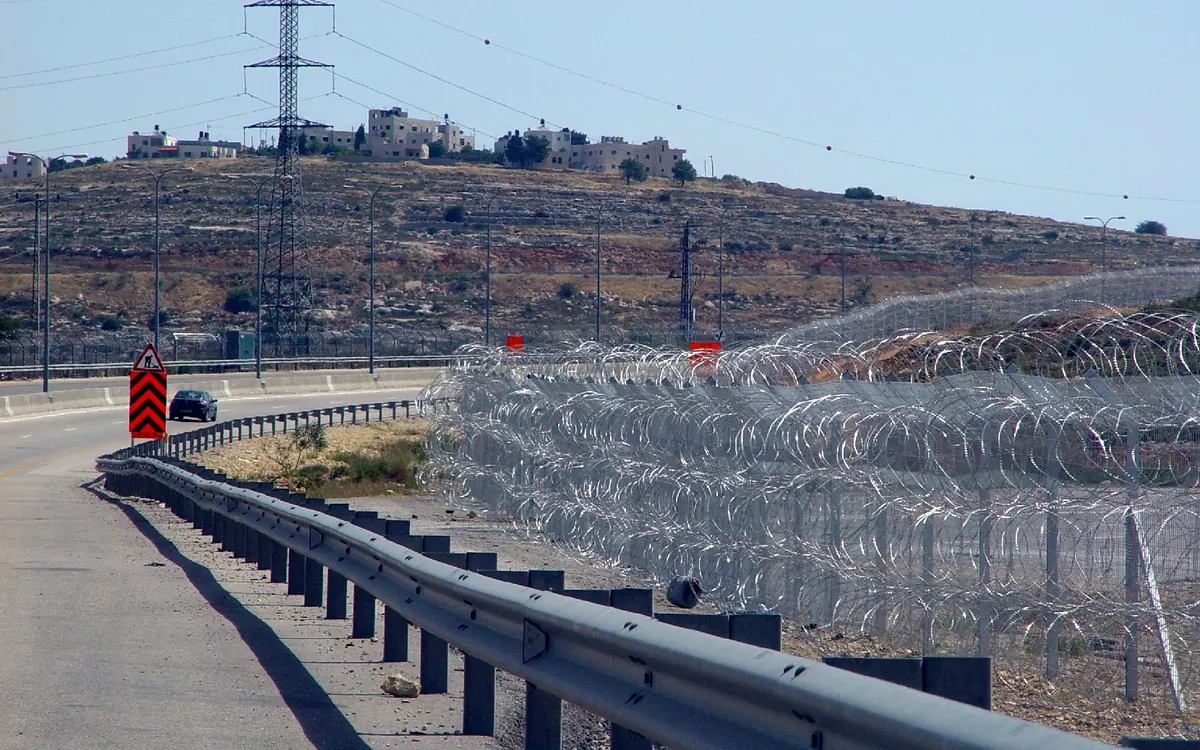
Though the first intifada paved the way for the wall, the second - known as the Oslo War - brought it into being. This episode makes a bridge between these two conflicts, tracing the arc from suppression to separation and asks the question -why not sovereignty?
About this episode
Men build too many walls and not enough bridges, said Isaac Newton, and Rav Mike traces the evolution of one wall from the first intifada to the second. He refuses the name second intifada and calls it the Oslo War, since the first was a popular uprising against military rule while this was a strategic decision by one nation's leaders to wage war on another, the culmination of ten years of process with precious little peace. The war launched on Erev Rosh Hashanah 2000, nominally triggered when Sharon went up on the Temple Mount, had clearly been prepared for. For Rav Mike what preceded this wall will forever be Passover 2002, the morning a terrorist slipped into the Park Hotel in Netanya and murdered thirty at a Seder, when every Israeli paper carried the same headline, in every generation they rise up to destroy us.
Robert Frost wrote that something there is that does not love a wall, and before building one he would ask what he was walling in or out. Rav Mike remembers a geologist, Eiler Henriksen, who answered the geographic question of why the car beat the train in America with a political one, the teamsters, and that is the power of political geography, the study of place and the relationships between people, state and land. Ask why a wall won out over sovereignty in Yehuda and Shomron and the answer is the generals. After the Six-Day War they controlled the ground and joined the political discussions, and so long as Israel neither declared itself sovereign nor made peace with another sovereign, they ran security and development with a power only a military government wields, for fifty-five years.
The first general to make a political proposal was Yigal Alon, whose plan showed security overwhelming even his old secular messianic dream of a greater Israel. Alon aimed to widen Israel's narrow waist, and his guiding principle was maximum territory with minimum Arabs, which meant separation, and it guided every security negotiation for six decades. The next general was Ariel Sharon, a lifelong believer in settling the periphery, whose plan strung communities along the western Shomron and the Jordan Valley, thickening the coastal waist and strengthening the eastern border with east-west roads and a ring around Jerusalem. Sharon joked that the faithful called him Messiah's donkey, a workhorse carrying their redemptive vision whether he grasped it or not, since for him the whole enterprise was about security and control.
When the first intifada ran out of steam another general arose with his own vision of separation, Yitzhak Rabin, architect though not initiator of Oslo. Rabin brought the perspective of a pragmatic military man and likely never expected peace, understanding how incompatible the two peoples' positions were. He feared that brutal suppression would make Israel a pariah like South Africa while granting the Palestinians citizenship would dissolve the Jewish state, so he declared that the sharper the separation the more security would be restored, and the word peace was absent. A darker undercurrent ran alongside, a 1988 poll where nearly half of Israelis backed transferring the Arab population and Rehavam Zevi's Moledet party built on the same idea. That year King Hussein renounced his claim to the West Bank, closing the Jordanian option and leaving Rabin's choices running out.
So Rabin reasoned that if he could not remove the people under his rule he could separate his rule from the people, and that is what Oslo was, a process of separation wearing the clothes of peace. Part was political, turning the PLO into an authority Israel could negotiate with and hand the dirty work of suppressing violence. Part was the roads, since Article 13 redeployed Israeli forces outside populated areas while Article 10 kept Israel responsible for the Jews planted throughout, and so the bypass roads were born, physical barriers that isolate communities even while they allow travel. Military rule is a kind of civil war, land conquered yet neither taken as sovereign nor given away. When Rav Mike looks at the wall he sees a failure of imagination, and he wants his children to see it too, so its ugliness reminds them of the obligation to tear it down.
Key ideas
- Rav Mike calls the second intifada the Oslo War, a strategic decision to wage war rather than a popular uprising against military rule.
- Political geography, the triangle of people, state and land, explains why a wall won out over sovereignty, and the answer is the generals.
- The Alon plan set the principle of maximum territory with minimum Arabs, guiding every security negotiation for six decades.
- Sharon settled the periphery for security and control, and called himself Messiah's donkey carrying a redemptive vision he did not share.
- Rabin pursued Oslo as separation for security, never peace and never sovereignty, fearing both a pariah state and a binational one.
- The bypass roads and military rule made a civil war of the land, and Rav Mike wants his children to see the wall so they remember to tear it down.
Chapters
- 0:00 Walls and bridges; tracing a wall
- 1:07 The Oslo War, not the second intifada
- 3:17 Sharon on the Temple Mount
- 5:32 Passover 2002; the Park Hotel
- 7:50 Robert Frost; something hates a wall
- 10:03 The teamsters; political geography
- 12:20 The generals shaped the wall
- 13:23 The Alon plan; minimum Arabs
- 14:33 Maximum territory; separation
- 15:45 The Sharon plan; Messiah's donkey
- 16:51 Rabin and the vision of separation
- 20:07 Separation for security, not peace
- 24:36 The transfer undercurrent; Moledet
- 30:05 Who grabs sovereignty by the horns
- 33:17 The bypass roads
- 38:01 The wall as failure of imagination
Who, where and when
People
Isaac Newton, Robert Frost, Eiler Henriksen, Yigal Alon, Ariel Sharon, Yitzhak Rabin, Benjamin Netanyahu, Rehavam Zevi, King Hussein, Yasser Arafat
Places
Netanya, The Shomron, The Jordan Valley, Jerusalem, Hebron
Texts
The Oslo Accords, The Alon Plan, Mending Wall
When
2000 CE: the Oslo War begins, 1967 CE: the Six-Day War, 1977 CE: Sharon's settlement plan, 1988 CE: Moledet founded and Hussein renounces the West Bank, 2002 CE: the Park Hotel massacre
Read the transcript
Men build too many walls, said Sir Isaac Newton, and not enough bridges. I can connect to that. I'm Rav Mike Foyer, and this is the Jewish Story. Season 6, Episode 8, Boundary Issues, Part 4. So we're tracing the evolution of a wall. And in order to do so, we're going to have to race a bit through time. Evolution, after all, is best understood in its broad scale. And in terms of our story, this means we need to move fairly quickly from the first intifada to the second. Though I'm going to have to do my almighty best to give some bridging context. That feels necessary to me because the so-called second intifada was the true context for the birth of the security barrier. I say so-called because I don't really call it that, at least not to myself.
To me, it will always be the Oslo War, an eruption of sustained violence that deserves both the status which comes with that category of conflict and the reminder of the name of those responsible for it. I'll use second intifada for mutual understandings from time to time, but it's a complete misnomer and not accidentally so. Remember, the original usage of Intifada described the violent loss of public order in Yudashermon and Aza, and the street war that was fought between Arabs and Jews to restore it. It quickly became a political struggle for Palestinian sovereignty, but it retained that character and tactics of a popular uprising throughout, a shaking off, as it's called, of military rule through riots and non-cooperation, punctuated, of course, by acts of murderous terror.
which served to remind Jews not living in the territories of what was being suppressed. The second intifada, on the other hand, had all the hallmarks of a strategic decision by one nation's leaders to wage war on another. And rather than coming on the heels of two decades of political suppression, that uprising was the culmination of ten years of peace process, granted more process than peace, stymied by many things, Not the least of which was the fact that neither side actually wanted to make a deal, at least not one that was going to be acceptable to the other. Israel wasn't going to give up that essential connection to its heartland, or its conceptions of security. I mean, this doomed the idea of any clean separation, us here, them there, right off the bat.
The Palestinian leadership, on the other hand, was a direct product of this process, and, in many ways, hopelessly corrupt in violence. Now, we could quibble from now until forever about whether the whole Oslo process was actually part of the PLO's original phase plan for Israel's destruction from the outset or no, but the war which they launched on Erev Rosh Hashanah 2000 seemed clearly aimed at just that. I recall quite clearly when Ariel Sharon went up on the Temple Mount, nominally the trigger to this explosion, It was, if you recall, an attempt to expose the illusion of our sovereignty there. It's a normal thing to visit the Temple Mount, and every Jew can visit the Temple Mount, exactly as every Arab can visit any other place in the country.
And all of us would like to have peace, all of us are committed to peace. I cannot see any possibility for real peace if Jews were not allowed to go to the holiest place that belonged to them. Jews will be visiting the Temple Mount, their most sacred place, the holiest of the holiest, also in the future. But one thing that worries me is when I see what happened there, I just think what will happen if Jerusalem will be divided, as Barak agrees to do already. You might say the rioting which erupted right afterwards was spontaneous, although the stockpiling of rocks and fireworks in the Dome of the Rock in the Al-Aqsa would belie that. But the sustained terror war which followed, only two months, mind you, after Yasser Arafat walked away from the negotiating table at Camp David, what was supposed to be the final end to the Azo process, that war had unquestionably been prepared for, likely for some time.
I mean, the amount of explosives alone would have taken some time to procure. This was not a second spontaneous revolt. Furthermore, the kind of broad, sort of high-intensity, low-impact of the First Intifada, rioting, was now replaced by a grim military focus. The years between 2000 and 2003 saw approximately 900 dead and 6,000 injured amongst Israelis, While the numbers amongst Palestinians were even higher, 2,100 dead and more than 15,000 injured. By Israeli standards, that means each month of that period saw almost as many deaths as soldiers killed during the 1982 Lebanon invasion. Except most were civilians murdered by suicide bombers. That is a war, and a nasty one to boot, so I prefer to call it so, the Oslo War.
Now, shortly, I'm going to lay out some of the socio-political processes that produced the separation barrier. That arc from suppression to separation that we've been speaking about, all in avoidance of sovereignty. But before we do, a personal note, and then some poeticism. For me, what preceded the birth of this wall desecrating our land will forever be Passover 2002, or 5762, as I ought to say. That was the day we all awoke to the news that a young Hamas terrorist had crossed the 10 miles from Tukarm in the Shomron to Netanya on the Israeli coast. And there, disguised the woman, he slipped into the park hotel, where a Seder meal for 250 people was underway, and detonated a suitcase packed with high explosives.
There was dead people on the floor and Ami, my husband, was not in the ambulance. Ami was not in the lobby area either. In a panic, Corrine searched and found all of her children. Her youngest, seven-year-old Netanel, was the last to turn up. And after a few minutes, a little girl comes with Nathanael in his hand because he was wounded in the knee. He can't walk. She takes him in his hand and Nathanael says, we have to pray, we have to pray all the time because you see what happened. Corinne was unable to tell me about how she found her husband Ami that day, the man she fell in love with at the age of 16. 30 people were killed, among them Holocaust survivals and another 140 wounded dozens, severely. That's bad enough on its own.
But what I'll really never forget was when the newspapers went to print after Chag. You know, that day that we woke up, the next day, and every major outlet in Israel carried the exact same headline. Bekol dovadol om bimalenu lechaloteinu. In every generation, they rise up against us to destroy us. Now, that's a truth of Jewish history we can choose to ignore, but not one will succeed in forgetting. That's the personal note. Do with it as you will. The poetic wisdom comes to us from Robert Frost. Most people are familiar with his famous line from the poem Mending Wall, Good fences make good neighbors. He says, Good fences make good neighbors. Spring is the mischief in me, and I wonder, if I could put a notion in his head, why do they make good neighbors?
Isn't it where there are cows? But there are no cows here. Before I built a wall, I'd ask to know what I was walling in or walling out, and to whom I was like to give offense. Something there is that doesn't love a wall, that wants it down. I once took a class called Economic Geology. And, like all good Colorado College geology classes, it included a field component. And that's how I found myself one day rolling down the road, sitting next to Eiler Henriksen, as he drove us north through his native state of Minnesota, headed for the iron shaft mine he'd arranged for us to visit. It was actually pretty cool. Now, Eiler was the closest thing to a decorated geologist that the United States has ever known.
The pictures and the stories that he shared with us in his capacity as department head of the CC geology department were gems plucked from a career that spanned from the post-World War II mineral race of mapping the U.S. strategic reserves right through the space race of the 90s. And his wisdom was sometimes stunning. I took the opportunity sitting next to him there to ask what was at the time a burning question amongst ardent and economically aware young environmentalists like myself. I said, why did the car win out over the train in America? Or at least tell me what was the main reason. Now, in my eyes, America should have been at least as integrated by trains as Europe, and considering size, distribution of resource, and arc of population growth, likely even more so.
furthermore if you know a bit of history the robber barons were on track to make it happen in the 19th century pun intended i guess they had the money the power to lay down the infrastructure for the growth of the agro giant that america would become in the 20th century And now America and in her wake much of the world worship the car and its roads and they are seen as the logical center point for all development, perhaps the biggest barrier to a sustainable economy and saving our planet, by the by. Now, Eiler didn't even pause. The teamsters, he said. You'll have to catch me over a beer some other time. The explanation of his answer, I'll give you my full-on rant about how the Eisenhower highway system shaped the world.
But for now, I want you to appreciate it as an example. Example of the fact that he gave a political answer, the vision and actions of a small group of men, to what I thought was a geographic question. How did the society of a continent develop? And that serves us in our present task by illustrating the power of what's known as political geography. Now, classic geography is the study of the nature of place and the relationships between peoples and their environment. Political geography looks at that entire relationship through a political lens. Call it the study of place and the relationships between people, state, and land. As an avowedly critical discipline, political geography is also interested in what they call spatially uneven outcomes of that triangle relationship between people, state, and land, and how political processes are in turn affected by spatial structures.
I'm sure you can start to hear the relevance to our story of the wall by now. Now, I'm no Eiler Henriksen, but if you asked me, Mike, what's the reason a wall won out over sovereignty in Udah and Shomron? I don't need to hesitate either. It was the generals. In the immediate aftermath of that stunning six-day war victory, the generals controlled the situation on the ground in the territories as befitted a recent battlefield. They also took part right from the outset in the political discussions which took off about how to move forward with this possession of the biblical heartland, one that also happened to provide a strategic dominance over both the population clustered along the Israeli coastal plain to the west and the vulnerable border of the Jordan Valley to the east.
And, of course, so long as Israel neither declared itself sovereign nor recognized some other sovereign and made peace with it, the generals remained in charge of the reality on the ground, both security and development, with a power that only a military government can wield. That has gone on for 55 years. 55 years which have been a rapid and intense developmental arc in population, economy, and infrastructure. Hence the fact that the political geography of Yehuda and Shomron, which finds its perhaps ultimate expression in the wall, has been shaped by the generals. Now in fairness, the first general to make an avowedly political proposal of how to develop this new one territory, was a hero general from the War of Independence, long since a civilian by 1967.
But you know what they say, once a military man, always a military man. And the alone plan crafted by foreign minister Yigal Allon in the months after the Six-Day War shows that the vision of security was able to overwhelm even the old school Ach-Dut-Avodah, secular messianic dreams of a greater Israel, sovereign in its land, on which Yigal-Halon had actually been raised. The plan deserves its own detailed consideration. You can go back to Season 4, Episode 6 for more of its story. But for right now, just recall, it laid down a principle which has guided the relationship between territory, people, and state ever since. Because the biggest practical issue that Alon was looking toward was widening Israel's narrow waist.
Before the Six-Day War, Israel was less than 15 kilometers wide at its narrowest point. Now, in its aftermath, there was almost 65 kilometers from the Mediterranean to the Jordan River to work with. And the principle of political geography that Alon held to in order to figure out how to draw that border was maximum territory with minimum Arabs, meaning separation. Now keep in mind that even though the alone plan was never formally adopted by any Israeli government, it served as the semi-official guide to every security-based negotiation of the next six decades. Those who are familiar with the details of President Trump's plan might even find it strikingly familiar. The next big general to offer a vision of how to develop that relationship between people, state, and land in the mountains of Udan Sharon, the so-called West Bank, was, not surprisingly, Ariel Sharon.
When Sharon became minister of agriculture, with Begin's upheaval victory of 1977, it was a very fitting appointment. He was a member of a dying breed of politician. Sharon was a lifelong believer in settling Israel's periphery wherever it happened to be located. Recall that in the early phase of the Zionist enterprise, civilian settlement determined its borders. And now, Sharon saw that type of settlement as the tool crucial to protecting open spaces under Israel's rule, be that civil or military. And thus, the Sharon Plan proposed a string of buildings along the western slopes of the Shomron Mountains and in the Jordan Valley, thickening Israel's narrow coastal waste and strengthening that vulnerable eastern border, right along the heels of the Alone Plan.
It also, crucially for our story, envisioned a network of east-west roads linking those so-called eastern and western seam zones, as well as a ring of settlement and transportation encircling Jerusalem on the eastern side. His vision was all about security and control, not about sovereignty. Nonetheless, Sharon used to half-joke in the later phases of his life that the national religious Zionist faithful, who were the ones who lived in most of the 64 points he built, called him Messiah's donkey. It's a rabbinic term. He meant that he was a workhorse carrying forward their redemptive vision, whether he understood it or not. Now, until 1987, the Sharon Plan actually seemed to be working. The Jews held the high ground, the valley, and the capital.
But then the Intifada shook those assumptions, especially along the roads. Villages meant to be sources of new life became strong points, often under siege, as the military grappled to suppress the violence and reassert its rule, but not Israeli sovereignty. In fact, as you know, by the time the First Intifada ran out of steam, another general had arisen with a different vision of political geography, one that said, separation. And that, of course, was Yitzhak Rabin. There's a tendency to speak about a peace process which began with the 1993 Oslo Agreement. But even ignoring the fact that it never brought peace, I believe this is actually a misnomer from the very outset. As we touched on back in Episode 4, Prime Minister Yitzhak Rabin was not the initiator of Oslo, but ultimately he was its architect.
And as such, Rabin brought the perspective of a pragmatic military man to the table. And it's entirely likely that Rabin never even expected peace with the Palestinians to come from the Oslo process. He too well understood how incompatible the positions between the Jews and the Arabs of the land really were. Nonetheless, as he'd done his entire life, Rabin moved forward toward a tangible, or at least definable, goal, which was security almost at any cost. Now, my present purpose isn't to plumb the depths of the Oslo process, though since we keep touching it tangentially, I guess at some point I'm going to have to meet the beast head on. But for right now, the question on the table is how Oslo moved that arc of policy forward that produced a wall bisecting the land of Israel.
And in that sense, we need to understand the Oslo process really, in many ways, in the same way as the disengagement of forces that took place between Israel and Egypt following the Yom Kippur War. That painful and delicate process was driven by U.S. Secretary of State Henry Kissinger's famous shuttle diplomacy. And it was guided, at least on the Israeli side, by Rabin's philosophy, a piece of territory for a piece of peace. Now, it did ultimately lay the groundwork for the signing of the Egyptian-Israeli peace treaty at Camp David less than 10 years later, which means it's not unreasonable to think that Rabin envisioned a similar process in Oslo. But the security threat that was removed post-Yom Kippur was clear to everyone involved.
No one wanted a war between these two sovereign powers, so best to disentangle their forces, and frankly, only a few radical dreamers thought retreating from the Sinai was too high a price to pay. The problem is, when it came to Oslo, and when it came in particular to the biblical heartland of Yudah and Shomron, the West Bank, the situation was far less clear. That being said, Shrabin, even though the solution might not be clear, the threat was crystalline. His iron fist policy may have succeeded in quelling the violence on the streets of the West Bank and Gaza for a time But he knew that to continue on that path of brutal suppression risked Israel becoming an international pariah along the lines of South Africa Remember, this is the early 90s here.
On the other hand, Rabin felt that to grant full citizenship rights to the Palestinians living in the territories threatened his vision of Israel as a democratic and Jewish state. Hence his declaration in 1993, right at the beginning of the Oslo process. He said, the main question around which there are differences of opinion, is whether to annex the two million Palestinians living in the territories and turn them into Israeli citizens, or find a way of coexistence while preserving the Jewish uniqueness of the state of Israel as the state of the Jews. We must bring separation to provide security. Without separation, there will be no personal security. The sharper the separation, the more security will be restored.
Now, two things. Notice, the sharper the separation, the more security will be restored. Shortly, you'll see, though, those are nice words, but the Oslo process was anything but sharp. The other is, notice that the word peace isn't mentioned here. In my humble opinion, Rabin was never actually part of the peace camp, except when it suited him to pose as such politically. He was all about security. and that's why the leader of the opposition to his plans in Knesset, Benjamin Netanyahu, tried to fight him on that very front, labeling the PLO's willingness to accept the Oslo process as part of that phase plan to destroy Israel, and as he said right before the adoption of the second part of Oslo in 1995, and here lies before us the Oslo II agreement.
This is Bibi speaking. What emerges from it is not your intention to establish a Jewish state, speaking to Rabin, but to jeopardize the one that already exists. Not to be separated from the Arabs living in Yehuda and Shomron, but to relinquish the security that the Arabs of Yehuda and Shomron give us. You're creating an immediate threat, a terrorist state, a strategic threat, and a threat to the very existence of the state. Again, the word peace is not in the picture, because no one but idealists were thinking about it or even believed it was possible, in the same way that no one but idealists were thinking about sovereignty. In this sense, the Azzel process becomes the political turning point from that policy of suppression to one of active separation at all costs.
Like I said, the word of sovereignty isn't here. The most Rabin could imagine resulting from Israeli sovereignty over Yudah, Shomron, and Gaza was this binational state, a disaster to be avoided in his eyes. as he said in 95, right back in that Knesset debate with Bibi, we are in the process of resolving the conflict between us and the Palestinians. There are indeed differences of opinions in this house between two worldviews. We believe that the dream of generations of Jews, since the destruction of the Second Temple and their prayer to return to Zion, are not for the establishment of a binational state. The dream of generations of Jews in today's reality is to establish a Jewish state with Jerusalem as its capital.
Not a binational state, but a Palestinian entity on our side. Notice how he mixed the dream of Jews, the Second Temple prayers, and the establishment of a Palestinian entity as part of that 2,000-year dream. The assumption here, one again which deserves its own discussion, is that democracy is part of a sacred vision. But at the very least, there is a total absence of thought, of creative thought at least, about sovereignty. And frankly, it has to be said, the right was just as unable to offer any better option. Hence the fact that you have never seen a comprehensive proposal for peace or sovereignty coming from that side of the aisle. Now actually, I'm going to back that down just a second. For truth's sakes, it's not entirely accurate.
There is another policy undercurrent, which was there in Oslo, and which still exists today, and it needs to be named in order to understand what's upholding that wall through our land. In 1988, at the height of the Intifada, when violence was surging and the suppression looking ever uglier and less feasible as a policy, A poll was taken in August, and it found that 49% of Israelis supported, to some degree at least, the transfer of the Arab population out of Yudash Shumron in Gaza. And notably, a third of those who answered in the positive were registered labor voters. That very same year, retired General Rehavam Zevi founded the Moledit Party, Moledit means homeland, which offered a right-wing vision of how to make peace between the Jewish and Arab peoples.
His vision was founded on separation of the two nations, just like Rabin's. But in Zevi's vision, that was to be achieved by completing the population exchanges, which had been begun with the upheavals of the 1948 war, when Arabs fled and were driven out of Israel, and the subsequent flight and driving out of Jubes from the Arab lands that came in its wake. significantly in that very same year King Hussein of Jordan had renounced his claims to the West Bank and declared his support for the PLO as the sole legitimate representative of the Palestinian people I mean, frankly, as a British installed colonial ruler, one whose populace was more than 60% Palestinian the king clearly was looking to cut and run before the violence crossed the river and toppled his throne but this meant for Israelis that the Jordanian option was off the table.
The left had always looked to Jordan as potentially the joint custodian or perhaps even the sovereign over the West Bank, while the right had seen it as the Palestinian state. Two-state solution, by the way, is quite popular on the right. It just depends on where you draw the border. But what it meant was that by the time Oslo came around, Rabin's options were running out. And he was facing an electorate that was increasingly willing, or at least interested, in making the Arabs just go away. I know that sounds harsh, but it's true nonetheless. So much of the intractable nature of the conflict as I see it is two peoples who have their hands over their ears, their eyes shut, hoping that the other one will just go away.
And so Rabin realized that if he couldn't remove the people under his rule, he could at least separate his rule from the people, hence Oslo. not as a peace process, but as a process of separation. Another attempt, along the lines of the Alone Plan, and even the Sharon Plan, that aimed to meet Israel's security needs by controlling the political geography, relationship between people, state, and land. Now, part of that was to be done through politics. He needed to transform the PLO into the Palestinian Authority, someone with whom Israel could negotiate. You need an address if you're going to have a two-sided process. And by the way, someone to whom he could hand off the continually important role of suppressing violence.
The years from 1993 to 1996 were arguably the height of the Oslo process, and they were also the height of horrible death and destruction, much of which was driven by Hamas and other fundamentalists who opposed Oslo and were determined to destroy Israel even then. As Rabin made clear in an interview on Channel 1, in March of 1994, the Palestinian Authority will be able to fight Hamas without B'Tselem and without the Supreme Court, meaning he created a junior partner, how shall we say it, that wasn't going to be restrained by those things that he considered to be so important, like democracy and civil rights. Now, only a month before that speech, Baruch Goldstein had masquered 29 Palestinians in the cave of the Machpelah in Hevron.
Rabin had wanted to use that as an opportunity to advance his vision of separation by extracting the numerically small but ideologically strong core of Jews in Hevron, but he was politically too weak to do so. It should have been a warning sign that he couldn't even pull a couple hundred Jews out to give his clean separation. Instead, Rabin just ended up urging Israelis to fight terrorism as if there's no peace process, and work for peace as if there's no terror. The policy of the government of Israel is to continue the peace process with the Palestinian elements, the Palestinian authority, the PLO. We will fight within the limits of our laws against the enemies of Israel and the enemies of peace.
it's a painful day but it will not deter us to do both I mean, that may sound okay but it's really just a lame echo of Ben-Gurion's 1939 declaration you may remember it we must assist the British in the war as if there were no white paper white paper that was keeping the Jews out of Israel we must resist the white paper as if there were no war and Rabin's words were expressive of just as ineffective a policy remember in Ben-Gurion's case It wasn't his militia which brought victory. It was the Lehi, whose ideological clarity allowed them to recognize the British as the true barrier to our independence and apply maximal force, together with the Irgun eventually, in driving them out. For Rabin, the question he's facing is, who will finally grab the bull of sovereignty by the horns?
And the answer to that remains to be seen. and by the way in addition to the political side one of the ways in which Oslo executed political geography was through the roads You know, it occurred to me just the other day that military rule, on some level by definition, is a state of civil war. Now, I don't mean this in the classic sense of civil war, two parties struggling for control of a polity that they feel both belong to, and thus ought to rule, but rather in the sense that land and people have been conquered, but never taken as sovereign or relinquished to someone else's sovereignty. Nonetheless, military rule allows for the maintenance and even growth of a civilian fabric of life. So on one hand, it's civil to a degree, but it's also still a state of war.
Civil war. And whatever else I might say about the Oslo process, as far as I can tell from the Israeli side, it was doomed from the outset by the unresolved internal conflict between the goals of separation and territorial expansion. Now in a sense, that's a tension which reflects one of the deepest, I might even call it primal historical political drivers, of the Zionist project altogether. Reclaim as much of our land as we can expand in order to get as far from the nations as possible. Separate. and sadly there were good reasons that created that driver though the world loves to see us today as big bad occupiers at this stage they also love to forget the century which led up to this situation part of the Oslo process which fed directly into the creation of all was that very ambiguity one part of the heart of the country was determined to separate captivated by the vision if not of peace at least of security to be gained through us here, them there.
Granted, there was an argument about where the here and there were. The other part of the country was convinced that to separate from Uda and Shomron and Gaza would lead only to war, not to safety. Now, despite the severe attacks by Hamas that marked almost the entire Hasla process, as well as Arafat's obvious unwillingness to fight terror, Rabin plowed ahead. And in specific, he instructed his negotiating team to present what he called Israel's basic security positions. That was that Israel would control external security and borders, settlements, and the bypass roads in the West Banks. And this brings us to the oh-so-controversial question of Jews, like myself, who have chosen to willfully plant ourselves in the biblical historical heartland.
The political, culture, and spiritual waves that the so-called settlement movement is making even today are going to, yes, I've said it so many times, get their own consideration. But there's a specific aspect of this whole endeavor that needs to be pointed out in order to understand how the wall came to be. And that's the practical infrastructure which makes the lives of these Jews possible, specifically the roads. The lives of Jews and Arabs, I should say. Now, I'm not going to go into that whole romantic thing. Oh, I remember the good old days when we shopped in Gaza City, when we ate hummus and bet lechem, etc. But I will say it's important to know that before Oslo, there was only one transportation system for all human beings between the river and the sea, to borrow a phrase.
The shift on that began with the violence of the Intifada. As the Israeli army struggled to regain control over public order, like I said, Jewish town became islands of friendly territory, strong points for those patrols. Not to mention occasionally the site of sieges and even a source of public order themselves. Now, you might recall also my personal story from the end of last episode. Much of the violence of the Intifada was experienced by Israelis on the roads. Now, Article 13 of the Oslo Agreement is called the redeployment of Israeli forces. And point two in Article 13 states the following. In redeploying its military forces, Israel will be guided by the principle that its military forces should be redeployed outside populated areas.
The goal is obvious, separation, one which would not only reduce friction, but which would allow the budding Palestinian security force created by the Accords to begin to take responsibility for order on the ground. At the same time, though, Article 10 says the following, Israel shall continue to carry responsibility for overall security of Israelis for the purpose of safeguarding their internal security and public order. And that means that the Jews planted on the western Shomron, Jordan Valley, and elsewhere by the 1977 Shomron Plan, and through all the efforts of the 16 years since, will still be under the protection of the IDF. You see the issue? How exactly are you going to separate when you have to pass each other on the road every single day?
You know, that term bypass roads that you heard me use was actually a product of the Oslo Agreement. It didn't exist until the attempt at separation was made. Because the bypass road designates roads that bypass Palestinian towns and communities, which will be able to fulfill those twin commitments of separation of the Arab populist centers and maintenance of military rule, if not sovereignty, over the Jewish ones. Now just to be clear, prior to the outbreak of the Oslo War in 2000, Palestinians had as much access to these bypass roads as Israeli, barring times when the IDF was dealing with a specific security alert. It was only in the wake of that vicious conflict that the very idea of creating separate road networks began to emerge.
Nonetheless, even open-use bypass roads divide by their very nature. Physical barriers, roads are physical barriers, ones that can isolate communities, prevent their expansion, cut land off from people, even as they allow access and travel, be that accidental or intentional. And through the 90s, the Oslo process gave ever more control of the land over to the Palestinian Authority, even as its ambiguity allowed the Jewish population of Yudah Shomron and Aza to continue to grow. On the Israeli side, socially and politically, the internal confusion between that desire to separate and the desire to expand prevented any clear plan for either sovereignty or separation to emerge, and continuing terror kept the tools of suppression and control close at hand.
now I thought I was actually going to get to the explosion of 2000 today hence how I began the episode but I could tell that that was a lost cause actually quite a bit of time ago so instead I want to draw things to the close with a promise that indeed next week will be the last episode in this series we'll understand please God the physical entity of the wall and I want to end once again on a personal note It seemed from people's feedback that that was a good idea last week. By the way, send me your feedback. Those of you who do it, I really appreciate it. I can use it. As long as it's constructive, it can be harsh. Just let me know what you think. Rav Mike Foyer, gmail.com, or you can find me on Facebook, Rav Mike Foyer.
But anyway, back to our task at hand. When I look at the wall, it represents a failure in so many ways. Not the least of which is a failure of imagination. and it also fills me with a sense of urgency. I can't help feeling that we're in a situation of sovereignty or bust. And no matter how much faith I have in God's promise to our people, that whole triangle of people, state, and land has a divine light to it as well. As much as I have faith in that promise, that in no way means that personally I or my children will survive to see it fulfilled, though I really would like to. You know, once I had a friend from the States who came to visit me. As we're driving to Jerusalem from Malia de Mim, we passed along the edge of the separation barrier.
I saw him staring out the window at that concrete, topped by barbed wire. It's as ugly as reality, as you're likely to see if you're an American. A far cry from the scenery in his green mountain state home. After a few minutes, he said to me, how could you raise your children in a place where they see this every day? It's a fair question especially for those of us who chose to plant ourselves in the heart of this beloved and conflicted zone. Don't kid yourself, I said to him. There are walls just as ugly and large that keep your children safe. It's only that the power and scale of the country in which you live places them far away and out of sight. I want my children to see that wall, I said. So its reality makes them remember that we have an obligation to tear it down.
I just want to thank some folks. I want to thank all the folks who give their hard-earned money and make this show possible. Keep it free, widely available. I'm calling on you to join them right now. I need your support for Season 6. Go to my website, Jewestory.co, and you'll see a button in the upper right-hand corner that says Be a Patron. You can click on that to give a little bit of per-podcast support, or you can write to me, RobMikeFoyer, gmail.com, or on Facebook, RobMikeFoyer. I'm happy to share with you the ways in which you can dedicate a show or give a one-time donation. I want to also thank the Land of Israel Network. That's thelandofisrael.com. They are building a center for global transcendence right in the heart of the mountains of Judea.
I want to thank the Pardes Institute, pardes.org.il, for throwing the doors of the Beit Midrash open as wide as possible. I want to thank you for listening. I'm Rav Mike Foyer, and this is The Jewish Story.
More from Season 6
TJS S6 Interlude - On violence
In this episode we take a break from tracking the evolution of Israel's separation wall to consider the deeper issues of violence on which it is built. Rav...
Play Episode
TJS S6E7 Boundary Issues part III
Violence often has an arc, and in this episode we trace how the intifada progresses together with the Israeli policies of suppression and separation. Along the way we...
Play Episode
TJS S6E9 Boundary issues part V
Uzi Dayan was national security advisor to both Ehud Barak and Ariel Sharon, helping them navigate the stormy waters of the Camp David summit, the Oslo war and...
Play Episode