
TJS S6E10 American Antisemitism part I
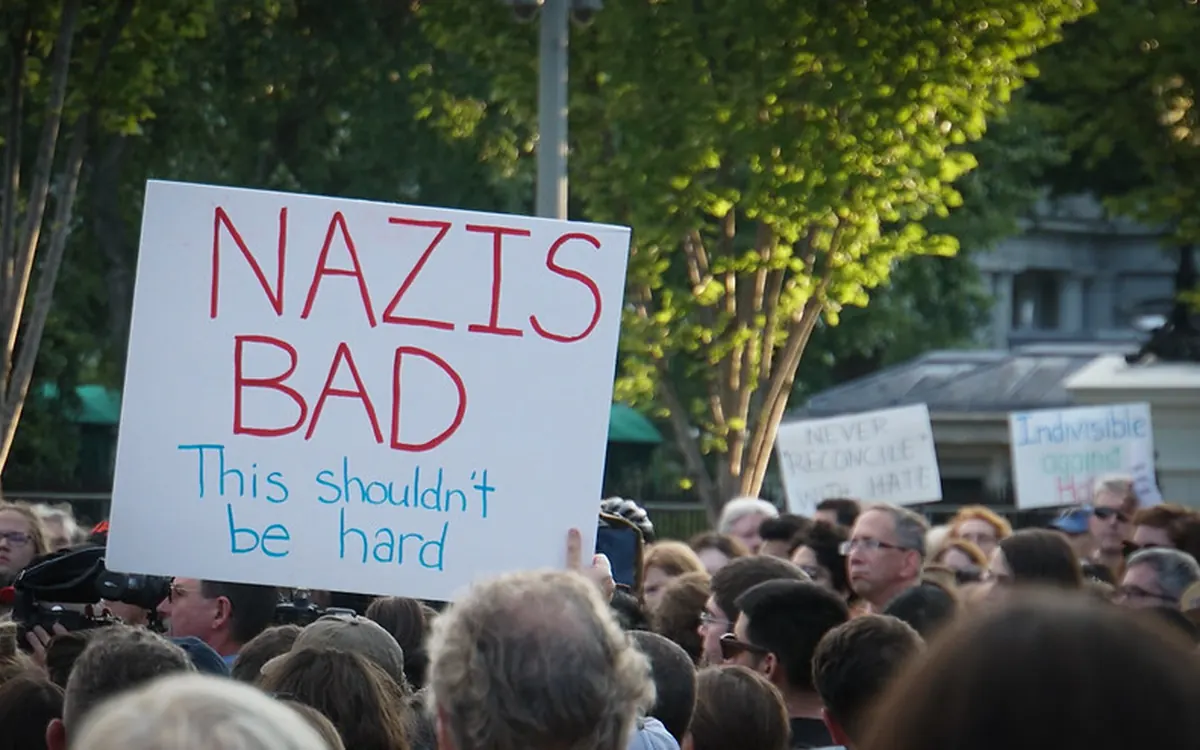
Antisemitism It's an old topic, but somehow seems to be making yet another comeback in America. Here is the introductory episode in my quest to understand the rebirth of humanity's oldest hatred in the United States today. Learn about British Israelism, white supremacy and more.
Image attribution: Ted Eytan
lic: creativecommons.org/licenses/by-sa/4.0/legalcode
About this episode
It is easy to hate and difficult to love, said Confucius, and Rav Mike wades into why antisemitism seems to be exploding in America again. He begins with theory, since the form hate takes shifts in every generation, and to understand it we must also see how the Jews are always telling our story, often against the world. When we tell it well, in truth and righteousness, we gain strength and the story gathers cohesion, and when we stumble into foolish shortcuts and dark alleys we grow weak and things fall apart. Most theories of antisemitism study the antisemite, but his interest is the role opposition plays in the Jewish story, beginning with the obvious one, that hate has been a boundary keeper holding us apart as a distinct minority through all of history.
The sages taught that hatred came down at Sinai, playing on the word Sinah, a third Torah of opposition beside the written and the oral. One side is the hate rooted in otherness, sharpened by the claim of being chosen, which the Ran said flows from God dividing us out, since distance and division always breed hatred. The other side is jealousy of the Torah itself, resentment that we received a gift and hatred of what that gift brought into the world. Rav Mike adds his own structure, the four eras in which we have stood against the power of the age, for he has been tracing exactly how our otherness provokes a different hatred in each phase of history, each layer still residing in the world in both its socioeconomic and its conceptual form.
In late antiquity the Jew was the indigestible element of empire, refusing the yoke of foreign sovereignty, and three Roman wars proved the point. In the Middle Ages, under Christianity and Islam, we became the obstinate refuser of salvation, clinging to the Torah that had become our portable homeland. Modernity let the Jew in as a human being on one condition, that we check our culture at the door, and when we became more German than the Germans the hatred turned scientific and ended in dehumanization and erasure. Now in the postmodern era, amid the death of the grand narratives, we are the story that will not die, insisting that it is possible to fight for the good, which is about as countercultural as it gets when every hero is called a villain with good PR.
Turning to white antisemitism, Rav Mike grants that America has been the best home of exile, from the Constitution's protection to George Washington's 1790 letter to the Newport congregation promising a government that gives bigotry no sanction. Yet the 1920s revival of the Ku Klux Klan brought the first organized white antisemitism, and Henry Ford pushed conspiratorial hate to the masses through the Dearborn Independent and the Protocols of the Elders of Zion. When Ford's paper closed, its editor migrated to British Israelism, the pseudoscience that Anglo-Europeans are the real chosen people and the Jews are mongrel Khazars. That strange mix of white supremacy, conspiracy and Christian racial anthropology became the Christian identity movement, whose radio preacher Wesley Swift taught that Jews are the literal offspring of Satan and that a coming race war is Armageddon.
The sociologist Earl Rabb gives the framework. He names commodity antisemitism, a hate that is dangerous less as a sacred creed and more when it becomes useful on the political market, and the foreboding syndrome, the built-in Jewish sense that it could happen here. He breaks hate into a target factor, a trigger factor and a control factor, the strength of the law that suppresses the well-armed kooks. Richard Hofstadter, writing in 1964, described the paranoid style that sees history as apocalyptic conspiracy and refuses compromise, warning that certain traditions and catastrophes can release those energies into mass movements. Rav Mike lands in the present, where a 2021 poll finds fifteen percent believing a Satan-worshiping cabal runs the country, where Kanye West and Nick Fuentes dine with a former president, and a sense of foreboding is not out of place.
Key ideas
- The sages taught that hatred came down at Sinai, a Torah of opposition rooted both in our otherness and in jealousy of the Torah.
- Jewish otherness has provoked a different hatred in each era, from indigestible element of empire to the story that will not die.
- America has been the best home of exile, yet the 1920s Klan and Henry Ford planted an organized white antisemitism.
- British Israelism and Christian identity fused white supremacy, conspiracy and theology into the claim that Jews are the sons of Satan.
- Earl Rabb's commodity antisemitism grows dangerous when Jew hate becomes useful on the political market rather than as a sacred creed.
- With a QAnon poll and public figures dining with antisemites, Rav Mike finds a sense of foreboding is not out of place.
Chapters
- 0:00 It is easy to hate
- 2:13 The Jew as storyteller
- 3:16 Hate began at Sinai
- 5:29 Jealousy of the Torah
- 6:34 The four eras of otherness
- 10:01 Scientific antisemitism; modernity
- 11:04 The story that will not die
- 16:35 Washington's Newport letter
- 18:52 The Klan revival; Henry Ford
- 21:00 British Israelism; the Khazar theory
- 23:09 Christian identity; sons of Satan
- 26:34 Rabb; the foreboding syndrome
- 28:59 Commodity antisemitism
- 30:01 Hofstadter's paranoid style
- 34:34 The control factor
- 35:38 QAnon; a sense of foreboding
Who, where and when
People
Confucius, George Washington, Henry Ford, Wesley Swift, Earl Rabb, Richard Hofstadter, The Ran, Kanye West, Nick Fuentes
Places
America, Newport, Rhode Island, Dearborn, Mount Sinai
Texts
The Protocols of the Elders of Zion, Washington's Newport letter, The Paranoid Style in American Politics, The Dearborn Independent
When
1790 CE: Washington's Newport letter, 1920 CE: the Klan revived, 1964 CE: Hofstadter's paranoid style, 1983 CE: Rabb names commodity antisemitism, 2021 CE: the QAnon poll
Read the transcript
It is easy to hate, said Confucius, and it is difficult to love. This is how the whole scheme of things works. All good things are difficult to achieve, and bad things are very easy to get. I guess that's why the road to hell is all downhill. I'm Rav Mike Foyer, and this is The Jewish Story. Season 6, Episode 10, American Antisemitism, Part 1. Well, with great trepidation and not a bit of confusion, I'm ready to wade into the question of why it is anti-Semitism seems to be exploding on the scene in America once again. Now, I'm aware it's a swamp of a discussion, one that's probably going to push buttons on every side of the aisle, as they say. And so in order to make a little bit of order out of something which is just frankly chaotic, I want to start with some theory.
because we have to think about the form in which anti-Semitism takes in any given generation. You know, to me, one of the primary definitions of what it means to be a Jew is to constantly be swimming upstream. And that's why, if we want to understand anti-Semitism, we also need to understand how it is at any given moment we Jews are trying to tell our story, often in opposition to the world. Now, we could look at the ways in which that's brought us suffering, resistance, how we've internalized the hate and violence that's been turned against us, which is going to be part of our future discussion. But we also have to look at the way in which we've actually been agents in that process. Because like it or not, as far as I can tell, when we play our part as storytellers well, in truth and righteousness, we gain strength and our story gathers cohesion around the world.
And when we stumble in that telling, losing our way in foolish shortcuts or dark, confused back alleys, we tend to be weak and things fall apart. In general, the theories of how to categorize, much less explain antisemitism, are multitudinous. And most of them have to do with the antisemite and not with the Jew. It's called a psychopathology, xenophobic tendency on steroids, a product of racial theory, the ultimate social disease. Well, my interest, of course, in what this all has to do with the Jews. What role does opposition, of an often sick and violent kind, play in the development of the Jewish story? Now, the first answer, I think, is the obvious one, which is it's a boundary keeper. the negative pressure against joining majority society even when we Jews have been willing to give up everything that makes them other has been constant and intense for most of our history and it has certainly kept us as a distinct minority, which is frankly half the battle.
I mean our sages were very clear on that when they identified where the hate and opposition to Am Yisrael comes from I'm going to tell you now, you may be surprised if you're unaware of what they say or just freshly disturbed if you already knew. Because when the sages want to understand where the hatred of the Jews came from, they ask, right, why was Mount Sinai called Mount Sinai? And the answer is, Shemisham Yarda Sinah Leumot Olam. That from there, hatred, Sinah, came down to the nations of the world. Sinah, Sinai. Now, there are two sides to that hatred which our sages saw as coming down with the tablets to Moshe. We could even call it a third Torah. There's the written, there's the oral, and then there's the opposition.
Now, one side, as I said, is the hatred rooted in otherness, especially when it's touched with a claim of special status. As the Ron, great sage of the Middle Ages, said, that the nations hate us because God divided us from amongst all the nations. And distance and division always cause hatred, says Theron. Now, notice Theron is actually saying two things about the nature of Jewish otherness, both a specific and a general. Right? There is Karshborcho Hivdilanu That's a very specific act of God separating out the Jewish people. And then the general principle that distance and division always cause hatred. These are related in very complicated ways. For one way, anyone who thinks that there isn't a continuum between knowing the obligation of being chosen by God, feeling a justifiable pride in that awesome task, and sliding into arrogance and even supremacy because of it, doesn't see the Jews are only human, just like everybody else.
Don't kid yourself, people. At the same time, No matter how far the Jews have gone to debase, erase, deny any reality to our having been set apart by God, history has shown its incredible ability to emphasize that otherness even when we try to hide. So, one half of the hate that came down with the Torah at Sinai was the same hate everyone else faces. Otherness, although complicated by the whole chosen thing. The other half is actually rooted in the Torah itself. Because as another Midrash says, What does it mean that hatred came down at Sinai to the nations? That they were jealous of Israel in our Torah. There's an element of jealousy about what we received at Sinai and hated us specifically in that, be Torah Tan.
Because when the sages said, Moshe kibel Torah mi sine, that Moshe received Torah at sine, it doesn't say ha Torah. It doesn't say he got the Torah. It says Torah, a general idea that some hora'ah came into the world. Some instruction about life was placed into Moshe's hands, an instruction so big that its revelation has unfolded in the world through Israel, all down through history. And the written and oral Torahs, together with the Torah of Opposition, have brought this hora'ah, this instruction for life, into the world. It's a jealousy that we should get a gift, and a hatred of what that gift actually brought to the world, no matter who brought it down, or who holds it up in any given generation.
So that's what our sages say. Hate began at Sinai. And who am I to argue? As a student of how our history has unfolded since that seminal event, I will add a structure. It's something I've actually been sharing with you since season one, if you've been paying attention. Call it the wisdom to be gained from identifying exactly how we've stood in opposition to the political and cultural power structures of the last four eras of history, including the present. So back in late antiquity, the good old Greco-Roman era, I would say that we were the indigestible element of empire. The Judeans refused to accept the yoke of foreign sovereignty, even when that resistance appeared futile. And the hate of the Greco-Roman world was primarily for the Judean, and that insistence on remaining an independent, at least as much as we could.
Now, no doubt, there was what we would call religious hatred of the Jew in the pagan world as well, But the real conflict of late antiquity was political. I mean, three Roman Jewish wars during the Pax Romana proved that out. And proved enough, by the way, to crush our sovereign embodiment for almost 2,000 years. Now, moving out of late antiquity into the Middle Ages, I would say that the Jews suddenly became the obstinate refuser of salvation. Once Christianity adopted the Roman Empire, and then Islam burst out of the Arabian Peninsula to contest the world with it, the nature of Jew hate evolved. Because in exile, these religious empires made us into a religion. We were also, of course, labeled as a despised people.
But ultimately, the Jews in exile have been defined by our refusal to abandon the Torah in exchange for supposedly superior faiths. It's true, religious hate was welded to economic opposition in that era, as the Jew was molded by society into a very specific role for the medieval world. And every form of torture, persecution, forced conversion was used. And yet, we stiff-necked Jews held to our Torah, going deeper into it, in fact, as it truly became the portable homeland in the Middle Ages. But every era comes to an end, thank God, including the Middle Ages. And when modernity came, the Jew went from indigestible element of empire to obstinate refuser of salvation into the role of the ultimate alien other.
The modern world somehow became convinced that men have inalienable rights. And the Jew was gradually and even begrudgingly recognized as a human being just like everyone else. But our entry into humanity had one specific condition that we check our culture at the door I mean come on what place could there possibly be for Jewish clannish insistence on otherness our strange practices and primitive beliefs in this brave new world which we can all share so the Jew became more German than the Germans more French than the French and the hatred of the Jew suddenly became scientific anti-Semitism is a term which really heralded a form of hate that ended in our total dehumanization even though we've been let into the holes of humanity and ultimately being erased and expelled from the heart of modern Europe and now today in the post-modern era Well, we have been indigestible and apparently remain so, especially now that we're back in our land.
And despite the massive work done to detach the people from the Torah, thank God, thank God, that obstinate core clings on. And certainly, anti-Semitism, in the sense of irrational, even scientific Jew hate, is alive and well, as are the many Jews who just want to be accepted, like everyone else, nothing more than human. the particularly post-modern form of opposition, however is that we are a story which just won't die see, because if I were going to give a layman's sort of starter definition for the post-modern I'd say it's that skeptical stance that remains when all the guiding myths of life have been exploded it's called the death of the grand narratives, all the stories religious, political, national, philosophical that have guided humanity toward the light, toward greater achievement, or even in the belief that such an achievement in light is possible, have been wrecked.
I'm speaking less of a philosophy and more of a culture, even a psycho-emotional posture born of the repeat historical experience of the lie always mixed in with the great truths. And in the heart of the 20th century, as the atom bomb and the gates of Auschwitz announced the death of that last sacred Western myth of progress, Israel's story proved to be far from dead. We have this insistence on ultimate significance, on good, and thus the possibility for heroism as the base of our story. And that's about as counterculture as it gets today. We're certainly swimming against the stream in an era when any hope for moral grounding has been rooted in a dichotomy between victim and oppressor, with power being what lies between them.
In the postmodern world, a hero is just a villain with good PR. And that's why the postmodern world hates Am Yisrael, for insisting it's actually possible to fight for the good and the right. Hence the fact, by the way, that the onslaught of hate we face today centers around the narrative war, that attempt to undermine our story, to show that we're the Nazis, worse than the Nazis, therefore everyone's a Nazi, and nah, nah, nah, nah, nah. For what it's worth, the reason our story won't die is that it lacks any illusion of perfection, even as a desirable state, much less an achievable one. Israel's story embraces everything that is messy and problematic as part and parcel of heroism and righteousness, not as bugs in the system.
Ad Shevo Mashiach Tzikinu. Until that time comes, let it be soon, let it be now. We're all flawed, and that is, in fact, the source of the beauty of our story. But until such a time, I have a specific goal. I'm reeling it in here. I have many goals, but for this season, I want to put my finger on the things happening in the Jewish story right now, here today, and by tracing their roots to where we left off in the 80s, offer a bit of a better understanding of our world. Well, like I said, I point the finger at the eruption of anti-Semitism in America today, which is, of course, the ultimate showcase of every which way you can possibly hate a Jew in the postmodern era. Opposition to the Jews in the United States appears quite complex when I compare it to simple imperial opposition, or religious hate or even racial theory, because all of these are present and oh so much more.
And each is developed along lines which can sometimes run parallel and then suddenly sharply intersect. Not surprising, by the way, considering America's history as a divided society, united by a continent. And in What Lies Ahead, there are three somewhat distinct tracks that we're going to need to explore. I'll give them the broad labels of white antisemitism, black antisemitism, and progressive anti-Zionism. Now don't worry, if that conflation of anti-Zionism and anti-Semitism still bothers you, we'll get there. But since I need to give a nutshell definition to each of these three before we start the deep dive, I'll begin there at the end. Jew hatred from the left has its roots, at least in America, in that communist opposition to religion in general, and especially to the Jews.
It's an animus that flowered amongst the intellectual and political leadership of the new left in the 60s and 70s, and has borne ripe fruit in progressive anti-Zionism today. We'll come to it in a full episode. We touched one of the roots of what I called black anti-Semitism back in season three, episode 22, if you want to do a little bit of review, with the rise of an alignment between the black power leadership and the third world liberation movement. It's a short step, by the way, from Zionist pig to Jewish pig, as we will discuss. And for a deeper understanding, we're also going to have to tell the story of the breakup of the Black Jewish Alliance and the rise of a personality like Louis Farrakhan.
So stay tuned if you want to understand Kanye West and Kyrie just a little bit better. And of course, what could be more down-home American than white anti-Semitism? On one hand, this is an old European stock simply planted in new soil. Christian racial religious supremacy has deep roots in American history through slavery and easily incorporates the Jew into a special and hated position. On the other hand, there's something unique about white Jew hatred in the United States. And we're going to have to unpack a bit of the American psychology before we can understand why a white internet hate monger like Nick Puentes would back Kanye West for president. now since white hate is arguably the classic flavor I think we ought to start there though we can't go all the way back even though there were of course some small seeds carried across the Atlantic with the Mayflower and that being said it's still beyond question that not only the historical experience of the Jews in America but even the philosophical and political principles on which the country was founded have been the best for the Jews in the history of exile Now, aside from the unprecedented protection given to religious rights by the Constitution, there was an attitude amongst the national leadership toward the Jews which was often philo-Semitic and quite encouraging.
I mean, what could be more foundationally American than George Washington's 1790 letter to the Hebrew congregation of Newport, Rhode Island, in which he declared, all alike possess liberty of conscience and immunities of citizenship. It is now no more that toleration is spoken of, as if it was by the indulgence of one class of people that another enjoyed the exercise of their inherent natural rights. For happily the government of the United States, which gives to bigotry no sanction, to persecution no assistance, requires only that they who live under its protection should be good citizens. may the children of the stock of Abraham who dwell in this land continue to merit and enjoy the will of the other inhabitants while everyone shall sit in safety under his own vine and fig tree and there shall be none to make him afraid may the father of all mercies scatter light and not darkness in our paths and may make us all in our several vocations useful here and in his own due time and way everlastingly happy it's a powerful letter worth reading in full But of course, not every white American felt quite as loving toward the Jews as Washington did, or even all that tolerant.
But like I said, the revolutionary reality of the Constitution, together with the philo-Semitic attitudes amongst high-profile political and cultural leadership, was a powerful new combination in Jewish history. Not to mention the fact that through the 17th, 18th, and even most of the 19th century, there just weren't that many Jews around to hate in America. Certainly not enough to develop the type of grounded tradition of opposition that had existed in old Europe. Though, it's not unlikely that the average white Christian looked a bit askance at whatever Jews they actually did encounter. It was the revival of the Ku Klux Klan in the 1920s which saw the first organized white anti-Semitism in America.
Originally founded in 1865 as a vehicle for resistance to the reconstruction of the South post-Civil War, the Klan had declined toward the end of the 19th century. But the 20s brought them right back. white Protestant nativist groups, as they were called, revived that infrastructure of hate and began donning hoods to burn crosses and rally against immigrants, Catholics, black Americans, and of course, Jews. Now this revival of the KKK came on the heels of the end of the truly massive wave that brought Jews to America. Two million souls between 1880 and 1924 when the gates were shut by nativist political legislation At first the Jew was lumped in with everyone the angry white folk loved to hate. But we came into special focus as a problem through the agency of auto tycoon Henry Ford.
Because in addition to bringing the automobile to the average American, Ford also introduced conspiratorial Jew hate to a good chunk of the populace. The Dearborn Independent was Ford's weekly newspaper, and its regular column, The International Jew, borrowed heavily from that classic of anti-Semitism, The Protocols of the Elders of Zion. The readers were exposed to a secret global financial conspiracy whose aim was no less than the undermining of the United States and indeed the whole Western world, and whose orchestrator was, of course, the Jew. Now Ford published The Independent from 1919 through 1927, and its peak circulation hit 900,000, second only to the New York Daily News, driven by the leverage he had over his automobile dealerships to promote it.
It was only shut down in the end due to lawsuits over its grossly anti-Semitic content. But you know, Jew hate is the ultimate hydra. Cut off one head, and another just springs up. Because the editor of The Dearborn Independent was William J. Cameron. And when the paper shut down, he migrated to a new form of Jew hate, which was known as British Israelism. Now, what's coming may sound a little wacky, but listen close nonetheless. Because this is the type of thinking which became the foundation for a uniquely American white anti-Semitism, one which is alive and well today. Cameron came to believe in what I might call a pseudoscientific anthropological theory, One that claimed that when the northern kingdom of Israel was overcome way back in antiquity, the ten so-called lost tribes were exiled to the Caucasus.
The remaining two tribes became the house of Judah. So far, reasonable. But then he said they actually migrated to Europe, meaning that it was Anglo-Europeans who are the real chosen people. Meanwhile, the European Jews, who had now flooded America's urban ghettos in the last decades, were what he called mongrels, descendants of the Mongol Turkic Khazars. Yes, this is that old school theory that the Jews aren't really the Jews, we're all Khazars. Now, it doesn't matter whether you follow the details of that. Just understand that this type of mix of white supremacy, anti-Jewish conspiracy, and Christian racial anthropology lies at the base of most white hate for Jews today. Scrolling forward, post-World War II, we're going to add some anti-communist and segregationist fears, things that were rampant amongst white Americans.
They'll be welded onto this strange anthropological frame. And suddenly, a white supremacist ideology that centered the Jew as the main enemy of the United States and the white nations in general was born. Today, it's called the Christian Identity Movement, originally popularized by radio evangelist Wesley Swift. In the early 60s, Swift's radio sermons attracted hundreds of thousands of listeners and reached followers across the country through a network of white supremacists who distributed audio tapes of his sermons. And because of this, every thought of these evil offspring was evil continually. They were Canabales, they were priests of Baal, which was the worship of Lucifer. And therefore they ate human flesh, and that's where you get the word Canabale today.
For cannibal, it comes from Canabale. Now, they started to seize the women of your race. All them off as captives, wounded with promises of power. The political theme was almost always the same. We might call it the Great Replacement Theory. See, there's a Jewish-run global conspiracy, Marxist in nature, of course, which is hijacking the U.S. government and manipulating the blacks of the civil rights movement, as you call them, all toward the end of replacing the white nation. Now, if that political analysis sounds somewhat far-fetched, get a load of the theological approach. Because Christian identity believers went well beyond the old Christian doctrine that had persecuted Jews for supposedly rejecting their saver.
Now, the Jews became an enemy that even Jesus couldn't forgive, and thus, not human at all. This CI identity, this Christian identity, asserts that Eve had their baby Seth with Adam. And that produced the line of white Christians. But she also bore the child of the serpent, the actual manifestation of the devil. And he became the progenitor of the Jews today. Yes, that's right. Literally, we are the sons of Satan in this type of thinking. As such, the Jews have been engaged in a centuries-long, let's call it cosmic conspiracy, against white Europeans, manipulating peoples of color who are called mud people by the Christian identity folks against the whites, and there's a coming battle of Armageddon that will literally be a race war.
Now, this may sound like it came from nowhere, but by 1966, Swift had established a chain of churches, California, Arkansas, Louisiana, Missouri, Florida, Washington, and many other places around the U.S. By the 90s, there were 245 ministers and groups across 41 states that were publicly promoting Christian identity teachings. Certain well-known white supremacists like David Duke and Tom Metzger, if you're familiar, were major promoters in the 70s and 80s. And violence was always part of the myth, especially the provocative type of violence which might trigger their hope for race war. CI-influenced groups targeted Jews through the mid-60s, though with little actual success. Police caught the would-be attackers with Arsenal's weapons that they said would make the Marines proud.
As one law enforcement official told reporters, kooks they are, but harmless they are not. It's only due to their incompetence and not any lack of motivation that they haven't left a trail of corpses in their wake. now I have to be careful not to simply lump the American Jewish experience too heavily into the history of Jew hate at least at this stage meaning that sense that people have that it's happened elsewhere and it will just happen here or there as the case may be since I'm no longer there white antisemitism may have found its crystallized form in America in the 60s but it came at a time when, frankly, Jewish economic, political, and social standing was rapidly on the rise. Go back to season three.
We talked about the golden era for the Jews. And in fact, in many ways, oddly, the Jews were becoming white. But despite this almost uninterrupted growth of Jewish security, old attitudes die hard. A 1982 study of a large sample of Jews found that nine out of ten agreed with the statement anti-Semitic attacks are increasing in the United States. And 60% agreed that, quote, the neo-Nazi movement in America is today a major threat to the Jews of the country. Now, even though so many felt that they were a major threat, only one quarter of them actually felt Americans were becoming, quote, more and more negative about Jews. It's quite a confusing picture painted by the survey. In reality, upon further investigation, most of these people clarified that they were actually afraid of the possibility that under certain circumstances, an organized anti-Semitic movement could grow strong in America.
Now, Jewish sociologist Earl Rabb called this the foreboding syndrome. This sense almost built into the Jewish experience that it could happen here. He explained it with an old joke. It says an old Jewish man on a train sighs and moans repeatedly, Oy, oy, am I thirsty. Oy, oy, am I thirsty. Finally, after the tenth time, a fellow passenger gets fed up. She can't stand in anymore, jumps up to bring him several cups of water, which he drains one after another, allowing her to return to her quiet reading. A few minutes later, she hears him sigh and moan, Oy, oy, I'll probably be thirsty. now as Rab points out foreboding shouldn't be confused or equated with paranoia a person who has repeatedly been lost in the desert would be a fool not to be concerned about potential future thirst and the Jews have known that in every society in which we found ourselves through time at a certain point a breaking point comes now I actually gave the basics of Rab's analysis in a previous episode but it's worth revisiting them now in order to understand not just white Jew hatred, but the actual potential for anti-Semitism to rise in America altogether.
First of all, Rav notes that in 1983, when he published his article, by all visible measures, active anti-Semitism was negligible in America. Aside from a small percentage of hardcore haters, those Christian identity folks, Americans simply didn't hold anti-Jewish beliefs. nonetheless he points out that history has proven true large scale anti-Semitic movements don actually grow out of active hate but mostly out of indifference of those who really could care less one way or another about the Jews And Rab cites a 1982 survey, which asked Americans how they would vote in case of a congressman who ran on an explicitly anti-Jewish platform. More than 30% said it wouldn't make any difference. That was 1982.
too. That's what Rab labels commodity anti-Semitism. As opposed to the type of sacred belief of medieval Jew hate that was popular in Europe, the modern version in America is powerful insofar as it's useful on the political market. And he points out in the 80s, it simply wasn't useful. Because to Rab, a commodity is something which, under certain circumstances, becomes instrumental and therefore profitable as opposed, again, to that sacred article of belief or identity which you'd never trade on the market. Meaning, should anti-Semitism ever become valuable as a political commodity in America, Jews might be surprised at how quickly it comes out of the woodwork. That should sound familiar. Now scroll back to where we left off with the Christian identity movement.
Back in 1964, American historian, public intellectual Richard Hofstadter, published an article in Harper's Magazine entitled the paranoid style in American politics. Now, it seems at the time he was unaware of the growth of the Christian identity movement and the intersection growing between anti-governmental sentiment, white grievance, and anti-Semitism. But the point he makes proves to be prescient from our perspective. Hostatter says the paranoid style is an old and recurring phenomenon in our public life, which has been frequently linked with movements of suspicious discontent. He goes on to list anti-Masonic movement, nativist anti-Catholic movement, and he says in the contemporary American right wing on both sides of the race controversy today among white citizen councils and black Muslims.
We'll get to that story in a coming episode. He says the paranoid spokesman sees the fate of conspiracy in apocalyptic terms. He traffics in the birth and death of whole worlds, whole political orders, whole systems of human values. He is always manning the barricades of civilization. He doesn't see social conflicts as Hofstadter, as something to be mediated and compromised. No, no, no. This is a battle of, as he says, good and evil, which is necessary not to compromise, but requires the will to fight things out to the finish. And finally, at the end, Hofstadter sounds what I seem to be an alarming note. Because he says that his glimpse across the long span of time as a historian emboldens him to say that a mentality deposed to see the world in this way just might be a persistent psychic phenomenon, affecting, he says, a modest minority of the population.
But certain religious traditions, certain social structures and national inheritances, certain historical catastrophes or frustrations may be conducive to the release of such psychic energies and to situations, he says, in which they can more readily be built into mass movements or political parties. That was 1964. And 19 years later, Earl Rabb clearly understood that the social structures, national inheritances, and even religious traditions, as he labels them, were all in place for a subset of Americans to see it as useful to turn on the Jews. Now, Rab gave us an explanation of the basic elements that make up Jew hatred, which are worth understanding. He says there's a target factor, meaning the raw susceptibility of Jews to becoming a target.
How negative is the general populace's attitude toward Jews, and therefore how prone are they to becoming hostile? In the 80s at least, this was all but a non-concern. I leave it to you to wonder how it is today then says Rab there is what he calls the trigger factor the potential for a precipitating set of events which can turn not only passive anti-Semitism but even neutrality toward the Jews into an active state these are the forebodings that Jews hold about what would happen if if the economy, if the politics, if, if, if then there is the crucial element that Rab labels the control factor, the strength or weakness of the legal and political forces that can inhibit activation of anti-Semitism, even should events trigger it, meaning what are the forces that will hunt down and suppress those well-armed kooks?
Now, Rab sees the control factor, allegiance to law and the ideals it embodies as the most important factor for the safety of the American Jews, and points out the well-known parallel between rising education and falling anti-Semitism. He says the reason that happens in America is that the quality of society Americans cherish, is individual freedom. And in general, at least in the 80s, the more educated, the more cherishing. But history has shown that if the educated lose their sense of allegiance to society, they're doubly dangerous. They often become the sophisticated ideologues of anti-Semitism. And if individuals, educated or not, feel that their freedom is actually threatened by the structures of control, they can easily become the tools of those educated haters.
Then, all that needs to happen is anti-Semitism can become a commodity traded for political power by white, black, left, or right. Now, I'm throwing out a lot of thoughts, ones that, God willing, are going to be woven together in coming episodes. But just to round out the present exploration of specifically white antisemitism, I want to point out that by the late 80s, terrorism experts saw every significant right-wing terrorist group in the U.S. to be under the influence of Christian identity theology, meaning that one of the things which united them was a sense that the Jew is the ultimate enemy. Furthermore, in 1999, the FBI published what they called the Megiddo Project. It's a wonderful name. It was a strategic assessment of the potential for domestic terrorism in anticipation of the arrival of the new millennium.
You remember the whole Y2K thing? That report says, quote, Christian identity is the most unifying theology for white supremacists, a belief system that provides its members with a religious basis for racism and an ideology that condones violence against non-Aryans. The doctrine allows believers to fuse religion with hate, Conspiracy theories and apocalyptic fear of the future. Now keep pushing forward to the present day. And what we find is that type of conspiracy, which to the average person you might think would be beyond the pale. But nonetheless, a 2021 poll, that was a year and a half ago, by the Public Religion Research Institute, found that 15% of Americans say they think the levers of power in America are controlled by a cabal of Satan-worshiping pedophiles.
And the same percentage said it was true that, quote, American patriots may have to resort to violence to depose these pedophiles and restore what they consider to be the country's rightful order. A full 20% responded that they thought a biblical-scale storm would soon sweep away these evil elites and restore the rightful leaders. those are the core beliefs of what's called the QAnon conspiracy theory a perspective born and steeped in anti-Semitism and if you do the math of those percentages across the country's total population that's more than 30 million people recall Hofstadter's point about historical catastrophes and frustrations that might be conducive to the release of these psychic energies to be built into mass movements or political parties take it together with Rab's insight that American anti-Semitism is really only a danger if it becomes a political commodity and now add the personalities that seem to be popping up on the extreme wings of the American political and cultural discourse over the last decade left, right, white, black picture Kanye West and Nick Fuentes having dinner with a former Republican president at the same time that anti-Zionism has become a litmus test for entry into progressive politics.
We're far from finished with this story. But for the meantime, take those elements and stir. And I'd say that a sense of foreboding is not so out of place. I want to thank folks before I take off here. I want to thank all the folks who give their hard-earned money to make this show possible, keep it free and widely available. I want to invite you to join them. Go right now to my website, jewishstory.co and you'll find a button in the upper right hand corner that says be a patron. You can click on that to give a little bit of per podcast support or be in touch with me robmikeboy at gmail.com happy to hear your comments and tell you how you can give a one time donation. I want to thank also the Land of Israel Network.
That's thelandofisrael.com. They're building a center for global transcendence in the heart of the Judean mountains. I want to thank the Pardes Institute pardes.org.il for throwing the doors of Beit Midrash open as wide as possible. And I want to thank you for listening. I'm Rav Mike Foyer, and this is The Jewish Story.
More from Season 6
TJS S6 interlude - The Age of Prophecy
Here is an interview with my dear friend and co-author Dave Mason. In it we explore imagination as a tool of spirituality, the challenges of co-writing a novel...
Play Episode
TJS S6 interlude - Greek Wisdom and cultural sovereignty
Here is my annual Hanukkah class in honor of my father, Charles Feuer/Betzalel ben Avraham ob'm. As the end of the Hasmonean kingdom that was established after the...
Play Episode
TJS S6E11 American Antisemitism part II
In part 2 of our exploration of the new face of the oldest hate focuses on the history of Jewish response to American Antisemitism through a look at...
Play Episode