
TJS S6E17 The Temple Mount part I - The Hinge Point
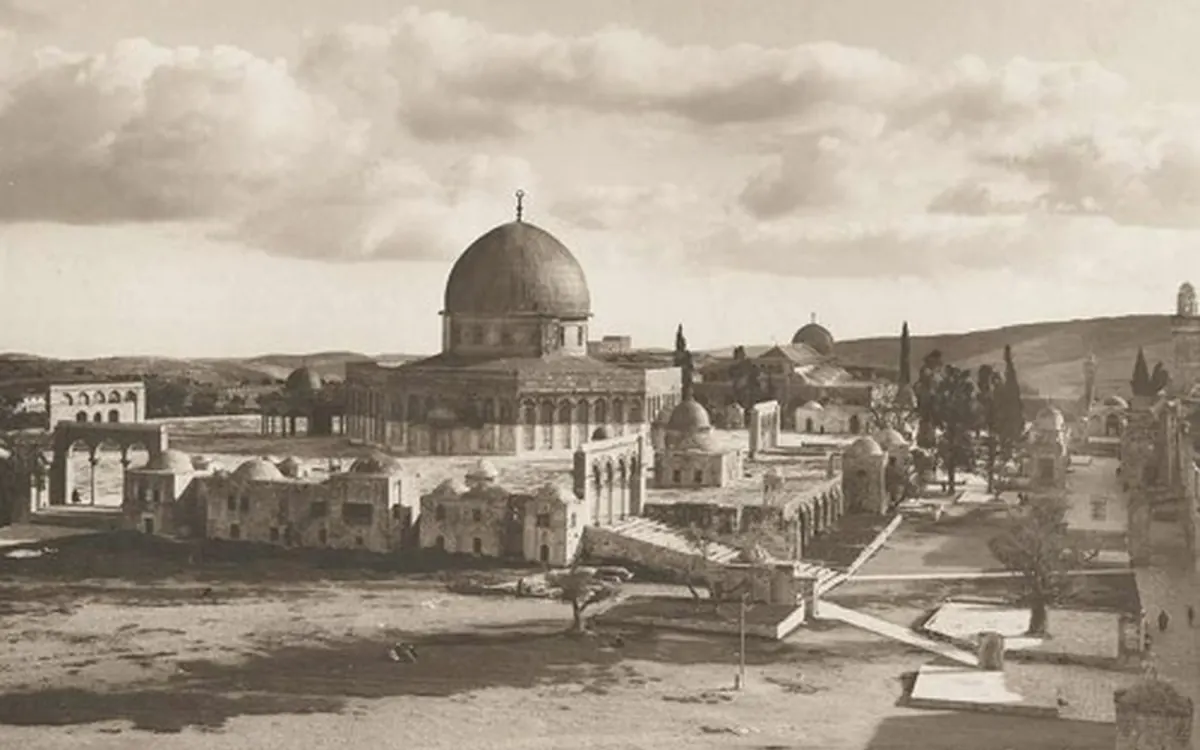
Every tale has a point around which it revolves, and for the Jewish Story that is the Temple Mount. Here is the opening round in a new series tracing the way in which the sacred mountain in the middle of Jerusalem is still at the center of our story.
About this episode
History gives answers only to those who know how to ask, said Hajo Holborn, and if ever a story had a hinge point it is the temple in the Jewish story. Rav Mike rests the telling on a claim about the mission of Am Yisrael, to maintain the connection between shamayim and aretz, heaven and earth. Aretz is manifest reality, the dirt that gives life and the society and concreteness that lets anything actually be, while shamayim is the limitless horizon, the infinite possible, the endless not yet that underlies everything. The Jewish task is to be a channel linking that well of possibility to the specificity of creation, and every story needs place, time and person, what Torah calls Ashan, olam, shana, neshama, world, year and soul.
Heaven and earth meet in time through Shabbat, unbounded rest once in seven days, holiness coming first to time when God blessed the seventh day. They meet in the person through the strivings of Am Yisrael, a kingdom of ministers tasked to serve creation on behalf of God. And they meet in place, the narrowest dimension because it is bounded by its specificity, which is exactly what gives place its power. Deuteronomy speaks more than a dozen times of the place God will choose, in the future tense, yivchar, a place that must be kept desirable as a channel for the infinite, and one with enough gravity that it draws the Jews to seek it, to come there and seek God's dwelling. That is the role of the Temple Mount as the pivot of the story.
Rav Mike calls the Mount the oldest colonial tale in history, with the Jews cast as colonized rather than colonizers, its layers running down through Persians, Greeks, Romans, Arabs, Crusaders and Turks to the rock where Abraham bound Isaac. When Caliph Omar reached Jerusalem in the seventh century, Herod's platform was a trash heap the Byzantines kept lowly as a sign that the church now held the keys. Muslim tradition tells of Kab al-Ahbar, a Jewish convert who traveled with Omar and helped locate the foundation stone, and so it was a Jewish compass that placed the Dome of the Rock and Al-Aqsa atop the Mount, the same spiritual true north around which the earliest practical dreams of return would revolve.
Rav Zvi Hirsch Kalischer, among the heralds of Zion, devoted much of his 1862 Drishat Zion to whether Jews could offer sacrifices on the Mount even before the temple was rebuilt, and wrote to Baron Rothschild urging him to purchase the site from the Ottoman ruler so a government of Israel might rise. The Zionist movement born in Basel shared his urgency while lacking his spirit, a pragmatic secular nationalism, and Herzl's imagined temple sat elsewhere while the Dome of the Rock stayed as a skyline item. This vagueness among Zionists stood against the oldest libel of Arab nationalism, that the Jews were threatening to storm the Mount, a lie embodied by Haj Amin al-Husseini, Grand Mufti of Jerusalem, who raised funds and fears across the Muslim world.
Al-Husseini's claim welded the struggle over the Mount into the base of the conflict, reaching a crescendo in the riots and Hebron massacre of 1929, triggered by a mere mechitza at the Kotel, despite Jewish letters swearing no intent to infringe Muslim rights. The issue receded under the questions of military power until 1967, when Rav Shlomo Goren blew the shofar at the Western Wall and called at once to close the Mount to all and place it under the rabbinate, warnings that went unheeded as Moshe Dayan retreated and handed religious control to the Waf. Gershon Solomon, run over by a Syrian tank and crying Shema as the enemy fled from angels only they could see, took an oath inside the Dome of the Rock and founded the Temple Mount Faithful.
Key ideas
- The temple is the hinge point of the Jewish story, and the mission of Am Yisrael is to connect shamayim and aretz, heaven and earth.
- Heaven and earth meet in time through Shabbat, in the person through Am Yisrael, and in place through the Temple Mount.
- Deuteronomy's place God will choose is in the future tense, a channel that must be kept desirable and sought.
- The Mount is the oldest colonial tale, with the Jews colonized, and a Jewish convert's compass placed the Dome of the Rock.
- Kalischer urged Rothschild to buy the Mount, while Herzl's Zionism shared the urgency and lacked the spirit.
- Al-Husseini's Al-Aqsa libel welded the struggle over the Mount into the base of the conflict, and Dayan's 1967 retreat set the status quo.
Chapters
- 0:00 Holborn; the hinge point
- 2:09 The mission; connecting heaven and earth
- 4:38 Ashan; world, year and soul
- 8:00 Holiness in place; the place God will choose
- 10:18 Yivchar; the future tense
- 13:31 The oldest colonial tale; the layers
- 14:36 Omar; the trash heap; Kab al-Ahbar
- 17:52 Rav Kalischer; Drishat Zion
- 18:57 The letter to Rothschild
- 20:01 Herzl; the temple elsewhere
- 21:09 Al-Husseini; the Al-Aqsa libel
- 24:22 The 1929 riots; the libel works
- 27:40 1967; Rav Goren's shofar
- 29:48 Rav Goren's unheeded warnings
- 30:54 Dayan's retreat; the status quo
- 37:39 Gershon Solomon; the tank; Shema
- 42:04 The oath; the Temple Mount Faithful
Who, where and when
People
Hajo Holborn, Caliph Omar, Kab al-Ahbar, Zvi Hirsch Kalischer, Baron Rothschild, Theodor Herzl, Haj Amin al-Husseini, Shlomo Goren, Moshe Dayan, Gershon Solomon
Places
The Temple Mount, Jerusalem, Hebron, Basel
Texts
Deuteronomy on the place God will choose, Drishat Zion, Altneuland
When
7th century CE: Omar takes Jerusalem, 1862 CE: Drishat Zion, 1929 CE: the riots and Hebron massacre, 1967 CE: the Six-Day War and Dayan's status quo
Read the transcript
History, said Ha-Ho-Helborn, gives answers only to those who know how to ask questions. Well, Lord, I only really have one question. What the? I'm Rav Mike Foyer, and this is The Jewish Story. Season 6, Episode 17, The Temple Mount, Part 1, The Hinge Point. If ever a story had a hinge point, it is the temple in the Jewish story. Our history, our sacred mythology, and ideally our daily practice as Jews all revolve around this one place. And some of the circles that these describe span millennia. In light of this season's goal, to point at something in today's world which is currently shaping the story, and traces origins at least as far back as where we left off in the linear narrative in the 80s, it is time now to talk about the mountain at the heart of Jerusalem.
And that's good, because that purpose of picking something in the present and telling its backstory is to shed light on what's happening, how we got here, and perhaps a little bit about where we're headed. And there's no question that the sacred geography of the Temple Mount has always played a pivotal role in the past, and increasingly so in the present, and likely to be the future. The challenge in telling the story of the Temple Mount is that it plays out on planes from the cosmic to the political, and in the current moment, it's driven by conflicts both within Am Yisrael and between Israel and the nations. Increasingly high-stakes conflicts, I might add. And long ago, in season three, I shared with you my memories of looking out at the old city from the Tayelet, that walkway there in Talpio, back when I was in college, and joking with my friends that whether you believe in God or not, the Dome of the Rock was like a giant golden button that said, push here for Armageddon.
Now, our laughter then had a little touch of fear. And just to throw some current tears and frustration into the mix, I'm going to add the observation, a simple political statement, that so long as a building other than the temple sits on the mount, the world will see Jerusalem as an occupied city. Before I dive too quickly into building a narrative, which is in any way is going to be wise or productive, I need to speak out some of how I understand the essential topography underlying the story. And I want to rest that topographic exploration on an assertion, an assertion about the mission of Am Yisrael, indeed the reason for our existence. And that is that we're here to maintain the connection between Shemaim and the Arez.
Now, Arez is easily translated as land or even the earth. It represents manifest reality, whether we mean that literally as the earthy reality of dirt that gives us life, or the social reality that gives us human society, or the conceptual reality that things require concrete expression in order to actually be something. Art is that which is. And it's no mystery that without ground to spring from, no story ever gets started. So, Shemaim presents a greater challenge to our understanding. If I translate it as heaven or even heavens, it's both vague and baggage laden. So, let me offer a different working definition of the limitless horizon. That's in the sense of the sky is the limit. Shemaim has the infinite possible, that endless not yet which underlies everything.
Because, you know, there's an unbounded potentiality which finds expression in existence in Aret, but is by no means exhausted by it. And the very belief in that potential is what gives hope to generate greater life. The Jewish mission is to connect Shemaim v'aret, to be a channel which links that well of possibility to the specificity of creation as we live it, wherever and whenever we are. Now, it's also a truism that every storyteller knows, that a story has to have three things, place, time, and person. They all tell a tale of somebody who did something somewhere and some when. And the divine story, which Am Yisrael is tasked to tell, is no different. In Torah, we call this three-dimensional narrative framework Ashan.
It's an acronym for Olam, Shana, Neshama, the world, year or time, and Sol, meaning character. And the driving theme of the Jewish story to connect heaven and earth has an ideal expression in all three dimensions as you can imagine. First comes first, let's start with time. where the infinite meets the work of day world through Shabbat. I mean, what greater expression could there be of the boundless potential of time than unbounded rest? It's a time of recreation, once every seven days, one which breathes life and meaning into the entire work week. If you don't indulge in the Holy Sabbath, I highly encourage you to do so. And we call it the Holy Sabbath because holiness comes first to time in the divine story.
when God blessed the seventh day and declared it holy. And by the way, the nature of kedushah, of holiness, sanctity, its quality as both a means to and expression of that connection between heaven and earth is much of the substance in the story ahead. Now when it comes to the second dimension of nishama, of person or character, heaven and earth are connected through the strivings of Am Yisrael. Now ultimately, of course, this is a human, universal quality. But in terms of focused mission, the Jewish story has a unique role to play in keeping heaven and earth together. And I'm not going to dive into Hasbro memes about the number of Jewish Nobel Prize winners, but I hope you'll agree that history has well demonstrated that Jews are a people of unique potential.
Holiness in the human dimension finds expression in Mamlechot Kohanim V'Goi Kadosh, that kingdom of priests and holy nation, or kingdom of ministers, I might better say, that Israel was tasked with being right before standing at Sinai. And I say minister because it carries the connotation of service. We were chosen to serve creation on behalf of God, and God on behalf of creation, and by doing so to make ourselves and the world just a little bit holier. And that brings me, after Shana and Neshama, back to the Olam, back to the world. The third dimension in which heaven and earth connect and holiness finds expression. Space, the final frontier. Now, this is, at least at first glance, the narrowest dimension of any story, insofar as it's bounded by its specificity.
I mean, two objects can't occupy the same space. A place is either here or there. It's defined by its boundaries. And that very specificity is what gives place its power. Now, how exactly will the infinite find expression in that which appears to be such a limited, finite medium? I mean, isn't place all aretzol, the ground and no shamayim? I mean, isn't it just what is? Well, interestingly enough, we can look to the book of Davarim for some insight on this question, if not, for a complete answer. You know, Israel has only one home, one place for true divine service. And while Davarim is speaking from the perspective of a nation camped around the Mishkan, the tabernacle, that portable version of the home of divine service.
It's speaking about what will be when the tribes come into their lasting inheritance after they cross the River Jordan. Now, on the heels of a command to destroy idolatry from the land, they are told not to adopt the old sacred places, but rather to gather, To that place which the Lord your God will choose from amongst all your tribes to place God's name there. You know, that phrase, the place which God will choose, is actually repeated more than a dozen times in the book of Davarim, Deuteronomy. they say Jerusalem has 70 names and I myself actually in my research have identified dozens more than that, you can send me an email if you want, I'll send you back a link of my Jerusalem garden project you can see it with your own eyes but this name, the place which God will choose, characterizes the book of the Torah which is all about leaving the state of spiritual potentiality that we gained in the wilderness in order to manifest in a society within the land.
It's all about connecting shamayim baaretz, the potential and the actual baaretz in the land, as it were. The key to understanding how the infinite finds expression in the spatial dimension is half in that future tense of the verb yivchar. This is the place God will choose, not the one which God has chosen. It has to be kept desirable and it needs to be a source of blessing as a channel for the infinite potentiality of that which is not yet in the physical world of food, shelter, and history. And, ideally, ultimately, someday it will be chosen as the cornerstone for a world still unbuilt, but not quite undraft. Now the other half to understanding how a specific spot on Earth could possibly connect But, Shamaim, the Arez, is in the second part of the verse that I quoted, which I actually didn't say.
The location of the permanent home isn't just a place which God will choose, and thus one which must be maintained as desirable for the dwelling of the Divine Name. The end of the verse reads, V'hishikno t'droshu uvata shama. You shall seek God dwelling and come there It has to be a place with enough gravity that it draws the Jews into seeking it It never quite settled And that brings us back to the role of Temple Mount as pivot in the Jewish story. I mean, certainly since the destruction of that place which God will choose during the Roman Jewish wars, the Jews have been seeking that center in our exile. We've been keeping time connected to heaven and earth through the Holy Shabbos, which has definitely kept us as much as we've kept it.
And we've been surviving amongst the nations, like a sheep among the 70 wolves, as our sages pointed to, as proof of the ongoing connection between the divine and the human story. And we've been turning to pray, longing to return to that center point where we can bring Shemaim Ba'ars together in the physical world. By the way, longing right up until it actually became possible, apparently. Now, don't worry. I'm not going to review 2,000 Years of Exile just to tell a good story about the 80s. And in fact, I doubt I'll even reach the 80s today. If you want that kind of lead up, go binge Seasons 1, 2, and 3. It is nonetheless worthwhile to recall at least a little bit about that subtle messianic spark and profound irony, which exists in how the Temple Mount was saved from being lost to the obscurity of time, because it was at the hands of Islam, guided by an apostate Jew.
Metaphysics and mythic narrative frameworks aside, The Temple Mount stands at the center of the Jewish story as the oldest colonial tale in history. Now, don't get your hackles up when I say colonial, because contrary to popular present opinion, in that story we play colonized and not colonizers. Just like geology, archaeology reveals its truths in layers. And were we to find an undisturbed environment atop the Temple Mount, a sad impossibility by the way, The archaeological terrorism being done in service of the 21st century's hottest replacement theory for the Jews is going to be a topic for a coming episode. But were we to find an undisturbed environment? Just imagine, we could peel back the layers on top, all the way down to that rock on which Abraham bound Isaac.
It's said by our sages to be Evin Sh'tiah, the place from which the crust of creation began to harden. It would be surrounded, perhaps, by the last stones of Solomon's temple, buried in their destruction and thus left undisturbed by the following millennia. And even if you prefer to leave those tales in the realm of sacred myth, the documented ruins lay out a story of conquering empires which spans 2,500 years. Persians, Greeks, Romans, Persians, Arabs, Crusaders, Muslims and Turks oh my, all of them drawn in one way or another to this spot at the center of the sacred city built around the platform of Herod's temple its glory preserved by the Romans as a monument to their power the might of the Jewish national life that they crush left as proof of the might of the empire but Rome ebbed too in its day And when the armies of Islam reached Jerusalem under Caliph Omar in the early 7th century, Herod's glorious platform was a growing trash heap in a neglected quarter of the city.
The Byzantines, Christian inheritors of that pagan empire, had made the spot into a geographic parallel to the lowly social state in which they kept the Jews, a reminder that neither the people nor the temple connected heaven and earth any longer. The church, they said, had taken over that role. They now held the keys. In part, Omar's recovery of the Temple Mount as a platform for what the Muslims came to call their third holiest site, let's just call it the bronze medal, shall we, was simply an obvious move in his worldview. In many places that Islam conquered, they built masque on top of almost anything the locals considered to be sacred ground, just as their prophet had taken the holy place of the Meccans and transformed it into the center of his religion.
But Muslim tradition tells a fascinating other story about another player involved in the initial Islamic attachment to the Temple Mount. Recorded in fragments and hints, present mostly in extra-canonical collections, told in popular religious literature like the stories of the prophets and referenced by the biographies of the founders of Islam, you will find the story of Kab A'Akbar, a Jewish convert to Islam in the generation after Muhammad, who traveled with Omar in his conquest of Jerusalem. Now, some say Kab was a rabbi, and at least one tradition accused him of bringing Jewish myths into the heart of Islam. He's credited with helping Omar identify the location of the foundation stone, which lay at the heart of the Temple Mount, buried under the rubble of the Roman Temple to Jupiter and the trash of Christian centuries.
There are some even who claim that Qab wanted Omar to place the place of prayer to the north of that rock, going through Makoma Migdash, the location of the temple, and facing south toward Mecca. Now perhaps this was just meant to be an expression of the role Jerusalem had originally played as the Qibla, the direction for Muslim prayer. in the brief period before Muhammad conquered Mecca, or maybe it's an anecdote meant to support Qab's Judaizing tendencies. Either way, it was the Jewish compass that placed the Dome of the Rock and the Al-Aqsa Mosque atop the Temple Mount. It was that same sense of spiritual true north around which some of the earliest dreams of return to Zion continued to revolve.
Now, I should say earliest practical dreams because, of course, Jews had been dreaming, turning toward the Temple Mount in prayer, singing L'Shanah Haba'ah B'Yerushalayim H'Abinuya in the coming year in a rebuilt Jerusalem at our highest spiritual moment annually, and, of course, mourning the loss of the Temple for 2,000 years when Zionism began to awaken. Rav Svi Hersh Kalischer is considered to be amongst the earliest of what we call the heralds of Zion, the generation of dreamers and idealists whose thought began to point the way for the practical work of the Zionist movement which followed. You can go back to Season 2, Episode 20, for a review of this revolutionary era, or send me an email, robmikefoyer, gmail.com.
I'll even share with you a live series I gave not too long ago about the heralds of Zion. For now, just know, there was a very specific longing, a familiar one, in fact, at the heart of Rav Kalischer's Dreams of Zion. Much of his great 1862 work, Drishat Zion, the seeking of Zion, is devoted to an analysis of whether the Jews could offer sacrifices on the Temple Mount even before the Mikdash itself was built. Spoiler alert in case you can read the book, his conclusion was yes. And Rav Kalischer even wrote to the great philanthropist and banker, Baron Rothschild, beloved of anti-Semitic theories, to suggest he purchased the Temple Mount from Ibrahim Tha, the Ottoman official who is currently controlling the land of Israel.
He wrote, we have been fortunate to live during a time when God has sent to the Jewish people a great man like yourself who stands before kings. Flattery will get you nowhere, right? At this time, he goes on to say, when the land of Israel is under the rule of the Fah regime, if my Lord would purchase this area that is small in quantity but large in quality, when the leaders of Israel will gather on the Holy Land, a government of Israel will rise. And if Fah doesn't wish to sell the entire land, let him sell just the site of the temple and its environs, so we can bring offerings to Hashem our God. Like all the heralds of Zion, Rav Kalischer sensed the urgency of history, and he believed that a return to sacred center and to the divine service commanded atop the temple mount could trigger a mass return of the Jews to their home.
Now unfortunately, the Zionist movement born in Basel, 35 years after the publication of Rishat Sion, shared Rav Kalasher's sense of urgency, but not his sense of spirit. Theirs was a pragmatic and almost entirely secular nationalism, which, even as it inherited the momentum of Jewish history, which, in a sense, revolves around the temple, was far from considering the recovery of the physical Temple Mount as some sort of Archimedian point in the process of Jewish salvation. Herzl did write of the rebuilt temple in his visionary work, Ulf Neuland, but it wasn't even located on the Temple Mount. The Dome of the Rock was left there as an iconic Jerusalem skyline item, and his temple was elsewhere basically a modern Orthodox shul of his day, high society exclusive, of course.
This attitude toward the temple amongst early Zionist leaders, either vague symbolic importance or even downright dismissal, stood in stark contrast to how early Arab nationalist leaders framed the Jewish return. The oldest and most volatile libel against the Zionist movement is that the Jews are threatening to storm the Temple Mount. Now, in recent years, we've seen the results of this lie. Sieges between police and Muslim rioters in the Al-Aqsa Mosque almost annually. Rockets fired on Jerusalem, even at least one full-scale incursion into Gaza triggered. The sad irony of this lie is that it couldn't actually be further from the truth, even though from the arc of Jewish history, it should be. Because when Ezra and Nehemiah and Zerubel led the first return, their essential goal was to rebuild the temple.
And their Persian province of Yahud wasn't much more than Jerusalem and its surroundings. the fight for the temple was the driver of the Maccabean revolt and it sat at both the religious and political center of the Judean state that the Hasmonean kingdom built and which Herod inherited even after the destruction the Kohanim at their service the Levim and their song and Am Yisrael gathered in the temple courtyards was a sustaining image for the Jews in 2,000 years of exile from that perspective It was the territorial political focus of the secular Zionists which was an aberration of history not the spiritual religious dreams of people like Rav Kalasher Now despite Zionist al non in the Temple Mount the accusation that the Jews were threatening the Al-Aqsa Mosque played a formative role in the development of Palestinian nationalism.
And there is no personality who illustrates that process better than Haj Amin al-Husseini, Grand Mufti of Jerusalem in the 1920s, founding figure of Palestinian nationalism, Nazi collaborator, and arch-opponent of Jewish return. The Temple Mount and the shrines atop it had been deeply neglected during the Turkish period, much like everything else in Jerusalem. And once appointed Grand Mufti in 1921, al-Husseini took it upon himself to change that. Now beyond any question of real religious sentiment and the desire to elevate his personal profile, the Mufti realized the potential of such a project to draw the eyes of Muslims from around the world toward Jerusalem and thus toward the budding Palestinian national struggle.
By 1924, al-Husseini's emissaries had gathered almost 90,000 pounds sterling. That's a lot of money in the day. And more importantly, they captured the imagination of millions of the devout. Wherever they traveled, these emissaries not only extolled the importance of the Dome of the Rock and Al-Aqsa Mosque as Islamic shrines, they also carried documents proving the danger posed to them by the Jews. In an odd twist of history, many of these so-called proofs were actually the product of Jewish fundraising efforts by institutions in Jerusalem, whether old-school Torah institutions like the Yitzchayim Yeshiva or newer Zionist materials. Most, of course, included pictures of the Al-Aqsa Mosque or the Dome of the Rock as iconic Jerusalem images, and all were adorned with Jewish symbols like the Stars of David, thus making it relatively easy to indicate that the Jews were looking to replace Islam on the Mount.
In fact, Al-Husseini himself preached at every opportunity that, quote, Zionism is both a religious and a political Jewish idea, and that amongst its goals were, quote, the rebuilding of the temple that is called Solomon's Temple in place of the blessed Al-Aqsa Mosque and the conducting of religious worship in it. You know, it's truly unfortunate that while his words would have fallen flat with almost any actual Zionist of his day, the Muslims ate them up. And gradually, it became a truism amongst many Arabs of the British mandate in Palestine that the Al-Aqsa Mosque was under real threat. Back in Season 2 to Episode 30, I told the story of the rising violence of the 1920s and how it reached a crescendo with the riots and Hevron massacre of 1929.
Those bloody events were triggered by the Jews' desire to put a mechitza at the Kotel. Some things never change, right? Something which the Grand Mufti claimed was the opening move in their ultimate plot to storm the Temple Mount. Now that claim gathered momentum despite the words of the National Committee of the Jews of the Land of Israel, who published an open letter in hopes of dispelling the libel and calming the fears of their fellow Arab residents. This may sound vaguely familiar. We hereby announced, honestly and sincerely, that no one from Israel has any intention of infringing the rights of Muslims to the places that are holy to them. However, our Arab brothers must also recognize the rights that Israel has in this land to our own places.
Any attempt to describe the desire of the Jews to pray at this holy place, the Western Wall Plaza, notice not the Temple Mount, in peace with respect and without restriction, as the creation of a strategic base for an attack on the mosque of the Muslims, is nothing but the fruit of a fevered imagination or a malicious libel. The aim of this libel is to sow tumult and confusion in the hearts and arouse animosity and conflict between different peoples. Well, it worked. Jewish protestations of innocence dented the power of that lie that al-Aqsa is under threat? Not at all, much as they fail to do so today. The 1929 riots may not have been exactly the ground zero of the Arab-Israeli conflict, as some historians would like to label it, but it was unquestionably a formative moment, one which welded the struggle over the Temple Mount into the base of the conflict between Arabs and Jews in the land of Israel.
But often the issues at the base of a conflict are covered over by the layers of subsequent events, particularly if they prove to be bloody ones. The violence unleashed in the 20s rose through the 30s and 40s into a full-scale intercommutal combat until, with Israel's independence in 1948, it officially became a war. And the role of the temple receded as questions of military power and territorial control took center stage. But the issue is still there, just below the surface, but at the base. And it had to wait for the messianic revolutionary events of 1967 for a conflict over history, theology, and even truth itself to be added for the territorial struggle and for the Temple Mount to re-emerge at the center.
I am speaking to you from the plaza of the Western Wall, the remnant of our holy temple. Nahmu, nahmu, ami, comfort, comfort my people, says the Lord your God. This is the day we've hoped for. Let us rejoice and be glad in his salvation. The vision of all generations is being realized before our eyes. The city of God, the site of the temple, the temple mount, the western wall, the symbol of the nation's redemption have been redeemed today by you, heroes of the Israel Defense Forces. By so doing, you have fulfilled the oath of generations. If I forget the old Jerusalem, may my right hand forget its cunning. Indeed, we have not forgotten you, Jerusalem, our holy city, our glory. In the name of the entire Jewish people in Israel and the diaspora, I hereby recite with supreme joy, Blessed are you, O Lord, our God, King of the universe, She'echiano, the Ki'amano, the Higiano, the Hizman Haze, who has kept us in life, preserved us, and enabled us to reach this day, this year, in Jerusalem rebuilt.
Those are the words spoken by Rabbi Shlomo Gorin, General and Chief Rabbi of the IDF, just before his famous blowing of the shofar at the Western Wall. Now, Rav Gorin's messianic excitement in the moment is well known, but many people are unaware that he was quick to make policy recommendations in the wake of this historic event, and not shy to establish some facts on the ground either. Rav Gorin called on the Prime Minister to place the Temple Mount immediately under the jurisdiction of the Chief Rabbinate, as was the case with all Jewish holy sites within the State of Israel. He further insisted that, as it was halakhally forbidden, For Jew and non-Jew alike to enter a large part of the platform, it should be closed immediately to all people, and done so before the military curfew over Jerusalem as a whole was lifted.
Now is the time when, quote, the Arabs are in a state of shock, and their only hope is to stay alive and not be massacred, to establish a new status quo which changes exclusive Muslim rule on the mount. Later warned Rav Gorin, It will not be possible to do anything. It was a fateful warning, but one which went unheeded. Instead, on the first Shabbat after the war, Defense Minister Moshe Dayan descended the mount to meet with Sheikh Abdul Hamid Sayyid, Chief Muslim Judge, along with the Mufti of Jerusalem, the Gardening of the Mosque compound, and other Islamic leaders. And what followed set the pattern for the conflict which we are playing out in Israel today. I mean, truth is, Dayan had already begun his retreat from the Temple Mount days before.
When paratroop commander Matagor announced his famous, Har Habayit Biya Deinu, right, the Temple Mount is in our hands over his radio, he wasn't just making a report to his superiors, he was asserting a historic claim. And that's why Ghor allowed his men to run an Israeli flag up the Dome of the Rock, flying the Star of David above the Crescent, which topped the Dome. And that's also why, when Defense Minister Moshe Dayan saw that flag floating in the breeze through his binoculars from his observation post on Mount Scopus, he immediately radioed Gore to order it to be lowered. Do you want to set the Middle East on fire, he said? So Dayan's ascent to the Temple Mount to speak with Muslim leaders, his insistence that his soldiers leave both guns and shoes outside of the mosque, were basically a foregone conclusion.
As was the deal which he struck, the so-called status quo, which has somehow maintained its status as sacred, even though what he did has become a complete and absolute falsehood. Let me explain. There are two sides to this so-called status quo. Dayan asked that religious services be resumed, promised that Israeli soldiers would be repositioned outside of the compound, and insisted that Israel had, quote, no intention of controlling Muslim holy places or interfering in their religious life. He also told the assembled leaders that he had no intention of continuing the longstanding Jordanian practice of censoring the Friday Sermon, a sermon which drew thousands and was broadcast to 10,000 more before it was delivered.
And what was the flip side? What did Moshe Dayan expect to receive in return? Well, of course, the imams wouldn't take advantage of such freedom to indulge in excitement, and that there would be freedom of access for the Jews to the Temple Mount. It was inconceivable, he said, quote, for Jews not to be able freely to visit this holy place now that Jerusalem was under our rule. Well, if you read the news, you may have noticed it didn't quite play out that way. Service has indeed resumed. I mean, tens of thousands every Friday during Ramadan. And Muslim religious control over the mount has not only been restored, it has been assured. But the Jews are 0 for 2 when it comes to the other side of Dayan bargain Access for non on the Mount is severely restricted and so far from free that a Jew who mumbles or bows will certainly be harassed likely ejected, and possibly arrested for disturbing the peace.
As for the Friday servant, uncensored to this day, here's a little taste from Sheikh Omar Abu Sara, delivered just before he was finally arrested for incitement when his words made it into the Israeli media. I say to the Jews loud and clear, the time for your slaughter has come. The time to fight you has come. The time to kill you has come. Please do not leave in our hearts a single grain of mercy toward you, O Jews, because when the day of your slaughter arrives, we shall slaughter you without mercy. Jews are our people, but God made them monkeys and pigs. That's not really a violation of the status quo. It's important to note that though he was defense minister, Moshe Dayan made the decision to retreat from the mount and cut this deal without any cabinet meeting or governmental authorization.
It was his personal decision, carried by his immense popularity in the wake of the victory of the Six-Day War, and by the support of almost all of Israel's religious authorities. It's crucial to understand this last piece because it articulates so much of the story that lies ahead. Now, nominally, the religious establishment supported a ban on Jewish prayer and even significant Jewish presence on the Temple Mount because of the concern lest a Jew should trespass the forbidden places. But if that were really the case, why didn't they back Rav Gorin's insistence that it would be closed to all people? Remember, anywhere that was closed to a Jew is certainly closed to a non-Jew as well. There are many reasons I could offer for why the religious establishment, then and now, continue to support a ban, if not outright on Jewish presence, which many do, certainly on mass Jewish prayer.
Some of those reasons are legal halachic. There are definitely major, major halachic issues. Some are political, and some downright cynical power analyses. But for right now, I want to put that to a side and suggest that sometimes history comes at you so fast and so big that you're simply unprepared to receive it. I mean, think of the decisions that were being made in that moment. Mata Gorin made a snap decision, run up the Israeli flag. Rav Gorin said, establish my office on the mount. Moshe Dayan made just as quick a choice to retreat from that which he feared could not be controlled. And most of the religious world, I mean the Jews in general, but the religious world especially, simply stood there in shock.
I mean, how do you receive what you've been praying for for 2,000 years and what you actually have no idea what to do with? The sad truth of life and history is that they don't stop, no matter how big the events are that we encounter. And cataclysmic historical events like the Six-Day War can really be thought of as evolutionary watersheds. And that always poses tremendous opportunities and real dangers. Whatever it's going to be, it won't be what was. Except the action which survival in the face of such a moment demands, and the doubt which often comes with it, force many of us to go with behavioral choices that are based on what we already know, as opposed to what a new situation demands, even if those choices ultimately prove to be maladaptive to a new situation.
However, there are always a few seeds of a new world, birthed by any change of an evolutionary scale. It's just a question of whether their potential will bear fruit, and how long that process might take. Christian Solomon was born in Jerusalem in 1935, the tenth generation of his family, to live in the Holy City. And, like almost every man of his age, Gershon's life was shaped by war. First, in his childhood, when he survived the siege of Jerusalem, and then later as a man fighting for the state of Israel. As a young officer, Solomon was positioned as the commander of one of the commando units on the eastern edge of the Sea of Galilee, tasked with defending the kibbutzim and villages from Syrian attacks, which rained down regularly from the Golan Heights above.
And a little bit more than a year before the Six-Day War, his unit was overwhelmed by a massive Syrian incursion. Toward the end of the battle, which his soldiers won despite the odds, Solomon was actually run over by a tank in the night and horribly wounded. Later he recalled lying alone in the dark, in terrible pain, his legs paralyzed when he heard footsteps approaching. And he understood enough Arabic that he could hear the people speaking that they were coming to take revenge on the commander of the Israeli unit that had defeated him, who they were certain lay somewhere out there in the night. Now, rather than opening fire with the gun he still held, Solomon shut his eyes and cried out in his heart, Shema Yisrael, Adonai Eloheinu, Adonai Echad, Hero Israel, The Lord our God, the Lord is one.
the words spoken by many Jewish martyrs in history. And in that moment, he heard a voice respond within his heart. He says it was God telling him, don't hurry away. I'm not finished with you. And here I am calling you and dedicating you for a great, great major event, the rebuilding of the Holy Temple in Jerusalem. The dream of your childhood and young life will come to pass in your lifetime. and then he heard the Arab soldiers turn and flee. Later, his soldiers found him lying there unconscious in the darkness and after a year of pain surgery and recovery, including a platinum rod inserted into his spine, he indeed recovered. Now while Solomon lay there in the hospital, he was visited by UN observers tasked with writing a report about the ceasefire violation in which he'd nearly been killed.
And one of the Dutch members of the team lingered after the details were taken. He had something to say. We came, he said, to write the protocol of the battle, as we've already done the same with the Syrian officers who fought. However, with you, we must share something that will give you the strength and hope to overcome your severe injury. The Syrian officers shared with us that they came to take revenge against you and kill you. And when they came close to you, they could see by the light of the stars that illuminated you so brightly you were surrounded by angels. They became very afraid and full of fear started to run back to the Syrian mountains and into their bunkers. They felt like the angels were running after them.
Despite his severe injuries, Gershon Solomon was determined to serve and strengthened both by the divine mission he felt he had received and the UN observers who had unknowingly confirmed it. After a year, he was able to return to his unit, assisted by no more than a cane. And that's how it came to pass that he was amongst the precious few in Jewish history who participated in the liberation of the Temple Mount. Now, if you read the memoirs of those soldiers, some of whose stories have intersected my telling of the Jewish story before now, you'll find that whomever they were, not a one of them was left untouched by the power of that historic moment. Some were driven toward religion, some toward radical politics, but no one was ever the same.
And until the end of his life, Solomon recalled standing inside the Dome of Rock, built upon the Holy of Holies, and making an oath. I swore, he says before the God of Israel, that I would not be silent or rest into the mountain of the God of Israel is liberated and the third holy temple is built. I dedicated my entire life for God and for this most holy cause of my life. During these exciting moments in the Holy Temple Mount, I could hear sounds like Moshiach ben David, the messenger of God of Israel, knocking at the eastern gate of the Temple Mount, calling to his people Israel, Open for me the gate. I am here. When the war ended, Solomon, together with many of his fellow soldiers, witnessed with dismay Moshe Dayan's hasty retreat from the sacred high ground.
And he was equally shocked and saddened by the complicity of the religious leaders who fell and stepped behind him in banning Jewish prayer on the Temple Mount. But he'd survived worse. And he held the divine promise he'd received while lying wounded and half down on the battlefield, close in his heart. And so, together with some of his fellow soldiers who had also heard the divine call in that historic moment, Solomon founded an organization called the Temple Mount Faithful. We came here today on the day of the destruction, Tisha B'Av, the destruction of the First and the Second Temple. We shall go up to the Temple Mount to show our feelings toward this place, and to pray and to ask God and the people of Israel to have the courage to fulfill the will of God of the rebuilding of the Temple, of making the Temple Mount again a focus and a heart and the soul of the Jewish nation.
And it will come. In a short time, we shall see the accomplishment of all the desires of God and the prophets of Israel, the rebuilding of the temple, the becoming of Jerusalem, the real capital of Israel, and the promised land, all of it, the land of the Jewish and the Israeli people. Thank you. You may not have heard of them. Or if you have, you might be accustomed to think of them as the radical fringe, messianic extremists, as the media loves to say. And indeed, for most of our story, they will remain the radical fringe. And if I haven't quite brought us up to the 80s, I've at least made the bridge. And before I close, I want to say this. Just remember, as radical as the fringe may be, it's often those who swim against the stream of what we assume to be true that make history.
And that's a big part of the story to come. I just want to thank some folks. I want to thank all the folks who give their hard-earned money to make the show happen, to keep it free, widely available. I want to call on you to join them now. Go to my website, jewishstory.co, where you can see a button in the upper right-hand corner. Click on that. Get a little bit of per podcast support. Or send me an email, robmikeforger, gmail.com. Or find me on Facebook, robmikeforger. I'm happy to share with you the details of how you can make a one-time donation. I also want to thank the Land of Israel Network. That's thelandofisrael.com. They're building a center for global transcendence in the heart of the Judean Mountains.
I want to thank the Pardes Institute, pardes.org.il, for throwing the doors of the Beit Midrash open as wide as possible. And I want to thank you for listening. I'm Rav Mike Foyer, and this is The Jewish Story.
More from Season 6
TJS S6 interlude - Constitution Now!
Rav Mike Feuer calls for a constructive alternative to the current mass protests against judicial reform being debated in Israel's Knesset. Along the way he touches upon some...
Play Episode
TJS S6 interlude: The Crisis of Israeli Sovereignty
A live webinar on behalf of for Fuel For Truth: Israel Education & Advocacy Training, on "The Crisis of Israeli Sovereignty." First Rav Mike lays out his innovative...
Play Episode
TJS S6E18 Temple Mount part 2 - The Status Quo
Should Jews be allowed to pray on the Temple Mount? Or will it inflame Muslim sensitivities? Learn the history of this debate from the Six Day War in...
Play Episode