
TJS S6E18 Temple Mount part 2 - The Status Quo
Should Jews be allowed to pray on the Temple Mount? Or will it inflame Muslim sensitivities? Learn the history of this debate from the Six Day War in 1967 when General Moshe Dayan argued with Rabbi Shlomo Goren on the issue, to the fire started by Australian tourist Denis Michael Rohan, the shooting by Allan Goodman, through the 1980s up until the riots in 1990. Plus learn more about Zionist philosopher Shabtai Ben-Dov, radical activist Yehuda Etzion, Gershon Salomon and the Temple Mount Faithful. What Muslims call the Haram al-Sharif and Al Aqsa Mosque and what Jews call the Har HaBayit and Beit HaMikdash have ramifications for today's conflict.
About this episode
If you must break the law, said Julius Caesar, do it to seize power. Rav Mike turns to the legal layers over the Temple Mount, since law is power enforced in time and space, just like war. After 1967 Israel unified Jerusalem, first in fact and then in law, extending the municipal boundary and, in 1980, passing Basic Law Jerusalem, which declared the city the united capital and charged the state with protecting the holy places from desecration and guarding freedom of access and feelings. Freedom of religion here rests on layers reaching down to the British King's Order in Council of 1922, absolute freedom of conscience so long as public order and morals are upheld, and the word feelings is a mess to define and to enforce.
At the heart of the legal reality is justiciability, the question of what a court may decide, and on the holy places the court has been clear that freedom of access is guaranteed yet subject to the government rather than the court. The first battle came in Shabtai Ben Dov versus the Ministry of Religious Affairs in 1968, brought by a former Lehi fighter and messianic visionary horrified at the status quo that handed the Waf control under the Jordanian ministry. Ben Dov asserted the Jewish right to pray and sought to stop the Mount from becoming a mere tourist attraction, and though the court never denied the right, it dismissed the case as a threat to public order, meaning the Muslims are sure to riot, so the Jews cannot pray.
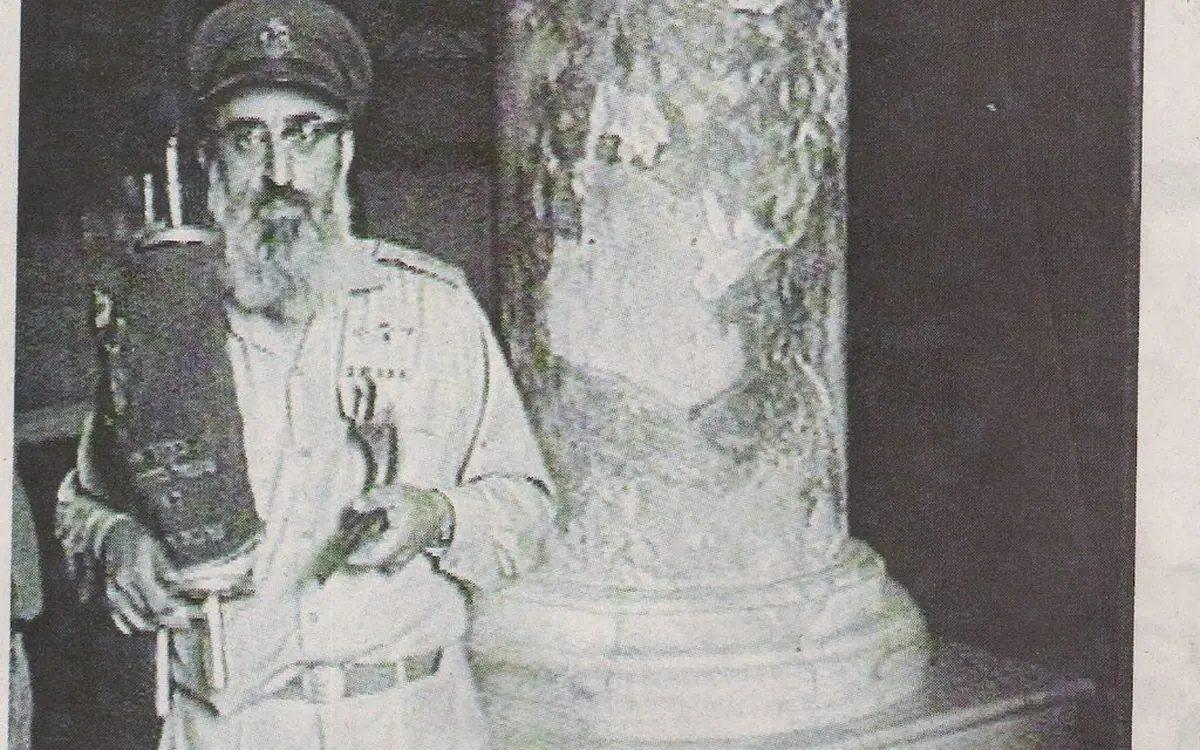
Facts on the ground shape reality more than law, which a photo of Rav Goren proves, taken on June 7, 1967 and published only in 2006, showing him with Torah and shofar inside the Dome of the Rock where the Holy of Holies is thought to have stood. The faithful received it as a Gilui Milta, since the mitzvah to conquer the land permits much, perhaps even entering a forbidden place in a time of war. It recalls Goren's demand to Dayan to clean the area, shut down as quickly as the flag the paratroopers had raised. The real step that secured Dayan's status quo came a day later, when Teddy Kollek, Ben-Gurion and the military razed the Mugrabi quarter to open the Kotel plaza, and the crowds came.
Through the eighties Rav Goren pressed on, reviving in 1983 an excavation toward the Second Temple foundation where he claimed a glimpse of the Ark before a brawl and six feet of concrete ended it, and convening in 1986 a conference of eighty rabbis where he unfurled an army map marking a shadow-free spot for a synagogue, and then conceded the big problem, the Dome of the Rock sat directly over the temple. Officialdom stood behind the status quo throughout, for order if not for ideology, which is why Rav Mike rejects the libel that Israel's forces aid a plot to storm the Mount, since those same forces secured it against every violent plot of the decade.
The violence ran both ways. In 1969 the Australian Christian Dennis Rohan torched Al-Aqsa believing God told him to build the temple, and the blame fell on the Jews. In 1982 Alan Goodman shot his way in wearing an IDF uniform, and in 1984 the Lifta Band was caught scaling the wall with explosives meant to bring the Messiah, every plot thwarted by the Israeli police. Gershon Solomon's Temple Mount Faithful kept to a lawful pantomime, requesting a prayer service, being denied, petitioning the High Court, and marching to the Mugrabi Gate to be turned back, closing with Hatikvah and thanks to the police. The 1990 Sukkot march, met at the height of the first intifada, ended in a riot that left seventeen Arabs dead, a turning point in the story.
Key ideas
- The legal layers over the Mount run from the British King's Order of 1922 to Basic Law Jerusalem of 1980 and its charge to guard access and feelings.
- On the holy places the court guarantees access but leaves control to the government, as it ruled in Ben Dov's 1968 case.
- The 1968 case was dismissed as a threat to public order, meaning the Muslims may riot so the Jews cannot pray.
- Rav Goren's hidden 1967 photo inside the Dome of the Rock became a Gilui Milta for the faithful.
- Dayan's status quo was secured the next day by razing the Mugrabi quarter to open the Kotel plaza.
- Every violent plot of the eighties was thwarted by Israeli forces, and the 1990 Sukkot riot left seventeen Arabs dead.
Chapters
- 0:00 Caesar; the legal layers
- 2:10 Basic Law Jerusalem; the holy places
- 4:31 Justiciability; government not court
- 5:36 Ben Dov versus the Ministry, 1968
- 8:48 The case dismissed; the Jews cannot pray
- 10:58 Facts on the ground; Goren's photo
- 12:02 Gilui Milta; the mitzvah to conquer
- 14:21 Kollek; razing the Mugrabi quarter
- 16:30 The Kotel plaza; the crowds come
- 19:42 Rav Goren in the eighties; the tunnel
- 21:54 The 1986 conference; the map
- 24:09 Standing behind the status quo
- 25:16 Dennis Rohan; the 1969 arson
- 27:40 Alan Goodman, 1982
- 30:54 The Lifta Band, 1984
- 33:04 The Faithful; the legal pantomime
- 36:25 The 1990 Sukkot march
- 39:42 The riot; seventeen dead
Who, where and when
People
Julius Caesar, Shabtai Ben Dov, Shlomo Goren, Moshe Dayan, Teddy Kollek, David Ben-Gurion, Dennis Rohan, Alan Goodman, Yehuda Etzion, Gershon Solomon
Places
The Temple Mount, East Jerusalem, The Mugrabi quarter, The Al-Aqsa Mosque
Texts
Basic Law Jerusalem, The King's Order in Council 1922, Israel's Redemption in the Crisis of the State
When
1922 CE: the King's Order in Council, 1968 CE: the Ben Dov lawsuit, 1969 CE: Rohan's arson, 1980 CE: Basic Law Jerusalem, 1990 CE: the Sukkot riots
Read the transcript
If you must break the law, said Julius Caesar, do it to seize power. In all other cases, observe it. Well, that's a dicey proposition. I'm Rav Mike Foyer, and this is the Jewish Story. Season 6, Episode 18, The Temple Mount, Part 2, The Status Quo. You know, with all my previous talk about metaphysics and history, it's the layers of the legal story overlaying the Temple Mount which are actually some of the most contorted by conflict. Law, after all, is power enforced in time and space, just like war. And hence the fact that from the human agency perspective, it's played a definitive role in creating the situation which we now see on the Temple Mount. Almost immediately after the conquest of Jerusalem, the state of Israel moved in to unify the city.
At first, this was just de facto, focused on security and daily life, by removing physical barriers between the east and western halves of the city, enforcing law and order throughout. But the de Uriah reality began with the expansion of the municipal boundaries to include another 70 or so square kilometers of freshly conquered territory. At first, the government denied that extending Israeli law into what was now called East Jerusalem amounted to political annexation, but within less than three years, the Supreme Court was treating the situation otherwise. I mean, after all, if you pick up the trash, police the streets, invest in infrastructure, then it's definitely one of those looks like a duck, walks like a duck, quacks like a duck situation.
I mean, even if the municipality didn't actually pick up the trash in many of the poor new eras, or police the streets particularly well, for that matter. In 1980, Menachem Begin's government passed Basic Law Jerusalem, Capital of Israel, declaring Jerusalem complete and united is the capital of Israel, and thus removing all distinctions in law, at least domestically speaking, because the world had refused to recognize Israel's sovereignty over the eastern half of Jerusalem since 1967, just like, by the way, it tried to reject its rule over the western half in 1948. To them, the Basic Law was only a provocation, and indeed, condemnation rained down from the nations of the world. This is actually when the UN Security Council passed its resolution calling on all countries to remove their embassies from Jerusalem, which we see slowly crumbling only today, and of course declaring Israel's Basic Law null and void.
But, for purposes of the present story, the significance of Basic Law Jerusalem is mostly domestic. It lays not its declaration of sovereignty, but actually in the labeling of one of the key responsibilities that comes with such power in the holy city in specific. The third clause of the law reads like follows. The holy places shall be protected from desecration and any other violation, and from anything likely to violate the freedom of access of the members of different religions to the places sacred to them, or their feelings toward those places. and this is where the legal story really gets sticky. I mean, freedom of religion in general has a venerable status in Israeli law because law, like archaeology and geology, happens in layers and at the base of this particular freedom lies section 83 of the King's Order in Council 1922.
That's about as old as western law gets around here. It reads, all people in Palestine will enjoy absolute freedom of conscience and may practice their form of worship undisturbed as long as public order and morals will be upheld. Also, anyone who reads the news knows by now that Israel's Declaration of Independence pledges to, quote, guarantee freedom of religion, conscience, language, education, and culture. Now, it's the nature of this issue to get complicated quickly. For the British, it was public order and morality. And in the basic law, Jerusalem, it was protecting both freedom of access and feelings. Now, those things are a mess when it comes both to defining them and thus enforcing them. By definition, acts that offend in a holy place or somehow limit your freedom would be permissible and perhaps protected in the mundane space.
like, I don't know, wearing Talit and Tefillin reading Torah if you're a woman perhaps or spitting on your fellow Jews at the heart of the legal reality on the Temple Mount is the question of what we call justiciability at the basis of any legal system there's a question of what questions a court can and cannot decide what lies in the purview of the court and what actually is a governmental issue for your information This is a big piece of the opposition to Israel's Supreme Court as currently constructed. There are no seeming bounds to what they deem in their purview, and thus to their power. But I digress, because in the case of the holy places, the court has actually been quite clear. Freedom of access to the holy places, and the protection of the sentiments around them, is indeed guaranteed under Israeli law.
But it's subject to governmental jurisdiction, not to the court. If a truly criminal matter comes up, they will hear it. But aside from that, the government is judge, jury, and executioner when it comes to the reality on the ground in any one of the holy places. And already back in 1967, the preservation of the holy places law had made the Minister of Religious Affairs the authority responsible for implementing all laws concerning those said holy places. And its passage actually provoked the first legal battle over the Jewish right to pray on the Temple Mount less than a year later, Shabtai Ben Dov versus the Ministry of Religious Affairs, 1968. Now, that name, Shabtai Ben Dov, may ring a bell, whether you happen to remember it from back in Season 5, or you just happen to be well-versed in radical Jewish national religious thought.
Ben Dove was a former Lechi fighter, polymath, and messianic visionary whose writings, amongst other things, inspired Yehuda Etzion's dreams of triggering the redemption by blowing up the Dome of the Rock in the late 70s. Now you can go back to Season 5, Episodes 12 and 13, for that story if you want, because only going to mention it briefly later. For now, just know that Ben Dove was past the age of battle when the Six-Day War broke out, working as a legal advisor to the Ministry of Trade and Industry, But his sense of imminent redemption was no less now than it had been as a Lehi fighter in the pre-state days, and certainly no less than Gershon Solomon's, whose story we told last episode. And Ben Dov was no less ready to fight for it, this time in the courts of the state of Israel.
Because, like so many of his compatriots, Ben Dov was horrified at the status quo that Dayan had declared on the Temple Mount, deeming an affront not only to Jewish history, but a barrier to its future unfolding. And by the time he brought his suit, that reality had coalesced quite clearly around the WAF, that group of local Muslim religious leaders, acting as an arm, by the way, of the Jordanian Ministry of Sacred Properties. They were managing the religious and civil affairs, while the Israeli police controlled security, both within the walled compound of the mount and around its perimeter, especially including, of course, the gates of entry. And despite Dayan's initial assistance that Jews would have freedom of worship at their holiest site, something which he deemed impossible to do without, the situation had already become one in which, as they say, Muslims come to pray, Jews come to visit, because Jewish prayer was already deemed a provocation and thus a danger to public security.
Now, Shabtai Bendov felt that the law was unquestionably unquestionably behind him when he asserted the Jewish right to prayer and in undermining Dayan's decision to place the waft in charge of the mount. His lawsuit demanded that the state return control, quote, to people whose interest is to guard it as a holy place for the members of the Jewish faith. Ideally, that would be the Ministry of Religious Affairs, the legal body vested with the authority to implement law in all holy places. Ben Dov wanted not only to guarantee the right of Jewish worship, as per all precedents under mandatory and Israeli law, but also to stop the Mount from becoming a mere tourist attraction, something which he really, deeply feared.
Sad to say that despite the clarity of his case, Shabtai Ben Dov did not succeed, neither on the legal nor the societal level. Now, the court didn't deny the fundamental Jewish right to pray, and in response to Ben Dov's challenge, the IDF actually took the keys in the Mugrabi gate away from the WAF, permitting free access, something which in the months after the war had not existed. Non-Muslims had been paying an entrance fee. But, bottom line, the situation on the Temple Mount was so new and so sensitive that the court deemed any real change, whether in status or freedom's exercise, to be a threat to both public order and the general security of the population, and thus it dismissed Ben Dove's case.
meaning the Muslims are sure to riot, so the Jews can't pray. And by the way, don't bother this court about your rights. You need to talk to the government about both your rights and your security when it comes to the holy places. Dayan's initial decision had been carried by his overwhelming popularity, and as I mentioned, swiftly supported by a halachic ban on Jewish entry from almost the entire rabbinic establishment. And now, less than a year later, the Supreme Court added the full force of law to the mix. Such a conjunction of state, rabbis, and high court is a rare beast, to say the least, in Israeli history, and it made the status quo on the Temple Mount seemingly unassailable. It was a situation that forced Bendov to draw a bitter conclusion as he wrote As for the official state of Israel the mosques on the Temple Mount the stinking markets where the Hasmonean palace once stood and all the like, represent no humiliation at all, but rather a decorative mantle of antiquities and a nice tourist attraction.
The state of Israel has nothing to do with destinies and temples, and believes it only convenient that it be left alone in the stagnation it finds ideal. but every idealist knows that there's more than one way to make reality happen everyone in Israel knows that law and politics are all well and good but nothing can shape a situation like facts on the ground which is why a picture of Rav Shlomo Gorin taken on June 7, 1967 but only published for the first time almost 40 years later in 2006 is worth way more than a thousand words. It shows Rav Gorin holding a Torah skull and shofar, but this isn't the iconic photo by the wall that we all know and love. In this shot, Rav Gorin is standing inside the Dome of the Rock, where he himself, not to mention most other religious authority, believed the Holy of Holies once stood.
And thus, he's standing in a place in which it was completely forbidden to be, except perhaps in a time of war. The photo's publication caused a little tempest in a teacup amongst the faithful of the Temple Mount, many of whom received it as what we call a Gilui Milta, an event that demonstrates an essential principle. Let me explain. There is a mitzvah, a commandment in the Torah, to conquer the land of Israel, according to most authorities. And in pursuit of repossessing all the land held by non-Jews, One is permitted many things, perhaps even to enter a place normally reserved for the high priest on Yom Kippur. I mention this now for two reasons, one general and one specific. In general, it's my opinion that we as a society need to recognize that we are at war and to act accordingly, or to somehow cease war, make peace, and lay down arms.
Because there are behaviors in war which are necessary, and perhaps even praiseworthy, which become forbidden in times of peace. It's the moral clarity of a real vision of victory that provides the weight to make distinctions about such questions. And if we continue to try and just keep a lid on the situation, mow the lawn, lower the flames, whatever metaphor you prefer, what I see happening is that we will find ourselves both engaged in morally corrosive acts, without a vision to guide us, and failing to take the decisive type of actions that war demands because we don't actually know what we're trying to do. That's the type of clarity that might, and I say might because Rav Gorn, of course, was dead by the time that photo was released, might have led the Rav to step decisively into a space where no man had gone before, or at least no Jew for 2,000 years.
Now that's the general. The specific reason I mention the picture in the course of the present story is that it serves as a visual emphasis, a proof perhaps, of Rav Gorin's legendary demand to Moshe Dayan made in the heat of the historic moment of conquest when he waved at the mosques and declared, clean this area up. Needless to say, Dayan shut the rabbi down just as quickly as he forced the paratroopers to lower the Israeli flag from atop the Dome of the Rock. Which is not to say, by the way, that the Israeli government had a general version to creating realities through facts on the ground. Just a specific one when it came to the Temple Mount. It's an often missed fact that the real step which ensured the success of Dayan's status quo decision occurred only one day after that photo of Rav Gorin was taken and only meters away from the mount.
Actually, where he took his more famous picture, and that stopped with both swift and merciless. Jerusalem mayor Teddy Kalik arrived in the Old City less than 24 hours after Muttagor and his paratroopers declared, Har Habait be a denu, that the Temple Mount is in our hands. Nonetheless, he and the other Zionist leaders with him had been raised on longing for the Kotel and not on dreams of rebuilding the Temple, and so it was to the wall that they went. Mehron Benvenisti was Kalik's advisor at the time, soon to be deputy mayor responsible for the new Arab residence of Unified Jerusalem, and he recalled how Ben-Gurion was with the party, and how the old man burst into tears when they finally saw the Kotel, demanding that a tile plaque which labeled as the Al-Burak Wall, in reference to Muhammad's winged steed of Islamic legend, be immediately removed.
Then, Ben-Gurion turned on Khalek, who was after all his protege, and asked how he wasn't embarrassed by the homes crowding the Kotel, some with their bathrooms built directly against its stones. We've only been here since yesterday, the mayor protested, and a consensus was quickly reached amongst politicians, advisors, and the senior military staff present that indeed something must be done now. The result was the raising of the entire Mugrabi, or Moroccan quarter, that abutted the wall, creating the space for the Kotel Plaza beloved by tourists from around the world today. It was a decision as swift, as consequential, and as officially unapproved as Moshe Dayan's handing over the keys of the Temple Mount to the Waf.
And in reality, both had the same purpose, whether they knew it or not. Dayan was looking to diffuse an unprecedented historical situation, and really rob it of its power. Externally, he wanted to avoid the type of victorious conquest which the Middle East knew so well, and in fact, which the Arabs expected. in order to keep his options open to hand back newly won territory in return for the peace deal that he would spend the rest of his life pursuing. Internally, meaning between the Jews, he hoped to maintain the wall between messianic religious hope and pragmatic nationalism that Zionism had erected, a wall so strong that many religious Zionist leaders had actually opposed liberating the old city to begin with.
Teddy Kallick and the military men who were with him shared both of those concerns. They also knew full well that the Jewish festival of Shavuot was less than a week away and that tens of thousands of Jews could be expected to stream into the newly liberated old city. The logical space for all those people to congregate would be the Temple Mount. Not only because that's where the Torah actually commands us to go on the pilgrimage festivals, but simply because it was the only place with enough open space to accommodate them all. Now, I really don't believe in what-iffing history, but I can't help to at least wonder what would have become of Dayan's status quo, of the Zionist project, and perhaps of the entire world if that gathering had been allowed to happen.
But, like I said, consciously or no, Kalech, Ben-Gurin, and the other decision makers present that day wanted to keep Zionist project on the track that they envisioned, forget where Jewish history was headed, and the Magrabi quarter seemed a small price to pay in their eyes. Before Prime Minister Levi Eshkol's government was even aware of what was happening, more than 100 houses were knocked down in the heart of the old city, and their residents displaced. Some accepted compensations, Others refused it, lest it appear to legitimize these facts on the ground, but all were gone, almost overnight. And by some estimates, 200,000 Jews streamed into the Old City in that first week, culminating on June 14th, the Shavuot Festival holiday, and without exception, they gathered joyously in the new Kotel Plaza, thus proving, by the way, if you build it, they will come.
In the following decades, as the status quo settled in, pun intended, the Temple Mount took on an almost bizarre status in the mind of Jews. The Dome of the Rock became definitive of the skyline of the capital of the Jewish people. The Mount itself, an exotic tourist attraction maybe? An abstract focus for religious thought? Or frankly, a weird irrelevancy? Which is not to say that it was entirely forgotten. even simply as a place for practical prayer. There were always the faithful who, like Shabtai Bendov and Gershon Solomon, struggled to assert Jewish sovereignty over our most holy site, or at least fought to get the government to enforce both ends of the bargain that Dayan had struck without anybody's approval.
By the 80s, when in theory this story is supposed to start, Rav Gorn had retired from his role as Chief Ashkenazi Rabbi of Israel, but the passion ignited by his moment in the Holy of Holies had in no way diminished. I mean, truth be told, Rav Shlomo Goran deserves a deep exploration of his own when it comes to the Jewish story, especially for those who want to understand the intersection between Torah and state, both potential and actual. But for present purposes, I just need to let you know that Rav Goran had devoted his considerable energy, vast intellect, and potential spiritual force to the reconciliation of the Torah and modern issues posed by our national rebirth as the State of Israel, and to a practical approach to the Temple Mount.
Now, since leading Tisha B'Av prayers on the Mount in August of 1967, without Moshe Dayan's knowledge, and frankly in defiance of his direct orders, Rav Goran had never lost his belief that it was possible to create facts on the holiest of ground. In the summer of 1983, he and Rabbi Huda Getz, Rabbi of the Kotel Western Wall, revived the excavation of a tunnel that was headed north from the Kotel under the Temple Mount. Their aim was to reach the foundation of the Second Temple. And in statements that they later made to the press both Rabbi Getz and Rabbi Gorin claimed to have seen the Ark of the Covenant But it must have been a brief glimpse because when Waf guards heard the digging they quickly sent some young men down to the entrances to discourage the work.
What resulted was an underground brawl between yeshiva students and Arab workers, one the police had to break up. And due to the complexity of law as it relates to holy sites, Rav Goetz might have actually been entirely within his jurisdiction as Rabbi of the Kotel. Nonetheless, the government quickly made the question irrelevant by sealing the Kotel side of the tunnel with six feet of concrete. By the way, that excavation became today's Kotel Tunnel Tours, and I'll mention the violence that accompanied its reopening when we get to the 90s next episode. For now, undeterred, Rav Goorn continued to call for the construction of a synagogue on the Mount throughout the 80s. In 86, he actually convened a conference on the question.
A group of 80 rabbis, activists, including then Sephardic Chief Rabbi Mordechai Eliyahu, debated the question from historical, religious, political perspectives. We must establish a place, a permanent place of prayer on the mount, Rob Korn told them. It is a desecration of God to enter the mount under the authority of an Arab guard, to enter without saying any holy words because Jews are afraid. The major practical halachic question at hand was where it would actually be permissible to gather Jews for prayer, a question which was largely put to rest when Rav Goran unfurled a map of the mount dated June 21, 1967, made by the Army Corps of Engineers at his order. I've never shown it to anyone, he said, and proceeded to lay out his answer to their halachic problem.
The only place that has absolutely no shadow of doubt is the self. There's room there for a synagogue that could hold a thousand people, he said. Maybe two thousand, chimed in another participant. After this stunning revelation, the conversation took on a decidedly practical bent. That is, until one journalist who'd been allowed to attend asked Rav Gorin the big elephant question in the room. What, he said, is the location of the possible third temple on that map. Rav Gorn looked down at his map, which clearly indicated that the Dome of Iraq had been built directly over the site of the second temple. It's a big problem, he replied. Of all the many lies thrown around in the media as part of the narrative war against the Jewish state, One that really makes me nuts is the repeated assertion that it's Israel's security forces who are aiding and abetting the plot to storm the Temple Mount.
Since Dayan's decision, officialdom in Israel, political, military, or otherwise, has stood solidly behind his status quo. If not for ideological reasons, at the very least in the interest of public order. which is why when Mayor Teddy Collick heard of Rob Gorin's conference on building a shul in Temple Mount he told the press the calm in Jerusalem is a direct result of the 1967 unity government decision not to alter the status of the rights of the various religious groups I only hope that the Prime Minister and the Chief Rabbinate won't change their minds on that now maybe what he's saying is true that the calm was all about that or maybe it was more like the status quo was a welding of a lid on a boiling pot, a short-term attempt to prevent a boil over which ignores the long-term explosive potential that it itself actually creates.
A potential that you could hear clearly in the words chosen by Sheikh Sa'ad al-Din al-Ami, head of the Supreme Muslim Council in Jerusalem, also in response to Rav Gorin's conference. He said, the Muslims will never permit any Jew to pray on Haram al-Sharif, which is what they call the Temple Mount, or any council to establish a synagogue in the area. The Muslims are prepared to die for this. I mean, truth be told, this dancing back and forth between the Messianic pull of the Mount and the threat of Muslim violence that pushed Jews away was nothing new in the 80s. Already back in 1969, Australian Christian Dennis Rohan had attempted to destroy the Al-Aqsa Mosque. He actually managed to torch much of the southern part of the structure, including a 12th century pulpit dedicated by Saladin upon his conquest of the Holy City.
And during the subsequent inquiry and trial, Rohan said that God had instructed him to build the new temple. Yep, he said, I lit the fire in the Al-Aqsa Mosque, he said. I am a descendant of the family of King David, and the Queen of England is a relative of mine. Three judges of the Jerusalem District Court officiated the trial of the Australian accused of setting fire to the El Aqsa Mosque. A member of a religious sect called the Church of God, Rowan is said to have admitted setting fire to the mosque. The fire nearly provoked a holy war against Israel. Now, despite his obvious madness, the blame for his act was placed squarely on the Jews. It was only the decision by the police forces not to use force to suppress the violent riots that followed his arson, at risk, by the way, to their own lives, and those are the firefighters who managed to put out the blaze that prevented a bloodbath.
My girlfriend, the first thing she said to me was, guess who'd set fire to the mosque? So I said, who? And she said it was the crazy Australian. Well, he went around telling everybody. When somebody, if somebody mentioned the fact, you know, and said that he was in Jerusalem, you know, what did he see? He said, well, I did it. Nonetheless, in a pattern which is well familiar to us today, Islamic leaders in Jerusalem called for the closure of the Mount to non-Muslims, and 27 Islamic countries called on the UN Security Council to hold an urgent session on the arson of this madman. The accused is mentally disturbed. At the time of the commission of the criminal acts in question, the accused was seriously ill with a mental illness, which is called paranoid schizophrenia.
As a result of that illness, the curse suffered from delusions which dominated his way of life and caused him to create for himself a false world of values. At the time of the commission of his act, the curse was in a serious psychotic state. It was also Israeli security forces who secured the Temple Mount against rising Jewish violence in the 80s. Like I mentioned, back in Season 5, Episodes 12 and 13, we spoke about Yehuda Etzion's dream of destroying the Dome of the Mosque in order to kickstart the redemptive process. He'd absorbed the idea from his mentor, Shabtai Bendov, and his willingness to pass outside the bounds of the law were actually inspired by Bendov's book, Israel's Redemption, in the Crisis of the State.
There, Ben Dov wrote, it will not be the laws of the state themselves that determine for us what we may and may not do in our revolutionary struggle against the state, but rather the Torah of Israel and the consciousness of national responsibility. Back in Season 5, we trace how this sense of national responsibility led Yehudah Etzion and his friends down the path of deterrence, vengeance, and finally to jail. Now, maybe I'll revisit his story when he's released from jail in 89, next episode. That's when he founded Ha'i V'kayam, the movement for redemption, as it's known in Israel. And though Etzion refused to express remorse for any of his actions, he did admit that his plans to blow up the Dome of the Rock had been ill-advised.
In 1982, the forces of law and order in Israel faced an unprecedented crisis when American-Israeli Alan Goodman shot his way into the Al-Aqsa Mosque on Easter Sunday, killing one and wounding several others. I say shot his way in, but the truth is, he walked right up to the mosque in his IDF uniform, able to pass uncontested through all the checkpoints. He then shot the guard outside and opened fire on the crowd praying within. Chaos erupted. Eventually, police and riot troops actually had to surround the mosque to hold back the surging crowd wielding stones and sticks. They managed to capture the gunman, hustle him off the mount before he was lynched, and then retreat while firing in the air to keep the angry mob at bay.
Immediately, Palestinian flags, outlawed by Israel at the time, were unfurled by kefya mass use, while chants of PLO, PLO, Palestine is Arab, and we will avenge with blood and spirit the mosque's honor, filled the air. Dozens were injured, and another Arab was killed in the subsequent riots. Teddy Kalik, still mayor then in 82, called the shooing a terrible incident, reminding the press that, quote, We have all these years guarded the holy places with the utmost care. We never had anything of this kind happen in 15 years. But mad things do happen. That last was not a throwaway line. The official Israeli stance has always been that only a madman would do such a thing, at least if it was a Jew. Islamic leaders, of course, saw things in a different light, declaring a week-long general strike to protest what they considered an act condoned by, if not actually coordinated with, Israeli officialdom.
Now, only two years later, in 1984, security forces stopped a potentially catastrophic attack by a group that called itself the Lifta Band. It was on January 27th when a small group, maybe six or eight Jews, scaled the outer wall of the mount in pre-dawn darkness. They had with them at least 30 pounds of explosives and two dozen hand grenades. And some reports actually claim many times more, as well as an unshakable belief that the destruction of the Dome of the Rock and Al-Aqsa would immediately bring the Messiah. Their plot was thwarted when a Muslim guard alerted, yes, the Israeli police, who quickly chased them off. There were other attempts to change the status quo in a violent fashion in the 80s, all of them thwarted by Israeli forces.
Nonetheless, there was a basic truth that took hold in the public mind during this period, that there was a link between these acts of violence attempted or otherwise and the Jewish desire to pray on the Mount and that somehow the Israeli government was aiding and embedding Now for Muslims the link was obvious as when the Supreme Muslim Council of Jerusalem connected Alan Goodman's shooting spree to what they called the Temple Mount Faithful and their attempts to overturn the ban on Jewish prayer. And to some Jews, it was obvious as well, as when the Jerusalem Temple Foundation, an ally of Gershon Solomon's group, issued the following statement. after the Lift-A-Band plot was foiled. The latest attempted assault on the Temple Mount will not be the last as long as the present injustice prevails.
Police and soldiers and violence and barbed wire could be dispensed with and peace reign if one simple basic condition were fulfilled, namely freedom of worship for all faiths on the Temple Mount as provided by Israeli law and as confirmed by the High Court of Israel. Meaning that everyone agreed on the two sources of the problem, Jewish prayer and the Israeli government. But they were all dancing around the third, Muslim violence. And that means that when it comes to the next chapter, the writing was already on the wall. Pun definitely intended. Jerish and Solomon and the Temple Mount faithful may have been extreme in their hopes, but they were entirely law-abiding in their behavior. Unlike the various plots I mentioned previously, the activity of his organization were always coordinated with the police, and on a deeper level, its vision was essentially Zionist, in a way in which the others were not.
Meaning that their dream was to see the state of Israel reorient itself around the center that it miraculously gained in 1967, not to bring it down in a messianic crash. That's why, from its very first moments of formination in the late 60s, the Temple Mount faithful continued to play out the legal spiritual pantomime that Shabdai Ben-Bab began with his 1968 lawsuit. Their attempts to ascend the Temple Mount on three pilgrimage festivals on the 9th of Av on Hanukkah were always preceded by a request to the Israeli police for permission to hold a prayer service on the Mount. By the way, another reflection of that Zionist stance was that they added national days like Jerusalem Day, Holocaust Memorial Day, and Yomazikaron to that list.
But no matter the date, the invariable answer was permission denied, which produced the next inevitable step, a petition to the High Court of Justice. Now here you have to know the court played its role consistently as well, ruling that the group was indeed permitted to enter the mount en masse, but not to pray there. However, however, that entry was to be contingent upon the professional opinion of the police regarding the security implications of such an act. Which, of course, was always that it was a really bad idea. And thus, the last step of the pantomime took place when the marchers would approach the Mugrabi Gate, remember, the only place allowed for non-Muslim center, to be met by dozens, if not hundreds, of police.
Now, for sake of clarity and for the sake of history, I do have to be clear, the Temple Mount faithful rarely mustered more than two dozen people for those demonstrations, certainly in the 80s. But it was Gershon Solomon's unwavering dedication to his vision, his legendary rhetorical abilities, as well as the immediate tendency to lump any group that cared about the temple under the heading of the Temple Mount faithful, which gave him his perceived power. We came here today in the day of the destruction, Tisha B'Av, the destruction of the first and the second temple. we shall go up to the Temple Mount to show our feelings toward this place and to pray and to ask God and the people of Israel to have the courage to fulfill the will of God of the rebuilding of the Temple of making the Temple Mount again a focus in the heart and the soul of the Jewish nation and it will come in a short time we shall see the accomplishment of all the desires of God and the prophets of Israel, the rebuilding of the temple, the becoming of Jerusalem, the real capital of Israel, and the promised land, all of it, the land of the Jewish and the Israeli people.
Thank you. Not to mention that after articulating his hawkish views on everything from the temple to world politics and then tearing up the symbolic representation of Palestinian nationalism the marchers loved to carry like coffins for Yasser Arafat, Gershon Solomon ended every march with the singing of HaTikvah and a word of thanks to the Israeli police for protecting the demonstration. Very different than many others. It worked out fine, fine, if tremendously frustrating, right up, actually, until 1990. And the reality is, Gershon Solomon was a voice in the wilderness from his beginning to his end. He was a groundbreaker, first to take up the cause, leader of a small, fervent group, and personally banned from the Temple Mount for the last 30 years of his life, largely because of the results of what I'm about to tell you.
He was also, by the by, a source of quite a bit of controversy within the various Temple Mount movements, not just for his law-abiding nature, but for his ties with Christian groups, another way in which he broke ground, something which is very familiar today. Let's call it the confluence of messianic aspiration that you might see between the religious right in Israel and the religious right in America was quite new in the early 1990s. It may have been those ties and how they intersected with Solomon's increasingly end-of-days style messianism that led to the Temple Mount riots of 1990. The violence actually began on Sukkot 1989 when the Temple Mount faithful attempted to march to the mount with what some said was a properly consecrated cornerstone for building the temple.
This itself was a bit of a shift because, classically speaking, their dedication had been to the Temple Mount and for the reorganization of Israeli society around it as a national, and yes, religious symbol. But the issue of rebuilding the temple had been kept in the background until Solomon started to appear in Christian circles, like on Pat Robertson's TV station in 1991, and the issue of the actual rebuilding came to the fore. in this case, stopped as usual by the police nonetheless, Muslim worshippers were still so agitated by the idea that the Jews might be marching with such a stone, that they began to hurl stones of their own this time down on the Jews who were praying at the western wall below on Sukkot, of course, that was quite a crowd now consistent with their pattern, Temple Mount faithful went to the courts, who decided that placing a stone on the Temple Mount was, let's say, perhaps not the safest idea, and frankly, most of them thought it was wacky as well.
Now, at least one Christian source claims that having been properly consecrated, that stone couldn't be just discarded, and thus was placed as close as they could get to the old city, across from the Damascus Gate. If anybody knows more on that stone and where it might be, I'd love to hear about it. Despite the coordination with courts and police, and the essentially peaceful nature of their activities, that peace cannot be lost track of. The Temple Mount's faithful 1990 Sukkot march was met with extreme violence, which in many ways is a turning point in our story. Now, due to the previous year's clashes, the police decided that this time the march wouldn't even be allowed near the Temple Mount. And the faithful said that they would do, as they'd always done, walk until the police told them to stop, then build a sukkah and pray.
Nonetheless, 1990 was in many ways the height of the first intifada. And when word got out that the Jews were on the march, daring to think to pray, Hamas and the PLO started going door to door. They called on Muslims to stop the march with their very bodies. And reports circulated that on October 7th, masked men actually went literally door from door in the Arab neighborhoods, demanding that residents participate. result was a riot that took place without even the marchers in proximity this time the explosion was so violent on the Temple Mount that the Israeli police were forced to enter in order to disperse the rioters and regain control of the situation before the stuff raining down on the worshippers of the Kotal blow really became deadly but the situation truly became deadly nonetheless 17 Arab rioters were killed dozens wounded on both sides civilian, police, and military.
Beyond the obvious condemnations, the death and destruction that was unleashed by this moment of Jewish desire to pray on the Mount shocked many observers. And I want to echo what Jim Baker said earlier that Israeli security forces need to be better prepared for such situations, need to act with greater restraint, particularly when it comes to the use of deadly force. I must say I regret the bloodshed It was not necessary. It was a result of an organized provocation of some Arab terrorists. Unfortunately, it's a pattern that would become familiar over time. And there were many elements that branched out from it, not the least of which was a decisive move by Muslim authorities to consolidate their hold on the mount.
But all these reactions to this moment in our story actually are the topics for an episode yet to come. I want to thank some folks before I sign up. I want to thank all the folks who give their money, hard-earned as it is, to keep this show free, make it widely available, and have it happen. I want to invite you to join them now. Go to my website, jewishstory.co, and you'll see a button in the upper right-hand corner that says Be a Patron. You can click on that to give a little bit of per-podcast support. Or write me at Rav Mike Foyer, or find me, Rav Mike Foyer, on Facebook. And I'll tell you how you can give a one-time donation. I also want to thank the Land of Israel Network. That's thelandofisrael.com.
They're building a center for global transcendence in the heart of the Judean Mountains. I want to thank the Pardes Institute, pardes.org.il, for throwing the doors of the Beit Midrash open as wide as possible. And I want to thank you for listening. I'm Rav Mike Foyer, and this is The Jewish Story.
More from Season 6
TJS S6 interlude: The Crisis of Israeli Sovereignty
A live webinar on behalf of for Fuel For Truth: Israel Education & Advocacy Training, on "The Crisis of Israeli Sovereignty." First Rav Mike lays out his innovative...
Play Episode
TJS S6E17 The Temple Mount part I - The Hinge Point
Every tale has a point around which it revolves, and for the Jewish Story that is the Temple Mount. Here is the opening round in a new series...
Play Episode
TJS S6 interview with Rabbi Shmuly Yanklowitz
Rav Mike Feuer interviews educator and activist Rabbi Shmuly Yanklowitz and discuss what it means to be both progressive and orthodox in the Jewish world, as well as...
Play Episode