
TJS S6E19 Temple Mount part III - The Narrative War
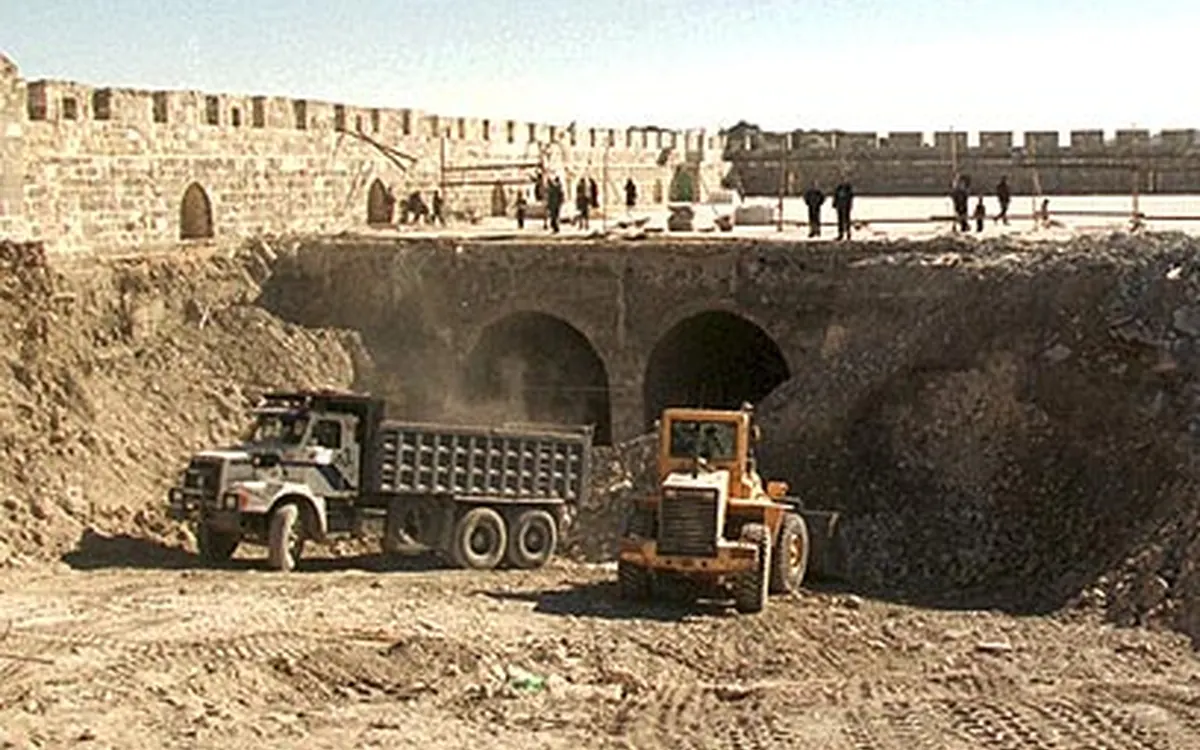
Why is the Temple Mount, the holiest site in Judaism a lighting rod for terrorist attacks and central to Israeli-Arab peace negotiations? Learn about how the Har HaBayit shifted from being acknowledged by Muslim leaders in the 1920s as a Jewish site to a complete denial by Yasir Arafat by the 1990s. The Oslo Accords, the Camp David Summit and reactions of President Bill Clinton. Plus, the history of the destruction of Jewish antiquities by the Muslim Waqf and the creation of the Temple Mount Sifting Project.
About this episode
Rav Mike opens with a reminder that law and narrative always travel together. Narrative without law builds little in the world, and law without narrative is a structure without a soul that tends toward totalitarianism. Stable societies show gradualism punctuated by crises that force a reworking of both the stories we tell and the laws they uphold, what the Jewish story means by narrative therapy for a nation. The Temple Mount moved from a hot potato that Moshe Dayan did not want to hold to the eye of a coalescing hurricane, and whenever law and order erode it is worth asking what narrative disintegration drives it. A story born in conflict risks two fates, stunting under punishing winds, and the twisting that comes when identity, a life and death issue, is threatened and fight or flight tells almost any story to survive.
There is a tremendous opposition to the centrality of the Temple Mount in the Jewish story, from committed Jews who turn away from what they face in prayer to enemies who contest our connection altogether. Internally the denial shows in Dayan's hasty status quo and in the choice to elevate the Kotel plaza as a gathering place, so that within minutes of Motta Gur's declaration the stream of Jewish history jumped its banks away from the Mount. Outwardly the response has been to rewrite history through an old erase and replace attack, deny our past while claiming it as your own. In 1930 the Supreme Muslim Council under Haj Amin al-Husseini published a guide calling the site's identity with Solomon's temple beyond dispute, a matter of universal belief. How things have changed.
Rav Mike tells of a friend in Arab and Jewish peace work who, after persuading Presbyterian ministers against BDS, asked a moderate Palestinian partner to acknowledge that the Temple Mount sits at the center of Jewish identity. The reply was that the Jewish claim is simply a Zionist lie, and the proof offered was that Israel relinquished the Mount in 1967 and never rebuilt the temple, so that the very act of compromise had become evidence of a lack of connection. In less than seventy years the Jewish bond had gone from a universal belief held by a fiery nationalist to a dismissal by a moderate. Since Islam itself did not arise until the seventh century, temple denial stands in conflict with the whole of Western history, which should trouble the world more than it does.
Physical erasure is the foundation of any narrative replacement, so when the assault began in earnest in the 1990s it started with the destruction of archaeology. The Israel Antiquities Authority wields shocking power over every shovelful of dirt in the country, yet on the Temple Mount it chooses a posture of helplessness, the second legal realm where the silence of the law is deafening. From 1990 the Waqf built pulpits and gardens without supervision, and in 1996 ceased all cooperation with what it now called the occupation, turning the Mount into an extra legal territory. An industrial saw appeared, ancient columns and Hasmonean capitals were chopped for construction, and when the new Al-Aqsa al-Qadim mosque was dug beneath the old one, eighty thousand cubic meters of earth laden with three millennia of Jewish history were trucked out by night. Two archaeologists rescued the rubble, and the Temple Mount Sifting Project was born.
The wholesale abandonment of our inheritance was driven less by a quest for quiet than by the quest for peace, which brings Oslo into the story as a narrative reversal of catastrophic proportions. The accords never mentioned the Mount, and the 1994 treaty with Jordan affirmed its special role on the surface while the deeper reality eroded. Oslo was a territorial retreat and a narrative one, undermining the story of return on which our sovereignty rests, the Tzidkut HaDerech that teaches why this land is our ancestral home. In 1996 the opening of the Kotel tunnels brought a blatant lie that they ran under the mosque, and rioting that left fifty nine Palestinians and sixteen Israelis dead, while Arafat renamed the Kotel al-Buraq and denied any Jewish stone. At Camp David in 2000 Arafat refused to confirm a temple ever stood, and two months later Ariel Sharon ascended the Mount.
Key ideas
- Law and narrative always travel together, and when order erodes around the Temple Mount it is worth asking what narrative disintegration drives it.
- A story born in conflict risks stunting under pressure and twisting under threat, since identity is a life and death issue.
- The erase and replace assault denies the Jewish past while claiming it, and in 1930 even Haj Amin al-Husseini called the bond with Solomon's temple beyond dispute.
- By the time of a moderate Palestinian partner, compromise itself had become proof of a lack of Jewish connection to the Mount.
- The narrative war began with physical erasure, the 1990s destruction of archaeology that the Antiquities Authority let pass, which gave birth to the Sifting Project.
- Oslo was a narrative retreat that undermined the story of return and the Tzidkut HaDerech on which Israel's sovereignty rests.
Chapters
- 0:00 A lie told often enough; law and narrative
- 2:17 Gradualism and punctuated equilibrium
- 4:45 Stunting and twisting under threat
- 6:54 The stream jumps its banks in 1967
- 8:03 Erase and replace; the 1930 pamphlet
- 10:14 A friend, the Presbyterians, and a moderate
- 11:35 Compromise read as lack of connection
- 12:41 Islam, the seventh century, and the West
- 13:47 Physical erasure; the Antiquities Authority
- 18:03 The Waqf construction begins in 1990
- 21:26 The industrial saw; the destruction
- 23:52 The ancient Al-Aqsa beneath the old
- 25:00 Solomon's Stables; the Sifting Project
- 28:23 Oslo as narrative reversal
- 35:10 The Kotel tunnels; Arafat's lie
- 39:42 Camp David; no temple ever stood
Who, where and when
People
Moshe Dayan, Haj Amin al-Husseini, Yasser Arafat, Ariel Sharon, Bill Clinton, Benjamin Netanyahu, Gabi Barkay and Zachi Dvira
Places
The Temple Mount, The Kotel plaza, Solomon's Stables, Camp David
Texts
The 1930 guide to Al-Haram al-Sharif, The Oslo Accords, The Israel-Jordan peace treaty
When
1930 CE: the Supreme Muslim Council guide, 1967 CE: the stream jumps its banks, 1996 CE: the Kotel tunnels riots, 1999 CE: the ancient Al-Aqsa dug out, 2000 CE: Camp David fails
Read the transcript
A lie told often enough becomes the truth, and oh, isn't it perfect that no one can agree on who actually said that? I'm Rav Mike Foyer, and this is The Jewish Story. Season 6, Episode 19, Temple Mount Part 3, The Narrative Front. So we left off last episode in the early 90s with a sense of, let's say, rising passion, much less growing violence around the Temple Mount. And that story is not going away. But I feel that before we can really appreciate how the escalation arrived at the situation we have today, one in which the Al-Aqsa Mas has become the rallying point for at least one full-scale terror war and countless waves of attacks, and where a nationalist march just directed toward the Mount can trigger rockets fired on Jerusalem from Gaza 80 kilometers away and an empathetic world reaction to Jewish provocation.
So before we can grasp all that, we have to understand how the story around the Temple Mount has evolved also rapidly in the last few decades. Because it's critical to recall that law and narrative are a package. They always come together in society. Narrative without law, it's just a bunch of fairy tales. and however sacred people may find them, and even personally inspiring, they will build very little in the world. Law without narrative is a structure without a soul. On the personal scale, it produces an empty life, and it makes a recipe for totalitarianism on the social scale. Though the relationship between law and narrative is always in flux, stable societies tend to show a model of what we might call gradualism and punctuated equilibrium.
I borrow those from the world of paleontology. Gradualism means that through the majority of history, law and the stories that society tells tend to evolve gradually, almost imperceptibly for the average person as the world turns. Now, that slow process, however, is punctuated by crises, moments of legal political explosion and narrative breakdown, which demand a reworking of both the stories we tell and the laws which they uphold. There is much to explore in that dynamic on every scale of life. In my personal counseling, I often focus with people on the relationship between the stories that we tell and the behaviors which we choose. It's really law and narrative on a personal level. And this is ultimately what the Jewish story's narrative therapy for a nation is all about, asking how we can tell the collective story of our past in a way that upholds actions and commitments in a society for present and future.
But right now, this essential relationship between law and narrative can help us understand how the Temple Mount went from being a hot potato that Moshe Dayan and his Zionist vision didn't want to hold, to the center of a slowly rising storm, what appears evermore to be the eye in a coalescing hurricane threatening social order on a regional scale, if not on a global one. I mean, just imagine what might happen if things exploded on the Mount today. Now, that's because any time a person is faced with a breakdown in their behavior or society witnesses an erosion of law and order, it's worthwhile asking what sort of narrative disintegration might be driving it. And when it comes to the Temple Mount, the destructive shift in that story hasn't even been subtle.
Now, we Jews may be used to it, but I do have to say, it's really hard to tell your story when it has been actively contested almost from the word go. You know, I can tell you from my work with people that there are two potential problems which loom when we face opposition in our attempt to express who we are and how we know the world through the story of our life. That first problem, at least in potencia, is what we might call stunting. A tree grown on an exposed ridge, subjected from the day it was a sapling to punishing winds, can survive, and it might even thrive, but it will never have the richness and freedom of growth offered by a sheltered forest glade. Now, I say can survive, might thrive, not just because such punishment can be prohibitive, meaning you can actually die, but also because opposition can produce powerful growth and not stunting.
In fact, sometimes the easy life of abundance robs us of the depth and drive which only the fight to be can provide. Hence the fact that Israeli society is so vibrant, not only despite our challenges, but also because of them. And so one challenge faced by a story born in conflict is potential stunting. And the positive possible is growth. The other challenge is that as soon as a story faces opposition, there's a risk it will become twisted and ingenuine in the fight to hold off the attack. Identity is a life or death issue. and thus it's subject to the fight or flight response. Human beings, as individuals and as societies, will tell almost any story when threatened, no matter how unacceptable or impossible.
This is the issue which really sits at the center of today's episode on the narrative war around the Temple Mount, because there is a tremendous opposition to the centrality which the Temple Mount plays in the Jewish story. It comes even from deeply knowledgeable and committed Jews who turn away from that which they face while they pray, much less from our enemies who'd like to replace us and actively contest our connection at all to the spot. Now we've seen some of the internal symptoms of this denial, most notably Moshe Dayan's hasty status quo that gained permanence through the unholy alliance of government, religious establishment, and courts. And no less, the decision by Ben-Gurin and Teddy Kallick to clear the Kotel Plaza as a gathering place for Jewish pilgrims, consciously or not, supplanting the Temple Mount.
And in a sense, I might say that the stream of Jewish history jumped its banks in 1967. Because until the liberation of Jerusalem, it had been flowing along steadily toward the Temple Mount. I mean, after all, Jews have been turning to face earth to praise since we were driven out 2,000 years ago. But within minutes of Matagor's premature declaration of sovereignty, it took a sharp left turn away from that target. Now, apropos my previous point, the result has been legal barriers to Jewish presence and prayer, and a story which casts anyone who actually goes or wants to go to the mount, much less rebuild the temple, as a madman, a fanatic, or a fool. And when we look outward toward the Muslim world, the narrative response to Jewish return to the Mount has been equally negative, although in a different fashion.
In this case, history itself has been rewritten. As my good friend Nishai Fleischer is determined to teach the world, as much as our return to the ancestral land has been bound up with classic style warfare, it has also involved a relentless narrative assault. And for better or worse, Am Yisrael is no stranger to the very specific type of weaponized narrative which the Palestinians, and now much of the Arab and Muslim world in their wake, have deployed against the truth of the Temple Mount. It's an old-fashioned erase-and-replace attack, the type we've faced at least since the early days of Christianity. Deny our past while simultaneously claiming it as your own. You know, in 1930, the Supreme Muslim Council of Jerusalem published a brief guide to Al-Haram al-Sharif.
That's the noble sanctuary, as the Muslims call the Temple Mount. And the council was under leadership at the time of Haj Amin al-Husseini. By that time, not only Grand Mufti of Jerusalem, Muslim religious leader, but also a committed Palestinian nationalist. So one might expect that a pamphlet published by the Supreme Muslim Council would at the very least downplay the Jewish connection to Har Abayit, if not erase it altogether. But at least in 1930, that wasn't the way it was. Listen to this quote. The site is one of the oldest in the world. Its sanctity dates from the earliest, perhaps from prehistoric times. Its identity with the site of Solomon's temple is beyond dispute. This too is the spot, according to the universal belief on which David built there an altar unto the Lord and offered burnt offerings and peace offerings.
The stories of the Hebrew Bible are not only proof of the site enduring sanctity, they establish a connection between the most famous king of Israel and the mount, which is a matter of universal belief. Oh, how things have changed today. A quick story. to demonstrate what I mean. I have a friend, who shall remain nameless, who engages in serious dialogue and peace work between Arabs and Jews in general, and Palestinians and Israelis in particular. Now, around about 20 years ago, when he was still young to the field, he joined forces with a fellow Palestinian activist in an attempt to convince a group of Presbyterian ministers who were visiting Jerusalem, that BDS, the Boycott, Divest, Sanctions movement, was a toxic movement, one whose methods would help no one and fix nothing.
I mean, thank God they were mildly successful, and as they sat in the cab on the way back from the meeting, basking in the afterglow of their shared victory, my friend decided to ask a question he'd been holding for some time, one that he considered central to all the issues at hand. When it comes to finally making a deal, he asked, you do understand that the Temple Mount lies at the center of Jewish identity, and therefore must at the very least be shared, he asked. To say he was shocked the reply he received would be a gross understatement. Ridiculous! The Jewish claim of a temple is simply a lie. Propaganda crafted by the Zionists to justify their conquest and occupation of Jerusalem. Haram al-Sharif is sacred to Muslims, Muslims only.
No other people have a claim, historic, religious or otherwise, to this holy site. Now, despite his astonishment, to his credit, my friend did push back. Listen he said all the work we do is based on our ability to hear and honor one another narratives Can you understand that the temple stands in the mainstream of Jewish history It the heart of our story Now the response of this young Palestinian activist was both heartbreaking and crucially instructive Because what he said was, if what you're saying is true, then why did Israel relinquish control of the mount in 67? And if the temple is so essential to what it means to be a Jew, why haven't you rebuilt it? now already two decades ago might have been more in the eyes of the most moderate type of nationalist you're likely to find the very act of compromise and moderation had become proof of a lack of connection in less than 70 years since that pamphlet was published the Jewish connection to the Temple Mount had gone from being held up as a universal belief by a fiery Palestinian nationalist to being dismissed by a moderate as a conquest-justifying settler-colonial piece of propaganda.
Now, let's not forget that even if one were tempted to downplay the denial of David, Solomon, and the First Temple as, quote-unquote, nothing more than an attack on our sacred mist, something I'm most assuredly not interested in doing, nonetheless, Islam didn't come into being until the 7th century of the Common Era, whatever some of its premises might insist. That's almost 600 years after the destruction of the second temple. And in that era, with the temple at the dead center of our story, we were wrapped up with the development of the Greco-Roman Empire and the birth of Christianity, which means that a stance of temple denial is a stance in conflict with the entirety of Western culture and history.
And that means you would think that the world might rise up a bit more at the type of denial which has become all but commonplace in the Muslim and Arab world. But they don't. Because in strange ways, the current desire by radical Islam and Palestinian nationalism to erase and replace the Jewish story serves powerful forces in the West which are interested in reworking and undermining their own history and culture. Now, how deep that goes is an exploration for another time. I do want you to remember it, though. For now, I'm tracing how this historical revisionist narrative even came about. And in order to do that, we've got to get out of the abstract ideas and back down to earth a bit. Because physical erasure is, of course, the best foundation for any narrative replacement.
If there's no evidence of the past, you can tell whatever story you want about it. Which is why, when the narrative assault on the Jewish connection to the Temple Mount really began in the 90s, it started with the destruction of archaeology. If you were to take an opinion poll as to what might be the strongest government institution in Israel, you'd get all the usual suspects. The army, the Mossad, the Shabbat, the tax authority. But if you kept plugging away, you might at least get one savvy person who will reveal to you the secret sleeper candidate for most powerful institution. And that would be the Israel Antiquities Authority. You may be shocked, but just think about it. You can't move much more than a shovel full of dirt in this country on public or private land without their involvement.
and should the IAA see fit, they have a shocking amount of power to put a halt to projects of every scale from home expansion to urban renewal. Established in 1990 to administer the 1978 Antiquities Law, among its other duties, the authorities are responsible for the examination and salvage dig required on any building site, any site at all. Basically, their mission is to determine that your new swimming pool won't be built on the ruins of a 2,000-year-old mikvah. An oi va voi should they discover that it is. Because the IAA has the right to seize and dispose of any antiquities found. Fair enough. But they can also order both government and private citizens to cease and desist all work until a proper excavation is made.
And that said excavation, by the way, is to be funded out of the pocket of the entity on whose property the antiquities were found, not by the government. meaning fieldwork, processing, storage, even publication of findings will all be funded by property owners and developers who are looking to build. It's a bit of blackmail. If you want to do it, you've got to cough up to the tune of nearly half a billion shekels per year by 2022. That is a lot of money and power, backed by the full force of court and police. And by all accounts, the Antiquities Authority doesn't hesitate to use it. except when it comes to the Temple Mount, where the Antiquities Law and its governing authority are actually the second legal realm we've encountered, where the silence of the law is entirely deafening.
The first, you'll recall, was the 1967 preservation of the Holy Places Law, which obligates the Minister of Religious Affairs to protect Holy Places from, quote, desecration and any other violation, and from anything likely to violate the freedom of access of the members of the different religions to the places sacred to them. Now that surely includes the right of Jews to congregate peacefully and pray at our only actual holy site, the Temple Mount, or so Shabdi Ben Tov thought, until the courts and government insisted otherwise in the last episode. And now we see that despite the astonishing amount of power which the Israel Antiquities Authority wields over governments and men, when it comes to the Temple Mount, it chooses a posture of helplessness.
Now, it may be shockingly obvious, but nonetheless, it's worth stating that beyond its sacred and contested nature, the Temple Mount represents one of the most concentrated and important archaeological sites in the world. There's a potential record of the sacred past spanning from King David through the Muslim conquest 3,500 years or more at the base of which is our holy mountain. Now turning the mount into an archaeological dig is out of the question for obvious and multiple reasons. But nonetheless, you might assume that the IAA would be diligent in ensuring no damage at least would be done to this precious legacy through further construction. But you know what they say about assumptions. As with Jewish prayer, As with the incitement that pours off the mount at every Friday servant, archaeology has been sacrificed to political expediency and fears of public disorder.
And with it has gone the foundations of the Jewish story in the minds of many, as we will see. The facts on the ground, or under the ground as it were, began to shift in the year 1990. Last episode, we saw how in the midst of the rising violence of the First Intifada, the dedication of the Temple Mount faithful triggered an explosion which left 17 rioters dead. That Sukkot march of 1990 also shattered the legal merry-go-round of requests for permission, court approval, police denial, and it forced the reassertion of Israeli sovereignty on the mount, even though the marchers never even got close to it. Now, about the same time, the waft Islamic authority, to which, you will recall, Moshe Dayan's status quo granted religious authority, but not legal or security authority over the mount, began construction of a series of outdoor pulpits and gardens in previously empty places of the plaza, which makes up most of the Temple Mount.
The explicit purpose was to create pleasant, open-air prayer areas, which could accommodate the masses of Muslims that come to the mount on popular holy days, like the Friday services of Ramadan. But no one doubted that a secondary goal was to head off any possible Jewish encroachment. After all, Rav Shlomo Goran had gathered a conference only a few years before, one which included at least one chief rabbi, whose purpose was to advocate for a synagogue on the Temple Mount. And the violence of that Sukkot riot actually pushed many Israelis to begin asking whether Har Habayit was really biyadenu. Did we actually have sovereignty over our holiest site? And was something to be done? Now the construction which took place in 1990 was not only a violation of the status quo, it was blatantly illegal as it was done without any supervision from the Israeli Antiquities Authority.
But once again, only the Temple Mount faithful cared to know what was happening in Judaism's holiest site, and they immediately petitioned the court to enforce the Antiquities Law. Unfortunately, in the wake of the recent violence, the court case only reinforced the narrative which set the law against them, first when it came to exercising Jewish prayer rites on the Mount, and now when it came to preserving the signs of our past. That story really was quite simple. Like I said, only dangerous fanatics want to exercise their personal rights on the Temple Mount, meaning to pray. And now the same crazies actually want us to enforce the law? Every rational person is interested only in stability and public safety, and perfectly willing to pray elsewhere and turn a blind eye to the destruction of our sacred heritage in pursuit of those noble goals.
Now once it was clear that the court would subvert the law, just as the police would ignore illegal acts on the ground, the destruction on the mount decreased haste. If you want to understand the scale of the devastation that occurred, all you need to do is go to the Temple Mount Sifting Project at Ein Rogel, just below the shoulder of Mount Scopus. Truth is, you should go there anyway if you haven't. It's a super cool experience, lots of fun with the kids. You can email me, I'll send you a link. But for present purposes, what matters is how the Sifting Project actually came about. And to be honest with you, that story takes a bit of the innocent fun out of the experience, though it can replace it with a sense of crucial mission.
By 1996, at the height of the Oslo process, and in the wake of a wave of riots that I'll mention later, the Oath Religious Authority ceased all cooperation with the Israeli government, henceforth to be known as the Occupation. Now, from this point on, for all intents and purposes, the Temple Mount became an extra-legal territory in the heart of Israel's capital. And really, it remains so until today, although there's a bit of a comeback happening. But in 96, it was entirely so. The Jewish presence was curtailed through threats of violence, hate and incitement were preached without restraint, and massive illegal construction was undertaken without any fear of punishment or even being stopped An industrial saw appeared on the Temple Mount and in ancient gravestones Roman columns Hasmonean capitals were all chopped up to be used as construction material.
Trenches for electoral infrastructure began to crisscross the plaza, dug without any consideration of their impact. And as part of the lost non-cooperation, the IAA inspectors who should have been at these sites were barred entirely, despite repeated petitions to the High Court by groups like a newly formed and apolitical committee to prevent the destruction of antiquities on the Temple Mount made up mostly of archaeologists and professionals who were horrified at what was going on. The situation actually grew so bad that the state comptroller issued a devastating report on the government's complete failure to enforce the law and thus prevent the archaeological destruction. But most of that report was never made public.
Nonetheless, eventually, the damage became so blatant and public that the court was compelled to issue an injunction to the government which said they must supervise all archaeological works on the Temple Mount and save the antiquities there. The injunction which was simply ignored. Finally, in November of 1999, the Wahab opened what they called a small emergency exit to access a new mosque that had been dubbed Al-Aqsa Al-Kadim, meaning the early or ancient Al-Aqsa. Now the name is no accident. Ancient Al-Aqsa, positioned below the modern mosque built in the 7th century. Never mind that it was built in the 90s. In archaeology, what lies below is older and has more precedent. This was the cutting edge of a new narrative assault.
No more would identity with the site of Solomon's temple be, quote, beyond dispute as it had been to Haj Amin al-Husseini. Now, a new mosque was inserted under the old mosque to insist that the site had always been a mosque. and any evidence of the contrary had been removed when the waft dug a 1,600 square meter, 15 meter deep pit down in Solomon's stables to build this new prayer space. Solomon's stables, by the way, were so named by the crusaders that kept their horses there in the 12th century, but in reality, that's a space which was created by the arches which Herod built to uphold the massive platform on which he placed the second temple at the beginning of the common era. For the mathematicians amongst us, or simply the curious, the creation of a pit 15 meters deep over a 1600 square meter area required the removal of 80,000 cubic meters of material.
Material which contained countless tons of irreplaceable Jewish history, the archaeology of three millennia. The sifting project Ein Rogel came about because two brave and concerned archaeologists realized that so much rubble doesn't just vanish into thin air it had to be put somewhere in a bold and somewhat dangerous move The archaeologists Gabibar Kai and Zahid Vira discovered that it was being spirited onto trucks by night and dumped as garbage in the nearby Kidron Valley and they actually managed to retrieve the bulk of that rubble which in 2004 they began to sift and thus the sifting project was born. In 1999, while I was a student of archaeology, I heard about an illegal excavation that took place in the Temple Mount.
Dr. Gabriel Bakay, my professor, enthusiastically helped us identify and date the finds. The significance of the finds led us to establish a project for systematically sifting the soil from the Temple Mount. The finds unearthed in the sifting project, it cast a new light. This is a very rare and once-in-a-lifetime opportunity to discover original finds originating from the Temple Mount. Many tens of thousands of artifacts which otherwise would have been thrown away. I would love to say that the rest was history, pun intended, of course, but in reality, Israeli sovereignty over the Temple Mount has only eroded further since then. In part, this is because of that ongoing sacrifice of our sacred history by courts, police, and politicians on the altar of fear and public order.
You know, one scholar who visited the Al-Qadim mosque in 2004 reported seeing Second Temple mosaics, extraordinarily rare, decorating what had become the ceiling of the new mosque, now crudely plastered over and in danger of being destroyed altogether. He reported it to the Antiquities Authority, and then asked why they didn't at least send some workers with a ladder to remove the plaster. The answer he received was, because whoever climbs up that ladder will never climb down. But the wholesale abandonment of archaeological inheritance in the 90s was driven by more than a desire for quiet and public order. The full abandonment of sovereignty on the mount, both in archaeological facts on the ground and in the ignoring of the narrative erasure of the Jewish past can only be explained not by the quest for quiet, but by the quest for peace.
Which means we need once again to touch on the Oslo process, this time in its role as a narrative reversal of catastrophic proportions. No matter how closely you look at the 1993 Declaration of Principles on Interim Self-Government Arrangements the so-called Oslo Accords signed between Israel and the PLO you will not find the Temple Mount mentioned. In fact, the document mentions Jerusalem itself only three times and makes it clear that questions pertaining to the Holy City were to be left to that mythical time of permanent status negotiations. Oslo, too, was signed in Washington, D.C. only two years later, and though Jerusalem gained a bit more attention in regard to questions of local council elections, still nothing of substance was said about the city, and there was total silence on what actually proved to be the most explosive issue of all.
Prime Minister Rabin, Chairman Arafat, on behalf of the United States and Russia, co-sponsors of the Middle East peace process, welcome to this great occasion of history and hope. The security of the Israeli people will be reconciled with the hopes of the Palestinian people and there will be more security and more hope for all. Which is not to say that the Oslo process left Moshe Dayan's status quo on the Temple Mount intact, either politically or practically. On the political front, the changes appeared at first to be cosmetic. The Oslo Accords, you may know, paved the way for the Israeli-Jordanian peace treaty in 1994, a document which, amongst other things, included the declaration that Israel, quote, respects the present special role of the Hashemite kingdom of Jordan in Muslim holy shrines in Jerusalem.
Now, on the surface, this was simply an affirmation of the status quo. You may or may not be aware that the Wath religious authority that had been ministering daily life on the Mount since 1967 had always been an official branch of Jordan's Ministry of Islamic Affairs and Holy Places. But the deeper reality triggered by Oslo was not so simple. Because remember, no one, not even the Israeli right, feared a Palestinian state more than the Jordanians. and any control they exercised over the mount quickly began to erode as the resurgent Palestinian militancy was fueled by Oslo itself. Practically speaking, Oslo represented a retreat. And when it comes to the territorial implications of that term, it's obvious land previously controlled by Israel was ceded to the newly formed Palestinian Authority.
I leave it to you to go back over the news of the last few decades or listen to the early parts of this season in order to appreciate the security consequences of that decision. But no less catastrophic was the narrative retreat that Oslo represented. Yitzhak Rabin may have truly believed he was cutting a final deal, maybe getting the best he could out of a bad situation, but in reality, he undermined the very story on which Israel's sovereignty is built. Ours is a story of return. it's a quest for historic justice which comes after colonization expulsion and 2,000 years of suffering laden wandering wandering that culminated in the genocide of one third of our people and at the center of that millennia long struggle for return the target if you will toward which our hearts minds and feet have been turning the entire time lay the biblical heartland of Yudah and Shomron Judea and Samaria.
At the core of those mountains lies Jerusalem and at its heart is the Temple Mount. Now, such a story provides Tzitkut HaDerek, a sense of righteousness and moral clarity which are essential for survival, much less victory in the hundred years wars we have fought and continue to fight to reestablish ourselves in our ancestral land. Now, Tzitzkut HaDerek is not just narrative justification, some sort of moral blank check drawn on the suffering of the past that allows us to justify what we have to do in the present to survive. It's the power of vision which gives energy and purpose. It's what teaches us what makes us Jews, how Israel is indeed our ancestral home and the state, its modern expression, and why that matters for our divine mission, and how it connects for the very purpose of our being.
Secular Zionism, from its inception, was infused with a pragmatic spirit. In many ways, that attitude of, one more dunam, one more goat, don't bother me about the big political picture, just let me keep building, has served us quite well. It certainly returned us to our land, and helped us to build ourselves brick by brick, up into a powerful fighting people once again. But, as we've seen, when our sacred center was basically dropped into our lap by the divine hand in 1967, the outcome of such pragmatism was Moshe Dayan's hasty retreat from that holy ground. He was unable to even comprehend, much less integrate into his notion of what the Zionist story was, The idea that we had returned to center and so the Kotel Plaza was elevated in place of the Temple Mount by Ben and Teddy Kalik who shared that pragmatic Zionist stance For 2 years Jewish history had been aiming toward that moment and frankly we balked when it arrived And I might say that Oslo was a balk of similar, if not larger proportions.
One whose narrative consequences have played out in what has become the assumption that we're occupiers. The growing belief that we Jews are settler, colonial, interlopers, white supremacists, in our ancestral lands. And nowhere Was the narrative consequence of that Oslo retreat more obvious than on the Temple Mount? As I said, the Mount, like the rest of Jerusalem, was left out of explicit discussions between Israel and Arafat's newly kosher PLO. But in the power struggle that underlay all the polite politics, it took on an increasingly central and volatile role. Next episode, I'm going to wrap up the series by looking at how the Temple Mount moved to the center of the violence with the breakdown of the Oslo process in 2000.
But in order to do so, we first need here at the end of this episode to understand two key moments which occurred along the way. The first took place in September of 1996, when the Israeli government opened the northern entrance to what is now known as the Kotel Tunnels Tour. Today it's a popular tourist attraction. I'm sure many people listening have done it. If you haven't, once again, unspeakably awesome. But back in 1996, at the height of the Oslo process, which was meant, of course, to establish peace and security for all, the opening of that tunnel was considered a provocation beyond all measure, one which led the entire Arab League to leap up in arms and declare that the tunnel ran underneath the western wall of the Al-Aqsa Mosque and thus was illegal.
This is a crime, a big crime, against our religious and holy places. And it is completely against the peace process. And it is a clear preaching to what had been agreed upon and what had been signed. It was a blatant lie, by the way. Tunnels don't go under the mosque or even under the teman. They run along the base of the Kotel, hence Kotel Tunnels. But not to be outdone in lying, Yasser Arafat, head of the Oslo-created Palestinian Authority, raised the stakes, declaring the government of Israel had no right to open the tunnel, since it lies in an area holy only to the Muslims. The name of the site is Al-Burak, not the Western Wall. This place is holy to Muslims according to the Quran. Now, as far as I know, and if you're a Quran scholar, you can tell me otherwise, the Western Wall is not mentioned in the Quran.
But notice how a lie spreads. No temple on the mount means no Jewish connection to the Kotel. And in fact, by 2001, the Palestinian Mufti of Jerusalem would issue a fatwa stating, we do not recognize any ownership of the Jews over this wall. In addition, no stone on this wall has any connection with Hebrew history. One might wonder how he explained its Herodian construction. Meanwhile, it's important always to remember that the narrative war exists on a continuum with actual violence. And rioting erupted the day after Arafat made his declaration that the entrance to the Kotel tunnel was forbidden. On behalf of the Prime Minister, there will be no intervention whatsoever in the religious holy sites for the Muslims on Temple Mount.
The tunnel has nothing to do with it. We respect the religious emotions and sensitivities of the Muslims in every part of Jerusalem, and we will continue to respect it, and there will be no intervention whatsoever. Though initially it was contained in Jerusalem, the violence quickly spread throughout Yudasherom and Gaza, and by the time order was restored, 59 Palestinians and 16 Israelis were dead, hundreds wounded. U.S. President Bill Clinton called Prime Minister Bibi Netanyahu directly. Yes, he was Prime Minister 27 years ago. He told him to reseal the entrance, because Arafat now refused to attend any further Oslo summit meetings until it was done. The UN Security Council was even more direct, passing a resolution calling for Israel to seek, quote, the immediate cessation and reversal of all acts which have resulted in the aggravation of the situation.
Now, despite that call for reversal of all acts that resulted in aggravation of the situation, no demand was made of the Palestinians. Nor were the lies which were the fuel for such a fiery explosion in the first place ever addressed. And perhaps because of the blatant narrative tack, in a rare statement of clarity, Beebe responded that he, quote, did not regret that we opened the Western Wall Tunnel, which has no effect on the Temple Mount and expresses our sovereignty over Jerusalem. This explosion of violence in 1996, at the peak of what was meant to be a peace process, and fueled by a historical reconstruction which wasn't just revisionist, it was delusional, should have prepared the world for what came at the Camp David Peace Conference of 2000.
Now, this is not the time or place to dissect Camp David, the place where the Oslo peace process went to die, or rather, perhaps where it proved its status as a zombie, seeing as so many times it's been killed and revived. But it is worth noting that well after the fact, former President Bill Clinton said that the Palestinians were offered everything Israel possibly could offer, including control over the Temple Mount. Clinton said that in the end, Arafat agreed. He agreed to Israeli control over the Western Wall, even the Jewish neighborhoods in East Jerusalem, but that he insisted on keeping 50 feet of land leading up to the entrance to the Kotel tunnels. and Israel refused. Why? Because the tunnel would grant access to the remains of the temples which underlie the mount.
And in retrospect, Clinton himself said that Israel was justified in that refusal because if you got in, you could do mayhem to the ruins of the temples, as he said. Now, why such mayhem might matter should be clear by now. Because if there's no insistence on the truth of a Jewish past in Jerusalem, then there's no reality to our insistence on a Jewish future here. But I want to drive the point home with a recollection from Ehud Barak, who was Prime Minister and head of the Israeli negotiating team at Camp David. By all accounts, Barak had come to Maryland to finish the job. Just like his predecessor, Yitzhak Rabin, he was determined to end the war. And also like Rabin, Barak was unconcerned about sacrificing sacred ground on this altar of peace.
Except what he encountered was a fundamentally different worldview. Once again, pun intended. By his own account, Edward Brock was quite surprised to discover that the Jerusalem issue actually lay at the core of the negotiations with Tephase. And at the core of the core was the Temple Mount, even though it had never officially been mentioned in any of the previous documents. Arethet repeatedly warned President Clinton that, quote, the Arab leader who would give up Jerusalem has not yet been born. I mean, even though he didn't control it. And when Israel presented a demand for sovereignty over the Temple Mount on the basis of its central holiness in Judaism, and even raised for the first time ever a demand for a Jewish prayer site at the edge of the mountain, the situation quickly broke down.
A WAF representative who was there declared the Al-Aqsa Mosque belongs to Muslims alone. According to a divine decision, it's part of the Muslim faith. Prayer in it by non-Muslims is forbidden. while Arafat himself told Clinton I'm a religious man and I will not allow it to be written of me in history that I confirm the existence of the so-called temple underneath the mountain. Barack tells the story that Clinton told Arafat about his attendance at a Sunday service during the negotiations where the minister had preached a sermon that mentioned Solomon the king who built the first temple and Arafat's reply there's nothing there meaning no trace of the temple on the Temple Mount. And when Bill Clinton responded, not only the Jews, but I too believe that under the surface there are remains of Solomon's Temple, one of the present's Jewish aides whispered in his ear, he should tell Arafat that's his personal opinion, not an official American position.
Oy, I'm Yisrael. The Camp David negotiations of 2000 failed as the culmination of the Oslo process, sorry to spoil it if you didn't know, in no small part, due to the issue of the Temple Mount. Because the relinquishing of Israeli sovereignty and the status quo, the turning of a blind eye to the denial of Jewish history, and the aiding and abetting of the destruction of our antiquities had all borne their bitter fruit. In light of those, I wonder why anyone was surprised that Erephan and his team insisted on their historical absurdities and tried to get them enshrined in international law. Now, Camp David may have failed to bring Oslo to a peaceful resolution, but in light of the narrative war on the Temple Mount, one could ask whether that was ever its goal.
In fact, only two months after negotiations broke down, opposition leader Ariel Sharon ascended the Temple Mount in an attempt to assert Israeli sovereignty, or perhaps prove the lack thereof. It's a normal thing to visit the Temple Mount, and every Jew can visit the Temple Mount, exactly as every Arab can visit any other place in the country. And all of us would like to have peace. All of us are committed to peace. I cannot see any possibility for real peace if Jews were not allowed to go to the holiest place that belonged to them. I just think what will happen if Jerusalem will be divided, as Barak agrees to do already. The sovereignty over the Temple Mount, it's in our hands now. It will be in our hands in the future.
That will be the future. What resulted was the Al-Aqsa Intifada and the beginning of a whole new phase in the story of the Temple Mount, a new phase that we'll have to pick up next week. So before I go, I want to thank folks. I want to thank all the folks who give their hard-earned money to make the show happen, keep it free, widely available. I want to ask you to join them right now. Go to my website, jewishstory.co. You can see a button in the upper right-hand corner that says Be a Patron. Click on that to give a little bit of per-podcast support. or email me, robmikefoyer at gmail.com. Find me on Facebook, Rav Mike Foyer. Happy to share with you the way in which you can make a one-time donation or dedicate a show.
I want to thank the Land of Israel Network. That's thelandofisrael.com. They're building a center for global transcendence in the heart of the Judean Mountains. I want to thank the Pardes Institute, pares.org.il, for throwing the doors of the Beit Meadrash open as wide as possible. And I want to thank you for listening. I'm Rav Mike Foyer, and this is The Jewish Story. Thank you.
More from Season 6
TJS S6 interview with Rabbi Shmuly Yanklowitz
Rav Mike Feuer interviews educator and activist Rabbi Shmuly Yanklowitz and discuss what it means to be both progressive and orthodox in the Jewish world, as well as...
Play Episode
TJS S6 Interlude - Future of American Zionism
Rav Mike Feuer speaks at Valley Beit Midrash in an event co-sponsored by Temple Chai entitled "Is There a Future for American Zionism? American Zionism in the Era...
Play Episode
TJS S6E20 Temple Mount part IV
Was Ariel Sharon's visit to the Temple Mount in 2000 the trigger for what the Arab community calls the Al Aqsa Intifada? Or was this a pre-planned assault...
Play Episode