
TJS S6E20 Temple Mount part IV
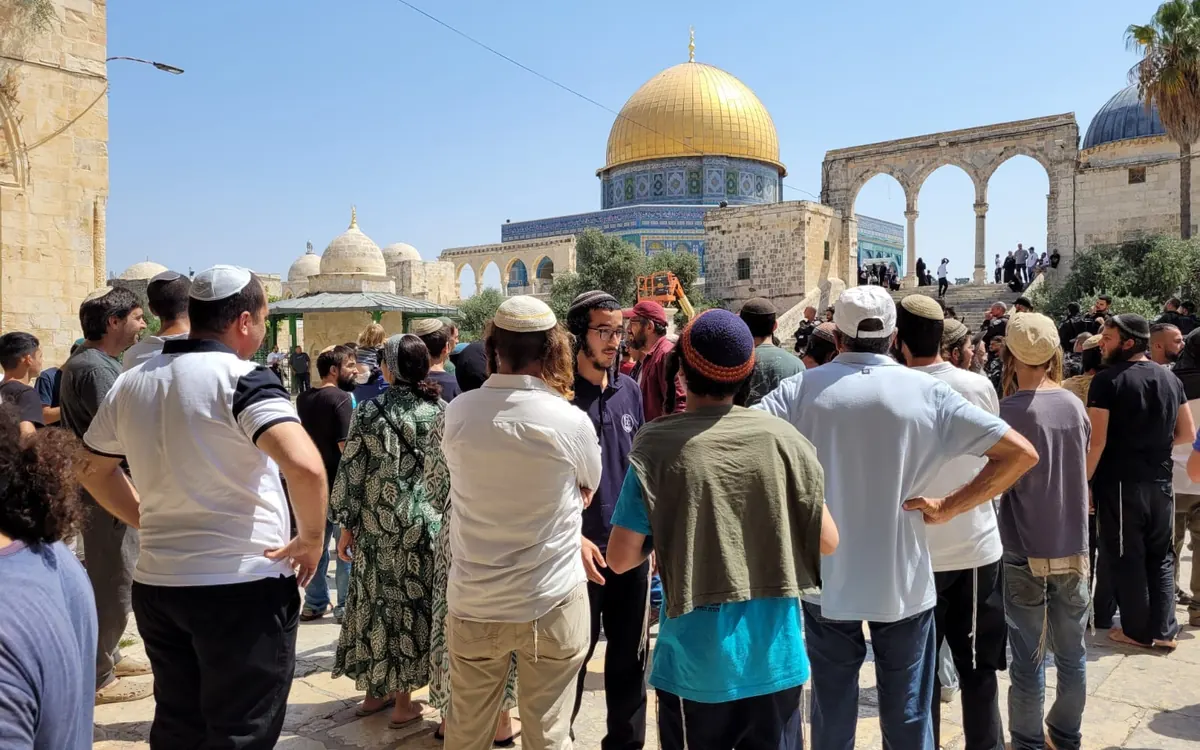
Was Ariel Sharon's visit to the Temple Mount in 2000 the trigger for what the Arab community calls the Al Aqsa Intifada? Or was this a pre-planned assault orchestrated by the likes of Marwan Barghouti, Raed Salah of the Northern Branch of the Islamic Movement in Israel and even the Palestinian Authority?
In this final installment of the Temple Mount series, learn about the assassination attempt against Rabbi Yehudah Glick, the lynching of two Israelis in Ramallah, the rejection of Jewish history by PLO leader Yasir Arafat during his meeting with Israeli Prime Minister Ehud Barak and US Secretary of State Madeline Albright, the and the rioting that took the lives of thousands including that of Muhammad al-Durrah during the Second Intifada. Plus, Yehuda Etzion and the Hai Vekayam movement who sought to ensure Jewish people had the right to pray at the Har HaBayit, the site of the Beit HaMikdash.
About this episode
Rav Mike returns mid-story and insists the Israeli establishment's foundational approach to the Temple Mount has been to minimize conflict at all costs, a policy becoming increasingly unstable. The tide turned with Ariel Sharon's visit on Erev Rosh Hashanah 2000. It has become gospel that his ascent triggered the Second Intifada, but like most stories too perfect to be true, this one is false. His visit was the perfect excuse, the hated figure ringed by Shin Bet agents, and sparks flew the moment his feet touched the plaza. Those sparks did not set off a natural explosion radiating from the mosque. They gave convenient cover to men who had been holding matches, waiting to touch them to fuses laid long before. Sharon came to assert sovereignty and to crowd his rivals from the right, and the government had coordinated the visit.
Trouble came when Sharon moved to inspect the recent construction in Solomon's Stables, and two dozen men blocked the entrance with cries to redeem Al-Aqsa with soul and blood. His detail backed him off as chairs and metal flew, and the clash spilled outside the walls. The next morning, Rosh Hashanah and Friday both, a barrage of stones poured from the Mount onto worshippers at the Kotel below, and when the police switched to live fire four were killed. Within hours violent demonstrations erupted across Yehuda, Shomron and Gaza, fueled by popular rage, and among the dead was Mohammed al-Dura, who became a global icon of the Al-Aqsa Intifada. Israel still approached it as intense civil unrest, hoping the Palestinian Authority would be a partner, an illusion that died October twelfth with the lynching of two reservists in Ramallah.
What followed was a war in every sense, which Rav Mike prefers to call the Oslo War, since Oslo created the possibility of such a conflict inside Israel's territory. Thousands died in waves of suicide bombings and raids until Operation Defensive Shield rolled back much of the territorial reality Oslo had made. Yet the world remembers it as the Al-Aqsa Intifada even though the mosque retreated from view almost at once, and the deeper casualty was truth itself. In a 2002 interview Ehud Barak described facing a leadership for whom truth is an irrelevant category, and placed Arafat's absolute denial that a temple ever existed at the heart of the Camp David breakdown. Barak recalled Arafat feigning ignorance of the very men orchestrating the violence, asking who, who, until his own aides burst out laughing.
The loose relationship to reality finds strange expression around the Mount. Captured documents held a letter to Arafat warning of a Zionist plot to collapse Al-Aqsa with an artificial earthquake, even as the Waqf's own excavations were hollowing the Mount into one vast mosque, and Arafat took it seriously enough to countersign it. Temple denial emerged at Camp David and, fueled by blood and terror, has morphed into a full rejection of Jewish history, with Mahmoud Abbas claiming Israel digs beneath Al-Aqsa and leaders tracing descent from the Jebusites to make King David the first occupier. Yet action provokes reaction. During the first intifada Yehuda Etzion founded Chai V'Kayam, living and existing, driven by the sense that until we return to the center of our identity, the national soul cannot breathe life into the powerful but empty body we have rebuilt.
The barriers to Jewish prayer rested on a tripod of rabbis, courts and police, and all three began to crack. Gush Emunim rabbis and the Yesha council called to ascend the Mount, Justice Dov Levin doubted the justice of barring only Jews on their holiest day, and the Women of the Wall case exposed the folly of courting threats of violence to keep order. After the Oslo War the Mount reopened to Jewish visits in 2003 and produced no violence, and in 2007 a judge supported Jewish prayer for the first time. Ascent climbed from a few thousand to over fifty thousand a year, and half of Jewish Israelis now support the right to pray there. Rav Mike closes by recalling a colleague who asked how he could imagine rebuilding the temple, and answers that serving God in space as well as time, peacefully and together, is the Tikkun we were placed here to achieve, and without a center he questions whether the story can hold.
Key ideas
- The establishment's approach to the Temple Mount has been to minimize conflict at all costs, a policy growing increasingly unstable.
- Sharon's 2000 ascent was a pretext rather than the natural trigger of the Second Intifada, cover for men holding matches to fuses laid long before.
- Rav Mike calls it the Oslo War, since Oslo created the possibility of such a conflict inside Israel's territory, and its deepest casualty was truth.
- Arafat's denial that a temple ever stood lay at the heart of the Camp David breakdown and has morphed into a full rejection of Jewish history.
- The tripod of rabbis, courts and police that barred Jewish prayer has cracked, and ascent has climbed from a few thousand to over fifty thousand a year.
- Serving God in space as well as time, peacefully and together, is the Tikkun, and without a center Rav Mike questions whether the story can hold.
Chapters
- 0:00 Minimize at all costs; an unstable policy
- 1:10 Sharon's visit; too perfect to be true
- 3:26 Coordinated ascent; political motives
- 5:34 Solomon's Stables; the confrontation
- 6:41 Stones on the Kotel; al-Dura
- 9:01 The Ramallah lynching
- 10:12 The Oslo War; truth as a casualty
- 12:32 Barak, Benny Morris, and who, who
- 14:40 The earthquake letter; runaway denial
- 19:03 Second and third commonwealth; avodah
- 20:17 Prayer as a national priority; Chai V'Kayam
- 22:28 The religious cracks; Gush Emunim
- 24:37 The courts crumble; Women of the Wall
- 26:52 Reopening in 2003; ascent climbs
- 29:19 Yehuda Glick; the shooting
- 37:03 A returning center; the Tikkun
Who, where and when
People
Ariel Sharon, Ehud Barak, Yasser Arafat, Mohammed al-Dura, Yehuda Etzion, Yehuda Glick, Raed Salah, Itamar Ben-Gvir
Places
The Temple Mount, Solomon's Stables, Ramallah, Gaza
Texts
The Oslo Accords, Barak's interview with Benny Morris, The Haliba movement charter
When
2000 CE: Sharon ascends the Mount, 2000 CE: the Ramallah lynching, 2003 CE: the Mount reopens to Jews, 2007 CE: a judge supports Jewish prayer, 2014 CE: Yehuda Glick is shot
Read the transcript
I love the man that can smile in trouble, said Thomas Paine, that can gather strength from distress and grow brave by reflection. Tis the business of little minds to shrink, but he whose heart is firm and whose conscience approves his conduct will pursue his principles unto death. Well, I hope to get there before that happens. I'm Rav Mike Foyer, and this is The Jewish Story. Season 6, Episode 20, Temple Mount, Part 4, the Al-Aqsa Intifada. So we're mid-story, and I'll just pick up by saying it's critical to remember that the foundational approach of the Israeli political establishment to the question of the Temple Mount has been to minimize. minimize, minimize at all costs as any element of conflict, local, regional, or otherwise.
And I'll just add that, wise or foolish, that policy is becoming increasingly unstable. If I were going to put my finger on the moment when I see the tide having really turned toward the impossibility of maintaining that low conflict status, it would be Ariel Sharon's visit to the Temple Mount on September 28, 2000, Ere Vosh Hashanah 5761. Now be warned, it has become a gospel truth amongst media pundits, politicians, and frankly the uninformed, that Sharon's ascent triggered the Second Intifada, also known as the Al-Aqsa Intifada. But like with most stories that are just too perfect to be true, this one isn't either. Now, his ascent certainly was the perfect excuse. I mean, the hated butcher of Sabra and Shatila ringed by Shin Bet security agents storming the mount as a police copter hovers overhead and a thousand armed policemen cover the ground.
I mean, there's no question that Sparks flew as soon as his feet touched the plaza. But they didn't just touch off some intrinsic natural explosion which radiated out from the mosque in a ring of fiery rage through the territories and indeed the Muslim world, as the story goes. If anything, the sparks generated by Sharon's visit provided convenient cover for the men who were holding matches waiting to touch them to fuses that had been laid long before. Now, part of Sharon's intent in going up to the mount was to assert sovereignty. As he explained to the press afterwards, his visit wasn't a provocation but a right. He said, it's our right. The Arabs have the right to visit everywhere in the land of Israel, and Jews have the right to visit every place in the land of Israel as well.
It's a normal thing to visit the Temple Mount, and every Jew can visit the Temple Mount, exactly as every Arab can visit any other place in the country. And though all of us would like to have peace, all of us are committed to peace, I cannot see any possibility for real peace if Jews were not allowed to go to the holiest place that belonged to them. I just think what will happen if Jerusalem will be divided, as Barak agrees to do already. The sovereignty over the Temple Mount is in our hands now. It will be in our hands in the future. That will be the future. Now granted, he said that as rocks and rubber bullets were flying on the Mount behind him. Sharon was both Likud party leader and head of the Knesset opposition at the moment, and so his other motivations were, let's say, no less clear.
By going up in force and then coming down to criticize Ehud Barak's offer to concede sovereignty in Jerusalem and even on the Temple Mount that he'd made in Camp David just a few months before, Sharon wasn't just bashing his competitor for prime minister. He was crowding Benjamin Netanyahu from the right, just as he was about to contest Sharon for leadership of the Likud. Now, for all his political agenda, Sharon had coordinated his assent with the government, and the Shabak General Security Services didn't tell him not to go. In fact, Foreign Minister Shlomo Ben-Ami later said that Jabil Rajoub, leading security figure in the Palestinian Authority, assured him personally that if Sharon did not enter any of the mosques, there wouldn't be any trouble.
And basically, that's how it went. Sharon went up, as I said, with almost as many troops as he crossed the Suez in 73, a fact which Faisal Houseni, top PA official in Jerusalem, used to highlight Israel's weakness on the mount, saying they have military might, they have the power of occupation, but not sovereignty. Makes you wonder, right? Now things were tense as soon as the party entered the plaza. But for most of the visit, there was only some shouting, mostly, frankly, from the Arab-Israeli members of Knesset that used their immunity to get as close as possible. And then Sharon expressed interest in inspecting the recent construction in Solomon's sables that we spoke about last episode. And that's when the confrontation really began.
Two dozen men blocked the entrance to the site. And cries of, God is great! With soul and blood, we will redeem you, Al-Aqsa! rang out as they forced against the police lines in an attempt to reach Sharon and prevent him from inspecting the construction site. Now, that's when Sharon's security detail quickly backed him off the mount, even as chairs and metal objects began to fly from the crowd, and the police responded with rubber coated bullets and riot sticks. This was a real clash, and it didn't die immediately. In fact, it spilled off the mount, and even outside the city walls to Salah Adin Street, That's the main shopping era in East Jerusalem, where Yus hurled stones at police and Israeli vehicles for several hours.
However, it did stop, at least until the next day, which was both Rosh Hashanah and Friday, when the Kotel Plaza was full of praying Jews and the mount above with Muslims doing the same. At the end of the prayers on the Temple Mount, a barrage of stones poured over the edge down onto the worshippers at the Kotel below. The Israeli police rushed the rioters with tear gas and rubber ammunition, but they proved to be well prepared, and a pitched battle began. When the rioters began to push toward the Mugrabi Gate in hopes of reaching the Kotel Plaza below, and the chief of the Jerusalem force was knocked unconscious by a stone, the forces switched to live fire, killing four. Within hours, violent demonstrations now did erupt across Judah, Shomron, and Gaza.
Dozens were killed and hundreds wounded in the first day. It was genuinely fueled by popular rage. Amongst the dead was a name you might recognize, Mohammed al-Dura. Depending on whom you ask, he was either the cruel casualty of Israeli snipers or the iconic victim of cynical Palestinian propaganda. I don't need to wade into the controversy about what really happened there. All I need to do is point out that al-Dura indeed became an icon. And with him, the Al-Aqsa Intifada that he'd already become to embody spread across the world. Parks and streets were named for him. A postage stamp was issued in some Arab countries. Osama bin Laden mentioned Al-Dur in his warning to President George Bush after 9-11.
And his image was in the background when Al-Qaeda beheaded American Jewish journalist Daniel Pearl in 2002. Now that is a global phenomenon. But nonetheless, Israel approached the situation as, let's call it, intense civil unrest, much like the first intifada that they'd faced in the late 80s. Except now, the IDF looked to the Palestinian Authority Security Services to be a partner in restoring order on the ground. That illusion was already somewhat tattered when the first Israeli armed PA officer turned his gun on the Jews, and it died a quick death on October 12th. along with two IDF reservists who had the misfortune to accidentally enter Ramallah. They were arrested by PA forces, and when the rumor of their presence in the jail spread, an angry crowd of more than a thousand gathered.
Both were beaten, stabbed, and mutilated in a horrific display caught on video and broadcast internationally by an Italian television crew at the risk to their lives. What happened today was the most heinous crime. It was almost, I could say, a premeditated crime, lynching two Israeli soldiers who strayed into an area, who are noncombatants, reservists, with families, with children, and a mob lynched them. And the mob lynched them with the support, tacit support, of the Palestinian police who interrogated them several minutes before. And the mob lynched them because the mob was incited for the past 10 days by the official Palestinian Authority, newspapers, television, radio. Do we even have reports of someone picking up the phone, their cellular phone, and calling, you know, the wife of one of them, telling, we're killing your husband right now.
The brutality of the killings shocked the Israeli public. They became proof positive in the minds of many of the blood hatred held toward Israel and Jews, and the complicity, incompetency, or both of the Palestinian Authority. What followed was a series of retaliatory airstrikes against PA targets, destroying positions through the West Bank and Gaza Strip, including that police station, and now the gloves were off. It became a war in every sense. The Oslo War, as I prefer to call it, seeing as Oslo is what created the very possibility that such an armed conflict, something of such a scale, could take place within Israel's territory for the first time ever. Thousands died. Waves of suicide bombing, army raids, roadside shootings, and ultimately Operation Defensive Shield which rolled back much of the territorial reality created by the Oslo Accords in the first place Nonetheless despite all that the world knows these events as the Al-Aqsa Intifada.
And if you ask many, it was a popular uprising with the mosque at its center. Not a terror war whose grim memory remains a pressing political consideration in the minds of most Israelis. For years, Prime Minister Ehud Barak, one of Israel's most decorated soldiers, insisted that Erephat had returned from his failure at Camp David, determined to go war, and that Israel has shared hard intelligence of that fact with leaders all around the world. He said that Shoram's visit was nothing more than a ripe pretext, which fell right into Erephat's lap. But boy, was it an ever-ripe one. because in many ways, the Al-Aqsa Intifada-Asla War became an inflection point, a turning in the struggle for Israel's very existence perhaps, and certainly in the fight for sovereignty over the Temple Mount.
Beyond the thousands of lives lost in the Asla War and the countless wounded, the truth was also wounded perhaps mortally at this stage. That damage is evident in how the terror war was so swiftly dubbed the Al-Aqsa Intifada, even though the issue of the mosque, the mount, or even Jerusalem retreated from view almost immediately after it began. And it can be seen in how the narrative war and the classic battlefield have gradually joined around that center ever since. You know, in an interview given to Benny Morris in 2002, even as the violence of the Oslo War raged, Ehud Barak tried to explain his experience in facing Yasser Arafat and the Palestinian leadership over the last two years. Truth, he insisted to Morris, is seen as an irrelevant category.
Quote, there is only that which serves your purpose and that which doesn't. They see themselves as emissaries of a national movement for whom everything is permissible. There is no such thing as the truth. And in that context, Barack explained Arafat's absolute denial of the existence of a temple, which he felt had actually been what thwarted the Camp David Accords. He also saw it as a fundamental problem underlying the terror war that Israel was even then fighting. Barack described how at the very outbreak of the Intifada in October of 2000, only two years before, he'd met with U.S. Secretary of State Madeleine Albright and Arafat in Paris. President Clinton and I will do everything we possibly can to assist Israelis and Palestinians in their effort to achieve a fair and durable peace that both sides need and deserve.
And we recognize the urgency of the moment. Hard work and courageous decisions lie ahead. But as Prime Minister Barack reiterated, it is the president who has to make this decision. Albright had come to broker a ceasefire, and she insisted Arafat right there and then call his police commander. When he listed the names he'd contact, Barak immediately interjected, but those aren't the people organizing the violence. If you're serious, then call Marwan Barghouti and Hussein al-Sheikh, the West Bank heads of Fatah who were actually orchestrating the violence. Arafat looked at him in blank innocence and said, Who? Who? And he only repeated it when Barak actually said the names in proper Arabic. Like, who? Who?
The farce might have held if some of his aides hadn't burst out laughing at his audacity. Arafat was then forced to call the men on whom Barak insisted, and they all agreed right there and then to stop the violence. Except nobody laid down their arms. This loose relationship to reality can find often strange expression, especially when it's focused on the Temple Mount. You know, when Israeli troops in 2002 seized the Orient House, unofficial Palestinian headquarters in Jerusalem, they found a treasure trove of documents which reported on many connections between the PA and the violence. And amongst them was a bizarre letter from Mahmoud Abu Samra, intelligence colonel in Fatah, to PA President Yasser Arafat.
Abu Samra wanted to apprise Arafat of a, quote, Zionist plan to destroy the Al-Aqsa Mosque with an artificial earthquake and he actually described how the plan would work. The reports point to the fact that the underground foundation of the Maks has been hollowed out by Israeli archaeological excavations. The Zionist experts expect the structure to collapse as a result of damage to the balance between the external air pressure and the internal pressure. I request your guidance and instructions. You can't make this stuff up. Now notice the insane dissonance. As an intelligence colonel in Fatah, Abu Sama was surely aware that the excavations on the mount had been undertaken by the Waf in order to open up a massive new mosque.
In fact, they were a key element of the national Islamist strategy to dominate the Temple Mount. Nonetheless, here they were also a foundation for the Israeli plot to destroy with precision earthquakes the very same Al-Aqsa Mosque. Erfad took it quite seriously, by the way. He countersigned the letter and sent copies to all relevant PA officials. Now, craziness aside, Temple Mount denial emerged as a major issue at Camp David, and, fueled by the blood and terror of the Intifada, has morphed into a full-blown rejection of Jewish history and connection to the land of Israel altogether. It's basically been a runaway train ever since. The hollowing out of the mount into one massive mosque has all but completed the archaeological destruction, and that's allowed for the denial of the Jewish story without any worry that there'll be a challenge from counter-evidence.
Combined with it, the narrative assault has increased apace. I mean, I'll just give you this recent prize quote from PA President Mahmoud Abbas, which he said in Qatar in 2021, that was two years ago. He says, despite all the enormous capabilities that the occupational authorities make available to the extremists who engage in never-ending digging and threaten to make al-Aqsa look less significant and vindicate the Israeli narrative, they have failed miserably. I mean, I don't even know where to begin with the nihilism there. Israel doesn't do any excavations on the Temple Mount, archaeological or otherwise. So the Al-Aqsa Intifada marked a doubling down in the employment of the erase and replace strategy.
By the way, since then, Palestinian leaders have upped the ante by even beginning to claim dissent from the Jebusites, the Canaanite people from whom King David conquered Jerusalem, which makes him, of course, the first Jewish occupier. There was even an attempt in 2002, at the heart of the Intifada, to sanctify the Temple Mount with water brought from Mecca. Sheikh Rayyad Salah, Israeli citizen and head of the northern branch of the Islamic movement in Israel, who we may have more to say about later, raised money from around the Arab and Muslim world to clean out ten water holes, which were meant to hold holy water from the Zamzam River in Mecca. His goal was to finally elevate the status of the Temple Mount in the eyes of Muslims to that of Mecca and Medina, and thus cement Islam's hold on the holy site, or at least to guarantee that anyone who challenged it would face religious war.
That was 21 years ago. I think I've made my point. Sharon's visit and the Oslo War, a.k.a. Al-Aqsa Intifada, were turning points away from the Israeli government's pursuit of stability and away from truth and rationality as guides for action. Whether the Israeli government was willing to recognize that or not. But you know, it's a funny thing. In history, as in physics, every action provokes a reaction. And while it may not exactly be equal and opposite, as Newton liked to say, once the boundaries of rationality start to slide around a locus like the Temple Mount, even the slightest acts have untold potential. You know, there's much to be learned if we compare and contrast the second commonwealth with the third, meaning the second temple period, with today's Zionist entity of the state of Israel.
It's actually one of my favorite intellectual games. I'd love you to play. Send me an email, robmikefoyer, gmail.com, or you can message me on Facebook. Your thoughts, questions, what are the ways in which the two overlap, and where do they diverge? Now, lately, the significance of a specific difference between the two has been gaining ground in my mind. It's obvious that a major difference between these two times is that then the temple stood, and now it does not. But I think framing the distinction that way doesn't actually offer so much insight. I'd rather put it like this. During the Second Commonwealth, Avodah, meaning divine service, was a national priority. Everything circled around the temple.
And today, it is not. The return he's led by Ezra Nehemiah and Zerubbel back then, 2,500 years ago or so, didn't just prioritize the rebuilding of the altar and the temple. It was the first thing they did. It's in fact why they came back in the first place. Avodah, divine service, was a national priority. Whereas today, the Avodah, which has been prioritized as our national concern, has been more of the physical labor type, which is not to disparage. But nonetheless there a whole discourse that we could have here about the difference between those two types of Avodah It have to wait for another time For the moment I just want to float a question What might it look like to make prayer, the type of Avodah we inherited after the Temple's destruction, a national priority?
I think it's worth pondering, especially in context of our present story, because despite the repeated defeats to Jewish prayer on our most holy site dealt by the courts, by the police, and the other guardians of the walls, those barriers began to crumble actually after the Al-Aqsa Intifada as well. I mean, truth be told, the fight to pray on the mount received new life already during the first Intifada, when Yehuda Etzion, who we know from our story, from his plot to actually blow up the Dome of the Rock in hopes of triggering a redemptive movement, founded the Chay the Kayyam group. Chay the Kayyam means living and existing. And the name expressed not only Etzion's personal determination to continue his activism now that he was out of jail, it also indicated the spirit which drove him.
That until we as a people return to the center of our identity, our national soul will not be able to breathe full life into the impressively powerful but dangerously empty national body that we have rebuilt. Even during the first intifada, individual Jews continued to go up to the mount in the limited times made available for entrance to non-Muslims, and some prayed in their hearts while there. But all of them knew that if they should stand and close their eyes, or God forbid, begin to mumble behind a hand, well that was courting harassment from Nourabit Ha'at, the Muslim women who had appointed themselves guardians of Haram Al-Sharif, the noble sanctuary as they called it, and that harassment was generally followed quickly by the Israeli police, not to stop the harassers, but to throw the Jew off the mount.
Nonetheless, in early 1995, Chai V'Kayyam began a campaign to hold actual prayer gatherings, a minion if you will, and unlike the Temple Mount faithful, they were more than willing to break the law to do it, at times actually forcing their way onto the plaza. The result, of course, was repeated arrest, and even condemnation by Sephardi Chief Rabbi Bakshi Daron, who not only opposed the Chai V'Kayyam activity in general, but published an article mocking the very idea of a synagogue on the mount. Now that second piece was a direct response to the first cracks which had begun to appear in the religious establishment's consensus opposition to prayer on the Temple Mount. In the summer of 1994, seven leading rabbis of the Gush Emonim settlement movement, published an open letter addressed to the chief rabbis, requesting that they deliberate the need to ascend the mount and to build a synagogue there.
Soon after, in the midst of the crisis of faith that had been produced by the Azla Accords, the Council of Yesha Rabbis, Yesha Yudah, Shomron, and Aza, the Council of Yesha Rabbis issued a call to all their members to ascend the mount themselves and to guide their congregants in ascending the mount within all the limitations of the halacha within Jewish law. Now their argument was that the lack of a Jewish presence on the Temple Mount, due to what they considered to be overly strict halachic prohibition, had led the Israeli government to see the site as one which could be easily abandoned, a painful thought as they were watching whole parts of their dream be stripped away before their very eyes.
The cracks in the consensus in the religious world might have remained small and, frankly, on the ideological fringe if it weren't for the pressure of Barak's concessions at Camp David in 2000. Because suddenly, many in the national religious camp, and well beyond, felt that Am Yisrael had dodged the bullet. That, frankly, we had only been saved because God had hardened Arafat's heart in Maryland like he'd done to Pharaoh's heart in Egypt of old. What, they ask, might have happened to the Temple Mount in Jerusalem if Arafat had simply said yes? That pressure wasn't actually enough to move the chief rabbinate to appoint a committee of rabbis to examine the issue of building a synagogue on the Temple Mount, something which they literally mocked only a few years before.
But these tremors amongst the religious leadership were only part of the picture. Recall that opposition to Jewish prayer, Jewish presence really, rested on a tripod of rabbis, the courts, and the police. And legal pressure to allow Jewish prayer as a civil right had actually been building at the same time. In a decision published in August of 1995, in the wake of Chai V'Kayyam's first attempts to force the issue, Supreme Court Justice Dove Levin expressed doubts as to the justice and even the wisdom of the traditional stand taken by court, police, and government. He said, To prevent only Jews, on the holiest day for Jews, to ascend the Temple Mount has a bad ring and is not proper. The negating of entrance for a defined specific group in a democratic country cannot be acceptable.
If the police announce beforehand that a danger stemming from the waft will prevent ascent by Jews, you are signaling to raise tensions and cause a disturbance in order to prevent Jews from entering. Now both points, the non-democratic nature of excluding a category of people from prayer, and the foolishness of not just catering to, but basically courting threats of violence in order to maintain public order, receives support from an unexpected quarter as the 90s progress. The women of the Kotel are a group who demand the right to pray with Talit, Tefillin, and Torah scrolls at the Western Wall, something which runs counter to the Orthodox approach to prayer. And they successfully petitioned the High Court to uphold their right in the late 90s.
Now, this was done despite threats from the ultra-Orthodox world, threats which Attorney General El-Yakim Rubenstein warned the Court could explode into violence. Sound familiar? Well, Supreme Court Justice Tova Strasburg Cohen actually berated the state's prosecutor, terming the government's non-action in face of such threats a defect in policy. Interesting. Now, though the court pretended otherwise at the time, the parallel to the issue of Jewish prayer on the Temple Mount is quite clear. And the wall might have come crashing down right then with the new millennium, but as we saw, instead it was the illusion of Oslo that came crashing down. in the wake of Ariel Sharon's ascent of the Temple Mount.
Now, one result of the Asla War morphing into the Al-Aqsa Intifada was that the Israeli government could no longer afford to pretend that what happened on the Mount didn't really matter. And thus, even while the violence raged, Minister for Public Security Tzachiyah Negbi opened a secret consultation with the Jordanian monarchy under whose aegis the Wath on the Temple Mount operated. and the result was that in August of 2003 the Temple Mount was reopened to full tourist visits by Jews a move which since the late 90s people had sworn would bring nothing but riots, mayhem and violence and which in the end produced absolutely nothing or I should say more precisely absolutely no violence what it did produce was a trickle which is rapidly threatening to become a flood which might overwhelm religious scruples court stances, and even police fears.
Because from 2004 onwards, Jewish ascent of the Temple Mount has seen a steady increase. And in 2007, for the first time ever, an Israeli judge ruled in support of Jewish prayer on the Mount. The ruling was issued in response to an appeal by Rabbi Arya Lipo against a police ban on his visits. And the judgment stated not only that his prayers were not criminal, but that his daily arrival indicates that this is a matter of principle and substance for him. The result, of course, was quite predictable. According to data published by the Israeli Daily Makor Rishon, the number of Jews who visited the Temple Mount moved from 6,568 in 2009 to almost 11,000 in 2014. And in 2022, the number was over 50,000. While in May of that year, just a year ago, the Israel Democracy Institute published a report saying that 50% of Jewish Israelis now support allowing Jews to pray on the Temple Mount, 38% because it's proof of Israel's sovereignty over the site, and 12% because it's a religious commandment.
So here we are. The religious establishment cracking, court opposition crumbling, and what about governmental concerns for law and order? For the last couple of decades, one of the leading advocates for Jewish rights on the Temple Mount has been American-born Rabbi, Temple Mount faithful member, and former Likud Knesset member Yehuda Glick. Rav Glick is also the founder of the Halibah, the heart movement, whose website declares, in face of deliberate aggression and subsequent Israeli government's attempts to compromise on the status of the Mount, The daily presence of Jews on the Temple Mount has taken on a crucial significance. Our peaceful presence is testimony to the paramount significance of the Temple Mount to the Jewish people.
No less importantly, our peaceful presence on the Mount is a daily reminder to the Israeli government and to freedom people around the world that our most fundamental and inalienable rights of freedom of worship are being denied Now it worth picking that apart to see how perfectly it articulates all the issues that we laid out And they more than words Not only has Glick shown his devotion through sometimes daily assent although often he's been banned, he almost paid for it with his life. On October 29, 2014, Rabbi Huda Glick gave a speech at the Begin Center entitled, Israel Returns to the Temple Mount. Eyewitnesses say that after the event, a man still wearing a motorcycle helmet and speaking with a heavy Arabic accent, approached Glick and asked if he was indeed Rabbi Huda Glick.
When he received the affirmative answer, he drew a pistol from his belt, shot Glick three times in the chest, and then fled the scene on his bike. A community activist, a law keeper, was shot only because of his faith, only because of what he believes in. Tomorrow it can happen to others. The terrorist who shot me said this to me I'm shooting you, I have no choice because you are desecrating Al-Aqsa Ladies and gentlemen, someone who shoots another person in the name of Al-Aqsa is the one desecrating Al-Aqsa A Muslim who takes care of patients at the Jehara Zedek Hospital is the one defending Islam's honor Now thank God, Yudhuklik survived and in his own quiet and powerful way, he continues to pursue his vision.
But with a bit of 2020 hindsight, we can see his attempted assassination as another turning point in the war over the Temple Mount. Now, the reason that it's often missed is because the summer of 2014 was horrible in and of its own right. That was the summer of the kidnapping and murder of Naftali Frankel, Gilad Sher, and Ayyal Iftach, a horrible act, which began to spiral downward into a full Israeli incursion to Gaza with Operation Tzuch Eitan. It was also a summer that saw a series of terror attacks all around Jerusalem, which, after a lull, were followed in 2015 by what became known as the Lone Wolf Intifada. Now, aside from the rising frequency, and change in modus operandi, as we say, what made these 2014-2015 attacks different was what investigators began to uncover in the police interrogation room.
Again and again and again, they heard the same thing from stone-throwing youths, from drivers of deadly car ramings, and from knife-wielding attackers. All of them said they were motivated by, quote, the Israeli occupation of Al-Aqsa and its defilement. And they saw themselves as liberators of the noble sanctuary. At a meeting between Israeli high school students from Sahnin and Kfar Kana, those are Arab villages, with their Jewish counterparts, held in Jerusalem at the peak of the riots and terrorism in the summer of 2014 in hopes of having some sort of bridge-building event, many people were shocked to hear that these students were willing to, quote, die for Al-Aqsa in order to liberate it from its captors.
Something which many of the Jews who've tried to go up there might found odd. But such sentiments were no accident. Throughout the summer of 2014 and into 2015, the Temple Mount and the Al-Aqsa became center points in the internet and social media within the Arab sector of Israel, Eastern Jerusalem, West Bank, and indeed Muslim countries around the world. And from the students to the terrorists, everyone was quoting the same source, the northern branch of the Islamic movement, headed by Sheikh Raid Salah, who had managed to turn the slogan Al-Aqsa in danger into a combat cry once again. as I said once already, Ra'ad Salah and the northern branch are a story which deserve their own treatment I don't know if I'll ever really get to them for present purposes, let's just say that he represents one possible branch of the future in relationship between Arabs and Jews in this land especially if I contrast him with Mansour Abbas the more familiar face associated with the southern branch of the Islamic movement, who served as a minister in the previous government The Northern Branch represents the rejectionist strain of Islamism.
And Ra'id Salah is its most vehement voice. So vehement, in fact, that he was jailed and his movement outlawed a couple of years ago, but not before he set the present into motion. At a certain point, the Northern Branch was running hundreds of buses to Jerusalem on Ramadan and any other special day. And they managed to back any moderate voice, which might still exist amongst the waft authorities on the Temple Mount, into a corner by regularly filling the plaza with angry youth, the same angry youth you might witness in the news, who tend to barricade themselves inside that holy mosque, stockpiling fireworks and rocks. Tawalik's incitement has actually managed to move the rallying cry of defending the Al-Aqsa mosque right back to where it was under Haj Amin al-Husseini in 1929.
And terror groups like Hamas have picked up right where he was forced to leave off. I'd love to say that the rest is history, but it isn't actually. It's the news. If you've been paying attention, the first rockets were fired from Gaza all the way to Jerusalem in 2012. That's seven years after Prime Minister Ariel Sharon threatened to flatten the Strip. Should even one mortar be lobbed over the border after he withdrew? No comment. And in 2021, Hamas actually used the Jerusalem Flag March's proximity to the Temple Mount as an excuse to consolidate their new profile as the defenders of Al-Aqsa by firing rockets on our capital. At the beginning of what became almost two weeks of fighting. At this point, the unrest of Ramadan, centered always on the Friday prayers on the Temple Mount, has become such an accepted phenomenon that the United States is becoming asking Israel to lower the flames of conflict every year.
And we listen. Meanwhile, it's a two-sided equation, of course, because this past Pesach saw a wave of Jews ascending the mount, perhaps the most ever on any single holiday, while National Security Minister Itamar Ben-Gvir, a long-time advocate of ascending the mount, announced Jews must go up to the mount. The Temple Mount is not just for Arabs. It's the most important place in the state of Israel. We won't give up on it. Now, in fairness, he did add, I'm not encouraging people to go up there with a Passover sacrifice. Without a sacrifice, everyone can go. But at this rate, who knows what the future might hold? Because, of course, that sacrifice, the type of avodah it represents, for quite some time, was actually the center point of the Jewish story.
So, just one word of conclusion for a story which is far from over. On the contrary, I hope your sense is that this story is really, in many ways, only beginning. I was once sitting in the Beit Midrash at Pardes when one of my colleagues approached me with a very serious question. She wanted to know, as a student of history, as a student of Torah, and as a person who prides himself on really loving humanity together with his own people. She wanted to know how I could ever imagine really rebuilding the temple. I mean, let's face it, both previous rounds were, let's say, less than successful. One was destroyed because of idolatry, and the other one was destroyed because we were killing each other before the enemy ever breached our walls.
It's a real question. Meaning, to bring such a center into our national life is to court the type of power which in the past has brought us to disaster. Now, the truth of the matter is, I don't recall what I said at the time. Although, I have to say that I can't imagine a future heading toward really any other point. But at this point, when I reflect on it, I might add the following. is that the question of how to serve God in space as well as time and through action peacefully and together as a people and as a species, if you will, is the Tikkun. It's the ultimate fixing which we were put into the world to achieve. And frankly, if we can't do that, then I have to ask the question of what exactly we're working toward both as a people and as a planet, which is not to downplay the risks of such a place becoming truly an idolatrous draw and it becoming the source of internecine conflict, much less the international conflict that we've seen today.
Nonetheless, without a center, I question whether this story can hold. So maybe I'm going to end this series with a little bit of an ad-lib prayer that we should all merit to see the center return. We should merit to see it return as a place of peace and inspiration, that we should have the Spirit of God dwell amongst us once again, and it should draw us together not just as one people, but as one planet speedily in our day. I just want to thank everybody involved here. I want to thank all the folks who give their hard-earned money to make this show happen, keep it free and widely available. I want to ask you to join them right now. Go to my website, JewStory.co, and you'll see a button in the upper right-hand corner that says be a patron.
You can click on that to get a little bit of per-podcast support or write me an email, robmikefoyer at gmail.com. Find me on Facebook, Rav Mike Foyer. Happy to share with you the ways in which you can donate on a one-time basis. I want to thank the Land of Israel Network. That's thelandofisrael.com. They're building a center for global transcendence in the heart of Judea. I want to thank the Pardes Institute, pardes.org.il, for throwing the doors of the Beit Midrash open as wide as possible. I want to thank you for listening. I'm Rav Mike Boyer, and this is The Jewish Story.
More from Season 6
TJS S6 Interlude - Future of American Zionism
Rav Mike Feuer speaks at Valley Beit Midrash in an event co-sponsored by Temple Chai entitled "Is There a Future for American Zionism? American Zionism in the Era...
Play Episode
TJS S6E19 Temple Mount part III - The Narrative War
Why is the Temple Mount, the holiest site in Judaism a lighting rod for terrorist attacks and central to Israeli-Arab peace negotiations? Learn about how the Har HaBayit...
Play Episode
TJS S6E21 The Final Episode of The Jewish Story
There is no way to give closure to six seasons of a story, but you have to try! Here is an interview with Rav Mike Feuer that looks...
Play Episode